

P0193 on 2014-2016 GMC Yukon: Fuel Rail Pressure Sensor Circuit High Fixes
Code P0193 on a 2014-2016 GMC Yukon most often indicates a faulty Fuel Rail Pressure (FRP) sensor, which is located under the intake manifold. Replacing the sensor is the most common fix. A GM TSB also points to this part as the likely solution if initial diagnostics are inconclusive. Wiring issues are the second most common cause.
- P0193 on a 2014-2016 Yukon means the fuel rail pressure sensor circuit is sending a high voltage signal to the engine computer.
- The most probable cause is a failed Fuel Rail Pressure (FRP) sensor, a fact supported by a GM Technical Service Bulletin (PIP5279A).
- Symptoms directly impact drivability, including hard starting, stalling, and reduced power.
- Before replacing parts, always inspect the sensor's wiring and connector for damage, as this is the second most likely cause.
- Due to the high pressures in the direct injection fuel system, this repair is best left to professionals to avoid injury and fire risk.
What's Unique About the 2014-2016 Gmc YUKON
The 2014-2016 GMC Yukon spans two different vehicle generations, which can affect diagnostics. The 2014 model is the last of the third generation (GMT900), while the 2015-2016 models are the start of the fourth generation (K2XX). Both generations use direct injection engines (5.3L L83 or 6.2L L86) with high-pressure fuel systems where the FRP sensor is critical. On these engines, the sensor is located on the driver's side fuel rail, underneath the intake manifold, making replacement more labor-intensive than on many other vehicles. GM issued a Technical Service Bulletin (TSB #PIP5279A) that covers these model years and specifically recommends replacing the Fuel Rail Pressure Sensor if standard diagnostics don't resolve the issue, indicating it's a known problem area.
Diagnostic Flowchart
Tap your situation to follow the diagnostic path that matches what you're seeing on this vehicle.
Generation note: The specified range covers two generations: the 2014 model year is the third generation (GMT900 platform), and the 2015-2016 model years are the fourth generation (K2XX platform). While both use direct injection V8s and have similar causes for this code, part numbers and sensor locations may differ slightly. The relevant TSB PIP5279A applies to both generations within this year range, covering the 5.3L and 6.2L engines. A key difference is the FRP sensor itself; early Gen V engines (circa 2014-2016) may have a four-wire sensor that also reads fuel temperature, while later versions use a three-wire sensor. The connectors and sensor nozzles are physically different, so it is critical to match the new part to the engine's original harness.
Symptoms You May Notice
- Check Engine Light is on
- Engine is hard to start or won't start
- Engine stalls or hesitates during acceleration
- Reduced engine power and performance, possibly entering 'limp mode'.
- Rough idling or misfires.
- Decreased fuel economy.
- Strong fuel smell from the exhaust.
- Black exhaust smoke.
- Replacing the high-pressure fuel pump (HPFP) when the issue is actually the Fuel Rail Pressure Sensor or its wiring.
- Replacing the fuel injectors without first verifying that the fuel pressure readings are accurate.
- Using a cheap aftermarket sensor that fails prematurely, causing the code to return. One owner reported an aftermarket sensor failing within a month.
Most Likely Causes
- Faulty Fuel Rail Pressure (FRP) Sensor 🔴 High Probability GM Technical Service Bulletin #PIP5279A specifically points to replacing the FRP sensor if diagnostics for P0193 and related codes are inconclusive, suggesting a higher-than-normal failure rate for this part on these vehicles. The sensor can fail internally, causing a short that sends a constant high voltage signal to the PCM. 🎬 See this breakdown of P0193 causes and circuit fixes.
How to confirm: With the key on and engine off (KOEO), use a scan tool to read live data from the FRP sensor. If it shows a voltage near 5.0V or a pressure reading that is maxed out (e.g., 4,600+ PSI), the sensor is likely faulty. A normal KOEO reading should be around 0.5V. Technicians can also test the sensor's voltage output directly at the connector with a multimeter.
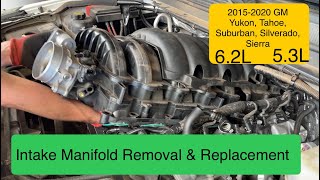
Typical fix: Replace the Fuel Rail Pressure Sensor. This requires removing the intake manifold.
Est. part cost: $50-$150 - Wiring or Connector Issue 🟡 Medium Probability The engine bay environment can lead to corrosion or damage to wiring and connectors over time. A common failure is the signal wire shorting to the 5V reference wire. Rodent damage has also been noted as a cause on some GM trucks. In some cases, technicians have found that the main harness connectors near the fuel rail were swapped by mistake after a previous repair, causing this code.
How to confirm: Visually inspect the FRP sensor's wiring harness and connector for any signs of damage, corrosion, melting, or loose pins. Perform a continuity test and check for a short to voltage on the signal wire. A Reddit user fixed their P0193 by finding and repairing a bad ground pin in the fuel injector harness, which is related.
Typical fix: Repair the damaged section of the wiring harness or replace the connector pigtail. Ensure harness connectors are correctly plugged in.
Est. part cost: $15-$50 - Faulty Fuel Pump Driver Module (FPDM) / Fuel System Control Module (FSCM) ⚪ Low Probability While not as common as the sensor itself, the module that controls the fuel pump can fail, leading to incorrect fuel pressure. GM has issued recalls for FPDMs on other model years, indicating potential vulnerabilities in this component. A faulty module can cause erratic fuel pressure that might trigger the code.
How to confirm: This requires advanced diagnostics with a capable scan tool to monitor the commanded vs. actual fuel pressure and check for communication errors with the module (DTCs).
Typical fix: Replace the Fuel Pump Driver Module and potentially reprogram it.
Est. part cost: $70-$200
Rare But Worth Checking
- Clogged Fuel Filter: While less common for a 'high input' code, a severely clogged filter can cause the fuel pump to work harder, potentially creating pressure spikes or erratic readings that could, in some scenarios, contribute to the code.
- Faulty Powertrain Control Module (PCM): This is extremely rare, but an internal failure in the PCM's analog-to-digital converter or voltage regulator can cause it to misinterpret the sensor's signal. This should only be considered after all other possibilities, especially the sensor and wiring, have been exhaustively ruled out.
Diagnosis Steps
- Connect an OBD-II scanner and confirm that P0193 is present. Check for any other related fuel system codes like P0192, P0089, P228C, or P228D.
- View live data on the scanner. Observe the reading for 'Fuel Rail Pressure' and 'Fuel Rail Pressure Sensor Voltage' with the key on, engine off (KOEO). A voltage reading at or near 5.0V (spec is >4.5V) or a pressure reading that is maxed out is a strong indicator of a circuit high fault. Shorting the sensor's 5V reference to the signal wire will produce a default high reading of ~4,600 PSI.
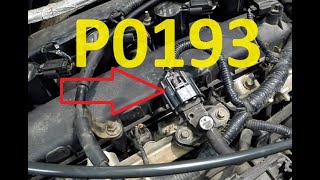
- Turn the vehicle off and locate the Fuel Rail Pressure (FRP) sensor. On the 5.3L/6.2L V8 engines, it is on the driver's side fuel rail, under the intake manifold. This will require removing the intake to access it for testing or replacement.
- Before removing the intake, inspect the visible portions of the engine wiring harness for damage, especially near the back of the engine where connectors for the fuel rail are located. Check for signs of rodent damage or chafing.
- Once the intake is removed, inspect the sensor's electrical connector and wiring for any visible damage, corrosion, or loose pins.
- Disconnect the sensor. With the key on, check the voltage at the connector's pins using a multimeter. You should find a 5-volt reference wire, a ground wire (near 0V), and a signal wire (should be 0V with sensor disconnected). If the signal wire shows voltage with the sensor unplugged, there is a short to voltage in the harness that must be found and repaired.
- If the wiring and voltages at the connector are correct, the sensor itself is almost certainly the culprit. As per TSB PIP5279A, if standard diagnostics do not pinpoint the cause, replacing the Fuel Rail Pressure Sensor is the recommended next step.
- After replacing the sensor or repairing wiring, clear the codes. Some scan tools may have a function to reset fuel system adaptations, which is recommended. Perform a test drive to ensure the fault does not return.
Parts You'll Likely Need
- Fuel Rail Pressure Sensor
(OEM #12679394)— This is the most frequent cause of P0193 on this platform, as identified by common repair data and a specific GM Technical Service Bulletin. It is often replaced as the primary fix after confirming the wiring is intact.
Trusted brands: ACDelco (OEM), Bosch, Standard Motor Products
OEM price range: $80-$150
Aftermarket price range: $40-$100 - Intake Manifold Gaskets
(OEM #12626354 (Set of 8))— These are single-use gaskets that must be replaced anytime the intake manifold is removed to access the fuel rail pressure sensor.
Related Codes That Often Appear With This One
- P0192 — This code is for 'Fuel Rail Pressure Sensor Circuit Low'. Seeing it with P0193 can indicate an intermittent wiring problem or a failing sensor with erratic readings that swing from high to low.
- P0089 — This code relates to 'Fuel Pressure Regulator 1 Performance'. It often appears with FRP sensor codes because the PCM uses the sensor's data to control the regulator. TSB PIP5279A lists these codes together as part of the same potential fault.
- P228C — 'Fuel Pressure Regulator 1 Control Circuit Low'. This is another code mentioned in TSB PIP5279A, pointing to a related fault in the fuel pressure control system.
- P228D — 'Fuel Pressure Regulator 1 Control Circuit High'. Also listed in TSB PIP5279A, this suggests a comprehensive check of the entire fuel pressure regulation circuit is needed.
Technical Service Bulletins (TSBs) & Recalls
- PIP5279A: Addresses a Service Engine Soon lamp with various fuel rail pressure codes (P0089, P0192, P0193, P228C, P228D). Recommends replacing the fuel rail pressure sensor if diagnostics do not lead to a clear cause. Applies to 2014-2015 models with 4.3L, 5.3L, and 6.2L engines.
Platform-Specific Known Issues
- TSB #PIP5279A - Inconclusive Diagnostics: GM issued this bulletin for 2014-2016 Yukon models (among others) that exhibit P0193 and other fuel pressure codes. It advises that if normal diagnostic procedures are inconclusive, the Fuel Rail Pressure Sensor (FRPS) should be replaced, acknowledging it as a common failure point.
- Sensor Location Increases Labor: On the Gen V V8 engines (5.3L L83, 6.2L L86) used in these Yukons, the FRP sensor is located under the intake manifold. This significantly increases the labor required for diagnosis and replacement compared to engines where the sensor is easily accessible on the fuel rail.
- Crossed Harness Connectors: In a documented case on a 2016 Silverado with the same 5.3L engine, a P0192 (low circuit) was caused by two adjacent harness connectors near the fuel rail being swapped during a previous engine repair. This created a ground on the 5V reference line. While a different code, it highlights a potential and easily overlooked installation error that could also cause a P0193.
Mechanic-Grade Diagnostic Values
- Fuel Rail Pressure Sensor Voltage (KOEO) — expected: ~0.5 V. Failure: A reading of >4.5V indicates a circuit high fault. A reading near 5.0V points to a short to voltage or internal sensor failure.
- Fuel Rail Pressure (KOEO, Scan Tool) — expected: Low, near atmospheric pressure.. Failure: A maxed-out reading (e.g., 4,600+ PSI or 95,058 PSI depending on scan tool) indicates a circuit high fault.
- Fuel Rail Pressure (Engine Idling) — expected: 500-600 PSI. Failure: Pressure stuck at a maximum value, not responding to engine RPM changes.
- FRP Sensor Signal Wire with Sensor Disconnected (KOEO) — expected: 0 V. Failure: Any voltage present (especially 5V) indicates a short to voltage in the wiring harness between the sensor connector and the ECM.
- FRP Sensor 5V Reference Wire at Connector (KOEO) — expected: 5 V. Failure: Less than 4.8V can indicate a short to ground or an issue with the ECM's 5V reference circuit.
- FRP Sensor Ground Wire at Connector (KOEO) — expected: Near 0 V. Failure: Voltage present indicates a bad ground connection.
Scan Tool Commands That Help
- GDS2 (GM Dealer Software): Fuel System Depressurize — With a cold engine at idle, this command will shut off the fuel pump and the engine will stall. A healthy FRP sensor's pressure reading should drop to zero. If the sensor reading remains high (e.g., 30-40 PSI) after the engine stalls, the sensor is faulty and not reading the low end of its range correctly. This is a definitive test for a bad sensor.
- GDS2 (GM Dealer Software): Fuel Pump Relay/Control — This bidirectional control allows a technician to command the low-pressure fuel pump on to check for fuel delivery and prime the system before checking for leaks. Note: The vehicle must be in the correct power mode (e.g., 'Service Only Mode') for the command to execute.
Wiring & Ground Locations
- G102 — Located at the left rear of the engine.. This ground point serves the 8 ignition coils. While not directly for the FRP sensor, a poor ground here can introduce electrical noise and affect overall engine sensor performance.
- G103 / G104 — On K2XX trucks (2015+), these are major ground points. One is on the engine block on the front left (driver's) side, part of the main negative battery cable harness. Another critical ground is on the passenger side frame rail, which can get corroded.. The ECM and multiple sensors rely on clean engine and frame grounds. A corroded or loose G103/G104 ground is a known cause of various electrical issues, including erratic sensor readings, on this platform.
- FRP Sensor Connector — On the sensor itself, under the intake manifold at the rear of the driver's side fuel rail.. This is the primary point for testing. The 3-wire connector contains the 5V reference, signal, and ground circuits. Testing voltages here is the fastest way to determine if the fault is in the sensor, harness, or ECM.
- Injector Harness Bulk Connectors — At the rear of the engine, where the fuel rail sub-harness connects to the main engine harness.. There are two similar-looking bulk connectors for the left and right bank fuel rails. It is possible to swap these connectors during a major repair like an engine replacement. This will mis-wire the FRP sensor, causing immediate fault codes.
Real Owner Repair Stories
- YouTube channel 'SuperMarioDiagnostics' (2016 Chevrolet Silverado 1500 5.3L V8) — Crank no-start condition after an engine replacement.
❌ Tried (didn't work) The shop that replaced the engine was unable to start it.
✅ What actually fixed it The technician found that the two main harness connectors for the fuel injector rails at the back of the engine were swapped. The connectors were physically identical and could be plugged in incorrectly. After swapping the connectors to their correct positions, the 5V reference and ground at the FRP sensor tested correctly, and the truck started and ran normally. This caused codes P0192 and P127C (low voltage), but demonstrates a critical, easy-to-make installation error that can cause fuel pressure sensor circuit faults.
OEM Part Supersession History
12651990→12679394— Part was updated by GM. The specific reason for the update is not publicly documented, but supersessions often address reliability or performance improvements.
Heads up: While 12679394 is the current service part, it's crucial to verify if the engine uses a 3-wire or 4-wire sensor, as they are not interchangeable due to different harness connectors and physical nozzles. Always use an OEM or high-quality aftermarket part, as cheap sensors are known to fail quickly.
Model Year Variations Within This Range
- 2014-2016 (approx.): Early Gen V engines in this range may use a 4-wire Fuel Rail Pressure Sensor that also incorporates a fuel temperature sensor. Later models transitioned to a 3-wire sensor. The wiring harnesses are different, and the sensors are not physically interchangeable due to different connector shapes and nozzle designs. It is critical to visually inspect the existing sensor or harness to ensure the correct replacement part is ordered.
Helpful Videos
Used OEM Parts in Stock


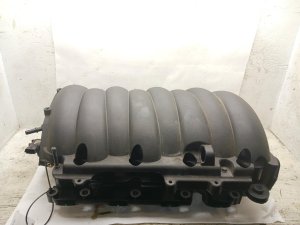
New Aftermarket Parts Available



The information in this article is provided for general reference and educational purposes only. Vehicle specifications, procedures, and part compatibility can vary by production date, trim level, and region. Always consult your vehicle's factory service manual and verify part numbers before purchasing or performing repairs. Safety-critical components such as airbags, seat belts, and braking systems should be installed by a qualified professional.
- Gmc YUKON:
- 🎬 Helpful Videos
- 🛍️ Shop This Part
- What's Unique About the 2014-2016 Gmc YUKON
- Diagnostic Flowchart
- Symptoms You May Notice
- Most Likely Causes
- Rare But Worth Checking
- Diagnosis Steps
- Parts You'll Likely Need
- Related Codes That Often Appear With This One
- Technical Service Bulletins (TSBs) & Recalls
- Platform-Specific Known Issues
- Mechanic-Grade Diagnostic Values
- Scan Tool Commands That Help
- Wiring & Ground Locations
- Real Owner Repair Stories
- OEM Part Supersession History
- Model Year Variations Within This Range
- 🎟️ Get 5% Off