

P0193 on 2013-2018 BMW X5 N63: Fuel Rail Pressure Sensor Circuit High Fixes
P0193 on a BMW X5 with the N63 engine indicates an electrical fault with the Bank 1 fuel rail pressure sensor, not a mechanical fuel pressure problem. The most common fix is replacing the sensor itself. Before replacement, check if the sensor's electrical connector is simply unplugged, as it's in a hard-to-reach location within the engine's 'hot-vee' valley. The corresponding BMW fault code is 119001.
- P0193 is an electrical fault, not a mechanical fuel pressure problem. Do not replace the expensive high-pressure fuel pump.
- The most common cause is a failed fuel rail pressure sensor on Bank 1 (passenger side).
- Before buying any parts, thoroughly check if the sensor's electrical connector has been accidentally left unplugged during previous service.
- Use a scan tool to check live data; a maxed-out pressure reading with the engine off is a clear sign of a bad sensor or circuit.
- A BMW TSB exists (SIB 12 14 13) that suggests the issue can be a poor connection from vibration, fixed by re-seating the connector and adding a specific cable tie.
- Due to the high-pressure fuel system, professional service is recommended if you are not experienced with this type of repair.
What's Unique About the 2013-2018 BMW X5
The BMW N63 is a twin-turbocharged V8 engine that utilizes a 'hot-vee' design, placing the turbochargers and exhaust manifolds in the valley between the cylinder banks. This compact design creates extremely high temperatures in the engine valley, which can degrade electronic components and wiring over time. The system has two separate fuel rails (one for each cylinder bank), each with its own high-pressure fuel pump and fuel rail pressure sensor. Code P0193 specifically points to the sensor on Bank 1 (the passenger side on US models). A very common scenario on these engines is for the sensor to be accidentally unplugged by a technician during other service in the tight engine valley, such as replacing crankcase ventilation lines.
Generation note: The 2013-2018 model years span two generations of the BMW X5: the end of the E70 (2007-2013) and the entire F15 (2014-2018). Both generations used versions of the N63 engine (N63B44O0 in the E70 and the updated N63B44O1 or 'N63TU' in the F15), and the causes and fixes for P0193 are consistent across them.
Symptoms You May Notice
- Check Engine Light is on
- "Drivetrain Malfunction" message on the iDrive screen
- Reduced engine power or entering 'limp mode'
- Engine hesitation or stumbling during acceleration
- Rough idle
- Engine stalling
- Long crank times or difficulty starting
- Poor fuel economy
- Replacing the High-Pressure Fuel Pump (HPFP). P0193 is an electrical circuit code, not a low-pressure code (like P0087). While HPFPs can fail on the N63, they are not the direct cause of a 'Circuit High' fault.
Most Likely Causes
- Failed Fuel Rail Pressure Sensor 🔴 High Probability The sensor operates in the high-heat 'hot-vee' environment of the N63 engine, which can lead to internal electronic failure over time.
How to confirm: Use a BMW-capable scan tool to monitor live data for fuel rail pressure. With the ignition on but the engine off, the pressure reading should be low. If it shows a fixed, impossibly high value (e.g., 200 bar / 3000 psi) or the sensor voltage is stuck at 5.0V, the sensor has almost certainly failed.
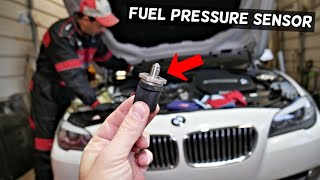
Typical fix: Replace the fuel rail pressure sensor for Bank 1. It is strongly recommended to use a genuine BMW or OEM Bosch part. The part number is often 13537537319.
Est. part cost: $80-$200 - Unplugged Sensor Connector 🟡 Medium Probability The sensor is located deep in the engine valley and is difficult to see. It is commonly disconnected during other repairs (like replacing crankcase ventilation lines or intake manifold work) and not reconnected.
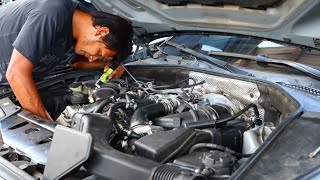
How to confirm: Visually inspect the sensor on the passenger side fuel rail. Check if the electrical connector is securely plugged in. This may require a flashlight and an inspection mirror. A YouTube video from 'I.E. Euros' shows this exact scenario on a 550i with the N63 engine. 🎬 Watch: Diagnosing an unplugged N63 fuel pressure sensor
Typical fix: Reconnect the electrical connector to the sensor. Clear codes and test drive.
Est. part cost: $0 - Wiring Harness or Connector Damage ⚪ Low Probability The engine valley is a high-heat area, which can make wiring insulation brittle and prone to cracking over time. Rodent damage is also a possibility. BMW issued a service bulletin (SIB 12 14 13) for the N63T engine addressing poor electrical connections at the sensor due to vibration, recommending securing the harness with a special cable tie.
How to confirm: Inspect the wiring leading to the sensor for any signs of chafing, melting, corrosion, or broken wires. Check for a short to power using a multimeter; voltage at the signal wire should not be stuck at 5V.
Typical fix: Repair the damaged section of the wiring harness and protect it from heat. In cases of vibration-induced faults, secure the connector and harness as per SIB 12 14 13.
Est. part cost: $10-$50
Rare But Worth Checking
- Faulty Engine Control Module (DME): This is very uncommon. Before condemning the DME, all other possibilities (sensor, wiring) must be exhaustively ruled out. A faulty DME might misinterpret a normal sensor signal.
Diagnosis Steps
- Connect a BMW-capable OBD-II scanner (like ISTA) and confirm the presence of P0193 and/or the BMW code 119001.
- Access the live data stream on the scan tool. Observe the value for 'Fuel Rail Pressure Bank 1'.
- With the ignition on but the engine off, check the pressure reading. If it shows a very high, static number (e.g., 200-250 bar), this confirms a circuit high fault.
- Turn the vehicle off. Visually locate the Bank 1 fuel rail pressure sensor in the engine valley (passenger side). This will require removing the engine cover.
- Carefully inspect the electrical connector. Ensure it is fully seated and not damaged. Many times, this is the entire problem.
- If the connector is secure, inspect the visible wiring for any signs of damage, melting, or corrosion. Wiggle the harness while a helper observes live data to check for intermittent connections.
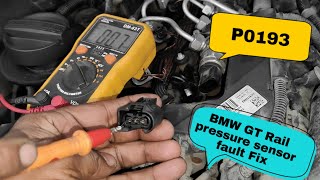
- If wiring appears intact, disconnect the sensor. With the key on, use a multimeter to check the connector for a 5V reference signal and a good ground.
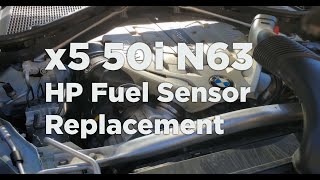
- If power and ground are present, the sensor itself is the most likely culprit. Replace the Bank 1 Fuel Rail Pressure Sensor. 🎬 See this N63 fuel sensor replacement walkthrough
- Per BMW SIB 12 14 13, after reconnecting, secure the harness to the fuel rail with a cable tie (BMW P/N 12 52 8 624 375) to prevent future issues from vibration.
- After replacement, clear the codes and perform a test drive to ensure the fault does not return.
Parts You'll Likely Need
- High Pressure Fuel Rail Sensor
(OEM #13537537319)— This sensor is the most common point of failure for a P0193 code, either through internal failure or its connector being left unplugged.
Trusted brands: Bosch (OEM), Genuine BMW
OEM price range: $90-$150
Aftermarket price range: $75-$130 - Sensor Harness Cable Tie
(OEM #12528624375)— Recommended by BMW in a service bulletin (SIB 12 14 13) to secure the sensor connector and prevent vibration-related connection issues.
Trusted brands: Genuine BMW
OEM price range: $5-$10
Related Codes That Often Appear With This One
- 119001 — This is the manufacturer-specific BMW fault code that directly corresponds to the generic P0193 code, specifically meaning 'Rail pressure sensor, electrical: Short circuit to B+'.
- P0192 — The companion code for 'Fuel Rail Pressure Sensor Circuit Low', indicating the opposite electrical fault (e.g., short to ground). Seeing both could suggest an intermittent wiring problem.
- P0172 / P0175 — Codes for 'System Too Rich' on Bank 1 and Bank 2. The DME may over-richen the mixture as a protective measure when it receives an implausible fuel pressure reading.
- P030x — Misfire codes for various cylinders (e.g., P0301, P0305). Incorrect fuel pressure data can lead to poor combustion and misfires.
Technical Service Bulletins (TSBs) & Recalls
- SIB 12 14 13: Addresses P0193-related codes (119001, 119002, etc.) on N63T engines. It identifies the cause as a poor electrical connection from vibration and explicitly states NOT to replace the sensor. The fix is to disconnect/reconnect the connector several times and secure the harness to the fuel rail with a special cable tie (P/N 12 52 8 624 375).
Platform-Specific Known Issues
- Hot-Vee Heat Soak: The N63's design places the turbos in the engine valley, creating intense heat that accelerates the degradation of plastic and rubber components, including sensors and wiring insulation. This is a root cause for many electronic failures on this engine.
- Difficult Access: The fuel pressure sensors are located deep in the engine valley, underneath intake ducting. Access is tight and can be frustrating for DIY repair. A forum user on Bimmerpost noted the difficulty of getting a 27mm socket on the sensor due to limited space.
Diagnostic Flowchart
Other Known Issues on This Vehicle
Issues unrelated to this code that are worth knowing about as an owner of this generation:
- Excessive Oil Consumption / Valve Stem Seal Failure 🔴 High — Very common, especially on pre-update (N63B44O0) engines, often starting around 50,000-80,000 miles. The primary cause is the 'hot-vee' design hardening the seals. (Ref: Subject of class-action lawsuits and BMW's 'N63 Customer Care Package' (B001314) which addressed the issue on earlier models.)
- Timing Chain Stretch 🔴 High — A well-documented issue where the timing chains stretch prematurely, potentially causing catastrophic engine failure if they skip a tooth. Often presents as a rattling noise on cold starts. (Ref: Addressed as part of the N63 Customer Care Package, which included an inspection and potential replacement.)
- Premature Battery Drain 🟠 Medium — Chronic issue where the battery drains excessively, sometimes requiring replacement annually. This was another focus of the N63 class-action lawsuits. (Ref: BMW issued TSB SIB 61 30 14 related to battery replacement intervals.)
- Fuel Injector Failure 🟠 Medium — Early versions of the N63 had high failure rates for the piezoelectric fuel injectors, leading to misfires and rough running, sometimes at low mileage (20k-30k miles). (Ref: Injectors were part of the N63 Customer Care Package.)
- Cooling System Component Failure 🟠 Medium — The intense heat in the engine valley degrades plastic and rubber cooling system components like hoses, the water pump, and the thermostat, leading to leaks and potential overheating.
Real Owner Stories
Aggregated from forums and TSBs cited above. Mileages and costs reflect what owners reported in those sources.
2011 BMW 550i N63
Symptoms: The car triggered a 119001 code (P0193 equivalent).
What fixed it: The electrical connector for the fuel rail pressure sensor was found to be completely unplugged. Reconnecting the sensor resolved the code.
Source hint: YouTube video from 'I.E. Euros' titled 'BMW 750i 650i 550i N63 engine code P0193 - 119001'
BMW 550i N63TU
Symptoms: Owner needed to replace the sensor but found extremely limited space to work.
What fixed it: Used a 27mm socket to remove the sensor located deep in the engine valley under the intake ducting.
Source hint: Bimmerpost F10 - 'F10 550i N63TU Fuel Pressure Sensor Install'
Related OBD-II Codes
Frequently Asked Questions
My 2013-2018 BMW X5 N63 is showing code 119001. Is this the same as P0193?
Does BMW SIB 12 14 13 apply to my N63 engine if I have a P0193 code?
I'm trying to DIY this on my X5; what size socket do I need for the fuel rail pressure sensor?
Why is the fuel pressure sensor failing so often on the N63 engine?
Is there a specific part number I should look for when replacing the sensor?
Could my P0193 code just be a loose wire from a previous repair?
Helpful Videos
We Have This Part in Stock



The information in this article is provided for general reference and educational purposes only. Vehicle specifications, procedures, and part compatibility can vary by production date, trim level, and region. Always consult your vehicle's factory service manual and verify part numbers before purchasing or performing repairs. Safety-critical components such as airbags, seat belts, and braking systems should be installed by a qualified professional.
- BMW X5:
- 🎬 Helpful Videos
- 🛍️ Shop This Part
- What's Unique About the 2013-2018 BMW X5
- Symptoms You May Notice
- Most Likely Causes
- Rare But Worth Checking
- Diagnosis Steps
- Parts You'll Likely Need
- Related Codes That Often Appear With This One
- Technical Service Bulletins (TSBs) & Recalls
- Platform-Specific Known Issues
- Diagnostic Flowchart
- Other Known Issues on This Vehicle
- Real Owner Stories
- 2011 BMW 550i N63
- BMW 550i N63TU
- Related OBD-II Codes
- Frequently Asked Questions
- 🎟️ Get 5% Off