

P0192 on 2016-2018 Mazda CX-9: Fuel Pressure Sensor Circuit Low Input Causes and Fixes
For a 2016-2018 Mazda CX-9, code P0192 is most often caused by outdated PCM software, which requires a dealer update. This update makes the system more sensitive to actual fuel delivery problems. If the software is current, the next most likely causes are a failed fuel rail pressure sensor or a weak high-pressure fuel pump (HPFP). A dealer software update is the first diagnostic step, while a sensor replacement costs around $150-$300 for the part. An HPFP replacement can cost over $2,000 at a de
- Your first step should be to check with a Mazda dealer if your vehicle needs the PCM software update mentioned in TSB #01-003-18-3421.
- Do not immediately replace the fuel pressure sensor; a software update is a very common and necessary fix for this specific vehicle.
- If the vehicle stalls or loses power, pull over safely as soon as possible. Continued driving could be hazardous.
- The code indicates a problem with the high-pressure side of the fuel system, which is specific to the SKYACTIV-G direct-injection engine.
- If parts are needed, the most likely culprits are the fuel rail pressure sensor or, less commonly, the high-pressure fuel pump.
What's Unique About the 2016-2018 Mazda CX-9

What's unique to this Mazda CX-9 is a specific Technical Service Bulletin (TSB 01-003-18-3421) that directly addresses the *conditions* under which this code is set. Mazda released a PCM software update to fix a separate power-limitation issue that occurred at high temperatures/altitudes. A consequence of this update is that the system became more sensitive to actual fuel delivery problems and will now correctly store code P0192 or P0087 if fuel delivery is insufficient. This means the code may not be a simple sensor fault, but could be the result of a software update correctly identifying a deeper fuel system issue, a fact corroborated by owner complaints where a PCM update was the prescribed fix.
Diagnostic Flowchart
Tap your situation to follow the diagnostic path that matches what you're seeing on this vehicle.
Symptoms You May Notice
- Check Engine Light is on
- Sudden loss of engine power or deceleration while driving
- Engine enters 'limp mode,' limiting acceleration and speed
- Engine hesitation or stumbling, especially when accelerating
- Rough idle or stalling at idle
- Difficulty starting or extended cranking time
- Stalling, sometimes at highway speeds
- Whining noise from the fuel tank area
- Replacing the fuel rail pressure sensor when the actual problem is outdated PCM software.
- Replacing the high-pressure fuel pump (a very expensive repair) when the issue is a much cheaper and easier-to-replace fuel rail pressure sensor or a weak in-tank pump.
Most Likely Causes

- Outdated Powertrain Control Module (PCM) Software 🔴 High Probability A specific TSB (#01-003-18-3421) was issued by Mazda that modifies PCM logic. An owner complaint also confirms a PCM update resolved a P0192 code after a highway stall.
How to confirm: A Mazda dealership can check the vehicle's service history and current software version against their database to see if the update from TSB 01-003-18-3421 has been applied.
Typical fix: Update the PCM with the latest software at an authorized Mazda dealership. This is often the first and most important diagnostic step.
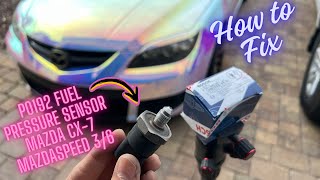
Est. part cost: $0 (if under warranty) or ~$150 for labor - Failed Fuel Rail Pressure Sensor 🟡 Medium Probability This sensor operates in a high-pressure, high-heat environment and is a common failure point for this code across many direct-injection vehicles. Some owner reports indicate Mazda may not sell the sensor separately from the entire fuel rail, complicating replacement. 🎬 See this guide for replacing the fuel rail pressure sensor.
How to confirm: Using a scan tool, monitor the fuel rail pressure live data. If the reading is stuck at a very low value (e.g., below 0.5V), is erratic, or doesn't change with engine RPM, the sensor is likely faulty. The sensor and its wiring can also be tested with a multimeter for correct voltage and ground.
Typical fix: Replace the fuel rail pressure sensor. This part can be difficult to source from aftermarket suppliers, often requiring an OEM part from a dealer or a compatible part from another manufacturer like Ford.
Est. part cost: $150-$300 - Failing High-Pressure Fuel Pump (HPFP) ⚪ Low Probability The TSB mentions that P0192 can be stored when 'fuel injection amount is insufficient,' which is a direct symptom of a weak HPFP. These pumps are a known wear item on direct-injection engines and can be extremely expensive to replace.
How to confirm: This is diagnosed by exclusion. If the PCM software is up-to-date and the fuel rail pressure sensor and its wiring test good, but actual fuel pressure is still below the target pressure shown on a scan tool, the HPFP is the prime suspect. When replacing, it is critical to also inspect the cam follower for wear, as a worn follower can damage the new pump.
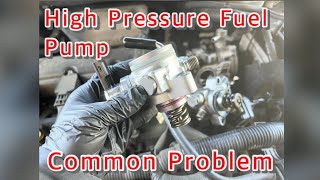
Typical fix: Replace the high-pressure fuel pump and inspect/replace the cam follower. 🎬 Watch: This 30-minute walkthrough shows how to replace the HPFP.
Est. part cost: $400-$800 (Part only), up to $2500 (Dealer installed) - Weak In-Tank Low-Pressure Fuel Pump ⚪ Low Probability The high-pressure pump can only deliver what it receives from the low-pressure pump in the tank. Forum discussions for Mazda vehicles with the 2.5T engine show a pattern where P0192 symptoms (stalling, limp mode) appear when the fuel tank is below 1/4 full and are temporarily resolved by filling the tank.
How to confirm: A fuel pressure test on the low-pressure side of the system is required. If the pressure is below specification (typically 40-75 PSI), the in-tank pump is likely at fault. Observing if symptoms correlate with the fuel level is a strong clue.
Typical fix: Replace the low-pressure fuel pump assembly in the fuel tank. Mazda provides an access panel under the rear seat to facilitate this job.
Est. part cost: $200-$400
Rare But Worth Checking
- Wiring or Connector Issue: Damage to the wiring harness or a corroded/loose connector at the fuel rail pressure sensor can mimic a failed sensor. One owner on a Mazdaspeed forum, after replacing every other fuel component without success, suspected a wiring issue was the final culprit. Always inspect the harness visually and test for continuity between the sensor and PCM before replacing expensive parts.
Diagnosis Steps

- Connect an OBD-II scanner to verify the P0192 code and check for any other related codes like P0087 or P0171.
- Contact a Mazda dealer with your VIN to determine if TSB 01-003-18-3421 or any other relevant software updates are pending for your vehicle. This is a critical first step.
- If software is not the issue, use a scan tool with live data capability to monitor 'Fuel Rail Pressure' and 'Desired Fuel Rail Pressure'. The sensor voltage should be between 0.5V and 4.5V; P0192 is set when it's below 0.5V.
- Observe the pressure at idle (should be ~500-600 PSI) and while carefully increasing engine RPM. If the actual pressure is significantly lower than desired, or if the reading is stuck or nonsensical, proceed with sensor/wiring checks.
- Pay attention to when symptoms occur. Do they get worse when the fuel tank is low? If so, suspect the low-pressure in-tank pump.
- Visually inspect the fuel rail pressure sensor's electrical connector and wiring for any signs of damage, corrosion, or looseness.
- If wiring appears intact, test the sensor circuit for proper voltage (5V reference) and ground using a multimeter and the vehicle's wiring diagram. The signal wire should read approximately 1.5V-1.8V with the key on and engine off.
- If the sensor and wiring are confirmed to be good but pressure remains low, the issue likely lies with the fuel delivery system. Test the low-pressure pump first, then diagnose the high-pressure fuel pump (HPFP). If replacing the HPFP, inspect the cam follower.
Parts You'll Likely Need

- Fuel Rail Pressure Sensor — This sensor is the primary component that reports the data causing the P0192 code. It's a common failure point when software is not the root cause. Note: Mazda may not sell this part individually, requiring purchase of the entire fuel rail.
Trusted brands: Mazda (OEM), Bosch (e.g., 0261545053, verify fitment for CX-9), Denso, Hitachi
OEM price range: $200-$300
Aftermarket price range: $100-$200 - High-Pressure Fuel Pump (HPFP)
(OEM #PY8V-13-3S0)— If the sensor is good but actual pressure is low, the HPFP is the next likely culprit responsible for generating that pressure. The provided TSB points to 'insufficient fuel injection amount' as a trigger.
Trusted brands: Mazda (OEM)
OEM price range: $400-$800
Aftermarket price range: $300-$600 - Cam Follower (Tappet) — This small part sits between the camshaft and the HPFP. It is a wear item and should always be inspected and likely replaced when replacing the HPFP to prevent damage to the new pump.
Trusted brands: Mazda (OEM)
OEM price range: $30-$60
Related Codes That Often Appear With This One
- P0087 — P0087 (Fuel Rail/System Pressure - Too Low) is mentioned in the same TSB as P0192. Both codes point to insufficient fuel pressure, and the PCM may store one or both depending on the specific conditions.
- P0171 — P0171 (System Too Lean) can occur alongside P0192 because low fuel pressure prevents the injectors from delivering enough fuel, leading to an air-fuel mixture with too much air. Forum users confirm seeing these codes together.
Technical Service Bulletins (TSBs) & Recalls
- Bulletin #01-003-18-3421: Notes a PCM logic modification where, after the update, DTCs P0192 or P0087 are stored if the fuel injection amount is insufficient. This was a side-effect of a fix for a separate power-loss issue.
- Bulletin #01-013/21: Describes a known issue of coolant leaks from cracks in the cylinder head on 2016-2020 CX-9s with the 2.5T engine.
Platform-Specific Known Issues
- A PCM software logic issue can cause this code to be stored. Mazda issued TSB #01-003-18-3421 to update the PCM, which may be the required fix.
- An owner of a 2016 CX-9 reported experiencing P0192, which led to a stall on the highway. The dealership resolved the issue by updating the PCM software, as noted in NHTSA ODI #11299308.
- The SKYACTIV-G 2.5T engine has a known issue with cylinder head cracking around the exhaust manifold, as detailed in TSB #01-013/21. While this does not directly cause P0192, it is a significant potential issue for this engine.
Mechanic-Grade Diagnostic Values
- High-Pressure Fuel Rail Pressure (Scan Tool) — expected: Approx. 500-600 PSI (40 bar) at idle.. Failure: Pressure is significantly below desired pressure, stuck at a low value, or does not increase with RPM.
- Fuel Rail Pressure Sensor Signal Voltage (KOEO) — expected: Approx. 1.5V - 1.8V with Key On, Engine Off.. Failure: Voltage is below 0.5V (sets code) or stuck near 5V, which indicates an open circuit or faulty sensor.
- Fuel Rail Pressure Sensor Reference Voltage — expected: 5V at the sensor connector.. Failure: No voltage or significantly lower voltage, indicating a wiring or PCM issue.
- Low-Pressure Fuel Pump Pressure (at schrader valve, if available) — expected: Approx. 60-70 PSI with Key On, Engine Off.. Failure: Pressure is below specification, indicating a weak in-tank pump or clogged filter.
Hidden / Shadow Codes Worth Checking
- P0192:00: The ':00' is a Symptom Byte or sub-code. In this context, it specifies the exact fault as 'High fuel pressure sensor circuit low input', confirming the nature of the electrical fault detected by the PCM. (see via Professional scan tools, including the Mazda MDARS system, will display this two-part code.)
Wiring & Ground Locations
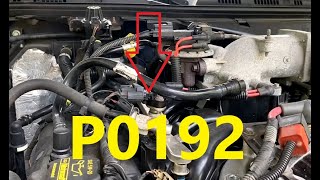
- Fuel Rail Pressure Sensor Connector — Located on the high-pressure fuel rail on the engine.. This is the primary connection point for the sensor. The three wires are typically a 5V reference, a signal wire, and a ground, all originating from the PCM. Corrosion or damage here will directly cause P0192.
- Interior Fuse Box — Inside the cabin, on the driver's side, located down by the driver's left foot behind a small cover.. Contains fuses for various electronic modules. A blown fuse related to the PCM or its inputs could potentially cause this code.
Real Owner Repair Stories
- Mazdaspeeds.org user 'crispyBYM' (Mazdaspeed (similar 2.3L DISI Turbo engine, diagnosis is analogous)) — Severe misfire feeling like the engine shuts off for a cycle, P0192 code, car running extremely rich and stalling when tapping the gas pedal.
❌ Tried (didn't work) Cleaning the spill valve on the high-pressure fuel pump.
✅ What actually fixed it Replacing the fuel rail pressure sensor. The user noted that Mazda would not sell the sensor without the entire fuel rail, so a compatible Ford sensor was used instead. - Mazda Forum user (2016 CX-5 (2.5L engine)) — Lacking power, limp mode, P0192 and P0171 codes stored. Symptoms were most prevalent when the fuel tank was less than 1/4 full.
❌ Tried (didn't work) Initial diagnosis pointed towards the high-pressure fuel pump or the rail sensor.
✅ What actually fixed it Adding gasoline to the tank was an 'instant fix'. The user concluded the problem was the in-tank low-pressure fuel pump, which was failing when the fuel level was low.
OEM Part Supersession History
Mazda OEM Sensor (as part of fuel rail assembly)→Compatible Ford or Bosch Sensor (e.g. Bosch 0261545053)— Cost and Availability
Heads up: Mazda may not offer the fuel rail pressure sensor as a separate part for some models, requiring the purchase of the entire fuel rail. Owners and independent shops have found that some Ford sensors or aftermarket Bosch sensors are a direct fit and functional replacement, avoiding the high cost of a full rail replacement.
Helpful Videos
Used OEM Parts in Stock


New Aftermarket Parts Available


The information in this article is provided for general reference and educational purposes only. Vehicle specifications, procedures, and part compatibility can vary by production date, trim level, and region. Always consult your vehicle's factory service manual and verify part numbers before purchasing or performing repairs. Safety-critical components such as airbags, seat belts, and braking systems should be installed by a qualified professional.
- Mazda CX-9:
- 🎬 Helpful Videos
- 🛍️ Shop This Part
- What's Unique About the 2016-2018 Mazda CX-9
- Diagnostic Flowchart
- Symptoms You May Notice
- Most Likely Causes
- Rare But Worth Checking
- Diagnosis Steps
- Parts You'll Likely Need
- Related Codes That Often Appear With This One
- Technical Service Bulletins (TSBs) & Recalls
- Platform-Specific Known Issues
- Mechanic-Grade Diagnostic Values
- Hidden / Shadow Codes Worth Checking
- Wiring & Ground Locations
- Real Owner Repair Stories
- OEM Part Supersession History
- 🎟️ Get 5% Off