

P0192 on 2015-2024 Ford Edge 2.7L: Fuel Rail Pressure Sensor Circuit Low Causes and Fixes
On a 2015-2024 Ford Edge with the 2.7L EcoBoost engine, code P0192 is most often caused by a faulty Fuel Rail Pressure (FRP) sensor or a wiring issue. The sensor itself is the most common failure point, costing around $65-$125 for an OEM part. A thorough inspection of the wiring harness for chafing is critical before replacing parts.
- P0192 indicates an electrical fault in the fuel rail pressure sensor circuit, not necessarily low fuel pressure.
- The most likely culprit is a failed Fuel Rail Pressure (FRP) sensor.
- Before replacing the sensor, always inspect the wiring harness for signs of damage or chafing, as this is a known issue on Ford vehicles.
- Driving with this code can lead to stalling and poor performance, so it should be addressed promptly.
- The repair is generally straightforward for a DIYer with basic tools and a scan tool.
What's Unique About the 2015-2024 Ford Edge
The 2.7L EcoBoost is a gasoline direct injection (GDI) engine, which uses a high-pressure fuel system that is critically dependent on the Fuel Rail Pressure (FRP) sensor for precise operation. The FRP sensor on this engine is located on the high-pressure fuel rail. While the sensor can fail, Ford vehicles of this era have a known susceptibility to wiring harness issues. Technical Service Bulletins for other models like the F-150 and even non-Ford vehicles with similar engine layouts mention wiring harness chaffing causing a P0192 code. These TSBs often point to specific areas where the harness may rub against engine or chassis components, like cylinder head edges or brackets, leading to a short circuit.
Symptoms You May Notice
- Check Engine Light is on
- Engine stalls or is hard to start
- Noticeable loss of engine power and poor acceleration
- Rough idle or hesitation
- Engine stutters or 'falls on its face' during acceleration
- Increased fuel consumption
- Replacing the high-pressure fuel pump. P0192 specifically points to an electrical circuit fault (low voltage), not necessarily a mechanical pressure problem. While a failing pump can cause other codes like P0087 (Fuel Rail/System Pressure - Too Low), it's not the primary cause for a P0192 circuit code.
Most Likely Causes
- Faulty Fuel Rail Pressure (FRP) Sensor 🔴 High Probability The sensor operates in a high-heat, high-vibration environment on the fuel rail and can fail electronically over time. It is the most cited cause for this code across many platforms.
How to confirm: With the key on and engine off (KOEO), use a scan tool to read the FRP sensor voltage. A reading near or at 0 volts (Ford's threshold is typically <0.27V) points to a failed sensor or a short to ground. You can also test the sensor's resistance with a multimeter or perform a wiggle test on the connector while monitoring live data to see if the voltage fluctuates.
Typical fix: Replace the Fuel Rail Pressure sensor. Be sure to properly relieve fuel system pressure before removal.
Est. part cost: $65-$125 - Wiring Harness Damage or Connector Issue 🟡 Medium Probability Ford has issued TSBs for other models (F-150, Escape) from the same era for wiring harnesses chaffing against engine or chassis components, leading to short circuits and codes like P0192. [SSM 47337, SSM 50116, SSM 50245] This is a known pattern for the manufacturer. Common chafe points on similar platforms include where the harness passes over the cylinder head, near accessory brackets, or against the shock tower.
How to confirm: Visually inspect the entire wiring harness leading to the FRP sensor for any signs of rubbing, melting, or corrosion. Pay special attention to where the harness is secured or bends near sharp metal edges. Check the connector for corrosion, backed-out pins, or moisture intrusion.
Typical fix: Repair the damaged section of the wire and protect the harness from future damage using abrasion-resistant tape, convoluted loom, or by re-routing it. Replace the connector pigtail if it is corroded or damaged.
Est. part cost: $15-$50
Rare But Worth Checking
- Powertrain Control Module (PCM) Fault: This is very rare. Before condemning the PCM, all other possibilities, especially the sensor and wiring, must be exhaustively ruled out. A faulty PCM driver circuit can mimic sensor failure. In some cases, corrupted software or a failed update can also cause the PCM to misinterpret sensor readings.
Diagnosis Steps
- Scan for Codes: Use an OBD-II scanner to confirm P0192 is present and check for any other related codes.
- Check Freeze Frame Data: Analyze the freeze frame data to see the engine conditions (RPM, temperature, etc.) when the code was set.
- Visual Inspection: Thoroughly inspect the Fuel Rail Pressure (FRP) sensor and its wiring harness. The sensor is located on the fuel rail. Look for obvious signs of damage, such as melted plastic, chafed wires, or corrosion on the connector pins.
- Check Sensor Voltage (KOEO): With the key on, engine off, use a scan tool to monitor the FRP sensor's live data. The voltage should be around 0.5V. If it's near 0V (below 0.27V), this strongly suggests a short to ground or a faulty sensor.
- Test the Circuit: Disconnect the sensor. Check for a 5-volt reference signal from the PCM at the connector. Check the ground wire for continuity to a known good ground. If both are good, the issue is likely the sensor itself.
- Jumper Test (Advanced): To confirm the wiring and PCM are good, you can use a fused jumper wire to connect the 5-volt reference pin to the signal pin on the harness connector (sensor unplugged). The scan tool reading should jump to a high voltage (near 5V). If it does, the wiring and PCM are okay, confirming the sensor is bad.
- Replace the FRP Sensor: If the sensor is determined to be faulty, replace it. Be sure to relieve fuel system pressure before removal by pulling the fuel pump fuse and running the engine until it stalls.
Parts You'll Likely Need
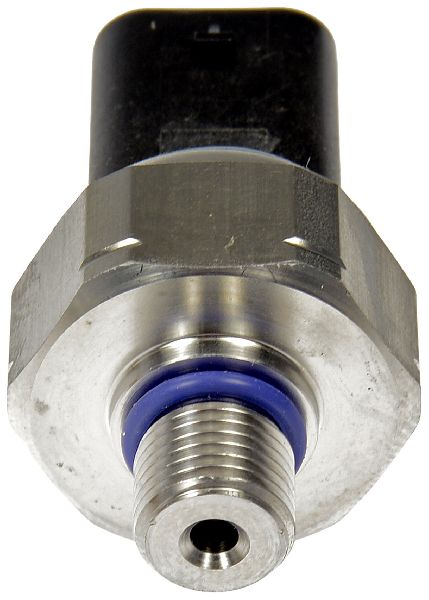
- Fuel Rail Pressure Sensor
(OEM #BU5Z-9F972-B)— This sensor is the most common point of failure for a P0192 code, as it fails internally and sends a low voltage signal to the PCM. This part number is widely used across many Ford EcoBoost engines.
Trusted brands: Motorcraft, Bosch, Standard Motor Products
OEM price range: $65-$125
Aftermarket price range: $30-$85 - FRP Sensor Connector Pigtail — If the connector is damaged, corroded, or the wires are broken at the connector, replacing the pigtail is necessary to ensure a solid electrical connection.
Trusted brands: Motorcraft, Dorman
OEM price range: $25-$45
Aftermarket price range: $15-$30
Related Codes That Often Appear With This One
- P0193 — This code means 'Fuel Rail Pressure Sensor Circuit High Input'. Seeing P0192 and P0193 together or intermittently can indicate a loose connection or damaged wire that is shorting to ground (P0192) and then to power or having an open circuit (P0193).
- P0087 — This code means 'Fuel Rail/System Pressure - Too Low'. If there is a genuine mechanical issue causing low fuel pressure, the sensor might report a low reading that could, in some cases, be accompanied by the P0192 electrical fault, especially if the problem is intermittent.
Technical Service Bulletins (TSBs) & Recalls
- SSM 47337: Notes that on some 2018 F-150s, a rough run condition with DTC P0192 can be caused by engine harness chaffing at the right cylinder head.
- SSM 50245: Lists P0192 as a potential DTC resulting from an inspection of the 14290 harness on some Ford Escape models.
- SSM 50116: Also lists P0192 as a possible code related to the 14290 harness on certain Ford Escape vehicles.
Platform-Specific Known Issues
- While no TSBs are listed specifically for the Ford Edge with code P0192, related Ford models have documented issues. TSB SSM 47337 notes that on some F-150s, the engine harness can chafe on the cylinder head, causing P0192.
- Similarly, TSBs SSM 50245 and SSM 50116 for the Ford Escape mention that damage to the 14290 wiring harness can cause a host of electrical codes, including P0192. This indicates a pattern of potential wiring vulnerability that Edge owners should be aware of during diagnosis.
- A Reddit user with a 2016 Mazda CX-5 (which uses a different engine but demonstrates the diagnostic principle) fixed a P0192 code by replacing the fuel rail pressure sensor after experiencing stalling and hesitation.
Mechanic-Grade Diagnostic Values
- FRP Sensor Voltage (KOEO) — expected: ~0.5V. Failure: Voltage less than 0.27V or greater than 4.76V. A reading near 0V indicates a short to ground or internal sensor failure.
- High-Pressure Fuel Rail Pressure (FRP) — expected: Nominal range 0 to 26 MPa (0 to 3770 psi). At idle, desired pressure is around 306 psi.. Failure: Pressure that does not respond to engine load or is wildly different from the desired FRP PID on a scan tool.
- Low-Side Fuel Pressure (FLP) — expected: Around 77 psi at idle.. Failure: Significantly lower pressure could indicate a weak in-tank fuel pump, which would starve the high-pressure pump.
- FRP Sensor Reference Voltage — expected: 5.0 Volts. Failure: No voltage or low voltage indicates a wiring or PCM issue.
Scan Tool Commands That Help
- Ford IDS (Integrated Diagnostic System): Datalogger for Fuel System PIDs — To monitor live data for FRP Desired, FRP Actual, FRP Voltage, and FLP (Low-Pressure Fuel) simultaneously to see if the sensor readings are logical and responsive.
- Ford IDS (Integrated Diagnostic System): Relative Injector Flow Test — While not a direct test for P0192, this test can help diagnose the overall health of the high-pressure fuel system and may be useful if other fuel-related codes are present.
- Ford IDS (Integrated Diagnostic System): Service Functions > Powertrain > PCM Reset — After replacing a component like the FRP sensor, a PCM reset may be required to clear learned adaptations and ensure the system operates correctly with the new part.
Wiring & Ground Locations
- Fuel Rail Pressure (FRP) Sensor — On the 2.7L V6, the sensor is located on the left-hand (driver's side) fuel rail. Access may require removing the intake manifold.. This is the primary component that generates the signal for the P0192 code. Its location in a high-heat, high-vibration area makes it and its connector susceptible to failure.
- Engine Harness Chafe Points — While specific Edge locations are not in TSBs, analogous models like the F-150 and other GM 2.7L engines show common chafe points where the harness crosses the cylinder head/camshaft cover, near the alternator bracket, and near the shock tower.. A short to ground in the FRP sensor signal wire within the main engine harness can cause P0192. These known chafe areas are the first places to inspect meticulously.
Real Owner Repair Stories
- fordedgeforum.com user (2017 Ford Edge with gasoline engine, ~221,128 km) — Check engine light on, rough running, stalling at idle, jerking during acceleration.
❌ Tried (didn't work) Initial suspicion was the fuel pump.
✅ What actually fixed it The issue was resolved by cleaning the fuel pressure sensor contacts and repairing a damaged wire in the sensor's connector/pigtail. - F150forum.com user (Ford F-150 with 2.7L EcoBoost, 62,000 miles) — Hesitation and bucking under load (going up a hill), misfire code, and a low fuel pressure code.
❌ Tried (didn't work) Replaced spark plugs and boots.
✅ What actually fixed it Dealer diagnosed and replaced a bad high-pressure fuel pump (HPFP) that was not maintaining pressure.
OEM Part Supersession History
BU5Z-9F972-A→BU5Z-9F972-B— Standard part revision and improvement. The 'B' revision is the current recommended OEM part.
Heads up: The superseded part BU5Z-9F972-A may still be available but it is best practice to use the latest revision, BU5Z-9F972-B. It is also sold under the Motorcraft part number CM5250.
Diagnostic Flowchart
Other Known Issues on This Vehicle
Issues unrelated to this code that are worth knowing about as an owner of this generation:
- Engine Oil Pan Leak 🟠 Medium — Common on 2015-2019 models. The original RTV sealant fails, causing leaks. Later models switched to a press-in-place gasket. (Ref: TSB 19-2219, TSB 19-2387, TSB 24-2345)
- Coolant Intrusion 🔴 High — This is a well-documented and catastrophic issue primarily affecting the 2.0L EcoBoost engine, but some 2.7L owners have reported unexplained coolant loss, raising concerns. It is far less common on the 2.7L than the 2.0L. (Ref: TSB exists for 2.0L engine (21-2346), but not specifically for the 2.7L.)
- Turbocharger Failure 🔴 High — Can occur due to oil starvation from leaking supply lines or internal wear. Symptoms include whining noises, excessive smoke, and loss of power.
- Faulty Brake Booster / Hoses 🔴 High — Multiple recalls were issued for front brake hoses that could rupture (2015-2018 models) and brake boosters that could fail, leading to a loss of braking assist. (Ref: NHTSA Recalls 20V422000, 16V915000)
- Carbon Buildup on Intake Valves 🟠 Medium — A common long-term issue for all direct injection (GDI) engines, including the 2.7L EcoBoost. Over time, it can cause misfires, rough idle, and reduced performance.
Used vs. New Parts: Buying Guide for This Vehicle
When a used part is the smart pick: Using a used part is generally not recommended for the critical electronic sensors in the fuel system. However, a used wiring harness pigtail from a junkyard vehicle could be a cost-effective source for a clean, OEM connector if yours is damaged.
Donor-vehicle mileage cap: roughly under 80000 miles for the part to have meaningful remaining life.
What to inspect on the donor part:
- For a connector pigtail, ensure the plastic is not brittle or cracked.
- Check that the locking tab is intact and functional.
- Inspect the pins inside the connector for any signs of corrosion (green or white powder) or being bent.
- Ensure there is at least 6 inches of wire attached to allow for proper splicing.
OEM-only on this vehicle (don't cheap out):
- Fuel Rail Pressure Sensor: Given the critical role of this sensor in a GDI engine and the potential for engine damage from incorrect fuel pressure, using a new, warrantied OEM (Motorcraft) or top-tier aftermarket (Bosch, Standard Motor Products) sensor is strongly advised.
Aftermarket brands forum-validated for this vehicle:
- Motorcraft (OEM)
- Bosch
- Standard Motor Products (SMP)
- Dorman (for connectors/pigtails)
Brands owners have reported issues with on this vehicle:
- No-name, unbranded sensors from online marketplaces. The risk of premature failure or inaccurate readings is high and not worth the small cost savings.
Real Owner Stories
Aggregated from forums and TSBs cited above. Mileages and costs reflect what owners reported in those sources.
2018 Ford F-150 2.7L EcoBoost
Symptoms: Rough run condition and DTC P0192.
What fixed it: Repaired engine harness chaffing at the right cylinder head.
Source hint: SSM 47337
2016 Mazda CX-5
Symptoms: Stalling and hesitation.
What fixed it: Replacing the fuel rail pressure sensor.
Source hint: Reddit user report cited in vehicle_specific_issues
2015 Ford Edge Sport 2.7L
Symptoms: Sudden loss of turbo boost with a 'pffffft' sound.
What fixed it: Tightened a loose charge air cooler pipe.
Source hint: fordedgeforum.com
2020 Lincoln Nautilus 2.7L
Symptoms: Wrench light, restricted boost, and various warning messages.
What fixed it: Not specified; used to demonstrate electronic complexity and cascading errors in the 2.7L powertrain.
Source hint: reddit.com/r/FordEdge
Related OBD-II Codes
Frequently Asked Questions
Does SSM 47337 apply to my 2.7L Ford Edge if I have a P0192 code?
I have a 2015 Ford Edge; are there any recalls related to the fuel system or P0192?
Could my P0192 code be related to the '14290' wiring harness mentioned in Ford service bulletins?
Is the P0192 code on my 2.7L EcoBoost likely caused by the same coolant intrusion issues I've read about?
What is the typical voltage I should see for the FRP sensor on my Edge during diagnosis?
Can I use a used Fuel Rail Pressure sensor to fix this code?
Helpful Videos
We Have This Part in Stock


The information in this article is provided for general reference and educational purposes only. Vehicle specifications, procedures, and part compatibility can vary by production date, trim level, and region. Always consult your vehicle's factory service manual and verify part numbers before purchasing or performing repairs. Safety-critical components such as airbags, seat belts, and braking systems should be installed by a qualified professional.
- Ford Edge:
- 🎬 Helpful Videos
- 🛍️ Shop This Part
- What's Unique About the 2015-2024 Ford Edge
- Symptoms You May Notice
- Most Likely Causes
- Rare But Worth Checking
- Diagnosis Steps
- Parts You'll Likely Need
- Related Codes That Often Appear With This One
- Technical Service Bulletins (TSBs) & Recalls
- Platform-Specific Known Issues
- Mechanic-Grade Diagnostic Values
- Scan Tool Commands That Help
- Wiring & Ground Locations
- Real Owner Repair Stories
- OEM Part Supersession History
- Diagnostic Flowchart
- Other Known Issues on This Vehicle
- Used vs. New Parts: Buying Guide for This Vehicle
- Real Owner Stories
- 2018 Ford F-150 2.7L EcoBoost
- 2016 Mazda CX-5
- 2015 Ford Edge Sport 2.7L
- 2020 Lincoln Nautilus 2.7L
- Related OBD-II Codes
- Frequently Asked Questions
- 🎟️ Get 5% Off