

P0191 on 2014-2021 Mazda 6 2.5L SkyActiv-G: Causes and Fixes
P0191 on a 2014-2021 Mazda 6 usually points to a problem with the high-pressure fuel system. The most common causes are a failing high-pressure fuel pump (HPFP) or a faulty fuel rail pressure sensor. Expect to pay $200-$500 for a new HPFP and $50-$150 for a sensor. Diagnosis involves monitoring live fuel pressure data to see if actual pressure matches desired pressure.
- P0191 on a 2014-2021 Mazda 6 points to a problem in the high-pressure fuel system.
- The most likely culprits are a failing high-pressure fuel pump (HPFP) or a bad fuel rail pressure sensor.
- Symptoms include hesitation, stalling, rough idle, and reduced power.
- Diagnosis requires a scan tool to monitor live fuel pressure data; comparing desired vs. actual pressure is key.
- Due to the extremely high pressures in the direct injection fuel system, this repair is best left to professionals unless you are highly experienced and have the correct tools and safety procedures.
What's Unique About the 2014-2021 Mazda 6
Mazda's SkyActiv-G engines rely on a high-pressure direct injection system to achieve their signature efficiency and performance. This system has two fuel pumps: a low-pressure pump in the tank and a high-pressure fuel pump (HPFP) driven by the engine. Code P0191 specifically relates to this high-pressure side. While the components are generally reliable, TSBs issued by Mazda for similar engines indicate that both the HPFP and the fuel rail pressure sensor can be sources of this code. Additionally, a recall on the low-pressure fuel pump for some 2018 models can sometimes be a related, though less direct, factor to consider.
Symptoms You May Notice
- Check Engine Light is on
- Engine hesitation or stumbling on acceleration
- Reduced engine power or feeling of 'limp mode'
- Rough idle
- Engine stalling, especially under load or after a long idle
- Difficulty starting the engine, or long crank times
- Decreased fuel economy
- In rare cases, the engine cranks but refuses to start entirely.
- Replacing the fuel rail pressure sensor when the high-pressure fuel pump is the actual cause.
- Replacing the low-pressure (in-tank) fuel pump without verifying it's the source of the fuel starvation to the HPFP.
- Replacing fuel system components without first thoroughly inspecting the wiring harness for damage, as noted in owner forums.
Most Likely Causes
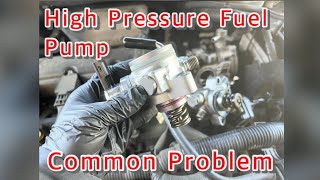
- Failing High-Pressure Fuel Pump (HPFP) 🔴 High Probability The HPFP is a mechanical pump driven by the camshaft that can wear out over time. Several Mazda TSBs, including #01-004/15, point to the HPFP not generating target pressure as a direct cause for P0191. Forum discussions confirm that HPFP failure is a known, though not exceptionally common, issue.
How to confirm: A technician will use a scan tool to monitor live fuel rail pressure data. If the actual pressure consistently fails to meet the desired pressure under load, the HPFP is likely weak. For example, if desired pressure is 2000 PSI on acceleration but actual pressure only reaches 1500 PSI, the pump is a strong suspect. Mazda's diagnostic procedure specifies checking if the 'FUEL_PRES' PID is 3.0 MPa (435 psi) or more at idle; if not, the HPFP should be replaced.
Typical fix: Replacement of the high-pressure fuel pump. TSB 01-004/15 outlines the replacement procedure with a modified part.
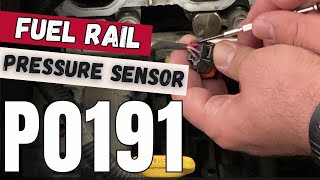
Est. part cost: $200-$500 - Faulty Fuel Rail Pressure Sensor 🟡 Medium Probability The sensor itself can fail, sending incorrect or erratic readings to the PCM even if the actual fuel pressure is normal. This can trick the computer into setting a P0191 code. The sensor is exposed to extreme pressure cycles and engine bay heat, which can lead to eventual failure.
How to confirm: Compare the sensor's reading on a scan tool with a manual pressure gauge (if possible on a high-pressure system) or check the sensor's voltage output against specifications. If the pressure reading is erratic, jumps to zero, or is clearly incorrect at idle (e.g., reading 0 PSI with the engine running), the sensor is suspect. A multimeter can be used to check the sensor's wiring for the correct voltage (typically a 5V reference, a ground, and a signal wire).
Typical fix: Replacement of the fuel rail pressure sensor.
Est. part cost: $50-$150 - Wiring or Connector Issues ⚪ Low Probability Vibrations and heat in the engine bay can cause wiring to fray or connectors to become loose or corroded over time, affecting the signal from the sensor to the PCM. One owner found a nearly broken wire in the harness under the intake manifold leading to the pressure sensor, causing an intermittent P0191.
How to confirm: Visually inspect the wiring harness and connector for the fuel rail pressure sensor. Check for continuity and resistance in the wires between the sensor and the PCM. Wiggle the harness while monitoring live data to see if the reading fluctuates, indicating a poor connection.
Typical fix: Repair or replace the damaged section of the wiring harness or the connector.
Est. part cost: $10-$100
Rare But Worth Checking
- Failing Low-Pressure Fuel Pump (In-Tank): While less likely to cause P0191 directly without other codes, a weak in-tank pump can starve the HPFP, causing it to underperform. Some 2018 models were subject to recall 5321K (NHTSA Campaign #21V875000) for this part. If actual high-side pressure is low, this is a secondary check, especially if the low-pressure system performance is also below spec.
- Clogged Fuel Filter: The primary fuel filter is typically part of the in-tank fuel pump assembly. If it becomes severely clogged, it can restrict fuel flow to the HPFP, leading to low pressure. This is more common on higher-mileage vehicles or those that have had contaminated fuel.
- Powertrain Control Module (PCM) Issue: In very rare cases, the PCM itself can be the source of the problem, misinterpreting a correct sensor signal or having an internal fault. This should only be considered after all other possibilities, including wiring, have been exhaustively ruled out.
Diagnosis Steps
- Connect an OBD-II scanner and check for any other stored codes. Note the freeze frame data for P0191 to see the engine conditions when the code was set.
- Use the scanner's live data function to monitor 'Desired Fuel Rail Pressure' and 'Actual Fuel Rail Pressure'.
- At idle, the values should be very close. For SkyActiv-G, idle pressure should be approximately 3.0 MPa (435 PSI).
- While safely test-driving, observe the pressure readings during acceleration. The actual pressure should closely follow the desired pressure, rising under load (potentially to over 2,000 PSI).
- If actual pressure is consistently lower than desired, suspect a weak HPFP or a fuel supply issue (low-pressure pump, filter).
- If actual pressure is erratic, drops to zero intermittently, or is stuck on one value, suspect a faulty fuel rail pressure sensor or a wiring issue.
- Visually inspect the wiring and connector for the fuel rail pressure sensor for any signs of damage, corrosion, or looseness. Pay close attention to the harness where it may rub against other components.
- If the sensor and wiring are good, and pressure is low, the focus should shift to testing the HPFP and the low-pressure fuel system.
- Check for any applicable recalls, like the low-pressure fuel pump recall for 2018 models (NHTSA #21V875000), as this could be a contributing factor.
- Due to the high pressures involved, professional diagnostic equipment is often required for further testing.
Parts You'll Likely Need
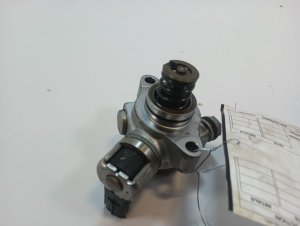
- High-Pressure Fuel Pump
(OEM #PE19-20-3F0)— This is a primary mechanical failure point for P0191, where the pump can no longer generate the pressure commanded by the PCM. TSB 01-004/15 calls for replacing the original pump with a modified part.
Trusted brands: Bosch, Hitachi, Mazda OE
OEM price range: $400-$600
Aftermarket price range: $200-$450 - Fuel Rail Pressure Sensor
(OEM #0261545074)— This sensor provides the critical pressure reading. If it fails, it can send incorrect data, triggering the code even if the pump is healthy.
Trusted brands: Bosch, Mazda OE
OEM price range: $100-$180
Aftermarket price range: $50-$120
Related Codes That Often Appear With This One
- P0088 — P0088 (Fuel Rail/System Pressure - Too High) can appear with P0191. This often points towards a faulty fuel rail pressure sensor or a malfunctioning pressure regulator within the HPFP. Mazda TSB #01-004-15 specifically mentions these two codes appearing together.
- P0087 — P0087 (Fuel Rail/System Pressure - Too Low) indicates that the fuel pressure is consistently low, which is a common cause for the P0191 performance code to be set. This strongly suggests a weak HPFP or a fuel delivery issue from the tank.
- P0300-P0306 — Random or specific cylinder misfire codes can occur because the incorrect fuel pressure leads to a poor air/fuel mixture, causing incomplete combustion.
Technical Service Bulletins (TSBs) & Recalls
- 01-004-15-3028: Mentions P0191 may be stored with P0088.
- 01-010-14-2896B: Notes P0191 may be stored with P0192 (Fuel Pressure Sensor Circuit Low).
- 01-024-12-2729A: Links P0191 to rough idle and potential stalling.
- 01-010-14-2896A: States the cause can be the high-pressure fuel pump not generating the target pressure.
Platform-Specific Known Issues
- Mazda has issued several Technical Service Bulletins (TSBs) for P0191 on various models using SkyActiv engines, including #01-004-15-3028, which supersedes earlier bulletins and applies to the 2014 Mazda 6. It specifically addresses P0191 and P0088, recommending replacement of the HPFP with a modified part.
- A recall (NHTSA Campaign #21V875000, Mazda recall #5321K) was issued for the low-pressure fuel pump on 2018 Mazda 6 models. The impeller could crack and cause the pump to fail, leading to stalling. While this is a different part, a failing low-pressure pump can affect the high-pressure pump's ability to function.
Mechanic-Grade Diagnostic Values
- High-Pressure Fuel System Pressure at Idle (PID: FUEL_PRES) — expected: Approx. 3.0 MPa {31 kgf/cm2, 435 psi}. Failure: Pressure significantly below 3.0 MPa indicates a likely failing high-pressure fuel pump.
- Low-Pressure Fuel System Pressure (Key On, Engine Off) — expected: 45 to 50 psi. Failure: Pressure below 45 psi can indicate a weak in-tank fuel pump or clogged filter, which can starve the HPFP.
- Fuel Rail Pressure Sensor Signal Voltage — expected: Approx. 0.5V at 0 PSI, scaling up to 4.5V at maximum pressure.. Failure: Voltage that is stuck, erratic, or does not correspond to actual pressure readings when tested with a mechanical gauge.
- Fuel Rail Pressure Sensor Wiring Harness - Reference Voltage — expected: 5V from the PCM to the sensor.. Failure: No voltage or significantly lower voltage indicates a wiring or PCM issue.
- Fuel Rail Pressure Sensor Wiring Harness - Continuity — expected: Less than 1 ohm resistance between the sensor connector and the PCM connector for each wire (power, ground, signal).. Failure: High resistance or an open circuit (OL) indicates a broken wire.
Scan Tool Commands That Help
- Mazda M-MDS (or equivalent professional scanner): Active Test: Fuel Pump (Low-Pressure) — To manually command the in-tank low-pressure fuel pump on and off. This helps verify if the pump is functional and allows for checking fuel pressure from the tank without starting the engine. It's a key step in differentiating a low-pressure supply problem from a high-pressure pump failure.
Wiring & Ground Locations
- Fuel Rail Pressure Sensor Connector — Mounted directly on the high-pressure fuel rail, near the intake manifold.. This is the primary connection point for the sensor. Corrosion, moisture, or pushed-out pins at this connector are a common cause of P0191.
- Data Link Connector 2 (DLC2) — Under the driver's side dashboard, standard OBD-II port location.. This is the connection point for the scan tool (like the Mazda M-MDS) used to read live data PIDs such as 'FUEL_PRES', which is essential for diagnosis.
- Main Engine Ground — Typically a heavy gauge wire from the negative battery terminal to the engine block and/or chassis.. A poor engine ground can cause erratic readings from various sensors, including the fuel rail pressure sensor, leading to false codes.
Real Owner Repair Stories
- YouTube Commenter (2015 Mazda 6 Touring 2.5L) — Vehicle would not start, presumably with a fuel pressure related code (comment was on a P0192 HPFP video).
✅ What actually fixed it The owner went to a U-Pull-It salvage yard, acquired a used high-pressure fuel pump, installed it, and the car started and worked correctly. The fix was reported to be holding for about 4 months. - Reddit User on r/mazda (2017 Mazda CX-5 2.5L (similar powertrain) with 63k miles) — Engine shut off completely while driving on the highway. Stored code P0192 (Fuel Rail Pressure Sensor Circuit Low), which is closely related to P0191.
❌ Tried (didn't work) The car had a previous HPFP replacement under warranty at 15,000 miles for a similar issue.
✅ What actually fixed it The dealer diagnosed and replaced the high-pressure fuel pump for a second time. The car then drove normally. This story highlights that even replacement pumps can fail prematurely.
OEM Part Supersession History
pe01203f0b, pe01203f0c, pe01203f0d, pe01203f0e, pe01203f0f, pe18203f0, pe18203f0a→PE19-20-3F0— Part has been updated/revised by Mazda over the years to improve reliability, as referenced in TSBs.
Heads up: When replacing, it is critical to use the latest part number (PE19-20-3F0) as it contains the most recent design improvements. Some parts may be stamped with PE18-20-3F0 or PE19-20-3F0, and it's important to verify the part number on the existing pump if possible.
Model Year Variations Within This Range
- 2018-2021: For the 2018 model year, Mazda introduced an optional 2.5L turbocharged engine (SkyActiv-G 2.5T). While the fundamental high-pressure fuel system is similar, the turbo engine has different power outputs and potentially different fuel demands, though it uses a similar diagnostic approach for P0191.
- 2018: A recall for the low-pressure in-tank fuel pump was issued for some 2018 Mazda 6 models. This specific vulnerability does not apply to other years in the range but is a critical check for any 2018 vehicle presenting with fuel pressure issues.
Diagnostic Flowchart
Other Known Issues on This Vehicle
Issues unrelated to this code that are worth knowing about as an owner of this generation:
- Infotainment 'Ghost Touch' and Delamination 🟠 Medium — Common on 2016-2020 models. The touchscreen registers phantom inputs, making the system difficult to use. It's caused by the screen's layers separating. (Ref: Mazda issued TSB 09-003/22 and a warranty extension program (CSP13) to address this by replacing the screen or updating software.)
- Intake Valve Carbon Buildup 🟡 Low — A potential long-term issue for all direct injection (GDI) engines, including SkyActiv-G. Can occur after 80,000+ miles, potentially causing reduced performance. However, Mazda's design seems less prone to severe buildup than some other manufacturers.
- Prematurely Warped Brake Rotors 🟡 Low — A common complaint among owners is that the OEM front brake rotors tend to warp, causing steering wheel vibration during braking. This can occur as early as 30,000-50,000 miles.
- Leaking Drive Belt Tensioner 🟡 Low — The hydraulic drive belt tensioner can leak oil over time, requiring replacement. This is often noticed during routine maintenance.
- Cracked Cylinder Head (2.5T Engine) 🔴 High — Primarily affects the 2.5L Turbo engine (not standard on all Mazda 6 models) where an external coolant leak can develop from a casting flaw in the cylinder head. This was the subject of a class-action lawsuit. (Ref: A TSB was issued for excessive oil consumption on some 2021 2.5T engines, which is a separate but related engine issue.)
Used vs. New Parts: Buying Guide for This Vehicle
When a used part is the smart pick: A used high-pressure fuel pump (HPFP) from a salvage yard can be a cost-effective option, especially if the budget is tight. There is at least one owner report of a used HPFP from a U-Pull-It yard successfully fixing the issue for several months. This is a higher-risk repair, but can save hundreds of dollars compared to a new OEM part.
Donor-vehicle mileage cap: roughly under 80000 miles for the part to have meaningful remaining life.
What to inspect on the donor part:
- Look for a donor vehicle with the lowest possible mileage.
- Check the vehicle history if available to ensure it wasn't salvaged due to a major engine failure.
- Visually inspect the part for any signs of external damage, corrosion, or leaking.
- If possible, get the part from a vehicle that was running before it was wrecked.
OEM-only on this vehicle (don't cheap out):
- While aftermarket pumps exist, Mazda has superseded the original HPFP part number multiple times, indicating design improvements. For maximum reliability and to avoid repeat failures, a new OEM pump (part #PE19-20-3F0) is the most recommended option, despite the higher cost.
Aftermarket brands forum-validated for this vehicle:
- Bosch (Often the OEM supplier)
- Hitachi
Brands owners have reported issues with on this vehicle:
- Unnamed, no-brand parts from online marketplaces should be avoided due to the critical nature of this component and the high pressures involved.
Real Owner Stories
Aggregated from forums and TSBs cited above. Mileages and costs reflect what owners reported in those sources.
2017 Mazda 6 2.5L SkyActiv-G — 49709 miles
Symptoms: High pressure fuel pump failure reported by the owner.
What fixed it: Replacement of the high-pressure fuel pump (HPFP).
Source hint: mazdaforum.com thread titled 'High pressure fuel pump failure'
2014 Mazda 6 2.5L SkyActiv-G
Symptoms: Intermittent P0191 code.
What fixed it: Repaired a nearly broken wire in the harness under the intake manifold leading to the pressure sensor.
Source hint: mazdaspeeds.org thread titled 'Solved: Possible fuel pressure problem'
2014 Mazda 6 2.5L SkyActiv-G
Symptoms: P0191 stored alongside P0088; engine not reaching target fuel pressure.
What fixed it: Replacement of the high-pressure fuel pump with a modified part as per TSB instructions.
Source hint: TSB 01-004-15-3028
Related OBD-II Codes
Frequently Asked Questions
Does TSB 01-004/15 apply to my 2014 Mazda 6 regarding the P0191 code?
Could the 2018 Mazda 6 fuel pump recall be related to my P0191 code?
What is the specific fuel pressure reading I should look for at idle on my SkyActiv-G engine?
Is there a known wiring issue that causes intermittent P0191 codes on the Mazda 6?
Can I just replace the fuel rail pressure sensor to fix P0191?
Helpful Videos
Used OEM Parts in Stock


New Aftermarket Parts Available


The information in this article is provided for general reference and educational purposes only. Vehicle specifications, procedures, and part compatibility can vary by production date, trim level, and region. Always consult your vehicle's factory service manual and verify part numbers before purchasing or performing repairs. Safety-critical components such as airbags, seat belts, and braking systems should be installed by a qualified professional.
- Mazda 6:
- 🎬 Helpful Videos
- 🛍️ Shop This Part
- What's Unique About the 2014-2021 Mazda 6
- Symptoms You May Notice
- Most Likely Causes
- Rare But Worth Checking
- Diagnosis Steps
- Parts You'll Likely Need
- Related Codes That Often Appear With This One
- Technical Service Bulletins (TSBs) & Recalls
- Platform-Specific Known Issues
- Mechanic-Grade Diagnostic Values
- Scan Tool Commands That Help
- Wiring & Ground Locations
- Real Owner Repair Stories
- OEM Part Supersession History
- Model Year Variations Within This Range
- Diagnostic Flowchart
- Other Known Issues on This Vehicle
- Used vs. New Parts: Buying Guide for This Vehicle
- Real Owner Stories
- 2017 Mazda 6 2.5L SkyActiv-G — 49709 miles
- 2014 Mazda 6 2.5L SkyActiv-G
- 2014 Mazda 6 2.5L SkyActiv-G
- Related OBD-II Codes
- Frequently Asked Questions
- 🎟️ Get 5% Off