

P0191 on 2012-2018 Land Rover Range Rover Evoque: Fuel Pressure Sensor Causes and Fixes
P0191 on a Range Rover Evoque indicates a fuel pressure problem, often causing limp mode and stalling. For 2018 models with the Ingenium engine, the most likely cause is a software glitch fixed by a dealer update (TSB LTB01245NAS3). For all other years (2012-2017 with the Ford EcoBoost engine), it's typically a faulty fuel rail pressure sensor, costing $60-$150 for the part.
- For a 2018 Range Rover Evoque with P0191, your first step should be to check if a PCM software update (TSB LTB01245NAS3) is needed.
- For 2012-2017 models, the most common fix is replacing the fuel rail pressure sensor.
- Symptoms typically include reduced power, hesitation, and an illuminated Check Engine Light.
- Ensure you purchase the correct sensor, as the part is different between the 2012-2017 engines and the 2018 Ingenium engine.
- DIY replacement of the sensor is possible for those with basic tools, but be aware the sensor can be very tight.
What's Unique About the 2012-2018 Land Rover RANGE ROVER EVOQUE

The 2012-2018 Evoque spans two different 2.0L petrol engines, which is critical for diagnosing P0191. Models from 2012-2017 use a Ford-based 2.0L EcoBoost engine, where this code usually points to a physical part failure like the sensor itself or its wiring. However, on the 2018 model with the JLR-built 'Ingenium' engine, Land Rover issued a Technical Service Bulletin (LTB01245NAS3) stating that P0191-85 can be falsely triggered by an incorrect PCM calibration. This makes a software update the primary suspect for 2018 models, while earlier years require traditional hardware diagnosis. This same software issue was noted for other JLR vehicles using the Ingenium engine, like the Jaguar E-Pace.
Diagnostic Flowchart

Tap your situation to follow the diagnostic path that matches what you're seeing on this vehicle.
Generation note: The 2012-2018 model years all belong to the first generation Evoque (L538), but a key facelift and engine change occurred. Models from 2012-2017 use a Ford-derived 2.0L GTDi 'EcoBoost' engine. The 2018 model year introduced the JLR 2.0L 'Ingenium' petrol engine. This engine difference is critical, as a specific TSB for P0191 (LTB01245NAS3) applies only to the 2018 Ingenium engine, recommending a software update as the primary fix.
Symptoms You May Notice
- Check Engine Light is on
- Reduced engine performance or 'limp mode'
- Engine hesitation or stuttering, especially during acceleration
- Rough or unstable idle
- Poor fuel economy
- Engine may stall, especially at stops
- In severe cases, the engine may crank but not start
- Replacing the high-pressure fuel pump when the issue is only a faulty sensor, wiring, or a software glitch.
- Replacing the fuel rail pressure sensor on a 2018 model without first checking if the PCM software update (TSB LTB01245NAS3) has been performed.
- Assuming the problem is the sensor when a wiring issue (like a corroded connector) is the true root cause.
Most Likely Causes

- Incorrect PCM Software Calibration 🔴 High Probability Specific to 2018 models with the 2.0L Ingenium petrol engine. TSB #LTB01245NAS3 explicitly states an incorrect calibration can cause a 'false flag' of DTC P0191-85. This issue also affects other JLR models with the same engine, such as the Discovery Sport and Jaguar E-Pace.
How to confirm: A Land Rover dealer or a specialized shop with access to JLR's diagnostic software (PATHFINDER version 351 or later) can check the vehicle's software version against the TSB.
Typical fix: Update the Powertrain Control Module (PCM) software to the latest version. No parts are required.
Est. part cost: $0 - Faulty Fuel Rail Pressure Sensor 🔴 High Probability This is the most common hardware failure for this code across all model years, especially on the 2012-2017 Ford engine. The sensor operates in a high-pressure, high-heat environment and can fail electronically or become contaminated over time.
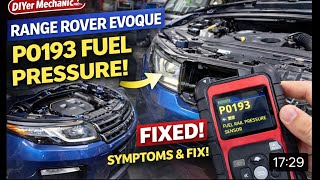
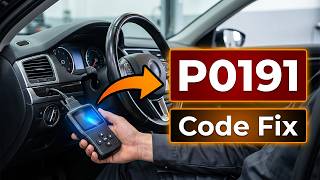
How to confirm: Using a capable OBD-II scanner, monitor live data for 'Fuel Rail Pressure'. If the reading is stuck at a default value, is erratic, or reads an impossible pressure 🎬 See how to diagnose and fix a P0191 range/performance code. (e.g., high pressure with the engine off), the sensor is likely bad. Also, inspect the sensor's connector for corrosion or damage. A technician may also compare the sensor's reading to a mechanical pressure gauge.
Typical fix: Replace the fuel rail pressure sensor. On Ford engines, it is recommended to use a genuine Motorcraft part to avoid compatibility issues.
Est. part cost: $60-$150 - Wiring or Connector Issue 🟡 Medium Probability The wiring harness to the sensor is exposed to engine heat, which can cause wires to become brittle or damaged over time. Corrosion or a loose connection at the connector pins can also disrupt the signal, a common issue on many platforms.
How to confirm: Visually inspect the wiring harness leading to the fuel rail pressure sensor for any signs of fraying, melting, or breaks. Unplug the connector and check for corrosion or bent pins. A 'wiggle test' on the harness while monitoring live data can show if the connection is unstable.
Typical fix: Repair the damaged section of the wiring harness or clean/replace the connector.
Est. part cost: $5-$50 - Failing High-Pressure Fuel Pump (HPFP) ⚪ Low Probability While less common than a sensor failure, a weak or failing HPFP can fail to deliver the pressure commanded by the PCM, causing a legitimate range/performance error. The HPFP on direct injection engines like the EcoBoost and Ingenium is a mechanical pump driven by the camshaft and is a known wear item on other platforms.
How to confirm: This requires in-depth diagnosis. A technician will monitor desired vs. actual fuel pressure readings under various load conditions. A consistently low actual pressure, especially when commanded pressure is high, points towards a pump or filter issue.
Typical fix: Replace the failing high-pressure (engine-mounted) fuel pump.
Est. part cost: $300-$800
Rare But Worth Checking
- Clogged Fuel Filter: The fuel filter can become restricted, leading to low fuel pressure being supplied to the HPFP. It's often overlooked but is a relatively inexpensive item to replace as part of diagnosis or maintenance.
- Contaminated Fuel: Water or debris in the fuel can cause pressure fluctuations and damage fuel system components, including the pumps and sensor. One owner on a forum discovered their issue was caused by contaminated diesel, leading to a major repair.
- Failing Low-Pressure Fuel Pump (In-tank): The in-tank pump's job is to supply the high-pressure pump. If it fails, the HPFP will be starved of fuel, leading to low rail pressure. A simple test is to listen for the pump priming when the key is turned on.
- Faulty Powertrain Control Module (PCM): In very rare cases, the PCM itself can have an internal fault, causing it to misinterpret the sensor signal. This should only be considered after all other possibilities, including the specific software TSB for 2018 models, have been exhausted.
Diagnosis Steps
- Read the full Diagnostic Trouble Code, including any suffix numbers (e.g., P0191-85).
- For 2018 Models with Ingenium Engine: The highest priority is to check service history or contact a dealer to see if TSB #LTB01245NAS3 (PCM software update) has been performed. If not, this is the most likely fix and should be done first.
- Connect an OBD-II scanner and view live data for 'Fuel Rail Pressure'. Note the reading with the key on/engine off (KOEO), at idle, and while revving the engine.
- Compare the live data to specifications. A reading that is stuck, zero, or impossibly high points to a sensor or wiring issue. For example, high pressure at KOEO is a clear sign of a bad sensor.
- Visually inspect the fuel rail pressure sensor's electrical connector and wiring. Look for signs of damage, corrosion, melting, or looseness. Perform a 'wiggle test' on the connector and harness while watching live data.
- If wiring appears intact, test the sensor circuit for proper reference voltage (typically 5V), ground, and signal continuity back to the PCM.
- If the sensor and wiring test good, but the pressure reading is genuinely low, the diagnosis should shift to the fuel delivery system. Check the low-pressure pump's output first, then the fuel filter, and finally the high-pressure fuel pump (HPFP).
- If all other components are confirmed to be working correctly, replace the fuel rail pressure sensor. It is often recommended to use an OEM or high-quality Bosch replacement.
Parts You'll Likely Need
- Fuel Rail Pressure Sensor (2012-2017 Ford Engine)
(OEM #LR024969)— This is the most common hardware failure for P0191 on Evoque models with the Ford-based 2.0L engine. The Bosch equivalent is part number 0261545064.
Trusted brands: Bosch, Genuine Land Rover, Motorcraft
OEM price range: $110-$180
Aftermarket price range: $60-$100 - Fuel Rail Pressure Sensor (2018 JLR Ingenium Engine)
(OEM #LR105424)— This is the correct sensor for the JLR Ingenium engine. It is a 4-pin combined pressure and temperature sensor. Note that for the 2018 model year, the primary suspect for P0191-85 is a software issue per TSB LTB01245NAS3, not sensor failure.
Trusted brands: Genuine Land Rover, Bosch
OEM price range: $120-$200
Aftermarket price range: $70-$130
Related Codes That Often Appear With This One
- P168F-00 — Mentioned in TSB #SSM73959.2 as a code that may be stored alongside P0191-85, indicating a related fuel system performance issue.
- P2178-00 — Also mentioned in TSB #SSM73959.2, this code relates to a 'rich off idle' condition, which can be caused by incorrect fuel pressure readings.
- P0089 — This code for 'Fuel Pressure Regulator Performance' can appear with P0191 as both relate to the control and measurement of fuel pressure in the rail.
- P0171 — A 'System Too Lean' code can be triggered alongside P0191 if the fuel pressure is genuinely low, causing a lean air/fuel mixture. A Ford Focus owner reported this combination was solved by replacing the sensor.
Technical Service Bulletins (TSBs) & Recalls

- LTB01245NAS3: States that on 2018 Evoque and Discovery Sport models with the 2.0L Ingenium petrol engine, the MIL may illuminate with DTC P0191-85 due to an incorrect PCM calibration. The fix is a software update.
- SSM73959.2: Notes that customers may report reduced performance with P0191-85 stored, sometimes without the MIL on. May be stored with codes P168F-00, P2178-00, or P144C-00.
- SSM74093: Similar to SSM73959.2, links reduced performance with P0191-85 and other potential DTCs.
- JTB00659NAS4: A similar TSB for Jaguar models (E-Pace, F-Pace, XE) with the same 2.0L Ingenium engine, confirming the P0191-85 software issue is common to the engine family, not just the Evoque.
Platform-Specific Known Issues
- On 2018 models with the 2.0L Ingenium petrol engine, DTC P0191-85 can be falsely triggered by a software error in the PCM, which is resolved by a software update per TSB #LTB01245NAS3.
- TSBs #SSM73959.2 and #SSM74093 note that P0191-85 can be associated with reduced performance and may appear with other codes like P168F-00 and P2178-00.
- A forum user on AULRO.com with a diesel Land Rover (not an Evoque) documented their entire P0191 diagnostic journey, which started with replacing the sensor, then checking pumps, and finally discovering contaminated fuel was the root cause, highlighting a thorough diagnostic path.
Mechanic-Grade Diagnostic Values
- High-Pressure Fuel Rail Pressure at Idle (GDI) — expected: Approx. 3.0-8.0 MPa (435-1160 PSI), or ~40 bar (580 PSI).. Failure: A reading of approx. 700-900 KPa (101-130 PSI) that does not increase with engine RPM suggests a failed High-Pressure Fuel Pump.
- High-Pressure Fuel Rail Pressure Under Load (GDI) — expected: Increases with engine speed, can reach 13-14 MPa (1900-2000 PSI) or higher.. Failure: Pressure fails to rise significantly when the throttle is opened or load is applied.
- Low-Pressure Fuel Sensor Voltage at Idle — expected: Approx. 3.0V (± 0.15V). After 30 seconds, engine speed may drop and voltage should read approx. 2.3V (± 0.15V).. Failure: Voltage readings are not maintained, or start low (2.6V or less) and slowly build. This points to a weak in-tank fuel pump.
- Fuel Rail Pressure Sensor Signal Voltage Range — expected: 0.5V to 4.5V.. Failure: Voltage is stuck at 0V, 5V, or stays outside the expected range for more than 5 seconds.
Hidden / Shadow Codes Worth Checking
- P0191-85: Indicates a 'Signal Bias Level Out of Range / Signal Invalid' fault. For the 2018 Ingenium engine, JLR TSB LTB01245NAS3 identifies the root cause as incorrect PCM software calibration, which falsely triggers this specific code. (see via A diagnostic scanner capable of reading manufacturer-specific DTCs and their suffixes, such as JLR SDD/Pathfinder or an advanced aftermarket tool.)
Scan Tool Commands That Help
- JLR SDD (Symptom Driven Diagnostics): Datalogger -> Engine system -> 'Fuel rail pressure - Low range sensor' — To monitor the live voltage from the low-pressure fuel system sensor to diagnose the health of the in-tank fuel pump, as per JLR's own diagnostic procedures.
- Advanced Aftermarket (e.g., iCarsoft CR MAX): Special Functions -> Engine -> Sensor Tests -> Fuel Pressure Sensor Circuit — To perform automated circuit integrity checks, including a 5V reference check, ground resistance test (<0.5Ω expected), and signal continuity test between the sensor and PCM. This helps isolate a wiring fault from a sensor fault.
Wiring & Ground Locations

- G1D130A — Located in the engine compartment on the left front side.. This is a primary ground point for the Engine Control Module (ECM) on the 2013 Evoque. A poor ground connection here can cause erratic behavior and fault codes from any sensor managed by the ECM, including the fuel rail pressure sensor.
- G1D108 — Located in the engine compartment near the battery.. Another key ground point for the ECM and battery junction box. Verifying this ground is clean and tight is a fundamental step in diagnosing any electrical fault code.
- ECM Connector Pins (Ford Engine) — At the Powertrain Control Module (PCM).. Technicians can back-probe the ECM connector to test for continuity without disconnecting the entire harness. For a similar GDI system, Pin 27 was the signal wire and Pin 15 was another circuit wire for the fuel rail pressure sensor. This allows for definitive testing of the wiring harness between the sensor and the control module.
- FRPT Sensor Connector (Ingenium Engine) — On the fuel rail, at the top of the engine.. The Fuel Rail Pressure and Temperature (FRPT) sensor on the Ingenium engine has a four-pin connector. It receives a 5V reference from the PCM and sends back both a pressure signal and a temperature signal. Knowing this helps in testing the correct pins for voltage and signal.
Real Owner Repair Stories
- SA Diagnostic's YouTube Channel (Jaguar XE 2.0L Petrol (JLR Ingenium Family)) — Limp mode, engine management light on, and engine juddering/stuttering.
❌ Tried (didn't work) The video advises checking wiring and fuses first before replacing parts.
✅ What actually fixed it The presenter identifies the fuel rail pressure sensor as the common cause for P0191 on this engine and replaces it to resolve the issue. The video shows the sensor's location at the top of the engine on the fuel rail. - AliExpress Customer Review (2015 Land Rover Freelander 2 (with Ford-based 2.0L engine)) — Hesitation during acceleration, unstable idle, and DTC P0191.
✅ What actually fixed it The owner replaced the fuel rail pressure sensor with part LR024969 (Bosch 0261545064). After installation, the P0191 code was cleared and engine performance returned to normal with a smooth idle and no hesitation.
OEM Part Supersession History
LR024969→LR024969 (current)— This is the primary OEM part number for the 2012-2017 Ford 2.0L TIVCT engine. Bosch is the OEM supplier, and their equivalent part number is 0261545064 or 0261545063.
Heads up: This part is for the Ford-derived engine ONLY and will not work on the 2018+ JLR Ingenium engine.LR105424→LR105424 (current)— This is the OEM part number for the fuel rail pressure sensor on the 2018+ JLR 2.0L Ingenium petrol engine.
Heads up: This is a 4-pin combined pressure and temperature sensor and is not compatible with the earlier Ford-engine models.
Model Year Variations Within This Range
- 2012-2017: Uses the Ford-derived 2.0L 'EcoBoost' engine. The fuel rail pressure sensor is typically a 3-pin unit, part number LR024969. The cause of P0191 is almost always a hardware or wiring failure.
- 2018: Uses the JLR-built 2.0L 'Ingenium' engine. The fuel rail pressure sensor is a 4-pin combined pressure/temperature unit, part number LR105424. For this year, P0191-85 is most often caused by a software bug requiring a PCM update per TSB LTB01245NAS3, not a faulty sensor.
Helpful Videos
We Have This Part in Stock



The information in this article is provided for general reference and educational purposes only. Vehicle specifications, procedures, and part compatibility can vary by production date, trim level, and region. Always consult your vehicle's factory service manual and verify part numbers before purchasing or performing repairs. Safety-critical components such as airbags, seat belts, and braking systems should be installed by a qualified professional.
- Land Rover RANGE ROVER EVOQUE:
- 🎬 Helpful Videos
- 🛍️ Shop This Part
- What's Unique About the 2012-2018 Land Rover RANGE ROVER EVOQUE
- Diagnostic Flowchart
- Symptoms You May Notice
- Most Likely Causes
- Rare But Worth Checking
- Diagnosis Steps
- Parts You'll Likely Need
- Related Codes That Often Appear With This One
- Technical Service Bulletins (TSBs) & Recalls
- Platform-Specific Known Issues
- Mechanic-Grade Diagnostic Values
- Hidden / Shadow Codes Worth Checking
- Scan Tool Commands That Help
- Wiring & Ground Locations
- Real Owner Repair Stories
- OEM Part Supersession History
- Model Year Variations Within This Range
- 🎟️ Get 5% Off