

P0191 on 2017-2018 Land Rover Discovery: Causes, Symptoms, and Fixes
For a 2017-2018 Land Rover Discovery, code P0191 often points to a faulty fuel rail pressure sensor or a software issue. On 2018 models specifically, a known software glitch can falsely trigger the code, and a dealer-installed update is the first thing to check. Otherwise, expect to replace the fuel rail pressure sensor.
- For a 2018 Land Rover Discovery with code P0191-85, your first step should be to inquire with a dealer about the software update outlined in TSB #LTB01245NAS3.
- For 2017 models, or 2018 models with up-to-date software, the most likely cause is a faulty fuel rail pressure sensor.
- Symptoms include reduced engine power, hesitation, and potential stalling, making it a safety concern that should be addressed promptly.
- Due to the high pressures involved, this is generally not a beginner-friendly DIY repair. Professional service is recommended.
- Check for other codes like P168F-00, P2178-00, or P144C-00, as they are known to appear alongside P0191 on this vehicle.
What's Unique About the 2017-2018 Land Rover DISCOVERY
For the 2017-2018 Land Rover Discovery, this code is the subject of multiple manufacturer Technical Service Bulletins (TSBs), indicating a known issue rather than a random failure. Critically, for 2018 models with the 2.0L Ingenium petrol engine, TSB #LTB01245NAS3 points to a software calibration error in the PCM that can falsely trigger the P0191-85 code. This makes a software update a primary and unique first diagnostic step for these vehicles, potentially avoiding an unnecessary hardware replacement. TSBs also note it can appear with other specific codes related to reduced performance.
Diagnostic Flowchart
Tap your situation to follow the diagnostic path that matches what you're seeing on this vehicle.
Symptoms You May Notice
- Malfunction Indicator Lamp (MIL) or Check Engine Light is on.
- Reduced engine performance or entering 'limp mode'.
- Engine hesitation or stumbling, especially during acceleration.
- Rough or unstable idle.
- Engine may stall or be difficult to start.
- Poor fuel economy.
- Engine cranks but does not start.
- Unusual smell from the tailpipe.
- Replacing the fuel rail pressure sensor on a 2018 model without first checking if the PCM software update from TSB LTB01245NAS3 has been performed.
- Replacing an expensive high-pressure fuel pump when the actual fault is a much cheaper sensor or a simple wiring issue.
- Assuming the fuel pump is bad without first performing voltage drop tests on the power and ground circuits for the fuel pump driver module.
Most Likely Causes
- Incorrect PCM Software Calibration 🔴 High Probability A specific TSB (#LTB01245NAS3) was issued for 2018 models with the 2.0L Ingenium petrol engine, stating an incorrect PCM calibration can cause a 'false flag' of DTC P0191-85. This issue is common across other JLR models using the same engine.
How to confirm: A Land Rover dealer or a specialized shop with JLR's diagnostic software (PATHFINDER version 351 or later) can check the vehicle's software version against the TSB.
Typical fix: Update the Powertrain Control Module (PCM) software to the latest version. No parts are required for this fix.
Est. part cost: $0 - Faulty Fuel Rail Pressure Sensor 🟡 Medium Probability This is a common failure point for P0191 across many makes and models. The sensor is exposed to heat and high pressure, leading to wear over time. For the gas engines in the Discovery 5, it is a combined pressure and temperature sensor.
How to confirm: Using a scan tool, monitor the live fuel rail pressure data. If the reading is erratic, stuck at a default value, 🎬 See this breakdown of fuel rail pressure sensor circuit performance. or doesn't change with engine RPM, the sensor is likely faulty (assuming wiring is okay). A key symptom of failure is a high pressure reading (e.g., 70 PSI / 500 kPa) with the key on and engine off, when the pressure should be near zero. A mechanical gauge can be used to verify the electronic reading.
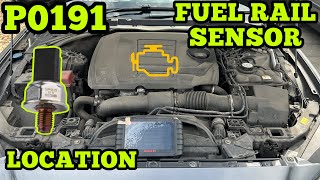
Typical fix: Replace the fuel rail pressure sensor. The sensor is often located on the fuel rail towards the back of the engine, and access can be difficult. 🎬 Watch: See the fuel rail pressure sensor location and replacement.
Est. part cost: $70-$200 - Wiring or Connector Issue ⚪ Low Probability Engine bay heat can degrade wiring insulation and connectors over time, leading to poor connections or short circuits. A forum user on AULRO.com mentioned a case where a rat chewed the harness.
How to confirm: Visually inspect the wiring harness and connector for the fuel rail pressure sensor. Look for signs of corrosion, frayed wires, or loose pins. Perform a continuity and voltage drop test on the circuit back to the PCM.
Typical fix: Repair the damaged section of the wiring harness or replace the connector pigtail.
Est. part cost: $10-$50
Rare But Worth Checking
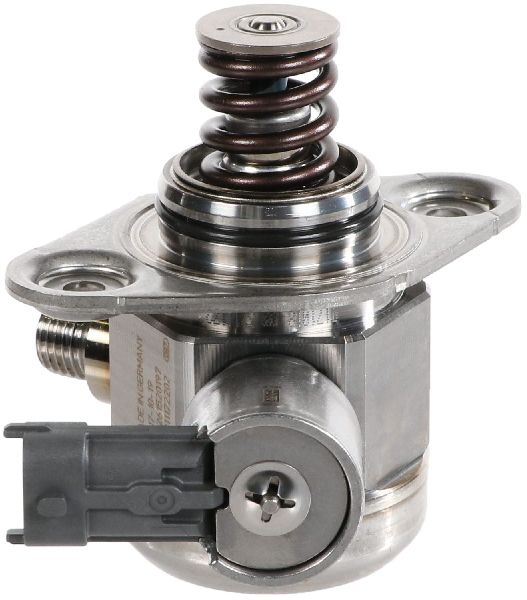
- Failing High-Pressure Fuel Pump (HPFP): While less common than a sensor failure, a weak or failing HPFP can fail to generate the pressure commanded by the PCM, triggering P0191. This is often accompanied by other fuel system codes. A catastrophic failure can result in a no-start condition.
- Failing Low-Pressure Fuel Pump (In-Tank): If the in-tank pump doesn't supply enough fuel to the HPFP, the high-pressure side will starve and be unable to meet its target pressure, leading to P0191. Diagnosis involves checking for fuel flow at the Schrader valve on the engine.
- Contaminated Fuel: Water or debris in the fuel can damage fuel system components, including the pumps and sensor, leading to pressure issues. One forum user with a diesel Land Rover traced their P0191 to this cause, resulting in a $17,500 repair to replace injectors, pumps, and fuel lines.
- Failed Crankcase Ventilation Valve (PCV System): On some Jaguar Land Rover vehicles, particularly with the 3.0L V6 and 5.0L V8 engines, a failed PCV system can cause lean running conditions (P0171/P0174) and may also trigger a P0191 code. A jammed-closed PCV valve can cause a high pressure condition, triggering the code.
Diagnosis Steps
- Check for Technical Service Bulletins (TSBs): For any 2017-2018 Discovery, but especially a 2018 model with a 2.0L petrol engine, the first step is to check with a dealer or authorized repair shop for open TSBs related to P0191. If TSB LTB01245NAS3 applies, perform the PCM software update using JLR's PATHFINDER diagnostic tool.
- Scan and Monitor Live Data: Use an advanced OBD-II scanner to read all stored codes and their suffixes (like -85). Monitor the 'Fuel Rail Pressure' and 'Desired Fuel Rail Pressure' PIDs. Observe if the actual pressure follows the desired pressure under different engine loads (idle, revving, driving). Pay special attention to the Key On, Engine Off (KOEO) reading; a healthy sensor should read near 0 PSI, while a faulty sensor may show a significant pressure reading (e.g., 70 PSI).
- Inspect Wiring and Connector: Perform a close visual inspection of the fuel rail pressure sensor's electrical connector and wiring harness. Look for any signs of damage, corrosion, or loose connections. Check for rodent damage, which has been reported.
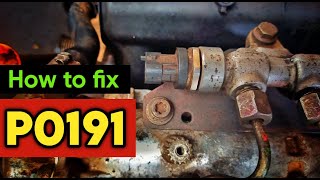
- Test the Sensor Circuit: If the wiring looks good, use a digital multimeter to test for correct reference voltage (typically 5V) and ground integrity at the sensor connector. A voltage drop test is recommended to find hidden resistance. 🎬 Watch: A helpful guide on how to diagnose the P0191 code.
- Test Fuel System Components: If the sensor, wiring, and software are all confirmed to be good, the issue may lie with a mechanical component. Further diagnosis would involve testing the low-pressure fuel pump's output (should be around 0.5 bar / 7 PSI) and the high-pressure fuel pump's performance, which typically requires specialized tools.
- Check for Related System Faults: If lean codes (P0171/P0174) are also present, investigate the PCV system for leaks before focusing on the fuel system.
Parts You'll Likely Need
- Fuel Rail Pressure Sensor
(OEM #LR105424)— This is the most common hardware failure for code P0191 when a software update is not the cause. It directly measures the pressure that the code reports as out of range. For the 2018 2.0L Ingenium engine, the sensor is a 4-pin combined pressure/temperature unit. The 3.0L V6 uses a different part, such as LR108241.
Trusted brands: Bosch, Denso, Genuine Land Rover
OEM price range: $150-$250
Aftermarket price range: $70-$150
Related Codes That Often Appear With This One
- P168F-00 — TSBs #SSM73959.2 and #SSM74093 explicitly state this code may be stored along with P0191-85 when reduced performance is observed.
- P2178-00 — Mentioned in TSBs #SSM73959.2 and #SSM74093 as a code that can accompany P0191-85, often related to a rich off-idle condition.
- P144C-00 — Also listed in TSBs #SSM73959.2 and #SSM74093 as a potential companion code to P0191-85.
- P0171 / P0174 — System Too Lean. These codes can appear with P0191 if a vacuum leak from a faulty PCV system is the root cause, particularly on the V6 and V8 gasoline engines.
Technical Service Bulletins (TSBs) & Recalls
- LTB01245NAS3: Engine MIL Illuminated With DTC P0191-85 Stored
- SSM73959.2: Reduced performance with P0191-85 observed in the PCM
- SSM74093: Reduced performance with P0191-85 observed in the PCM
Platform-Specific Known Issues
- TSB #LTB01245NAS3: States that on some 2018 models with the 2.0L Ingenium petrol engine, the Malfunction Indicator Lamp (MIL) may illuminate with DTC P0191-85 stored due to an incorrect PCM calibration. The fix is a software update, not a part replacement.
- TSB #SSM73959.2 & #SSM74093: Note that customers may report reduced performance with P0191-85 stored in the PCM, sometimes without the MIL being on. These bulletins also mention that DTCs P168F-00, P2178-00, or P144C-00 may be stored at the same time.
- PCV System Interaction: On models with the 3.0L V6 and 5.0L V8 gasoline engines, a faulty PCV valve can create a vacuum leak, triggering lean codes and sometimes P0191 as a secondary fault. A PCV valve stuck closed can also cause a high pressure condition, triggering P0191.
Mechanic-Grade Diagnostic Values
- Fuel Rail Pressure Sensor Signal Voltage — expected: 0.5V - 4.5V (proportional to pressure). Failure: Voltage is stuck, erratic, or reads high (e.g., >0.5V) with key on, engine off (zero pressure).
- Low-Pressure Fuel Pump (In-Tank) Output Pressure — expected: Approximately 0.5 bar (~7 PSI). Failure: Significantly lower pressure or no flow at the engine's Schrader valve indicates a failing LPFP or blockage.
- Sensor Ground Circuit Resistance — expected: < 0.5 Ω. Failure: Higher resistance indicates a poor ground connection, which can skew sensor readings.
- High-Pressure Fuel System (Diesel TDV6 - for reference) — expected: Idle pressure should be less than 180 MPa.. Failure: Pressure reading is > 180 MPa at idle, or changes by more than 40 MPa in 10ms.
Hidden / Shadow Codes Worth Checking
- P0191-85: Indicates a 'Signal Invalid' or 'Signal Bias Level Out of Range' condition. On the 2018 2.0L Ingenium engine, this specific sub-code is often caused by a PCM software calibration error per TSB LTB01245NAS3. (see via JLR diagnostic tools (SDD, Pathfinder) or advanced aftermarket scanners that can read manufacturer-specific code suffixes.)
Scan Tool Commands That Help
- JLR SDD (Symptom Driven Diagnostics): Datalogger -> Engine system -> 'Fuel rail pressure - Low range sensor' — To monitor the live data from the low-pressure fuel system to diagnose the health of the in-tank fuel pump, which feeds the high-pressure pump.
- Advanced Aftermarket (e.g., iCarsoft CR MAX, Autel): Special Functions -> Engine -> Sensor Tests -> Fuel Pressure Sensor Circuit — To perform automated circuit integrity checks, including a 5V reference check, ground resistance test, and signal continuity test between the sensor and PCM. This helps quickly differentiate a wiring fault from a sensor fault.
Wiring & Ground Locations
- Main Frame Ground — Straight down from the battery, on the frame rail.. A poor main ground can affect the entire electrical system, including the charging system and PCM, potentially causing erratic sensor readings and high alternator voltage.
- A-Pillar Earth Headers — Behind the kick panels at the bottom of the driver and passenger side 'A' Pillars.. These are common earth points for many interior modules and sensors. While not directly for the engine sensor, a fault here can introduce electrical noise.
- Bulkhead Ground Point — On the engine bay bulkhead (firewall), often on the driver's side behind the engine.. This is a primary grounding location for engine bay components and sensors. Corrosion here is a common cause of sensor circuit faults.
Real Owner Repair Stories
- YouTube video on a Land Rover Discovery 3 (Land Rover Discovery 3 (L319), TDV6 Diesel) — User was proactively checking live data and noticed the fuel rail pressure sensor was reading 500 kPa (~70 PSI) with the key on and engine off. No check engine light was on.
❌ Tried (didn't work) The user first suspected the reading might be normal.
✅ What actually fixed it The user replaced the fuel rail pressure sensor with a used, known-good part. The new sensor correctly read 0 kPa with the engine off. This confirmed the original sensor had failed with a significant positive offset, a classic failure mode for this type of sensor.
OEM Part Supersession History
Varies by Engine→N/A— Different engines used in the 2017-2018 Discovery require different fuel rail pressure sensors.
Heads up: The 2.0L Ingenium petrol engine uses a different sensor (e.g., LR105424) than the 3.0L Supercharged V6 petrol engine (e.g., LR108241 / Bosch 0-261-545-161). Using the wrong part will not work. Always verify the part number by VIN and engine type.
Model Year Variations Within This Range
- 2018: Models with the 2.0L Ingenium petrol engine are subject to TSB #LTB01245NAS3, where P0191-85 is likely caused by a PCM software bug rather than a hardware failure.
- 2017-2018: Early Discovery 5 models with the 3.0L TDV6 diesel engine had some reports of crankshaft failures. This engine also had an oil dilution issue that could be fixed with a software update that was officially released in 2019 but may be applicable to earlier models.
Helpful Videos
We Have This Part in Stock




The information in this article is provided for general reference and educational purposes only. Vehicle specifications, procedures, and part compatibility can vary by production date, trim level, and region. Always consult your vehicle's factory service manual and verify part numbers before purchasing or performing repairs. Safety-critical components such as airbags, seat belts, and braking systems should be installed by a qualified professional.
- Land Rover DISCOVERY:
- 🎬 Helpful Videos
- 🛍️ Shop This Part
- What's Unique About the 2017-2018 Land Rover DISCOVERY
- Diagnostic Flowchart
- Symptoms You May Notice
- Most Likely Causes
- Rare But Worth Checking
- Diagnosis Steps
- Parts You'll Likely Need
- Related Codes That Often Appear With This One
- Technical Service Bulletins (TSBs) & Recalls
- Platform-Specific Known Issues
- Mechanic-Grade Diagnostic Values
- Hidden / Shadow Codes Worth Checking
- Scan Tool Commands That Help
- Wiring & Ground Locations
- Real Owner Repair Stories
- OEM Part Supersession History
- Model Year Variations Within This Range
- 🎟️ Get 5% Off