

P0191 on 2018-2023 Kia Stinger 3.3L V6: Fuel Pressure Sensor Causes and Fixes
Code P0191 on a 3.3L Kia Stinger most often points to a faulty Fuel Rail Pressure Sensor (FRPS) or a failing High-Pressure Fuel Pump (HPFP). For 2018-2021 models, check for the SC281 recall on the HPFP first, as a sticking plunger can cause fuel over-pressurization. Replacing the sensor is a complex job (~$400-$650) as it's located under the intake manifold.
- For 2018-2021 models, your first step should be to check if your vehicle is part of Kia's safety recall SC281 for the high-pressure fuel pump.
- The most common causes are a faulty high-pressure fuel pump (especially on recalled vehicles) or a bad fuel rail pressure sensor.
- This is not a beginner-friendly DIY repair. The sensor is located under the intake manifold, and special care must be taken when working with the high-pressure fuel system.
- Symptoms like engine hesitation, stalling, or a sudden loss of power are serious safety concerns that should be addressed immediately.
- Always use a new set of intake manifold gaskets when replacing the sensor to prevent future vacuum leaks.
What's Unique About the 2018-2023 Kia Stinger
The Kia Stinger's 3.3L Twin-Turbo V6 uses a high-pressure Gasoline Direct Injection (GDI) system, which is sensitive to fuel pressure fluctuations. While the fuel rail pressure sensor can fail, this platform is notable for a safety recall (SC281 / NHTSA 23V634) issued for the High-Pressure Fuel Pump (HPFP) on 18,224 2018-2021 models. A defect in the HPFP's fuel control valve plunger can cause it to stick, leading to over-pressurization, a loss of power, and triggering codes like P0191 or P0088. This makes the HPFP a primary suspect for this specific vehicle range.
Symptoms You May Notice
- Check Engine Light is on
- Engine hesitation or sputtering, especially under acceleration
- Significant loss of engine power or entering 'limp mode'
- Rough or unstable idle
- Hard starting or extended cranking time
- Reduced fuel economy
- Engine stalls
- Abnormal smell from exhaust emissions
- Replacing the fuel rail pressure sensor without first checking if the vehicle is eligible for the high-pressure fuel pump recall (SC281).
- Replacing fuel injectors when the issue is with fuel pressure delivery.
Most Likely Causes
- Failing High-Pressure Fuel Pump (HPFP) 🔴 High Probability A safety recall (SC281) was issued for 2018-2021 models due to a manufacturing defect where a plunger in the fuel control valve can stick, causing fuel over-pressurization. This condition directly causes a 'Range/Performance' fault.
How to confirm: Check the vehicle's VIN against the NHTSA or Kia's recall database for SC281 (NHTSA Campaign #23V634000). A dealer will inspect the pump and check for related codes like P0088 🎬 Watch: How to diagnose a mechanical pump failure using OBDII data. as part of the recall procedure.
Typical fix: If the vehicle is part of the recall, a Kia dealer will inspect and, if necessary, replace the high-pressure fuel pump and update the ECU software free of charge.
Est. part cost: $0 (if covered by recall) - Faulty Fuel Rail Pressure Sensor (FRPS) 🟡 Medium Probability These sensors are a common failure point on many Hyundai/Kia GDI engines 🎬 See this guide on troubleshooting GDI fuel rail pressure sensor codes. due to heat and vibration in the engine bay. The sensor provides a direct input for this code, and if it sends erratic or illogical data, it will trigger P0191.
How to confirm: Using a diagnostic scan tool, compare the 'desired' fuel rail pressure with the 'actual' pressure reading from the sensor. At idle, pressure should be around 40 bar (approx. 580 PSI). If the actual reading is erratic, stuck on one value, or does not respond to changes in engine RPM, the sensor is likely faulty. This assumes the wiring is intact.
Typical fix: Replace the fuel rail pressure sensor. This requires removing the upper intake manifold for access. The intake manifold gaskets must also be replaced.
Est. part cost: $95-$200 - Wiring or Connector Issue ⚪ Low Probability The sensor's location under the intake manifold exposes its wiring to significant heat, which can cause wires to become brittle or the connector pins to corrode over time. A poor connection can cause the signal to be out of the expected range.
How to confirm: Visually inspect the wiring harness and connector for the fuel rail pressure sensor. Check for any signs of melting, chafing, or corrosion on the pins. Perform a continuity and resistance test on the sensor's circuit from the sensor connector to the ECM.
Typical fix: Repair the damaged section of the wiring harness or replace the connector pigtail.
Est. part cost: $15-$50
Rare But Worth Checking
- Failing Low-Pressure Fuel Pump: The in-tank low-pressure pump feeds the HPFP. If its output is weak, the HPFP can't reach its target pressure, which may trigger a rationality fault like P0191.
- Clogged Fuel Filter: A severely clogged fuel filter can restrict flow to the high-pressure pump, leading to pressure inconsistencies.
- Powertrain Control Module (PCM) Fault: In very rare cases, the PCM itself may have an internal fault in the circuit that processes the signal from the fuel pressure sensor.
- Carbon Buildup: While less common as a primary cause for P0191, NHTSA ODI #11716465 notes that on similar Kia GDI engines, carbon buildup has been associated with warning lights including P0171, P0174, and P0191.
Diagnosis Steps
- Check for Recalls: First, enter the vehicle's VIN into the NHTSA or Kia recall database to see if it is affected by Safety Recall SC281 for the high-pressure fuel pump. If it is, schedule a service with a Kia dealer.
- Scan Tool Data Analysis: Connect a diagnostic scan tool and observe the live data for 'Desired Fuel Rail Pressure' and 'Actual Fuel Rail Pressure'. At idle, they should be very close (around 40 bar or 580 PSI). Rev the engine; the actual pressure should track the desired pressure closely. If the actual pressure is erratic, stuck, or significantly different from the desired pressure, it points towards a sensor, pump, or wiring issue.
- Inspect Wiring: Visually inspect the fuel rail pressure sensor's connector and wiring harness for any signs of damage, melting, or corrosion. The sensor is located on the fuel rail, under the intake manifold. Test for 5V reference, good ground, and signal integrity at the connector.
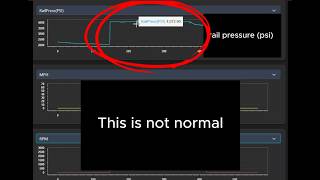
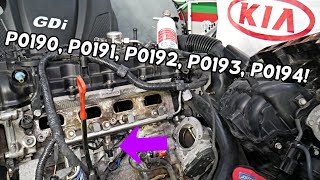
- Mechanical Pressure Test (Professional): If possible, connect a mechanical fuel pressure gauge to the high-pressure system to verify the actual pressure. Compare this reading to the scan tool's reported pressure. If the mechanical gauge shows correct pressure but the scan tool shows an incorrect value, the sensor or its wiring is the problem. If both show incorrect pressure, the issue is likely the HPFP or low-pressure pump. 🎬 Watch: A real-world example of Kia Stinger low fuel pressure issues.
- Isolate the Fault: Based on the previous steps, determine the faulty component. If the HPFP is under recall, have the dealer perform the fix. If the sensor is confirmed bad, proceed with replacement. If wiring is damaged, repair it.
Parts You'll Likely Need
- Fuel Rail Pressure Sensor
(OEM #35342-3L100)— This sensor is a common failure point in GDI systems and is responsible for reporting pressure to the ECM. An incorrect signal directly causes the P0191 code.
Trusted brands: Kia (OEM), Bosch
OEM price range: $100-$140
Aftermarket price range: $70-$120 - High-Pressure Fuel Pump (HPFP)
(OEM #35320-3L110 (or superseding part))— A known defect covered by recall SC281 for 2018-2021 models makes this a primary cause of fuel pressure issues on this vehicle.
Trusted brands: Kia (OEM)
OEM price range: $800-$1200 (Often covered by recall) - Intake Manifold Gasket Set
(OEM #29215-3L100, 28411-3L100)— These gaskets must be replaced when the intake manifold is removed to access the fuel rail pressure sensor to prevent vacuum leaks.
Trusted brands: Kia (OEM), Mahle
OEM price range: $40-$70
Aftermarket price range: $25-$50
Related Codes That Often Appear With This One
- P0088 — This code for 'Fuel Rail/System Pressure - Too High' is directly linked to the HPFP failure mode described in recall SC281, where the pump's plunger sticks and causes over-pressurization.
- P0087 — This code for 'Fuel Rail/System Pressure - Too Low' can appear if the HPFP is failing in a way that prevents it from building adequate pressure, or if the low-pressure pump is weak.
- P0171 — A lean condition code that can appear alongside P0191 when fuel pressure is inconsistent, as noted in NHTSA ODI #11597574.
Technical Service Bulletins (TSBs) & Recalls
- SC281: High-Pressure Fuel Pump Inspection/Replacement and ECM Software Upgrade. This safety recall addresses the most significant known cause for fuel pressure faults on the 2018-2021 Stinger.
Platform-Specific Known Issues
- Safety Recall Campaign SC281: Affects 18,224 2018-2021 Kia Stingers. A misaligned plunger in the high-pressure fuel pump can stick, causing over-pressurization and a potential loss of motive power. This is a critical issue to check for when diagnosing P0191.
- Diagnostic Challenges: As noted in NHTSA ODI #11682506 for a similar Kia model, some owners have reported that dealers may perform minimal investigation or claim certain recalls do not apply even when the P0191 code is actively displaying.
Mechanic-Grade Diagnostic Values
- High-Pressure Fuel System Pressure at Idle — expected: Approximately 40 bar (~580 PSI). Failure: Pressure is significantly lower (e.g., 4-5 bar), erratic, or does not increase with RPM.
- High-Pressure Fuel System Pressure Under Load — expected: Up to 200 bar (~2900 PSI). Failure: Actual pressure fails to meet the commanded pressure during acceleration.
- Fuel Rail Pressure Sensor (FRPS) Connector Voltage - Power — expected: Approximately 5V (Reference Voltage). Failure: Significantly lower or no voltage indicates a wiring or ECM issue.
- Fuel Rail Pressure Sensor (FRPS) Connector Voltage - Ground — expected: 0V. Failure: Any voltage reading indicates a bad ground connection.
- Fuel Rail Pressure Sensor (FRPS) Connector Voltage - Signal (Key On, Engine Off) — expected: Approximately 1V. Failure: Voltage is stuck at 0V, 5V, or is erratic.
Scan Tool Commands That Help
- Kia GDS (Global Diagnostic System) / KDS: Fuel System Actuation Test / Pump Activation — This function allows a technician to command the low-pressure and high-pressure pumps to run with the engine off. This is critical for isolating a pump failure from a sensor or wiring issue by observing if the pump runs and builds pressure when commanded directly.
- Kia GDS (Global Diagnostic System) / KDS: Flight Record / Trigger Module — For intermittent P0191 codes where the fault is not present in the shop, this function records vehicle data during a drive cycle. It can capture fuel pressure, sensor voltage, and other parameters at the exact moment the fault occurs, which is invaluable for diagnosing intermittent power loss or hesitation.
- Kia GDS (Global Diagnostic System) / KDS: ECU Upgrade — After replacing the High-Pressure Fuel Pump (HPFP), especially under the SC281 recall, an ECM software update is required. This update adjusts the limp-home mode logic and other parameters to work with the new hardware.
Wiring & Ground Locations
- Engine Ground Strap (91860-J5010) — Main ground strap connecting the engine block to the chassis.. A loose or corroded main engine ground can cause floating or erratic voltage readings on multiple sensors, including the fuel rail pressure sensor. This can lead to a P0191 code that is difficult to trace, as the sensor and its direct wiring may test good, but the ground reference for the entire system is unstable.
- FRPS Connector — On the fuel rail, located underneath the upper intake manifold.. This is the primary connection point for all voltage and signal tests for the Fuel Rail Pressure Sensor. It is a 3-pin connector: Pin 1 is 5V reference, Pin 2 is signal, and Pin 3 is ground (pinout may vary, confirm with a diagram). Due to its location, it is susceptible to heat damage.
- Ground Point GE02 — Located on the right front of the engine compartment.. While not exclusively for the fuel system, this is a major engine compartment ground point. A wiring diagram shows multiple systems using this ground, and corrosion or looseness here could cause difficult-to-diagnose electrical issues for various sensors.
Real Owner Repair Stories
- Kia Stinger Forum (2018 Kia Stinger GT) — Car went into limp mode, engine light came on.
❌ Tried (didn't work) The owner initially hesitated to take it to the dealer, hoping it was a minor issue.
✅ What actually fixed it The dealer diagnosed and replaced the high-pressure fuel pump (HPFP). The repair took an unusually long time (12 days) due to parts availability at the time. - NHTSA ODI #11597574 — An owner reported that their vehicle had codes P0171 and P0191 pop into the system for a third time, noting that after picking the car up, it "didn't feel right" immediately upon leaving the parking lot.
OEM Part Supersession History
35342-2B100→35342-2E500— Part revision or manufacturer change for the Fuel Rail Pressure Sensor.
Heads up: 35342-2E500 is the correct replacement for the earlier part number. Using old stock of 35342-2B100 is not recommended.Unknown→35320-3L110— This is the current OEM part number for the High-Pressure Fuel Pump for the 3.3L engine in many Kia applications, including the Stinger.
Heads up: While this part fits multiple vehicles (Cadenza, Sedona, Sorento), it is critical to confirm the exact part number for the Stinger via VIN, as there may be subtle differences. The recall (SC281) part may have a different number entirely.
Model Year Variations Within This Range
- 2022-2023: For the 2022 model year facelift, the 3.3L V6 engine received a variable exhaust system which resulted in a minor power increase from 365 hp to 368 hp. While this change is primarily exhaust and software-related and unlikely to directly affect the P0191 cause, it's a known difference. The infotainment screen and logos were also updated.
- 2018: A separate recall (SC170) was issued for some 2018 models concerning the front wiring harness. A sharp edge on the fender apron panel could chafe wires, potentially causing shorts or open circuits for various engine bay components. While not directly linked to P0191 in the TSB, such a wiring issue could theoretically affect sensor circuits and should be investigated on 2018 models.
Diagnostic Flowchart
Other Known Issues on This Vehicle
Issues unrelated to this code that are worth knowing about as an owner of this generation:
- Premature Paint Peeling/Chipping 🟠 Medium — Commonly reported, especially on bumpers and with specific colors like Micro Blue and Sunset Yellow. Often appears within the first 3 years/36,000 miles. (Ref: Covered under Kia's 3-year/36k-mile paint warranty, though owners report mixed success with claims.)
- Leaking Turbocharger Oil Feed Pipe 🔴 High — Widespread enough to trigger a safety recall (SC300 / NHTSA 24V-169) for 2018-2023 models. (Ref: Recall SC300 / NHTSA 24V-169)
- Brake Judder / Warped Rotors 🟡 Low — Frequently mentioned by owners, who report steering wheel vibration under braking. Often attributed to the stock Brembo pads and rotors being prone to warping.
- Hatch/Trunk Rattle 🟡 Low — A very common complaint. Usually caused by loose cargo cover components or adjustable bump stops that need tightening or modification.
- Failing Water Pump/Thermostat Housing 🟠 Medium — Some owners have reported coolant leaks from the water pump or thermostat housing area, sometimes leading to overheating or abnormal fan behavior.
- Anti-lock Brake (HECU) Module Fire Risk 🔴 High — A recall was issued for potential electrical shorts in the Hydraulic Electronic Control Unit (HECU) that could cause an engine compartment fire, even when the car is off. (Ref: NHTSA 20V-518 / Kia Recall SC197)
Used vs. New Parts: Buying Guide for This Vehicle
When a used part is the smart pick: For this specific repair, using used parts is generally not recommended. The key components (HPFP and FRPS) are known failure points. A used part may have significant wear and could fail shortly after installation, negating any cost savings.
Donor-vehicle mileage cap: roughly under 40000 miles for the part to have meaningful remaining life.
What to inspect on the donor part:
- If considering a used part is unavoidable, source it from a vehicle with the lowest possible mileage.
- Obtain a vehicle history report for the donor car to check for accident history that could have damaged components.
- Visually inspect electrical connectors for corrosion, melting, or bent pins.
- For an HPFP, check for any signs of external leaks or physical damage.
OEM-only on this vehicle (don't cheap out):
- High-Pressure Fuel Pump (HPFP)
- Fuel Rail Pressure Sensor (FRPS)
- Intake Manifold Gaskets
Aftermarket brands forum-validated for this vehicle:
- Bosch (Often the OEM supplier for fuel system components like the FRPS)
Brands owners have reported issues with on this vehicle:
- Unbranded, no-name sensors and pumps from online marketplaces should be avoided. The failure rate is high, and incorrect readings can lead to poor performance or further engine damage.
Real Owner Stories
Aggregated from forums and TSBs cited above. Mileages and costs reflect what owners reported in those sources.
2019 Genesis G70 3.3L Twin-Turbo V6
Symptoms: Intermittent P0191 code accompanied by RPM stuttering.
What fixed it: The issue was addressed via the high-pressure fuel pump recall (Hyundai recall 262 / 023G), which is the same platform-mate fix as the Stinger's SC281 recall.
Source hint: r/GenesisG70 - 'Strange Check Engine Light'
Related OBD-II Codes
Frequently Asked Questions
Is there a recall for the fuel pressure issues on my 2018-2021 Kia Stinger?
What will the dealer do to fix the P0191 code under the SC281 recall?
My Stinger is entering 'limp mode' and stalling; could this be the fuel rail pressure sensor?
How much does it cost to replace the fuel rail pressure sensor on a 3.3L Stinger if it's not under warranty?
Can a wiring issue cause the P0191 code on the 3.3L Twin-Turbo V6?
What should the fuel rail pressure be at idle for the 3.3L engine?
Helpful Videos
Used OEM Parts in Stock


New Aftermarket Parts Available


The information in this article is provided for general reference and educational purposes only. Vehicle specifications, procedures, and part compatibility can vary by production date, trim level, and region. Always consult your vehicle's factory service manual and verify part numbers before purchasing or performing repairs. Safety-critical components such as airbags, seat belts, and braking systems should be installed by a qualified professional.
- Kia Stinger:
- 🎬 Helpful Videos
- 🛍️ Shop This Part
- What's Unique About the 2018-2023 Kia Stinger
- Symptoms You May Notice
- Most Likely Causes
- Rare But Worth Checking
- Diagnosis Steps
- Parts You'll Likely Need
- Related Codes That Often Appear With This One
- Technical Service Bulletins (TSBs) & Recalls
- Platform-Specific Known Issues
- Mechanic-Grade Diagnostic Values
- Scan Tool Commands That Help
- Wiring & Ground Locations
- Real Owner Repair Stories
- OEM Part Supersession History
- Model Year Variations Within This Range
- Diagnostic Flowchart
- Other Known Issues on This Vehicle
- Used vs. New Parts: Buying Guide for This Vehicle
- Real Owner Stories
- 2019 Genesis G70 3.3L Twin-Turbo V6
- Related OBD-II Codes
- Frequently Asked Questions
- 🎟️ Get 5% Off