

P0191 on 2016-2018 Jaguar XF: Fuel Rail Pressure Sensor Causes and Fixes for 2.0L and 3.0L Engines
On a 2016-2018 Jaguar XF, code P0191 usually points to a faulty fuel rail pressure sensor, especially on the 2.0L Ingenium petrol engine. However, a critical Jaguar TSB (SSM73960.2) suggests a PCM software update may be the first required fix for a P0191-85 sub-code before replacing parts. If the sensor is faulty, expect to pay $50-$180 for the part. The fix is straightforward for DIYers, involving checking wiring, relieving fuel pressure, and replacing the sensor.
- P0191 on a 2016-2018 Jaguar XF indicates a problem with the fuel rail pressure sensor's signal.
- For the 2.0L Ingenium petrol engine, check for a required PCM software update per TSB SSM73960.2 before replacing any parts.
- The most common hardware cause is a faulty fuel rail pressure sensor, followed by wiring issues, particularly the ground wire.
- While you can drive, expect reduced power ('limp mode') and potential stalling.
What's Unique About the 2016-2018 Jaguar XF
For the second-generation (X260) Jaguar XF, particularly with the 2.0L Ingenium petrol engine (AJ20P4), the P0191 code is a commonly discussed issue. The key differentiator is Jaguar's Technical Service Bulletin (SSM73960.2), which addresses a specific sub-code, P0191-85 (Signal Invalid). Initially, Jaguar stated this could be a 'false flag' caused by incorrect PCM calibration, recommending a software update as the primary action before parts replacement. This suggests a pattern of software-related issues recognized by the manufacturer, making a systematic diagnosis that starts with checking software status crucial. The issue is also prevalent on platform mates like the Jaguar XE and F-Pace with the same engine.
Diagnostic Flowchart
Tap your situation to follow the diagnostic path that matches what you're seeing on this vehicle.
Symptoms You May Notice
- Reduced engine performance or 'limp mode'
- Check Engine Light (MIL) is illuminated
- Engine stuttering, hesitation, or misfiring during acceleration
- Difficulty starting the engine or long crank times
- Engine stalling, sometimes after a few minutes of driving
- Reduced fuel economy
- Car struggles to accelerate past a certain speed or RPM
- Replacing the fuel rail pressure sensor when the actual issue is a required PCM software update as per TSB SSM73960.2.
- Replacing the fuel pump when the issue is a simple clogged fuel filter or a faulty sensor.
- Replacing fuel injectors without verifying that fuel pressure is the actual root cause.
- Overlooking a simple wiring or ground issue and replacing the sensor unnecessarily.
Most Likely Causes
- Faulty Fuel Rail Pressure Sensor 🔴 High Probability The sensor is a common failure point discussed in owner forums and is the primary subject of repair guides for this code on the XF and its platform mates. However, it is often misdiagnosed when a software update is the real fix.
How to confirm: After checking wiring and verifying PCM software is up-to-date, test the sensor's voltage output with a multimeter to see if it's within the manufacturer's specified range. An OBD-II scanner with live data can also show if pressure readings are erratic or illogical. One user noted normal pressure around 300+ kPa, which dropped below 150 kPa when the fault occurred.
Typical fix: Replace the fuel rail pressure sensor. First, relieve fuel pressure via the Schrader valve on the fuel rail. Then, disconnect the electrical connector, remove the mounting bolt(s), and swap the sensor, ensuring O-rings are properly lubricated and seated.
Est. part cost: $50-$180 - Damaged Wiring or Connectors 🟡 Medium Probability The wiring harness to the sensor is exposed to significant engine heat, which can cause insulation to become brittle and wires to corrode or break over time. A forum member reported fixing their P0191 code by repairing a faulty ground (earth) wire to the sensor.
How to confirm: Visually inspect the wiring harness and connector leading to the fuel rail pressure sensor for any signs of fraying, melting, corrosion, or loose pins. Perform a continuity test on the signal, reference voltage, and ground wires between the sensor connector and the PCM.
Typical fix: Repair or replace the damaged section of the wiring harness or the connector itself. Ensure the ground connection is clean and secure.
Est. part cost: $10-$100 - Clogged Fuel Filter ⚪ Low Probability A restricted fuel filter can cause low or fluctuating fuel pressure, which the PCM may interpret as a sensor performance issue, especially under high demand. One owner on a forum noted that changing the fuel filter immediately triggered codes P0191 and P1338, suggesting an improperly installed or faulty new filter can also cause issues.
How to confirm: Test the fuel pressure at the rail. If it is below specifications and does not respond correctly to demand, a clogged filter is a suspect. Check the vehicle's service history, as this is an often-overlooked maintenance item.
Typical fix: Replace the fuel filter. Ensure the new filter is installed in the correct direction of flow.
Est. part cost: $40-$80
Rare But Worth Checking
- Failing Fuel Pump: While less common than the sensor, a weak or failing fuel pump can cause inconsistent pressure, mimicking a sensor fault. In a detailed forum thread for a similar Jaguar model, an owner chased a P0191 code by replacing the filter and sensor, but the ultimate culprit was a failing fuel pump that provided low pressure (around 250 kPa instead of 350+ kPa).
- Powertrain Control Module (PCM) Issue: In some cases, the fault may lie with the PCM itself. Jaguar TSB LTB01245NAS3 for platform mates specifically notes that an incorrect PCM calibration can cause a 'false flag' of DTC P0191-85, requiring a software update. This should be the first check on affected 2.0L Ingenium engines before replacing any hardware.
Diagnosis Steps
- Scan the vehicle for all stored trouble codes. Note if the code is specifically P0191-85 and if any other codes mentioned in TSB SSM73960.2 (P168F-00, P2178-00, P144C-00) are present.
- For 2.0L Ingenium engines, the first step is to check with a dealer or authorized shop if the PCM software is up-to-date, per TSBs SSM73960.2 and LTB01245NAS3. Do not replace parts before verifying the software status.
- Using a scan tool with live data, monitor the fuel rail pressure reading (FRP). Observe if the reading is erratic, stuck, or illogical for the engine's state (e.g., reading high pressure with the engine off). Compare readings to known good values (e.g., ~300-380 kPa for low pressure systems, or ~40 bar / 580 PSI at idle for GDI high pressure systems).
- Perform a thorough visual inspection of the fuel rail pressure sensor's wiring and connector. Look for damage, corrosion, or loose connections. Pay special attention to the ground wire.
- If wiring appears intact, test the sensor's circuit. Check for the correct reference voltage (typically 5V) and a solid ground at the connector.
- If the circuit is good, test the sensor itself. This can be done by comparing the live data pressure reading with a manual pressure gauge, or by back-probing and testing the sensor's output voltage.
- If the sensor and wiring are confirmed to be good, investigate other fuel system components. Check the fuel filter for restrictions and test the fuel pump's performance and delivery volume.
- As a temporary measure noted in the TSB, an ignition cycle (off for ~1 minute) may clear the reduced performance symptom. This further points to a potential software or intermittent sensor issue.
Parts You'll Likely Need
- Fuel Rail Pressure Sensor
(OEM #Verify with VIN; Example for 2.0L Petrol is Bosch W0133-3047663)— This is the most frequent hardware failure point for code P0191 on this platform, as indicated by repair guides and owner forums, but should only be replaced after checking for software updates.
Trusted brands: Bosch, Denso, Genuine Jaguar
OEM price range: $100-$180
Aftermarket price range: $50-$120
Related Codes That Often Appear With This One
- P168F-00 — Cited in Jaguar TSB SSM73960.2 as a potentially co-occurring code with P0191-85 on the AJ20P4 engine.
- P2178-00 — Cited in Jaguar TSB SSM73960.2 as a potentially co-occurring code with P0191-85.
- P144C-00 — Cited in Jaguar TSB SSM73960.2 as a potentially co-occurring code with P0191-85.
- P0087 — This code indicates 'Fuel Rail/System Pressure - Too Low' and can be a related symptom if the underlying cause is a failing fuel pump or clogged filter.
- P1338 — A forum user reported this code ('Fuel Pump drive circuit low/high voltage') appeared alongside P0191 after changing a fuel filter, pointing towards a fuel delivery system issue rather than just the sensor.
Technical Service Bulletins (TSBs) & Recalls
- SSM73960.2: Notes that customers may report reduced performance with P0191-85 stored in the PCM, potentially with other codes like P168F-00, P2178-00, or P144C-00. Initially suggested a software update was the intended fix.
- LTB01245NAS3: A related TSB for Land Rover models with the same Ingenium I4 2.0L Petrol engine, also for code P0191-85. It explicitly states the cause may be an 'incorrect PCM calibration causing a false flag'.
Platform-Specific Known Issues
- Jaguar issued Technical Service Bulletin #SSM73960.2 for 2016-2018 models with the AJ20P4 (2.0L Petrol) engine, which directly addresses customer reports of reduced performance associated with DTC P0191-85. The bulletin initially stated a PCM calibration was in development and that parts should not be replaced without further diagnosis, suggesting a software fix may be required.
Mechanic-Grade Diagnostic Values
- Fuel Rail Pressure (High Pressure GDI) at Idle — expected: ~40 bar (~580 PSI). Failure: Pressure is significantly lower, higher, or erratic at a steady idle.
- Fuel Rail Pressure (High Pressure GDI) at Startup — expected: ~2100 PSI (approx. 145 bar). Failure: Significantly lower pressure on startup, may cause long crank times.
- Fuel Rail Pressure Sensor Reference Voltage — expected: 5 Volts. Failure: Voltage is significantly lower than 5V or absent, indicating a wiring or PCM issue.
- Fuel Rail Pressure Sensor Signal Voltage — expected: Typically ~0.5V with pressure relieved and up to ~4.5V at maximum pressure.. Failure: Voltage is stuck high, low, or does not change smoothly as engine RPM and load change.
Hidden / Shadow Codes Worth Checking
- P0191-85: Indicates 'Signal Invalid'. This specific sub-code is the primary focus of Jaguar TSBs for the 2.0L Ingenium engine and strongly suggests the root cause is an incorrect PCM software calibration creating a 'false flag', rather than a hardware fault. (see via A professional scan tool capable of reading manufacturer-specific sub-codes, such as the JLR SDD or Pathfinder systems.)
Scan Tool Commands That Help
- JLR Pathfinder (or SDD for earlier models): Update ECU (for Powertrain Control Module) — This is the primary repair step recommended by Jaguar TSB JTB00659NAS2/3/4 for code P0191-85 on affected Ingenium engines. It flashes the PCM with a corrected software calibration.
- JLR Pathfinder / SDD: Powertrain control module adaption clear — This function should be used after replacing a fuel system component like the pressure sensor or fuel pump to reset the PCM's learned fuel trim and pressure values, as noted in TSB SSM73960.
- JLR Pathfinder / SDD / Advanced Generic OBD-II: Fuel System Test / Bi-directional control of fuel components — Allows a technician to command the fuel pump on and monitor the pressure response to diagnose if the pump is weak or if the control module is functioning correctly, without having to physically access the components.
Real Owner Repair Stories
- iCarsoft US User Example (Jaguar XF (year not specified, but within platform)) — Limp mode and hesitation with code P0191.
❌ Tried (didn't work) Visual inspection of wiring showed no damage.
✅ What actually fixed it The owner replaced the fuel rail pressure sensor with an OEM part and cleared the codes, which immediately resolved the issue. - Jaguar Forums user (Jaguar with NA V8 (different engine, but relevant tip)) — Erratic acceleration and P0193 (high pressure).
✅ What actually fixed it Replacing the fuel rail pressure sensor. A key tip shared was that letting the car sit overnight was sufficient to depressurize the fuel rail, making the sensor replacement possible without needing to find and operate the Schrader valve, which can be in an awkward location.
"I Checked Everything" — The Actual Cause
- The most common scenario fitting this pattern for a P0191-85 on the 2.0L Ingenium engine is not a physical leak a smoke test would find, but a software issue. Technicians may replace the sensor, check all wiring, and find no faults, only to have the code return. The actual cause is an incorrect PCM calibration that falsely flags the code, which can only be fixed with a software update from a JLR dealer or specialist with Pathfinder.
Model Year Variations Within This Range
- 2016-2018: The diagnostic software used by dealers changed during this period. Earlier models (approx. 2016-2017) are typically serviced with the Symptom Driven Diagnostics (SDD) tool, while later models (approx. 2017-onward) require the newer Pathfinder diagnostic system. This is important when seeking a software update, as the correct tool must be used.
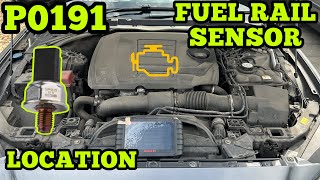
Helpful Videos
We Have This Part in Stock




The information in this article is provided for general reference and educational purposes only. Vehicle specifications, procedures, and part compatibility can vary by production date, trim level, and region. Always consult your vehicle's factory service manual and verify part numbers before purchasing or performing repairs. Safety-critical components such as airbags, seat belts, and braking systems should be installed by a qualified professional.
- Jaguar XF:
- 🎬 Helpful Videos
- 🛍️ Shop This Part
- What's Unique About the 2016-2018 Jaguar XF
- Diagnostic Flowchart
- Symptoms You May Notice
- Most Likely Causes
- Rare But Worth Checking
- Diagnosis Steps
- Parts You'll Likely Need
- Related Codes That Often Appear With This One
- Technical Service Bulletins (TSBs) & Recalls
- Platform-Specific Known Issues
- Mechanic-Grade Diagnostic Values
- Hidden / Shadow Codes Worth Checking
- Scan Tool Commands That Help
- Real Owner Repair Stories
- "I Checked Everything" — The Actual Cause
- Model Year Variations Within This Range
- 🎟️ Get 5% Off