

P0191 on 2018-2019 Jaguar E-PACE: Fuel Rail Pressure Sensor Causes and Fixes
On a 2018-2019 Jaguar E-PACE with the 2.0L Ingenium petrol engine, the diagnostic trouble code P0191, specifically P0191-85, is most often caused by a faulty Powertrain Control Module (PCM) software calibration. A Jaguar dealer must perform a software update as outlined in TSB JTB00659NAS3. This should be the first step before any parts are replaced. If the software is current, the next most likely cause is a failing fuel rail pressure sensor.
- For a 2018-2019 E-PACE, P0191-85 is very likely a software issue that a Jaguar dealer must fix with a PCM update per TSB JTB00659NAS3.
- Do not replace any parts until the PCM software has been verified to be the latest version by a dealer.
- If the software is current, the next most likely cause is a faulty fuel rail pressure sensor (OEM Part No. AJ813994).
- This exact software issue also affects the Jaguar F-Pace, XE, and several Land Rover models with the same 2.0L Ingenium petrol engine.
What's Unique About the 2018-2019 Jaguar E-PACE
For the 2018-2019 Jaguar E-PACE with the 2.0L Ingenium petrol engine, this code is frequently a 'ghost' code caused by a software glitch. Jaguar has issued Technical Service Bulletin JTB00659NAS3 (and later revisions) acknowledging that an incorrect PCM calibration can falsely trigger the specific sub-code P0191-85 ('Signal bias/out of range'). This issue is so prevalent that it also affects other JLR vehicles with the same engine. Before replacing any parts, it is critical to check if this software update has been performed, as it is the most common and specific fix for this platform.
Diagnostic Flowchart
Tap your situation to follow the diagnostic path that matches what you're seeing on this vehicle.
Symptoms You May Notice
- Reduced engine performance or 'limp mode'.
- Check Engine Light (Malfunction Indicator Lamp or MIL) may be on.
- Engine stuttering or hesitation, especially under load or during acceleration.
- Engine may stall, sometimes after driving for a period and then refusing to restart until it cools.
- Difficulty starting the engine.
- Reduced fuel efficiency.
- Replacing the fuel rail pressure sensor before checking for the required PCM software update. The TSB from Jaguar makes the software check the primary diagnostic step for the P0191-85 code.
- Replacing the fuel pump when the issue is actually the fuel rail pressure sensor providing incorrect data to the PCM.
Most Likely Causes
- Incorrect Powertrain Control Module (PCM) Software 🔴 High Probability Jaguar identified this as a specific issue and released TSB JTB00659NAS3 to address it. The bulletin explicitly states the code P0191-85 can be falsely flagged due to incorrect PCM calibration.
How to confirm: A Jaguar dealer or a qualified shop with Jaguar's diagnostic equipment (PATHFINDER, loaded with version 208 or later) can check the current software version and see if the update from JTB00659NAS3 or its successors is applicable and has been performed.
Typical fix: Update the Powertrain Control Module (PCM) software to the latest version. The TSB outlines this as a warranty-covered repair.
Est. part cost: $0 - Faulty Fuel Rail Pressure Sensor 🟡 Medium Probability This sensor operates in a high-heat, high-pressure environment and can fail over time, leading to erratic readings. It is the most common hardware failure after the software issue is ruled out.
How to confirm: With the software confirmed to be up-to-date, a technician can monitor the sensor's voltage reading with a scan tool. If the readings are erratic, frozen, or do not correspond to actual fuel pressure (which can be measured with a mechanical gauge for comparison), the sensor is likely faulty. A failed sensor might default to a reading of 55.11 psi.
Typical fix: Replace the fuel rail pressure sensor.
Est. part cost: $80-$200 - Wiring or Connector Issue ⚪ Low Probability The wiring harness to the sensor is exposed to engine heat and vibration, which can cause wires to become brittle, corroded, or damaged over time. Owners on forums have reported fixing the issue by repairing a faulty ground wire to the sensor.
How to confirm: Visually inspect the wiring and connector for any signs of damage, corrosion, or loose pins. A multimeter can be used to check for continuity, proper voltage, and ground at the sensor connector.
Typical fix: Repair or replace the damaged section of the wiring harness or the connector.
Est. part cost: $10-$150
Rare But Worth Checking
- Failing High-Pressure Fuel Pump (HPFP) or Low-Pressure Fuel Pump (LPFP): While less common for this specific code (which points to a sensor *performance* issue), a weak or failing fuel pump can cause fuel pressure to be genuinely out of range, which the sensor will accurately report. This would be a mechanical failure rather than a sensor or software fault.
- Clogged Fuel Filter: A restricted fuel filter can impede fuel flow, causing pressure to drop below the expected range, especially under load. This can trigger a P0191 code.
Diagnosis Steps
- Connect a Jaguar-compatible OBD-II scanner to the vehicle.
- Verify the code is P0191 and check for the '-85' suffix. If P0191-85 is present, immediately check for TSB JTB00659NAS3 applicability.
- If the PCM software is outdated, have a dealer perform the update. This is the most critical first step and often resolves the issue.
- If the software is up-to-date, clear the codes and test drive the vehicle to see if P0191 returns.
- If the code returns, use a scan tool to monitor the live data from the fuel rail pressure sensor. Look for readings that are erratic, frozen, or don't change logically with engine RPM and load.
- Visually inspect the fuel rail pressure sensor's wiring harness and connector for any visible damage, corrosion, or loose connections. Pay close attention to the ground wire.
- Test the sensor's circuit for proper voltage, ground, and signal using a multimeter according to the vehicle's service manual specifications.
- If wiring is intact and data is erratic, the fuel rail pressure sensor is the most likely culprit and should be replaced.
- If sensor readings seem plausible but the code persists, the issue may be mechanical. Test the low-pressure and high-pressure fuel pumps to ensure the actual fuel pressure is within specification. Check for a clogged fuel filter.
Parts You'll Likely Need
- Fuel Rail Pressure Sensor
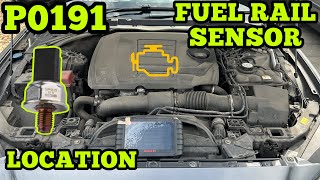
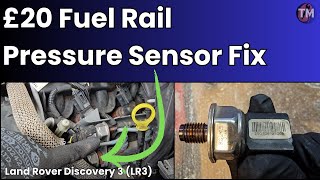
(OEM #AJ813994 (supersedes AJ813639, AJ813066))— This is the most common hardware failure after the software issue is ruled out. It directly provides the reading that the PCM is flagging 🎬 See this walkthrough for replacing a faulty fuel rail pressure sensor as out of range.
Trusted brands: Bosch, Genuine Jaguar
OEM price range: $150-$220
Aftermarket price range: $80-$150
Related Codes That Often Appear With This One
- P168F-00 — This Jaguar-specific code is mentioned in TSBs SSM74092 and SSM73960.2 alongside P0191, often relating to fuel control module communication issues.
- P2178-00 — This code for 'System Too Rich Off Idle' is also cited in the same TSBs. An incorrect fuel pressure reading from the P0191 fault can cause the PCM to command an incorrect fuel mixture, leading to a rich condition.
- P144C-00 — Mentioned in TSBs with P0191 and P2178, often related to air intake or evaporative emissions system issues that can indirectly affect the air-fuel mixture calculations.
Technical Service Bulletins (TSBs) & Recalls
- JTB00659NAS3: States the engine MIL may be on with P0191-85 stored due to an incorrect PCM calibration, requiring a software update.
- SSM74092: Notes that customers may report reduced performance with P0191-85, possibly without a check engine light, and potentially with codes P168F-00, P2178-00, or P144C-00.
- SSM73960.2: Contains similar information to SSM74092 regarding reduced performance and associated trouble codes.
Platform-Specific Known Issues
- A known software glitch in the Powertrain Control Module (PCM) can cause a false P0191-85 code, as documented in Jaguar Technical Service Bulletin JTB00659NAS3 and its subsequent revisions.
- TSBs SSM74092 and SSM73960.2 also document this code in conjunction with reduced performance, indicating it's a recognized issue on this platform.
Mechanic-Grade Diagnostic Values
- Fuel Rail Pressure Sensor (Signal Wire Voltage, KOEO) — expected: Approx. 0.5V - 1.8V. Failure: A reading of 0V or a static 5V suggests a wiring issue or failed sensor. A reading stuck at a high value (e.g., 4.8V) even with the engine running points to a bad sensor.
- Fuel Rail Pressure Sensor (Reference Wire Voltage, KOEO) — expected: 5V. Failure: Significantly lower or no voltage indicates a problem with the PCM or the wiring from the PCM.
- Fuel Rail Pressure Sensor (Ground Wire Voltage Drop) — expected: < 100mV (ideally < 50mV). Failure: High voltage reading indicates a poor ground connection, which can cause incorrect sensor readings.
- High-Pressure Fuel Rail (at idle) — expected: Approx. 500-600 PSI. Failure: Pressure that is significantly lower or wildly fluctuating can indicate a failing high-pressure fuel pump (HPFP) or a leak.
- High-Pressure Fuel Rail (at startup) — expected: Approx. 2,000+ PSI. Failure: Failure to build high pressure on startup can indicate issues with the low-pressure pump feeding the HPFP, or the HPFP itself.
Hidden / Shadow Codes Worth Checking
- P0191-85: Signal Bias Level Out of Range / Signal Invalid. This specific sub-type is explicitly mentioned in Jaguar TSBs as being caused by a PCM software calibration error. (see via Jaguar dealer-level diagnostic tools like SDD or Pathfinder, or advanced aftermarket scanners capable of reading manufacturer-specific sub-codes.)
Scan Tool Commands That Help
- JLR Pathfinder / SDD: Fuel System Test / Relative Injector Flow Test — To functionally test components of the fuel system after ruling out the software bug and checking sensor wiring. Can help identify a weak fuel pump or failing injector.
- JLR Pathfinder / SDD: Reset Mixture Adaptation — This should be performed after replacing a fuel system component (like the sensor or pump) or after a PCM software update to clear the old learned fuel trim values and allow the system to re-adapt.
- JLR Pathfinder / SDD: ECU Software Update — This is the primary repair step if the vehicle's software is outdated and TSB JTB00659NAS3 applies.
Wiring & Ground Locations
- Fuel Rail Pressure Sensor — Located on the high-pressure fuel rail, on top of the 2.0L Ingenium engine. The engine cover must be removed for access.. This is the sensor generating the signal that the PCM has flagged as out of range. Physical access is required for inspection, testing, and replacement.
- Sensor Connector — Directly on the fuel rail pressure sensor. It is a multi-pin connector (likely 4-pin for the Ingenium engine's combined pressure/temp sensor).. This is the most common point for wiring failures due to heat and vibration. It must be checked for corrosion, damage, and secure connection. Voltage and ground tests are performed at this connector.
Real Owner Repair Stories
- iCarsoft User Example (Jaguar XF with 2.0L Petrol (same engine family)) — Limp mode and hesitation with code P0191.
❌ Tried (didn't work) N/A, went straight to diagnosis.
✅ What actually fixed it After inspecting the wiring and finding no damage, the owner replaced the fuel rail pressure sensor with an OEM part and cleared the codes, which resolved the issue immediately. - Carly Forum User (2020 Jaguar E-Pace Hybrid) — Stalling, power loss, especially when idling or during warm-up. Check engine light was on.
❌ Tried (didn't work) Initial suspicion was on the fuel pressure regulator.
✅ What actually fixed it The problem was noticeably worse when the fuel tank was below half full. This pointed to the low-pressure in-tank fuel pump. A complete fuel pump replacement resolved the stalling and performance issues.
OEM Part Supersession History
AJ813066, AJ813639→AJ813994— Likely an internal revision for improved reliability or accuracy.
Heads up: The 2.0L Ingenium engine uses a 4-pin combined pressure/temperature sensor. Be cautious not to use older 3-pin sensors from different engine families, even if they physically fit.AJ813994 (Jaguar)→0261545161 (Bosch)— Bosch is a known OEM supplier for this part.
Model Year Variations Within This Range
- 2018-2019: The E-PACE was offered in different power outputs, such as P250 (246 hp) and P300 (296 hp), but both use the same 2.0L Ingenium petrol engine architecture. The P0191 fault and its primary cause (PCM software) are common to both versions within this model year range.
Helpful Videos
We Have This Part in Stock

The information in this article is provided for general reference and educational purposes only. Vehicle specifications, procedures, and part compatibility can vary by production date, trim level, and region. Always consult your vehicle's factory service manual and verify part numbers before purchasing or performing repairs. Safety-critical components such as airbags, seat belts, and braking systems should be installed by a qualified professional.
- Jaguar E-PACE:
- 🎬 Helpful Videos
- 🛍️ Shop This Part
- What's Unique About the 2018-2019 Jaguar E-PACE
- Diagnostic Flowchart
- Symptoms You May Notice
- Most Likely Causes
- Rare But Worth Checking
- Diagnosis Steps
- Parts You'll Likely Need
- Related Codes That Often Appear With This One
- Technical Service Bulletins (TSBs) & Recalls
- Platform-Specific Known Issues
- Mechanic-Grade Diagnostic Values
- Hidden / Shadow Codes Worth Checking
- Scan Tool Commands That Help
- Wiring & Ground Locations
- Real Owner Repair Stories
- OEM Part Supersession History
- Model Year Variations Within This Range
- 🎟️ Get 5% Off