

P0191 on 2016-2018 GMC Canyon: Fuel Rail Pressure Sensor Causes and Fixes
P0191 on a 2016-2018 GMC Canyon typically indicates a faulty Fuel Rail Pressure (FRP) sensor, its wiring, or fuel system contamination. Replacing the sensor is a common fix, costing around $85 for an OEM part. However, multiple GM Technical Service Bulletins (TSBs), including #PIP5151F and #20-NA-197, strongly advise investigating for fuel contamination and connector corrosion before replacing expensive components like the high-pressure fuel pump.
- P0191 on your GMC Canyon means there's a problem with the fuel rail pressure sensor's signal.
- The most common fix is replacing the Fuel Rail Pressure (FRP) sensor, but don't overlook wiring issues.
- Before replacing parts, be aware of GM Technical Service Bulletin #PIP5151F, which points to fuel contamination as a potential root cause.
- Symptoms can be severe, including stalling and no-start conditions, so addressing this code promptly is important.
- Using a scan tool to watch live fuel pressure data is a key step in diagnosing the problem correctly.
What's Unique About the 2016-2018 Gmc CANYON

For this generation of GMC Canyon with gasoline direct injection (GDI) engines, the fuel system is more complex, operating at much higher pressures (up to 2,800 PSI) than older port-injection systems. A key issue highlighted by General Motors is the potential for fuel system contamination, which can trigger a P0191 code. A specific Technical Service Bulletin (TSB), #PIP5151F, was issued for these vehicles, advising technicians to inspect for and clean out fuel system contamination if this code is present along with symptoms like hard starting or rough running. Another TSB, #20-NA-197, points to corrosion at the fuel pressure sensor electrical connector as a potential cause for P0191 and other related fuel codes on these trucks.
Diagnostic Flowchart

Tap your situation to follow the diagnostic path that matches what you're seeing on this vehicle.
Symptoms You May Notice
- Check Engine Light is on
- Hard starting or no-start condition
- Engine runs rough or idles poorly
- Engine stalling, especially under load
- Hesitation during acceleration
- Reduced engine power (limp mode)
- Poor fuel economy
- Abnormal smell from exhaust emissions
- Replacing the in-tank low-pressure fuel pump when the issue is with the high-pressure fuel system (sensor, high-pressure pump, or wiring).
- Replacing the Fuel Rail Pressure Sensor without first checking for fuel contamination as suggested by TSB #PIP5151F or connector corrosion as per TSB #20-NA-197.
- Replacing the High-Pressure Fuel Pump (HPFP) before verifying the low-pressure fuel system and FPCM are functioning correctly.
Most Likely Causes

- Faulty Fuel Rail Pressure (FRP) Sensor 🔴 High Probability The sensor provides a critical data point for the GDI system. Electronic sensors can fail over time due to heat cycles and vibration. Its location on the fuel rail, sometimes under the intake manifold, exposes it to harsh conditions.
How to confirm: Use a scan tool to monitor live data for Fuel Rail Pressure. At idle, a healthy 3.6L LGZ engine should show around 500-600 PSI. If the reading is erratic, stuck at a default value, or doesn't match a reading from a mechanical fuel pressure gauge, the sensor is likely bad. The sensor is located at the back of the driver's side fuel rail, underneath the intake manifold.
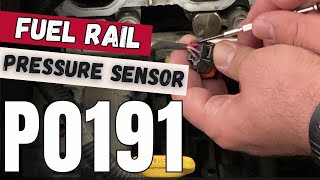
Typical fix: Replace the Fuel Rail Pressure sensor. This often requires removing the upper intake manifold for access. 🎬 Watch: Step-by-step guide to replacing the sensor on a 3.6L engine.
Est. part cost: $60-$90 - Damaged Wiring or Connector for FRP Sensor 🟡 Medium Probability The wiring harness in the engine bay is exposed to heat and vibration. GM TSB #20-NA-197 specifically calls out corrosion and damage at the fuel pressure sensor connector as a cause for P0191 on the 2016-2021 Canyon/Colorado.
How to confirm: Visually inspect the FRP sensor's connector and wiring harness for any signs of damage, corrosion (green or black residue), or loose connections. The TSB advises using a terminal test kit with dielectric grease to check for fretting corrosion inside the connector terminals.
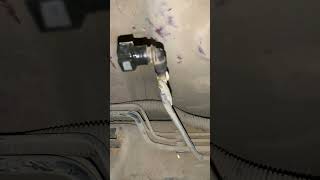
Typical fix: Clean the connector pins with electrical contact cleaner and apply dielectric grease. If damage or corrosion is found, replace the connector pigtail (GM Part #19367009 as per TSB #20-NA-197). 🎬 Watch: A quick look at the Colorado fuel rail pressure sensor.
Est. part cost: $15-$50 - Fuel System Contamination 🟡 Medium Probability As noted in TSB #PIP5151F, contamination from sources like water, debris, or incorrect fluids in the fuel system is a known issue for these vehicles and can cause erratic pressure readings by affecting the fuel pressure regulators or pump.
How to confirm: A fuel sample needs to be taken and inspected for debris, water, or other contaminants. The TSB shows examples of rust from water or contamination from Diesel Exhaust Fluid (DEF) on fuel pressure regulators. Placing a fuel sample in a styrofoam cup can help identify gasoline contamination, as it will melt the cup.
Typical fix: If contamination is found, the entire fuel system needs to be thoroughly cleaned, which may include flushing the tank, lines, and replacing the fuel filter. GM notes that damage caused by contaminated fuel may not be covered by warranty.
Est. part cost: $20-$100 (for filters and cleaning agents), but can be much higher if components need replacement. - Failing High-Pressure Fuel Pump (HPFP) ⚪ Low Probability The high-pressure pump is a mechanical component that can wear out. While listed as low probability for P0191 alone, it's a known failure point on the 3.6L V6. A Reddit user with a similar GM engine reported a mechanic diagnosing a bad HPFP after observing a 1000 PSI pressure drop under load.
How to confirm: Monitor desired versus actual fuel rail pressure with a scan tool, especially under heavy load or acceleration. If the actual pressure consistently drops well below the desired pressure, the pump may be weak. This is often accompanied by code P0087 (Fuel Rail Pressure Too Low). Smelling fuel on the engine oil dipstick is another key indicator of a failing HPFP.
Typical fix: Replace the high-pressure fuel pump. This is a more involved and expensive repair.
Est. part cost: $300-$600
Rare But Worth Checking
- Clogged Fuel Filter: While less common to cause a range/performance code than a low-pressure code, a severely clogged filter can cause pressure fluctuations that may trigger P0191.
- Faulty Fuel Pump Control Module (FPCM): The FPCM controls the in-tank low-pressure pump. A failure here can starve the high-pressure pump, leading to erratic pressure readings and triggering P0191. This is sometimes misdiagnosed as a high-pressure pump failure.
- Faulty Engine Control Module (ECM): This is very rare, but an internal fault in the ECM can cause it to misinterpret sensor data. This should only be considered after all other possibilities have been exhausted.
Diagnosis Steps

- Connect an OBD-II scanner and check for any other stored trouble codes, paying close attention to P0087, P0088, P128E, and P228C.
- Use the scanner's live data function to observe the 'Fuel Rail Pressure' and 'Desired Fuel Rail Pressure' PIDs. At idle, pressure should be stable around 500-600 PSI. Under load, it should rise to over 2,000 PSI and closely track the desired value.
- Turn the engine off. Following TSB #20-NA-197, visually inspect the FRP sensor's electrical connector and wiring harness for any signs of corrosion, damage, or looseness. The sensor is on the driver's side fuel rail, near the firewall.
- If symptoms and codes from TSB #PIP5151F are present (hard start, rough run), take a fuel sample to check for contamination before replacing parts.
- If possible, connect a mechanical fuel pressure gauge to the high-pressure fuel system to verify the accuracy of the electronic sensor's readings. (Note: This is dangerous on GDI systems due to extremely high pressure up to 2,800 PSI and may be best left to professionals).
- If the sensor readings are verified to be incorrect despite good wiring and clean fuel, replace the Fuel Rail Pressure Sensor. This will likely require removing the intake manifold.
- If the fuel pressure is confirmed to be low and does not meet the desired pressure under load, investigate the high-pressure fuel pump and the low-pressure fuel system (in-tank pump and FPCM).
- After any repair, clear the codes and perform a test drive, ensuring the vehicle meets the conditions for the P0191 self-test to run and confirm the fix.
Parts You'll Likely Need
- Fuel Rail Pressure Sensor
(OEM #12679394)— This is the most frequent failure point for a P0191 code, as it is responsible for sending the pressure reading to the ECM.
Trusted brands: ACDelco, Bosch, Standard Motor Products (FPS38)
OEM price range: $80-$95
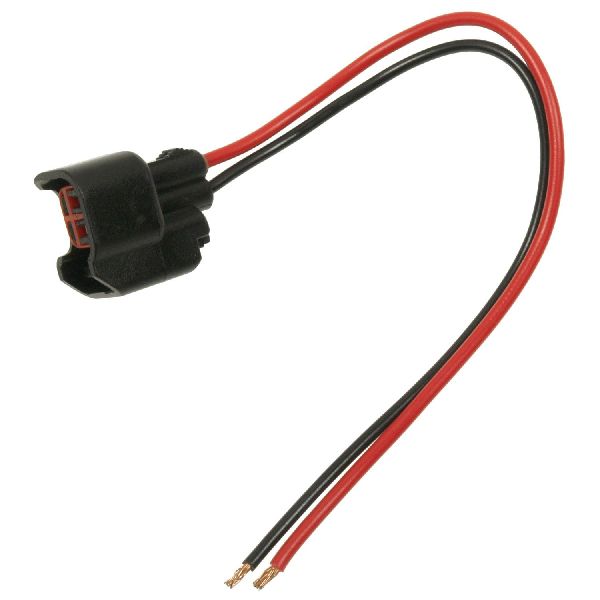
Aftermarket price range: $50-$75 - Fuel Rail Pressure Sensor Connector
(OEM #19367009)— TSB #20-NA-197 identifies corrosion or damage to this connector as a specific cause of P0191 on this vehicle.
Trusted brands: ACDelco
Aftermarket price range: $15 - $50
Related Codes That Often Appear With This One
- P0087 — Indicates fuel rail pressure is too low, often pointing to a weak high-pressure pump, clogged filter, or contamination. TSBs #PIP5151F and #20-NA-197 list this code alongside P0191.
- P0088 — Indicates fuel rail pressure is too high. This can occur with P0191 if the sensor is providing erratic readings. It is also mentioned in TSB #PIP5151F.
- P128E — This is a GM-specific code also related to the fuel rail pressure sensor performance and is cited in TSB #PIP5151F as appearing with P0191.
- P228C — A GM-specific code for 'Fuel Pressure Regulator 1 Control Performance - Low Pressure', which can be caused by the same connector corrosion issue noted in TSB #20-NA-197.
Technical Service Bulletins (TSBs) & Recalls
- PIP5151F: Addresses issues of a hard start, no start, rough running, or low fuel pressure. It suggests that if codes P0087, P0088, P0191, and P128E are found, the fuel system should be inspected for contamination like water or incorrect fluids.
- 20-NA-197: Addresses MIL illumination with P0191 and other fuel codes. It identifies the cause as potential corrosion or damage at the fuel pressure sensor electrical connector and provides a procedure for inspection and replacement of the connector.
Platform-Specific Known Issues
- TSB #PIP5151F documents that fuel system contamination can cause P0191 along with P0087, P0088, and P128E, leading to hard starts, no starts, or rough running. The bulletin advises cleaning the entire fuel system if contamination is found.
- TSB #20-NA-197 (updated Dec 2021) specifically covers the 2016-2021 Canyon/Colorado and points to corrosion in the fuel pressure sensor connector as a cause for P0191 and a dozen other fuel-related codes. The fix is to inspect and, if necessary, replace the connector pigtail.
Mechanic-Grade Diagnostic Values
- High-Pressure Fuel System (Scan Tool) — expected: 500-600 PSI at idle; 2,000-2,800 PSI under load.. Failure: Actual pressure does not track desired pressure, or is erratic.
- Low-Pressure Fuel System (Gauge) — expected: 55-60 PSI with Key On, Engine Off (KOEO).. Failure: Pressure is significantly below 55 PSI or bleeds off quickly, indicating a weak in-tank pump or leak.
- FRP Sensor Signal Voltage — expected: 1.5V to 1.8V on the signal wire with Key On, Engine Off (KOEO).. Failure: Voltage is outside this range, stuck, or does not change with pressure.
- FRP Sensor Reference Voltage — expected: 5V on the reference circuit from the ECM.. Failure: Voltage is significantly lower or higher than 5V, indicating a wiring or ECM issue.
Scan Tool Commands That Help
- GDS2 / Techline Connect: FPCM (Fuel Pump Control Module) Programming — Required after replacing the original equipment (OEM) Fuel Pump Control Module. The new module must be programmed with the vehicle's VIN to function correctly.
- Professional Scan Tool (e.g., Autel, Kingbolen): Injector Balance Test / Active Fuel Injector Test (AFIT) — To check for leaking fuel injectors, which can cause a loss of fuel pressure and potentially trigger a P0191, although more commonly associated with rich/lean codes.
Wiring & Ground Locations
- Fuel Pump Control Module (FPCM) — Located on the driver's side frame rail, often near or above the spare tire.. The FPCM controls the low-pressure in-tank fuel pump. A failure or poor connection here can starve the high-pressure pump, leading to erratic pressure readings and P0191.
- G106 (SP106) — A primary ground splice pack located on the passenger side of the engine bay, typically behind the engine airbox.. A poor connection at this major ground point can cause erratic behavior for multiple sensors and modules controlled by the ECM. While not directly for the FRP sensor, unstable grounds can introduce electrical noise that may trigger a range/performance code.
- Interior Fuse Box — Located behind a small access door in the passenger side kick panel.. Contains fuses for various body and control modules which could be related to the fuel system control.
- Underhood Fuse Box — Located on the driver's side of the engine bay.. Contains primary fuses and relays for the engine management and fuel systems, including the fuel pump relay.
Real Owner Repair Stories
- GM Forum user (2013 Buick Regal 2.0L Turbo (similar GM GDI system)) — Stabilitrak warning, reduced engine power message, and P0191 code would appear around 30 mph.
❌ Tried (didn't work) Replaced the Fuel Rail Pressure sensor., Replaced the High-Pressure Fuel Pump.
✅ What actually fixed it The user observed via scan tool that fuel pressure dropped to 70 PSI when the code triggered. The final fix was not posted, but the story is valuable as it shows a common misdiagnosis path of replacing expensive components when the root cause was likely electrical (wiring, FPCM) or a low-pressure fuel supply issue.
OEM Part Supersession History
12658331→28289962— Standard part revision by the manufacturer.
Heads up: This part number applies specifically to the 2017-2022 models with the 3.6L LGZ V6 engine. The 2016 model with the LFX engine may use a different part. Always verify the part number with the vehicle's VIN.
Model Year Variations Within This Range
- 2016 only: The 2016 model uses the 3.6L LFX V6 engine. While diagnosis is similar, specific part numbers for fuel system components may differ from the later LGZ engine.
- 2017-2018: These models use the updated 3.6L LGZ V6 engine. This was a significant redesign of the LFX, featuring a new block, heads, Active Fuel Management (AFM), and different fuel system components. Part numbers, such as for the fuel rail pressure sensor, are specific to this engine.
Helpful Videos
We Have This Part in Stock


The information in this article is provided for general reference and educational purposes only. Vehicle specifications, procedures, and part compatibility can vary by production date, trim level, and region. Always consult your vehicle's factory service manual and verify part numbers before purchasing or performing repairs. Safety-critical components such as airbags, seat belts, and braking systems should be installed by a qualified professional.
- Gmc CANYON:
- 🎬 Helpful Videos
- 🛍️ Shop This Part
- What's Unique About the 2016-2018 Gmc CANYON
- Diagnostic Flowchart
- Symptoms You May Notice
- Most Likely Causes
- Rare But Worth Checking
- Diagnosis Steps
- Parts You'll Likely Need
- Related Codes That Often Appear With This One
- Technical Service Bulletins (TSBs) & Recalls
- Platform-Specific Known Issues
- Mechanic-Grade Diagnostic Values
- Scan Tool Commands That Help
- Wiring & Ground Locations
- Real Owner Repair Stories
- OEM Part Supersession History
- Model Year Variations Within This Range
- 🎟️ Get 5% Off