

P0191 on 2005-2007 Ford Escape 2.3L: Fuel Pressure Fault Causes and Fixes
For a 2005-2007 Ford Escape with code P0191, the most common cause is a failing Fuel Rail Pressure (FRP) sensor. This part is relatively inexpensive (~$50-$100) and easy to replace. Before replacing parts, check for cracked vacuum lines near the sensor and inspect the sensor's wiring. Also consider inspecting the Fuel Pump Driver Module (FPDM) in the rear of the vehicle for corrosion, another common failure point.
- Code P0191 on your Escape is most likely caused by a bad Fuel Rail Pressure (FRP) sensor.
- Before buying parts, always check the simple things first: the sensor's vacuum line for cracks and its electrical connector for damage.
- Do not replace the fuel pump unless you have confirmed low fuel pressure with a mechanical gauge.
- Replacing the FRP sensor is a DIY-friendly job that takes less than an hour with basic tools.
- If the problem is intermittent and hard to diagnose, carefully inspect the wiring harness for hidden damage.
What's Unique About the 2005-2007 Ford Escape
On this generation of Ford Escape, the fuel system uses a returnless design controlled by a Fuel Pump Driver Module (FPDM). This module, along with the Fuel Rail Pressure (FRP) sensor itself, are common failure points that can trigger a P0191 code. The FPDM has 🎬 Watch: How to diagnose a P0191 trouble code a known design flaw where its bare aluminum body is mounted directly to the vehicle's steel frame, causing galvanic corrosion that cracks the housing and allows water to destroy the electronics. Unlike many other vehicles where a bad fuel pump is the immediate suspect, on these Escapes, the electronic components like the sensor and FPDM should be investigated first.
Symptoms You May Notice
- Check Engine Light is on
- Engine stalling, especially when coming to a stop or at idle
- Hard starting, requiring multiple cranks or extended cranking time
- Hesitation or loss of power during acceleration
- Rough or unstable idle
- Reduced fuel economy
- Replacing the fuel pump assembly before verifying if the issue is a faulty FRP sensor, wiring, or FPDM. The sensor and FPDM are much more common failure points, cheaper, and easier to fix.
Most Likely Causes
- Faulty Fuel Rail Pressure (FRP) Sensor 🔴 High Probability The FRP sensor is a known high-failure item on this platform due to age and heat cycles.
How to confirm: With a scan tool, compare the FRP sensor's pressure reading (FRP PID) to a mechanical fuel pressure gauge connected to the fuel rail's test port. If the mechanical gauge shows steady, correct pressure (typically 45-55 PSI at idle) but the scan tool reading is erratic or incorrect, the sensor is bad. A definitive test is to check resistance between the signal and ground pins of the disconnected sensor; a reading under 10k Ohms indicates an internal failure. A good sensor should show infinite resistance.
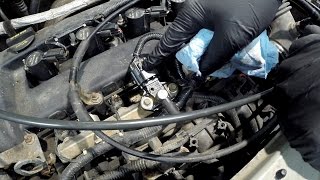
Typical fix: Replace the Fuel Rail Pressure sensor. It is located on the fuel rail and is accessible on top of the engine. 🎬 See this walkthrough for replacing the fuel rail pressure sensor
Est. part cost: $50-$150 - Damaged Wiring or Connector to FRP Sensor 🟡 Medium Probability The wiring harness can become brittle from engine heat or chafe against other components like the transmission pan or engine brackets, causing an intermittent short or open circuit.
How to confirm: Visually inspect the wiring harness leading to the FRP sensor for any signs of cracking, melting, or chafing. Check the connector for corrosion (green crust) or loose pins. Wiggle the harness with the engine running to see if it causes the engine to stumble or the FRP PID reading to fluctuate on a scan tool.
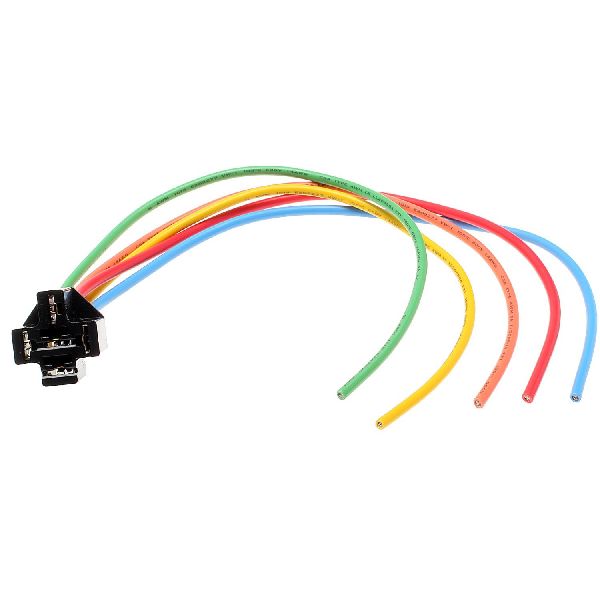
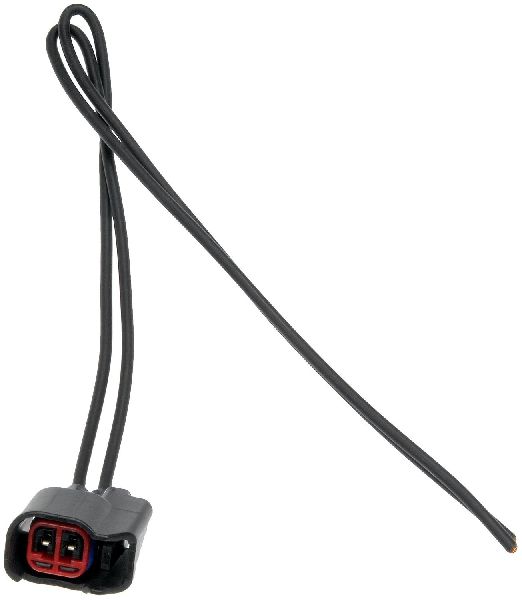
Typical fix: Repair the damaged section of the wire or replace the connector pigtail. Apply dielectric grease to the connector to prevent future corrosion.
Est. part cost: $10-$30 - Cracked or Disconnected Vacuum Line 🟡 Medium Probability
How to confirm: The FRP sensor uses a vacuum line for reference. Visually inspect the small rubber vacuum hose connected to the sensor for cracks, splits, or a loose connection. You can spray brake cleaner or starting fluid near the hose with the engine running; an RPM change indicates a leak.
Typical fix: Replace the damaged vacuum hose.
Est. part cost: $5-$15 - Failing Fuel Pump Driver Module (FPDM) 🟡 Medium Probability The FPDM is mounted to the frame in the rear of the vehicle, where it is exposed to road salt and moisture. Galvanic corrosion between the module's aluminum housing and the steel frame cracks the case, allowing water intrusion and electronic failure.
How to confirm: Symptoms include intermittent stalling or a no-start condition, sometimes with code P1233. Visually inspect the module for a white, powdery substance, cracks, or holes in the aluminum casing. If the module receives power and a command signal from the PCM but does not send voltage to the fuel pump, it has failed.
Typical fix: Replace the Fuel Pump Driver Module. Many replacement kits include rubber spacers or standoffs to mount the new module away from the frame, preventing a repeat failure.
Est. part cost: $70-$120 - Weak Fuel Pump or Clogged Fuel Filter ⚪ Low Probability
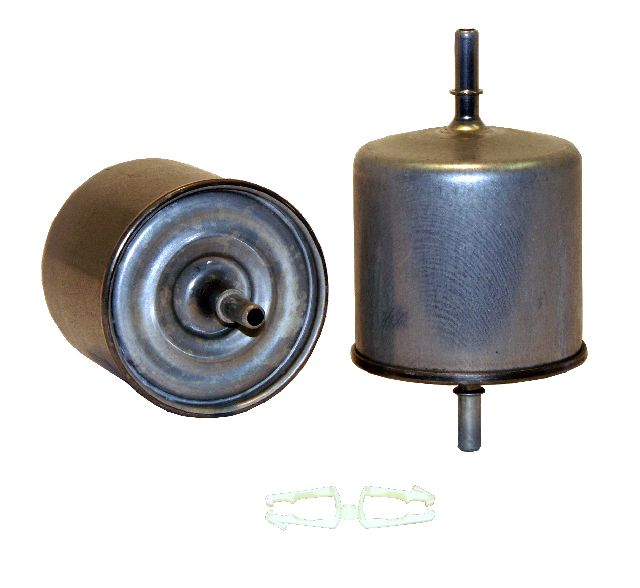
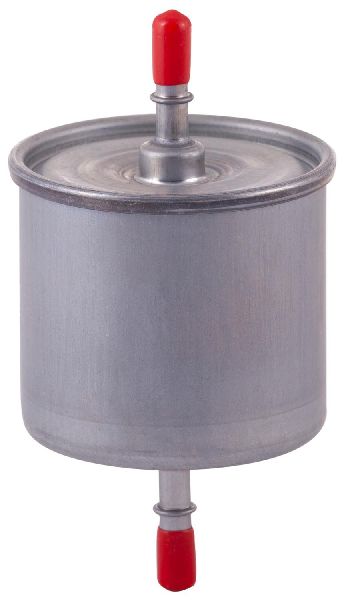
How to confirm: Perform a fuel pressure test with a mechanical gauge. If the pressure is consistently low (below 40 PSI) and does not match the specified range, the fuel pump is likely weak. The fuel filter on this model is integrated into the fuel pump assembly inside the tank, making it non-serviceable separately.
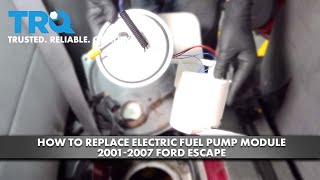
Typical fix: Replace the entire fuel pump module assembly. 🎬 Watch: How to replace the electric fuel pump module
Est. part cost: $200-$400
Rare But Worth Checking
- Internal Fuse Box Relay Failure: On some Ford platforms, the relay that powers the fuel pump circuit (including the FPDM and FRP sensor) is integrated into the main fuse box and is not separately replaceable. In a documented case on a similar vehicle, intermittent stalling and P0191 were caused by this internal relay failing, which was diagnosed by finding burn marks on the relay inside the fuse box. The fix required replacing the entire fuse box assembly.
- Faulty Powertrain Control Module (PCM): This is very rare. Before condemning the PCM, all other possibilities (sensor, wiring, fuel delivery) must be exhaustively ruled out. A Reddit user with a persistent P0191 issue reported that even a PCM replacement did not fix their problem, which was later suspected to be a complex wiring short. A manufacturer service bulletin, Bulletin #TSB 18-2326, notes that an illuminated MIL with P0191 may be stored in the PCM and requires specific service procedures to correct.
Diagnosis Steps
- Read all stored trouble codes with an OBD-II scanner. Note if P0192, P0193, or P1233 are present.
- Visually inspect the Fuel Rail Pressure (FRP) sensor's vacuum line for cracks or leaks.
- Inspect the FRP sensor's electrical connector and wiring for damage, corrosion, or chafing. Perform a 'wiggle test' on the harness while monitoring FRP data on a scan tool.
- Connect a scan tool and monitor the Fuel Rail Pressure (FRP) PID. Note the pressure reading with key-on-engine-off, at idle, and during a brief rev.
- Connect a mechanical fuel pressure gauge to the test port on the fuel rail.
- Compare the scan tool's pressure reading to the mechanical gauge. If the readings differ significantly (beyond the normal 7-10 psi variance), the FRP sensor is suspect.
- If the sensor is suspected, disconnect it and test the resistance between its signal and ground pins with a multimeter. If resistance is less than 10,000 Ohms, the sensor is internally shorted and must be replaced.
- If both scan tool and mechanical gauge readings are low, the problem is in the fuel delivery system. Visually inspect the Fuel Pump Driver Module (FPDM) under the rear of the vehicle for corrosion or damage. If it looks okay, test for power, ground, and command signal at the FPDM before condemning the fuel pump.
- If all components test good but the code persists, suspect a rare intermittent wiring issue or, as a last resort, a fault in the fuse box or PCM.
Parts You'll Likely Need
- Fuel Rail Pressure (FRP) Sensor
(OEM #3F2E-9G756-AA)— This is the most frequent cause of P0191 on this vehicle. It provides an incorrect signal to the PCM, causing drivability issues.
Trusted brands: Motorcraft (CM5229, 3F2Z9-G756-AC), Bosch (0261230093), Standard Motor Products (SMP)
OEM price range: $90-$150
Aftermarket price range: $40-$90
Related Codes That Often Appear With This One
- P0193 — This code for 'FRP Sensor Circuit High Input' often appears with P0191 when the sensor fails internally or its signal wire shorts to power.
- P0192 — This code for 'FRP Sensor Circuit Low Input' can accompany P0191 if the sensor fails or the signal wire shorts to ground.
- P0171 — This code for 'System Too Lean' can be triggered if the fuel pressure is genuinely low due to a failing FPDM or fuel pump, starving the engine of fuel.
- P1233 — This code for 'Fuel Pump Driver Module Offline' directly points to a failure of the FPDM, which is a common cause of the fuel pressure issues that also trigger P0191.
Technical Service Bulletins (TSBs) & Recalls
- While no specific TSB for P0191 on this model was found, TSBs on similar Ford platforms with this engine family often point to the FRP sensor wiring harness chafing on engine or transmission brackets as a cause for intermittent fuel pressure codes. For example, Bulletin #TSB 19-2231 notes that P0191 can be caused by an engine harness chafe on the powertrain control module (PCM) bracket.
Platform-Specific Known Issues
- The vacuum hose attached to the FRP sensor is prone to cracking due to age and engine heat, creating a vacuum leak that can trigger this code.
- The Fuel Pump Driver Module (FPDM) is highly prone to failure from galvanic corrosion caused by its aluminum body being mounted directly to the steel frame.
Mechanic-Grade Diagnostic Values
- FRP Sensor Signal Voltage (KOEO or Idle) — expected: 0.5V to 4.5V. Failure: Voltage is stuck at 0V or 5V, or does not fluctuate with engine RPM changes.
- FRP Sensor Internal Resistance — expected: Infinite resistance (Open Line). Failure: Resistance between the signal and ground pins is less than 10,000 Ohms, indicating an internal short.
- FPDM Control Duty Cycle (from PCM) — expected: 5% to 51% during normal operation.. Failure: No duty cycle signal present, or signal does not change with engine demand.
- FPDM to Fuel Pump Voltage — expected: Varies based on PCM command (duty cycle). The FPDM modulates voltage to the pump.. Failure: No voltage output to the pump despite receiving a valid command signal from the PCM.
- Ground Path Resistance — expected: Less than 0.1 ohm. Failure: Higher resistance indicates a poor ground, which can cause erratic sensor readings and module behavior.
Scan Tool Commands That Help
- Ford IDS / FORScan: Fuel Pump Command (FP_CMD) — To manually command the fuel pump on/off or to a specific duty cycle. This helps isolate whether the FPDM and pump are capable of responding to commands from the PCM, bypassing the FRP sensor input.
- Ford IDS / FORScan: Monitor PIDs: FRP (Fuel Rail Pressure), FP_DUTY (Fuel Pump Duty Cycle), FRP_V (Fuel Rail Pressure Voltage) — To graph the relationship between commanded duty cycle, sensor voltage, and resulting pressure. Seeing the duty cycle increase while pressure fails to rise points to a delivery problem (pump/FPDM), while seeing erratic voltage despite a steady duty cycle points to a sensor/wiring issue.
Wiring & Ground Locations
- Fuel Rail Pressure (FRP) Sensor — On the fuel rail, on top of the engine.. This is the primary sensor for the code. Its connector and wiring are exposed to engine heat and vibration, making them prone to damage.
- Fuel Pump Driver Module (FPDM) — Under the center of the vehicle, typically on a frame crossmember near the driver's side rear tire.. This module controls the fuel pump. Its location makes it highly susceptible to corrosion, which is a primary cause of failure and subsequent fuel pressure codes.
- G101 (Ground) — On the firewall in the rear of the engine compartment.. This is a key engine ground. A poor connection here can cause erratic voltage and sensor readings for multiple components, including the FRP sensor circuit.
- Powertrain Control Module (PCM) — Rear center of the firewall.. The PCM receives the signal from the FRP sensor and sends the command to the FPDM. All wiring for this system originates or terminates here.
Real Owner Repair Stories
- Reddit user on r/MechanicAdvice (2007 Ford Escape 3.0L V6 (symptoms and parts are shared with 2.3L)) — Intermittent hard starting, rough idle, and stalling when coming to a stop. Codes P0191, P0192, and P0193 were present.
❌ Tried (didn't work) Replaced fuel rail pressure sensor (3 times), Replaced fuel pump and filter (twice), Replaced fuel pump driver module (once), Replaced PCM (once), Repaired vacuum line leaks
✅ What actually fixed it The issue persisted after all part replacements. The user performed a resistance test on the brand new FRP sensor itself and found it was internally shorted (reading 5,400 Ohms instead of infinite). Even after replacing it with another new sensor that tested good, the stalling continued, pointing to an extremely elusive intermittent short in the wiring harness that was mimicking sensor failure. - CarTalk Community user 'Jack-Dak87' (2005 Ford Escape V6 (symptoms and parts are shared with 2.3L)) — Stumbles/dies while driving at speed, then restarts on its own. Also died at a red light but was able to be restarted. No check engine light initially.
❌ Tried (didn't work) Replaced crank sensor, Replaced fuel filter, Replaced fuel rail pressure sensor, Replaced fuel pump driver module
✅ What actually fixed it The final resolution posted by the user was the replacement of the fuel pump itself. Despite replacing all the common electronic culprits first, the intermittent stalling was ultimately caused by a failing fuel pump. - NHTSA ODI #10780588 — An owner reported their vehicle died at 45mph without warning. A shop found code P0191 and verified there was no fuel pressure; the issue was ultimately traced to broken bolts holding the internal fuel pump.
- NHTSA ODI #10446792 — An owner reported that replacing the fuel rail pressure sensor (P0191 code) did not resolve their issue, suggesting a need for a recall regarding fuel system failures in northern states.
- NHTSA ODI #11478786 — A report describes a vehicle with only 22,000 miles experiencing multiple equipment failures in the fuel system, listing code P0191 two to three times per day.
OEM Part Supersession History
3F2E-9G756-AA→3F2Z-9G756-AC (Motorcraft CM5229)— Part revision/update.
Heads up: The part number printed on the sensor body is often 3F2E-9G756-AD, while the correct service part number to order is 3F2Z-9G756-AC. They are interchangeable.5L8A-9D370-AA→5L8Z-9D372-B, Dorman 590-001 (aftermarket)— The original FPDM design was flawed. Aftermarket replacements like the Dorman 590-001 include spacers/bolts to mount the module off the frame, preventing the galvanic corrosion that caused the original to fail.
Model Year Variations Within This Range
- 2005: The 2005 model year was the first to move the automatic shifter from the column to the console and introduced a new automatic transmission for the 4-cylinder models. While the fuel system is largely the same as 2006-2007, be aware of potential mid-year production changes common in a refresh year.
Diagnostic Flowchart
Other Known Issues on This Vehicle
Issues unrelated to this code that are worth knowing about as an owner of this generation:
- Severe Rear Wheel Well / Subframe Rust 🔴 High — Very common in regions with road salt. Can occur under 100,000 miles. In severe cases, the rear shock absorber mount can rust through, causing the shock to punch into the cargo area. (Ref: While recalls existed for other models, the 2005-2007 Escape was often cited by owners as having the problem without a specific recall campaign.)
- Automatic Transmission Failure 🔴 High — A widely reported problem for the first generation (2001-2007), with failures sometimes occurring around or before 100,000-150,000 miles.
- Cracked ABS Tone Rings 🟠 Medium — Commonly occurs on higher-mileage vehicles, especially in rust-prone areas. Corrosion builds up under the tone ring on the CV axle, causing it to split and trigger ABS and brake warning lights.
Used vs. New Parts: Buying Guide for This Vehicle
When a used part is the smart pick: Used parts are generally not recommended for this repair due to the high failure rate of the key electronic components. However, a used wiring harness connector (pigtail) from a junkyard is a viable option if the original is damaged, as it is just wire and plastic.
Donor-vehicle mileage cap: roughly under 80000 miles for the part to have meaningful remaining life.
What to inspect on the donor part:
- For an FPDM: Inspect the aluminum case for ANY signs of white, powdery corrosion or cracks. If it's not pristine, do not buy it.
- For an FRP Sensor: There is no reliable way to inspect a used sensor. It is a high-failure electronic part and should be purchased new.
- For a Fuel Pump: Listen for a clean, whining sound when powered on; avoid any that sound rough or inconsistent. However, pump life is unpredictable, and new is strongly preferred.
- For a wiring pigtail: Ensure the plastic is not brittle, the locking tab is intact, and there is no green corrosion on the pins.
Aftermarket brands forum-validated for this vehicle:
- FRP Sensor: Bosch (often the OEM supplier), Motorcraft, Standard Motor Products (SMP).
- FPDM: Dorman (specifically the OE FIX version that includes mounting standoffs), Motorcraft, Standard Motor Products (SMP).
Brands owners have reported issues with on this vehicle:
- Unnamed, no-brand 'white box' electronic sensors from online marketplaces. These have a high rate of being dead-on-arrival or failing prematurely, as evidenced by forum posts where multiple 'new' sensors were tried before a quality brand part fixed the issue.
Real Owner Stories
Aggregated from forums and TSBs cited above. Mileages and costs reflect what owners reported in those sources.
2006 Ford Escape 2.3L I4 — 142000 miles
Symptoms: Check engine light on with P0191 and P0193 codes, unstable idle.
What fixed it: Replaced the Fuel Rail Pressure sensor with part number 3F2E-9G756-AA.
Source hint: U-S-Car-Part.com Article
2007 Ford Escape V6
Symptoms: Stalling and rough idle.
What fixed it: Diagnosis of Fuel Rail Pressure Sensor (FRP) related codes P0191, P0192, and P0193.
Source hint: r/MechanicAdvice - "2007 V6 Ford Escape P0191, P0192, P0193 Codes, Stalling, Rough Idle"
Related OBD-II Codes
Frequently Asked Questions
Is there a specific TSB for the P0191 code on my 2005-2007 Ford Escape 2.3L?
Why is my Fuel Pump Driver Module (FPDM) failing on my Escape?
Can I just replace the fuel filter to fix this pressure issue?
How can I tell if the FRP sensor itself is bad versus a wiring issue?
My Escape is stalling at stoplights; could this be the vacuum line?
What should the fuel pressure reading be at idle for the 2.3L engine?
Helpful Videos
We Have This Part in Stock


The information in this article is provided for general reference and educational purposes only. Vehicle specifications, procedures, and part compatibility can vary by production date, trim level, and region. Always consult your vehicle's factory service manual and verify part numbers before purchasing or performing repairs. Safety-critical components such as airbags, seat belts, and braking systems should be installed by a qualified professional.
- Ford Escape:
- 🎬 Helpful Videos
- 🛍️ Shop This Part
- What's Unique About the 2005-2007 Ford Escape
- Symptoms You May Notice
- Most Likely Causes
- Rare But Worth Checking
- Diagnosis Steps
- Parts You'll Likely Need
- Related Codes That Often Appear With This One
- Technical Service Bulletins (TSBs) & Recalls
- Platform-Specific Known Issues
- Mechanic-Grade Diagnostic Values
- Scan Tool Commands That Help
- Wiring & Ground Locations
- Real Owner Repair Stories
- OEM Part Supersession History
- Model Year Variations Within This Range
- Diagnostic Flowchart
- Other Known Issues on This Vehicle
- Used vs. New Parts: Buying Guide for This Vehicle
- Real Owner Stories
- 2006 Ford Escape 2.3L I4 — 142000 miles
- 2007 Ford Escape V6
- Related OBD-II Codes
- Frequently Asked Questions
- 🎟️ Get 5% Off