

P0191 on 2017-2018 Alfa Romeo Giulia: Fuel Rail Pressure Sensor Causes and Fixes
This code means the fuel pressure reading is erratic. The most common causes are a faulty fuel rail pressure sensor or outdated engine software. Check for available software updates with a dealer first, as TSBs exist. If software is current, the sensor itself is the next likely culprit.
- P0191 on a Giulia indicates an issue with the fuel rail pressure sensor's signal, not necessarily the fuel pump.
- Before replacing any parts, check with an Alfa Romeo dealer to see if your vehicle needs a software update, as this is a known fix per TSBs.
- The most likely physical part to fail is the fuel rail pressure sensor, but diagnosis is key, as wiring or even other fuel system components can be the root cause.
What's Unique About the 2017-2018 Alfa Romeo GIULIA

The Alfa Romeo Giulia uses a sophisticated direct-injection fuel system that operates under very high pressure. This makes it sensitive to sensor inaccuracies. Notably, Alfa Romeo has issued Technical Service Bulletins (TSBs) that address this code via software updates to the Powertrain Control Module (PCM). These TSBs often bundle fixes for a wide array of seemingly unrelated codes, suggesting complex software interactions are a key factor on this platform. Additionally, a federal investigation was opened into 🎬 Watch: Learn more about the federal investigation into fuel pump failures. low-pressure fuel pump failures on 2017-2018 models, which can cause stalling and may be related to pressure codes like P0191.
Diagnostic Flowchart

Tap your situation to follow the diagnostic path that matches what you're seeing on this vehicle.
Symptoms You May Notice
- Check Engine Light is on
- Engine hesitation or stumbling during acceleration
- Rough idle
- Engine stalling, sometimes specifically above a certain RPM (e.g., 2500 RPM)
- Reduced engine power or 'limp mode'
- Difficulty starting the engine or no-start condition
- Decreased fuel economy
- Unusual smell from the exhaust
- Replacing the fuel pump before verifying it's the cause. The sensor, wiring, and software are more common culprits and should be diagnosed first.
- Replacing fuel injectors when the issue is inconsistent pressure delivery, not the injectors themselves.
- Replacing the fuel pressure regulator repeatedly without diagnosing an underlying electrical or fuel supply issue, as documented in one owner's experience.
Most Likely Causes

- Faulty Fuel Rail Pressure Sensor 🔴 High Probability Sensors are common failure items, and the high-pressure nature of the direct injection system puts stress on this component. It is a known failure point on Alfa Romeo models.
How to confirm: A technician can monitor the sensor's live data with a scan tool to see if the readings are erratic or don't match the actual pressure. The sensor is typically located on the engine's fuel rail.
Typical fix: Replace the fuel rail pressure sensor.
Est. part cost: $70-$150 - Outdated Powertrain Control Module (PCM) Software 🟡 Medium Probability Manufacturer TSBs #18-027-20 and #18-030-17 explicitly list P0191 as a code addressed by software updates, indicating the original logic may have been too sensitive or prone to glitches.
How to confirm: A dealership or qualified shop with access to Alfa Romeo's service network can check if the vehicle's PCM software is up-to-date against the latest available versions.
Typical fix: Reprogram the PCM with the latest available software.
Est. part cost: $0-$200 (depending on dealer labor) - Wiring or Connector Issues 🟡 Medium Probability Engine vibrations and high heat in the engine bay can cause damage to wiring harnesses or corrosion in connectors over time. The connector pigtail for the sensor is a 4-wire oval connector.
How to confirm: Visually inspect the wiring and connector for the fuel rail pressure sensor for any signs of heat damage, fraying, looseness, or corrosion. Perform a continuity and resistance test on the circuit.
Typical fix: Repair the damaged wiring or clean/replace the sensor connector.
Est. part cost: $20-$100 - Failing Low-Pressure Fuel Pump ⚪ Low Probability NHTSA opened an investigation (PE24-000) into low-pressure fuel pump failures on 2017-2018 Giulia models, which can cause stalling. TSB 18-001-18 was issued to address this for cars built before August 30, 2017, often triggering code P008A-00. 🎬 Watch: A guide to troubleshooting and understanding the P008A fault code.
How to confirm: Test the low-pressure fuel system's pressure to ensure it meets manufacturer specifications. A failing low-pressure pump will starve the high-pressure pump.
Typical fix: Replace the in-tank low-pressure fuel pump.
Est. part cost: $250-$500
Rare But Worth Checking
- Failing High-Pressure Fuel Pump (HPFP): While less common than the sensor, the mechanical high-pressure pump can fail and be unable to generate the pressure commanded by the ECM, causing a range/performance fault. This was the cause of a P0191 code in at least one documented case on a similar platform.
- Faulty Engine Control Module (ECM): This is very rare, but an internal failure of the ECM can cause it to misinterpret a perfectly good sensor signal. This should only be considered after all other possibilities, including wiring and software, have been exhausted.
Diagnosis Steps
- Check for any Technical Service Bulletins (TSBs) related to your vehicle's VIN. The presence of TSBs #18-027-20, #18-030-17 (software), and #18-001-18 (low-pressure fuel pump) makes this a critical first step.
- If a relevant TSB exists, have the appropriate repair (e.g., PCM update or fuel pump replacement) performed by a dealership or qualified shop.
- Using a professional scan tool, monitor the live data from the fuel rail pressure sensor. Observe the 'Desired' vs 'Actual' fuel pressure readings. The sensor signal voltage should typically operate between 0.5V and 4.5V.
- While safely operating the vehicle, observe the pressure readings during acceleration. The actual pressure should closely follow the desired pressure, rising significantly under load. Look for dropouts, spikes, or a failure to build pressure.
- If sensor data is suspect, inspect the sensor's 4-wire pigtail connector and harness for any signs of damage, corrosion, or loose connections. Pay close attention to signs of heat damage.
- Test the low-pressure fuel system to ensure the high-pressure pump is receiving adequate fuel supply, especially on models built before August 30, 2017.
- If wiring and low pressure are good, the fuel rail pressure sensor is the most likely faulty component.
- As a final, less common check, the high-pressure fuel pump's performance can be tested.
Parts You'll Likely Need
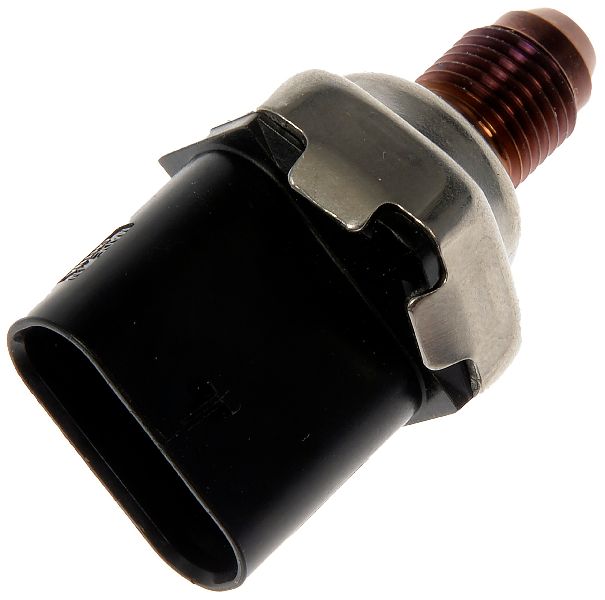
- High-Pressure Fuel Rail Sensor
(OEM #68212572AB)— This sensor is the most common failure point for P0191, as it directly measures the value reported to the ECM.
Trusted brands: Mopar, Bosch
OEM price range: $90-$160
Aftermarket price range: $60-$110
Related Codes That Often Appear With This One
- P008A-00 — This code for 'Low Pressure Fuel System Pressure - Too Low' is specifically mentioned in TSB 18-001-18 related to failing low-pressure fuel pumps on this vehicle, which can cause stalling and may appear alongside P0191.
- P01BA-00 — This and other codes are listed alongside P0191 in TSB #18-027-20, suggesting they can be triggered together and resolved with a single PCM software update.
- P2299-00 — Also listed in TSBs #18-027-20 and #18-030-17. Its presence with P0191 strongly indicates a software update is needed.
- P0089 — This code relates to Fuel Pressure Regulator Performance. If the regulator is failing, it can cause the pressure to be out of range, triggering P0191.
Technical Service Bulletins (TSBs) & Recalls

- 18-027-20: Flash: Powertrain Control Module (PCM) Updates (Bundles P0191 fix with others)
- 18-030-17: Flash: Powertrain Control Module (PCM) Updates (Bundles P0191 fix with others)
- 18-001-18: Low Fuel Pressure / Fuel Pump Replacement (For vehicles built on or before 08/30/2017)
Platform-Specific Known Issues
- Software Glitches: TSBs #18-027-20 and #18-030-17 confirm that P0191 can be triggered by software issues that require a PCM update, even though the TSBs are categorized under systems like 'Exterior Lighting' or 'Back Over Prevention'.
- Low-Pressure Fuel Pump Investigation: NHTSA launched a preliminary evaluation (PE24-000) for the 2017-2018 Giulia due to complaints of low-pressure fuel pump failures causing loss of power and stalling. Alfa Romeo had previously issued TSB 18-001-18 for this issue on cars built before August 30, 2017, which may also present with code P008A-00.
- Real-World Repair Saga: An owner on the Alfaholicy forum detailed a frustrating chase of code P0191. After the car stalled, they replaced the fuel pressure regulator multiple times, with new Bosch parts failing quickly. They also replaced the in-tank fuel pump and fuel filter. The issue persisted, with the car stalling above 2500 RPM, indicating the problem can be complex and not always a simple sensor swap. This highlights the importance of thorough diagnosis before replacing parts.
Mechanic-Grade Diagnostic Values
- Fuel Rail Pressure Sensor Signal Voltage — expected: 0.5V - 4.5V. Failure: Voltage outside of this range, or erratic/unstable readings that don't correspond to engine load.
- Fuel Rail Pressure Sensor Maximum Pressure Reading (for part 68212572AB) — expected: 4350 PSI (300 Bar). Failure: This is the design limit of the sensor, not a diagnostic value itself, but useful for context.
Hidden / Shadow Codes Worth Checking
- P008A-00: Low Pressure Fuel System Pressure - Too Low (see via A standard OBD-II scanner. This code is explicitly mentioned in TSB 18-001-18 for dealers to look for in relation to low-pressure fuel pump failures on the Giulia.)
Wiring & Ground Locations
- Fuel Rail Pressure Sensor Connector — On the high-pressure fuel rail on the engine.. This is the direct electrical connection for the sensor. It is an oval-shaped, 4-pin male connector. Damage or corrosion here will directly cause a P0191 code.
Real Owner Repair Stories
- NHTSA Preliminary Evaluation PE24-000 (2017-2018 Alfa Romeo Giulia (2.0L I4 & 2.9L V6)) — Sudden loss of motive power, engine stalling (often at speeds over 25 mph), and illumination of multiple warnings like 'Service Engine' and 'Service Electronic Throttle Control'.
❌ Tried (didn't work) Some owners reported that replacing the low-pressure fuel pump did not permanently fix the issue, with the replacement pump also failing.
✅ What actually fixed it The issue stems from a faulty low-pressure fuel pump. Alfa Romeo issued TSB 18-001-18 instructing dealers to replace the low-pressure fuel pump on affected vehicles. The NHTSA investigation was opened to determine the scope and root cause, and if a recall is necessary.
Model Year Variations Within This Range
- 2017 (built on or before August 30, 2017): These vehicles are the specific subject of TSB 18-001-18 for low-pressure fuel pump failure. Models built after this date may have an updated pump from the factory.
- 2017 vs 2018: The base 2.0L engine saw a minor power increase from 276 hp in 2017 to 280 hp in 2018. Also, 2017 models did not come standard with Apple CarPlay and Android Auto, which became available in 2018.
Helpful Videos
We Have This Part in Stock




The information in this article is provided for general reference and educational purposes only. Vehicle specifications, procedures, and part compatibility can vary by production date, trim level, and region. Always consult your vehicle's factory service manual and verify part numbers before purchasing or performing repairs. Safety-critical components such as airbags, seat belts, and braking systems should be installed by a qualified professional.
- Alfa Romeo GIULIA:
- 🎬 Helpful Videos
- 🛍️ Shop This Part
- What's Unique About the 2017-2018 Alfa Romeo GIULIA
- Diagnostic Flowchart
- Symptoms You May Notice
- Most Likely Causes
- Rare But Worth Checking
- Diagnosis Steps
- Parts You'll Likely Need
- Related Codes That Often Appear With This One
- Technical Service Bulletins (TSBs) & Recalls
- Platform-Specific Known Issues
- Mechanic-Grade Diagnostic Values
- Hidden / Shadow Codes Worth Checking
- Wiring & Ground Locations
- Real Owner Repair Stories
- Model Year Variations Within This Range
- 🎟️ Get 5% Off