

P0181 on 2012-2014 Volkswagen Passat 2.0L TDI: Fuel Temp Sensor Wiring Causes and Fixes
On a 2012-2014 Passat TDI, code P0181 is almost always caused by broken wires right at the fuel temperature sensor's electrical connector, not the sensor itself. The fix is typically to repair the wiring with a new connector pigtail or by re-pinning the existing connector, a sub-$50 DIY job.
- This code on your Passat TDI is almost certainly a wiring problem, not a bad sensor.
- Before buying any parts, remove the engine cover and carefully inspect the two wires going to the fuel temperature sensor connector.
- The most reliable fix is to repair the broken wires using a new connector pigtail or official VW repair wires.
- This issue is specific to 2012-2014 Passat models with the CKRA TDI engine.
- A DIY repair is very feasible for under $50 and requires basic wiring skills.
What's Unique About the 2012-2018 Volkswagen Passat

The 2.0L TDI engine family, including the CKRA, is well-known for a specific failure that causes this code. Due to engine vibration and heat cycles, the two wires leading to the fuel temperature sensor (G81) become brittle and break directly at the connector. While the code points to a sensor performance issue, the root cause is almost always a simple wiring failure, making diagnosis on this platform more direct than on other vehicles where the sensor itself is the more common culprit.
Generation note: The specified vehicle range (2012-2018) covers the North American Passat (NMS) B7 generation. However, the CKRA engine was only installed in the 2012, 2013, and 2014 model years. This guide is specific to those 2012-2014 TDI models. Later 2015+ models use the EA288 engine (CVCA) which has a different intercooler setup and may not be as prone to this specific wiring failure location.
Symptoms You May Notice
- Check Engine Light is on
- Flashing Glow Plug light
- Rough or unstable idle, especially when cold
- Reduced fuel economy
- Hesitation during acceleration or feeling of reduced power
- Engine may enter a 'limp mode' with severely restricted power.
- Replacing the fuel temperature sensor without first thoroughly inspecting the wiring harness. The wires are the most common point of failure, and replacing a good sensor will not fix the problem. This is a frequent mistake made by those unfamiliar with this specific TDI issue.
Most Likely Causes
- Broken Wires at Sensor Connector 🔴 High Probability Engine vibration and heat cycles cause the wires to fatigue and break where they enter the back of the G81 fuel temperature sensor connector. This is a widely documented failure mode on this engine platform, affecting not just the Passat but other models with similar TDI engines. The wires are very thin (around 22 gauge) and become brittle over time.
How to confirm: With the engine cover removed, locate the G81 sensor on a fuel line. Visually inspect the two wires going into the connector. Gently wiggle the wires; they will often be completely severed or make intermittent contact. The fault may appear or disappear on a scan tool when the wires are moved. The wires are often broken inside the insulation right at the connector, showing no visible copper.
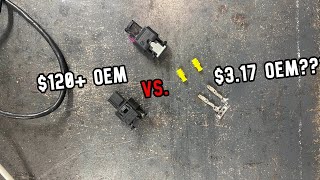
Typical fix: Repair the wiring. This can be done by splicing in a new connector pigtail, 🎬 See this walkthrough on how to fix the sensor wiring. or by carefully removing the pins from the connector housing (VW Part # 4H0973702A) and crimping on new repair wires (VW Part # 000979034EA). Using non-insulated butt connectors with heat shrink tubing is a reliable repair method.
Est. part cost: $10-$40 - Faulty Fuel Temperature Sensor (G81) ⚪ Low Probability
How to confirm: If the wiring is confirmed to be intact, test the sensor. On a cold engine (after sitting for several hours), use a scan tool to compare the fuel temperature reading to the intake air and coolant temperature readings. All three should be within a few degrees of ambient temperature. If the fuel temp is drastically different (e.g., 140°C), the sensor is likely faulty. You can also test the sensor's resistance with a multimeter and compare it to a temperature/resistance chart.
Typical fix: Replace the fuel temperature sensor. It is typically held into its housing in the fuel line by a small clip, making replacement relatively simple once access is gained. 🎬 Watch: A quick guide to replacing the fuel temperature sensor.
Est. part cost: $50-$100
Rare But Worth Checking
- Engine Control Module (ECM) Fault: This is extremely rare. All wiring and sensor tests should be exhausted before considering the ECM as the cause. A faulty ECM would likely present with multiple other unrelated codes.
Diagnosis Steps

- Connect an OBD-II scanner and confirm the presence of P0181. Note any other codes like P0182 or P0183, which strongly suggest a wiring issue.
- If possible, let the vehicle sit for several hours to 'cold soak'. Turn the ignition on (do not start the engine) and use the scanner's live data function to view the temperatures from the Fuel Temperature Sensor (G81), Intake Air Temperature Sensor (G72), and Coolant Temperature Sensor (G62). They should all be within a few degrees of each other. A fuel temp reading that is wildly inaccurate (e.g., -40°C or 140°C) confirms a fault in the circuit.
- Remove the plastic engine cover.
- Locate the Fuel Temperature Sensor (G81). It is a 2-wire sensor plugged into a housing on one of the hard fuel lines in the engine bay, often near the high-pressure fuel pump.
- Closely inspect the two wires (typically yellow and brown on the CKRA) where they enter the black plastic connector. Look for cracks in the insulation, exposed copper, or a complete break. The break is often right at the back of the connector where the wire flexes.
- Gently wiggle each wire individually at the back of the connector while observing the live data on the scan tool. 🎬 Watch: How to diagnose P0181 and P0183 using live data. If the temperature reading changes wildly, flickers between a real value and an extreme value, or cuts in and out, you have confirmed the wiring is the fault.
- If the wiring appears perfect and the wiggle test shows no change, disconnect the connector. Check for corrosion on the pins. If clean, proceed with testing the sensor's resistance using a multimeter.
- If both wiring and sensor test good, the fault may lie in the wiring harness further down or, in very rare cases, the ECM itself.
Parts You'll Likely Need

- Fuel Temperature Sensor Connector Repair Pigtail
(OEM #4H0973702A (Housing Only))— This is the most common failure point. The wires break at the connector, necessitating a repair. A pigtail is the easiest solution for DIYers. The housing itself is a TE Connectivity part #1-1718643-1.
Trusted brands: Genuine VW/Audi, Dorman, URO Parts, TE Connectivity
OEM price range: $15-$30 (Housing only)
Aftermarket price range: $10-$25 (Pigtail) - Fuel Temperature Sensor Connector Repair Wire
(OEM #000979034EA)— This is the official VW repair wire with a pre-crimped, gold-plated terminal. It is used to re-pin the existing connector housing if it is not damaged. Two are required. This is the more professional but also more expensive repair if you don't have the correct crimping tools for the bare terminals.
Trusted brands: Genuine VW/Audi
OEM price range: $15-$25 (Per wire) - Fuel Temperature Sensor (G81)
(OEM #03L906088EE)— Replaced only if the sensor itself is confirmed to be faulty after verifying the wiring is intact. Note: This part number may also be described as an 'emissions temp sensor' or may be superseded. Always verify with VIN.
Trusted brands: Bosch, Genuine VW/Audi
OEM price range: $70-$100
Aftermarket price range: $40-$70
Related Codes That Often Appear With This One
- P0183 — This code means 'Fuel Temperature Sensor 'A' Circuit High (Open or Short to Plus)'. It is often triggered along with P0181 when a wire breaks, creating an open circuit.
- P0182 — This code means 'Fuel Temperature Sensor 'A' Circuit Low (Short to Ground)'. It can be triggered if the broken signal wire makes intermittent contact with a ground source.
Platform-Specific Known Issues
- The wiring harness for the G81 sensor is known to be fragile and prone to breaking from normal engine vibration, making this a very common and predictable repair on TDI models from this era.
- This issue is so common that many owners on forums like TDIClub and VWVortex immediately point to the connector wiring as the first and most likely culprit for a P0181 code.
Mechanic-Grade Diagnostic Values
- Fuel Temperature Sensor (G81) Resistance — expected: Approx. 1500-2000 Ω at 30°C (86°F); Approx. 275-375 Ω at 80°C (176°F). The sensor has a negative temperature coefficient, so resistance decreases as temperature increases.. Failure: An open circuit (infinite resistance) or a short circuit (near zero resistance) indicates a failed sensor. A reading that doesn't correspond to the approximate fuel temperature is also a failure.
- Sensor Signal Voltage at ECM — expected: Typically a 5V reference is supplied to the sensor circuit. The return signal voltage will vary based on temperature (and thus resistance).. Failure: A reading of 0V could indicate a short to ground, while a reading near 5V could indicate an open circuit (broken wire).
Scan Tool Commands That Help
- VCDS (VAG-COM): Engine -> Measuring Blocks -> Group 007 — This is used to view live data from the fuel temperature sensor. Field 1 typically displays the fuel temperature in °C. This is the primary screen to watch while performing a 'wiggle test' on the sensor wiring to confirm an intermittent connection.
Wiring & Ground Locations
- G81 Sensor Connector (T2ey) — On a hard fuel line in the engine bay, near the high-pressure fuel pump.. This is the primary failure point. The wires break inside the insulation right at the back of this connector.
- G81 Pin 1 (Brown wire) — Connects to an engine compartment ground connection.. This is the ground reference for the sensor. While less common than a break at the connector, a poor ground connection can also cause incorrect readings.
- G81 Pin 2 (Yellow wire on CKRA, may vary) — This is the signal wire that runs to a specific pin on the 60-pin ECM (J623) connector. For a similar CFFB engine, it is Pin 42 on the T60 connector.. A break anywhere along this wire will cause an open circuit, triggering P0181/P0183. The most common break location is at the sensor connector itself.
Real Owner Repair Stories
- Ross-Tech Forums user 'b6paulfenning' (2011 VW Passat 2.0TDI (CFFB Engine - similar to CKRA)) — Check Engine Light with fault code P0181 - Implausible Signal.
❌ Tried (didn't work) Replacing the Fuel Temperature Sensor (G81) with a new genuine part.
✅ What actually fixed it The user was advised by forum experts that the problem was almost certainly a wiring break between the sensor and the ECU, a common failure mode. The final fix is to repair the wiring harness, not replace the sensor again.
OEM Part Supersession History
N/A→03L906088EE— This is the current part number for the fuel temperature sensor for the specified vehicle range.
Heads up: This part is sometimes generically described as an 'emissions temp sensor' for the pre-catalyst position. Always verify fitment with a VIN.N/A→4H0973702A— This is the part number for the plastic connector housing. It is used across a wide variety of VW/Audi vehicles and applications, not just for the fuel temp sensor.
Diagnostic Flowchart
Other Known Issues on This Vehicle
Issues unrelated to this code that are worth knowing about as an owner of this generation:
- Clogged Heater Core 🔴 High — Very common, especially on cars with over 60k miles. Often presents as heat on the driver's side but cold air on the passenger side. The original G13 coolant is suspected to break down and create sediment that clogs the core.
- Diesel Particulate Filter (DPF) Failure 🔴 High — Common, especially on vehicles used for frequent short trips. The DPF can become clogged with ash over time, leading to frequent regenerations, reduced power, and eventual replacement. Ash load limits are around 70g, but some have lasted longer. Turbo failure can sometimes be linked to excessive DPF backpressure. (Ref: Covered under the extended emissions warranty from the 'Dieselgate' settlement for a period.)
- Clock Spring Failure 🟠 Medium — A very common failure across many VW models of this era, including the Passat. Leads to an airbag warning light and loss of steering wheel button functions (horn, radio controls). (Ref: VW issued a warranty extension for the clock spring to 15 years/unlimited mileage for many affected vehicles.)
- AdBlue (DEF) Heater Failure 🟠 Medium — Extremely common failure, particularly in colder climates. The heating element in the Diesel Exhaust Fluid tank fails, triggering a check engine light (e.g., P202A) and a 'no restart' warning in a certain number of miles. (Ref: Covered under the extended emissions warranty from the 'Dieselgate' settlement.)
- Intercooler Icing (on other TDI models) 🔴 High — This issue primarily affects TDI models with an air-to-air intercooler like the Jetta/Golf (CJAA), where condensation can freeze in cold, humid weather and potentially cause engine hydrolock. The Passat's CKRA engine uses a water-to-air intercooler and is NOT affected by this specific problem. (Ref: A recall/service campaign was issued for affected Jetta/Golf models.)
Used vs. New Parts: Buying Guide for This Vehicle
When a used part is the smart pick: A used connector pigtail from a junkyard is an excellent, low-cost option. The failure is in the wires right at the connector, so cutting a pigtail with several inches of wire from a donor vehicle provides everything needed for a splice repair.
Donor-vehicle mileage cap: roughly under 150000 miles for the part to have meaningful remaining life.
What to inspect on the donor part:
- Inspect the donor pigtail's wires for any signs of brittleness, cracking, or previous repairs.
- Ensure the plastic locking tab on the connector housing is intact and not broken.
- Select a pigtail from a vehicle that appears to have been well-maintained, if possible.
OEM-only on this vehicle (don't cheap out):
- While aftermarket sensors exist, the low probability of sensor failure makes it wise to use a Genuine VW/Audi or OEM Bosch sensor if replacement is truly necessary, to avoid introducing a new variable.
Aftermarket brands forum-validated for this vehicle:
- Bosch (OEM for the sensor)
- TE Connectivity (OEM for the connector housing, pins, and seals)
Brands owners have reported issues with on this vehicle:
- Unnamed, no-brand sensors from online marketplaces are a gamble and may have incorrect resistance curves, causing persistent issues.
Real Owner Stories
Aggregated from forums and TSBs cited above. Mileages and costs reflect what owners reported in those sources.
2013 Volkswagen Passat CKRA 2.0L TDI
Symptoms: Check Engine Light on with code P0181.
What fixed it: Splicing in a new pigtail for the G81 fuel temperature sensor to repair the broken wires at the connector.
Source hint: TDIClub Forums: Numerous threads discuss the P0181 code on CKRA and similar engines, with the community consensus being that the wires breaking at the G81 connector is the cause over 95% of the time.
2015 Volkswagen Passat CKRA 2.0L TDI
Symptoms: Check Engine Light on with codes P0181 and P0183 stored.
What fixed it: Repaired the broken wires at the fuel temperature sensor connector using the correct VW repair wires (Part # 000979034EA).
Source hint: YouTube (JoshsJettas): A detailed video titled 'Diagnosing P0181 & P0183 VW TDI' shows the exact failure point on a CKRA engine...
B7 Volkswagen Passat TDI
Symptoms: Vehicle was experiencing P0181 faults.
What fixed it: The problem was diagnosed as a wiring issue at the G81 sensor, as advised by the forum, and subsequently repaired.
Source hint: Ross-Tech Forums: A user with a B7 Passat TDI experiencing P0181 faults was advised to check the wiring at the G81 sensor as the primary step.
Related OBD-II Codes
Frequently Asked Questions
My 2014 Passat TDI has a P0181 code. What's the most likely cause?
What are the VW part numbers for fixing the broken fuel temperature sensor wires?
My glow plug light is flashing and the check engine light is on. Is this related to code P0181?
How can I confirm the wiring is bad without special tools?
Does this same P0181 wiring issue affect other VW/Audi TDI models?
Is the intercooler icing problem that affects some TDIs a concern for my Passat?
Helpful Videos
We Have This Part in Stock




The information in this article is provided for general reference and educational purposes only. Vehicle specifications, procedures, and part compatibility can vary by production date, trim level, and region. Always consult your vehicle's factory service manual and verify part numbers before purchasing or performing repairs. Safety-critical components such as airbags, seat belts, and braking systems should be installed by a qualified professional.
- Volkswagen Passat:
- 🎬 Helpful Videos
- 🛍️ Shop This Part
- What's Unique About the 2012-2018 Volkswagen Passat
- Symptoms You May Notice
- Most Likely Causes
- Rare But Worth Checking
- Diagnosis Steps
- Parts You'll Likely Need
- Related Codes That Often Appear With This One
- Platform-Specific Known Issues
- Mechanic-Grade Diagnostic Values
- Scan Tool Commands That Help
- Wiring & Ground Locations
- Real Owner Repair Stories
- OEM Part Supersession History
- Diagnostic Flowchart
- Other Known Issues on This Vehicle
- Used vs. New Parts: Buying Guide for This Vehicle
- Real Owner Stories
- 2013 Volkswagen Passat CKRA 2.0L TDI
- 2015 Volkswagen Passat CKRA 2.0L TDI
- B7 Volkswagen Passat TDI
- Related OBD-II Codes
- Frequently Asked Questions
- 🎟️ Get 5% Off