

OBD-II Code P0176: Fuel Composition Sensor Circuit Malfunction
An ASE-Certified Master Technician's In-Depth Guide to P0176
- Code P0176 only triggers on Flex Fuel vehicles, indicating a failure in the sensor measuring ethanol content or its 3-wire electrical circuit.
- A failed fuel composition sensor causes 80% of P0176 codes, particularly on 2002-2014 Chevrolet, GMC, and Ford trucks.
- Test the sensor's 12V power, ground, and 50-150Hz frequency signal before replacing parts to rule out the 15% of cases caused by broken wiring.
- Driving with an active P0176 code drops fuel economy by 5-10% and forces a rich fuel mixture that destroys a $1,500 catalytic converter within 6 months.
- You must perform a 'Fuel Composition Reset' using a bidirectional scan tool after repairs, or the engine will continue running poorly on old data.
What Does P0176 Mean?
Code P0176 means the Powertrain Control Module (PCM) detects an abnormal or missing signal from the fuel composition sensor. Found only on Flex Fuel vehicles (FFVs), this sensor measures the gasoline's ethanol percentage. The PCM requires this data to precisely adjust ignition timing and fuel injector pulse width for optimal performance.
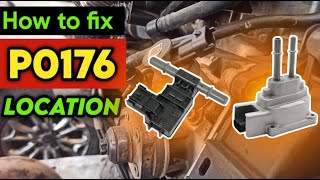
Technical definition: P0176 indicates the PCM received a signal from the fuel composition sensor outside its expected electrical range. 🎬 See this breakdown of the P0176 sensor circuit malfunction. The sensor outputs a digital square wave: frequency indicates ethanol content (50 Hz for pure gasoline, 150 Hz for 85% ethanol), and pulse width indicates fuel temperature (1ms to 5ms). The code sets when the PCM sees a stuck, intermittent, or out-of-bounds signal.
Can I Drive With P0176?
Yes, But With Caution. You can drive your vehicle, but address the issue within 100 miles. The engine runs on a default rich fuel mixture, causing a 5-10% drop in MPG and sluggish performance. Ignoring this long-term destroys the catalytic converter, a $1,500+ repair.
Common Causes
- Faulty Fuel Composition Sensor (Very Common) — The sensor itself accounts for 80% of P0176 cases. It fails internally from heat cycles or contamination, stopping the frequency signal entirely. 🎬 Watch: Diagnosing a fuel composition sensor circuit failure.
- Wiring or Connector Issues (Common) — Damaged, corroded, or loose wires interrupt the signal in 15% of cases. Always inspect the harness for chafing or water intrusion before replacing parts.
- Contaminated or Incorrect Fuel (Less Common) — High water concentration or debris in the fuel tank skews the sensor's readings, triggering a false circuit code.
- Corroded Main Ground Connections (Uncommon) — A corroded engine or chassis ground strap corrupts the sensor's digital signal. The sensor requires a clean ground (<0.1V) to function.
- Failing Fuel Pump or FPDM (Uncommon) — Electrical noise from a failing fuel pump or Fuel Pump Driver Module interferes with the sensor circuit, causing erratic readings.
- PCM Issues (Hardware or Software) (Rare) — A faulty internal analog-to-digital converter or outdated software causes the PCM to misinterpret a perfectly good sensor signal.
Symptoms
- Check Engine Light is On — The dashboard warning light illuminates, resulting in an automatic emissions test failure.
- Rough Idle or Stalling — The engine runs unevenly or stalls at low speeds due to an incorrect air/fuel mixture.
- Reduced Engine Power — The vehicle hesitates or stumbles during acceleration because ignition timing is not optimized.
- Worse Fuel Economy — MPG drops by 5-10% as the PCM defaults to a rich fuel mixture to protect the engine.
- Hard Starting — The engine cranks longer than usual before starting, especially in cold weather.
- Incorrect Fuel Composition Reading (scan-tool only — no driver-felt sign) — Live scanner data for 'Ethanol %' shows an illogical or stuck value (e.g., -40%, 0%, or 100% on E10 fuel).
Diagnostic Flowchart
Tap your situation to follow the diagnostic path that matches what you're seeing on this code.
Common Fixes & Costs
- Replace Fuel Composition Sensor — Parts: $150-$300, Labor: $100-$200, ~1.5 hr book time (Intermediate)
- Repair Wiring or Connectors — Parts: $10-$50, Labor: $120-$200, ~2 hr book time (Intermediate)
- Drain and Clean Fuel System — Parts: $20-$60, Labor: $200-$400, ~2.5 hr book time (Intermediate)
- Update or Replace PCM — Parts: $0-$1000, Labor: $100-$300, ~1.5 hr book time (Professional)
Used vs. New Parts: Buying Guide
When a used part is worth it: Never. These sensors have a high failure rate. A used part from a salvage yard has an unknown history and will likely fail shortly after installation.
Donor-vehicle mileage cap: roughly under 20000 miles for the part to have meaningful remaining life.
Donor quality checklist:
- Verify the part number matches exactly.
- Avoid parts from rust-belt regions, as connector corrosion is a primary failure point.
Decision logic:
- If The cost of a new OEM sensor is under $300 → Buy new. The warranty and reliability outweigh the minimal savings of a used part.
- If The vehicle is being sold immediately → A used part is a temporary gamble, but expect it to fail again.
Warranty tradeoff: Used parts offer a 30-day warranty covering only the part. New aftermarket parts offer 1-year to lifetime warranties. New OEM parts carry a 1-2 year warranty.
Worst-case if a used part fails: $400 if a used sensor fails, requiring you to buy a new part and pay labor twice.
What Happens If You Wait — Timeline
- 0-1 month: Check Engine Light illuminates. Slight hesitation when accelerating from a stop. (MPG impact: 3-5%% · Added cost: $20-$50 in wasted fuel)
- 1-3 months: Rough idle, hard starting, and a noticeable lack of power. The PCM runs a rich default mixture to protect the engine. (MPG impact: 5-15%% · Added cost: $50-$150 in wasted fuel)
- 3-6 months: The consistently rich exhaust overheats the catalytic converter. You smell rotten eggs from the exhaust. Spark plugs foul. (MPG impact: 10-20%% · Added cost: $1200-$2800 (catalytic converter replacement is required))
- 6+ months: Severe drivability issues and frequent stalling. The catalytic converter clogs completely, causing extreme exhaust backpressure that destroys the engine. (MPG impact: 20-30%+% · Added cost: $4000+ (catalytic converter, O2 sensors, and engine replacement))
Cost of Not Fixing It
- 0-1 month: Noticeable decrease in fuel economy (5-10% drop) and poor engine performance, including hesitation and rough idling. (Added cost: $20-$50 per month in wasted fuel.)
- 1-6 months: The engine runs consistently rich, overheating the catalytic converter and fouling the spark plugs. (Added cost: $1200-$2800 for catalytic converter replacement, plus $150 for spark plugs.)
- 6+ months: Severe rich conditions wash oil from the cylinder walls, causing premature wear on piston rings and catastrophic engine damage. (Added cost: $3000+ for engine replacement.)
Diagnosis Steps
- Scan for Codes and Check Live Data
Use an OBD-II scanner to confirm P0176. Access the live data stream for 'Fuel Composition' (or 'Ethanol %'). For E10 gasoline, it should read 8-12%. For E85, 70-85%. If the value is stuck at 0%, 100%, or fluctuates wildly, the sensor or circuit is faulty.
Tools: OBD-II Scanner (Beginner) - Visual Inspection
Locate the sensor on the fuel line. Inspect the wiring harness for cracked insulation, burnt wires, or green corrosion on the connector pins. Ensure the connector is fully seated.
Tools: Flashlight (Beginner) - Perform a "Wiggle Test"
While monitoring the live ethanol percentage on your scan tool, aggressively wiggle the wiring harness near the sensor. If the reading jumps or drops out, you have a broken wire or loose pin.
Tools: OBD-II Scanner (Intermediate) - Test Sensor Voltage and Ground
Unplug the sensor. Turn the key ON, engine OFF. Probe the vehicle-side connector. The reference wire must show steady battery voltage (12V). The ground wire must show less than 0.1 volts. If either is missing, trace the wiring fault back to the PCM.
Tools: Multimeter (Intermediate) - Test Sensor Signal Frequency
With the engine running, back-probe the signal wire. Set your multimeter to Hertz (Hz). The frequency must be stable: 50-60 Hz for E10 gas, up to 150 Hz for E85. A reading of 0 Hz or erratic jumping confirms a dead sensor (if power/ground are good).
Tools: Multimeter with Frequency (Hz) setting (Advanced) - Inspect Fuel Quality
Take a fuel sample from the Schrader valve. If the fuel looks cloudy or has a distinct layer of water at the bottom, drain and clean the fuel system before replacing any parts.
Tools: Clear container, fuel pressure gauge with drain hose (Intermediate) - Analyze with an Oscilloscope
Connect an oscilloscope to the signal wire. A healthy sensor produces a clean 50-150Hz digital square wave. Distorted waveforms or voltage drops indicate internal failure or severe electrical interference.
Tools: Oscilloscope (Advanced) - Check for PCM Issues
If the sensor, wiring, power, and ground test perfectly, the PCM is faulty or requires a software update. Take the vehicle to a professional shop equipped with a J2534 programmer.
Tools: Advanced Scan Tool, J2534 Programmer (Professional)
When This Code Triggers (Freeze-Frame Conditions)
- Engine Coolant Temp: 180-210°F (The engine is at full operating temperature.)
- RPM: 1500-2500 RPM (The code sets during steady-state cruising, rarely at idle or heavy acceleration.)
- Engine Load: 25-70% (Detected under normal driving load, such as maintaining speed on a flat road.)
- Vehicle Speed: 40-65 mph (Highway or arterial road speeds are required for the monitor to run.)
Related Codes
- P0178 — Indicates a 'Circuit Low Input'. The PCM sees a frequency below 50 Hz or a constant low voltage, proving a short to ground or a sensor that failed open.
- P0179 — Indicates a 'Circuit High Input'. The PCM sees a frequency above 150 Hz or a constant high voltage, proving a short to power.
- P0177 — Indicates a 'Circuit Range/Performance' problem. The signal is erratic or intermittent, usually caused by contaminated fuel or a loose connector.
- P0169 — Indicates 'Incorrect Fuel Composition'. The ethanol content reported by the sensor contradicts data from the oxygen sensors (e.g., sensor claims E85, but O2 sensors read lean).
Climate & Environmental Factors
- High Humidity / Road Salt: In winter climates, road salt causes severe corrosion inside the sensor's electrical connector. Water intrusion creates shorts or open circuits, triggering P0176 (addressed in Ford TSB 14-0023).
- Fuel Contamination: Sporadic high levels of water or sulfur in regional gasoline supplies coat the sensor's internal components, skewing the frequency output.
How to Talk to a Mechanic About This Code
Say this: "I have a P0176 code. Please check the live data from the fuel composition sensor for frequency and temperature, and test the sensor's power and ground at the connector before recommending a replacement part."
This proves you want a proper diagnosis, not a parts cannon. It directs them to test the most common failure points (signal and wiring), preventing you from buying a $300 sensor if the issue is a $10 broken wire.
Avoid saying:
- 'My check engine light is on, can you just fix it?'
- 'I think I need a new fuel sensor, can you replace it?'
- 'Just do whatever you think is necessary.'
Questions to ask before authorizing the repair:
- What did the live data for the fuel composition sensor show? Was the frequency stuck or erratic?
- Did you verify that the sensor has 12V power and a clean ground at the connector?
- Does the repair estimate include performing the 'Fuel Composition Reset' with a scan tool afterward?
- What is the warranty on the parts and labor?
Where to Take It: Dealer vs Independent vs Chain
- Dealer:
Recommended only if a PCM software update is required or the vehicle is under warranty.
Best for: Vehicles under powertrain or emissions warranty., Complex electrical issues requiring a PCM software update.
Downsides: Highest labor rates, typically 50% more than independent shops., May default to replacing the sensor without thoroughly testing the wiring harness. (Typical cost: +50% vs. baseline) - Independent Shop:
Best fit for P0176. Experienced independent technicians are well-equipped to diagnose and fix this common code affordably.
Best for: Out-of-warranty vehicles, especially GM and Ford trucks., Diagnosing and repairing wiring issues., Cost-conscious owners.
Downsides: Diagnostic capabilities vary. Vet them by checking for ASE certifications. (Typical cost: +0% vs. baseline) - Chain Shop:
Avoid for initial diagnosis. They frequently miss simple wiring issues and sell unnecessary sensors.
Best for: Simple part replacements when you have already confirmed the sensor is dead.
Downsides: Technician skill varies dramatically., High pressure to upsell services., Often lack the advanced scan tools required to perform the post-repair reset. (Typical cost: -10% vs. baseline)
When to Walk Away From the Repair
If the estimated repair cost for P0176 and other known issues exceeds 50% of your car's private-party value, sell the vehicle.
- Car worth $5000, fix is $400: Fix it. This repair is well below the threshold and restores fuel economy.
- Car worth $4000, fix is $2100: Walk away. The repair cost is over 50% of the car's value. Put that money toward a reliable vehicle.
- Car worth $8000, fix is $3500: Borderline. Get a second opinion. If the car is otherwise in great condition, it might be worth it. If it has other pending problems, sell.
What Scan Tool You Need for This Code
Minimum: A bidirectional scan tool that reads live data PIDs for 'Ethanol %' and performs a 'Fuel Composition Reset'. A basic $20 code reader is useless for this repair.
Basic readers only display the P0176 code. You need live data to see if the sensor's signal is erratic. More importantly, you must perform a 'Fuel Composition Reset' after the repair, which basic readers cannot do.
Budget: BlueDriver Pro Bluetooth OBD2 Scanner (~$100) — Reads and graphs live data for ethanol percentage. This confirms if the sensor is sending a bad signal, but it CANNOT perform the required reset.
Mid-range: Foxwell NT510 Elite / Launch CRP919E (~$180) — The sweet spot for DIYers. Offers bidirectional control to perform the critical 'Fuel Composition Reset' and provides full live data to confirm the diagnosis.
Professional: Autel MaxiCOM MK808BT (~$500) — Provides OE-level bidirectional control for fuel composition resets and all other system diagnostics. The interface is significantly faster than midrange options.
Rent vs buy: Buy. AutoZone's free Loan-A-Tool scanners are basic code readers that cannot perform the mandatory 'Fuel Composition Reset'. You must buy a midrange bidirectional tool to complete this job.
How to Clear the Code After You Fix It
- Reconnect the battery and sensor.
- Use a bidirectional scan tool to perform a 'Fuel Composition Reset' or 'Alcohol Content Reset'. This is mandatory.
- Clear the P0176 code.
- Perform a complete drive cycle to set readiness monitors.
Drive cycle (~30 minutes): Start cold. Idle for 3 minutes with A/C on. Turn A/C off, accelerate to 55 mph, and hold steady for 5 minutes. Coast to 20 mph without braking. Accelerate back to 55 mph for 5 minutes. Coast to a stop.
Readiness monitors affected: Catalyst Monitor, Oxygen (O2) Sensor Monitor, Comprehensive Component Monitor
Before emissions retest: drive at least 100 miles to fully set monitors.
Watch out for:
- Skipping the 'Fuel Composition Reset' with a scan tool, forcing the PCM to use old, incorrect data.
- Clearing the code without fixing the root cause.
- Testing for emissions before the readiness monitors switch to 'Ready'.
Will This Fail Emissions / State Inspection?
Yes — this code typically fails an OBD-II emissions inspection.
- California: An active P0176 is an automatic failure. After repair, the vehicle must be driven 100-200 miles to set all readiness monitors to 'Ready' before a retest.
- New York: Fails inspection immediately. For 2001+ vehicles, only one monitor can be 'Not Ready' after clearing the code.
- Texas: In the 17 emissions-testing counties, the Check Engine Light must be off and readiness monitors complete to pass.
Most Commonly Affected Vehicles
- Chevrolet / GMC Silverado, Sierra, Tahoe, Yukon, Suburban (Flex-Fuel) (2002-2014) — These GMT800 and GMT900 trucks suffer from exceptionally high sensor failure rates, causing rough idle and hard starts. Replacement is the standard fix.
- Ford F-150 (Flex-Fuel) (2004-2014) — Prone to P0176 from corroded wiring near the sensor. Ford TSB 14-0023 specifically addresses water intrusion in the C324 connector.
- Ford Ranger (Flex-Fuel) (1999-2011) — The 3.0L V6 Ranger frequently throws this code. The sensor is located on the chassis rail under the driver's seat.
- Chevrolet Impala (Flex-Fuel) (2006-2016) — The 3.5L and 3.9L engines experience P0176 due to internal sensor failure. The sensor is located near the fuel tank.
- Dodge / Chrysler Charger, 300, Town & Country (Flex-Fuel) (2008-2015) — Diagnosis often points to the sensor, but wiring should be checked for chafing against the frame near the fuel tank.
- Nissan Titan, Armada (Flex-Fuel) (2008-2015) — Typically caused by a failed sensor, but wiring damage near the fuel lines is also common.
Manufacturer-Specific Notes
- General Motors (Chevrolet/GMC): Flex-fuel models from 2002-2014 are extremely prone to P0176 due to a high failure rate of the original ACDelco sensor. It is almost always a hardware failure rather than a wiring issue.
- Ford: Ford TSB 14-0023 addresses P0176 caused by water intrusion into wiring harness connector C324. The fix is repairing the corroded pins and sealing the connector with dielectric grease, not replacing the sensor.
- Dodge / Chrysler / Jeep: P0176 is frequently triggered by software glitches. Check with a dealer for available PCM software flashes before replacing hardware.
- All: If the battery is disconnected, the PCM's learned fuel composition value is erased. The vehicle will run poorly and set P0176 until a 'Fuel Composition Reset' is performed with a scan tool.
Real Owner Stories
2008 Chevy Silverado 1500 at 145K miles
Check Engine Light came on, with noticeable hard starting in the mornings and a 20% drop in MPG. The truck felt sluggish under acceleration.
What they tried:
- Cleaned the MAF sensor and visually inspected for vacuum leaks.
- Scanned live data and saw long-term fuel trims were very high (+18%), confirming a rich condition.
- Replaced the fuel composition sensor (ACDelco 13577379).
Outcome: Replacing the sensor and performing a fuel composition reset fixed the issue. Hard starts disappeared, and fuel economy returned to normal.
Lesson: On high-mileage GM trucks, P0176 combined with performance issues points strongly to the sensor itself. Confirming with fuel trim data prevents unnecessary parts swapping.
2000 Ford Ranger 3.0L at 120K miles
P0176 appeared after water accidentally entered the fuel tank. The engine ran very rough and stalled.
What they tried:
- Siphoned the tank and cleared fuel lines.
- Replaced the fuel filter.
- Inspected the sensor connector, which looked clean.
- Drove the vehicle to see if the sensor would recover.
Outcome: After a few days of highway driving, the residual water cleared from the sensor. The engine smoothed out, and the code did not return.
Lesson: If the code is caused by known fuel contamination, the sensor can recover after the fuel system is cleaned. Drive the vehicle before resorting to a $160 replacement.
2005 Chevy Silverado 5.3L with 180K miles
An O2 sensor wire broke, tangled in the front driveshaft, and ripped the fuel composition sensor wiring completely off. The truck would not crank.
What they tried:
- Identified the damaged sensor via wiring diagrams.
- Spliced the three wires (power, ground, signal) back together using heat shrink tubing.
Outcome: After repairing the severed wires, the truck started immediately. The code was cleared and did not return.
Lesson: Physical damage to the wiring harness is a common, overlooked cause. Check harness routing near driveshafts and exhaust components before assuming the sensor failed.
How to Prevent This Code From Triggering
- Use high-quality, Top Tier gasoline (Every fill-up) — Top Tier fuels contain detergents that keep the fuel composition sensor and injectors clean from performance-robbing deposits.
- Avoid running the fuel tank near empty (Daily habit) — Running the tank low causes the fuel pump to run hotter, creating voltage irregularities that affect downstream sensors. It also stirs up sediment.
- Inspect sensor wiring and connectors (Every 5,000 miles) — In regions using road salt, visual inspections catch corrosion early. Applying dielectric grease to the connector prevents moisture intrusion.
- Be consistent with fuel choice (Ongoing) — Frequently switching between E85 and E10 forces the system to constantly re-learn, increasing stress on an aging sensor.
Frequently Asked Questions
What is a fuel composition sensor and what does it do?
It's a small electronic device on Flex Fuel vehicles that continuously measures the percentage of ethanol in the gasoline. The car's computer (PCM) uses this data to adjust ignition timing and fuel injection. This ensures the engine runs efficiently with different fuel blends like E10 or E85.
What is the most common misdiagnosis for P0176?
The most common mistake is immediately replacing the fuel composition sensor without testing the circuit first. Technicians often find the problem is a corroded connector or a damaged wire. Always test for power, ground, and signal before buying a new sensor.
Do I need to perform a 'fuel composition reset' after the repair?
Yes, this is a critical and often-missed step. After replacing the sensor or repairing the circuit, you must use a bidirectional scan tool to perform a 'Fuel Composition Reset'. Failing to do this forces the PCM to use old data, causing continued performance issues.
Can I fix a P0176 code myself?
Replacing a bad sensor is a straightforward job for intermediate DIYers, often involving simple quick-disconnect fuel lines. However, diagnosing the problem correctly requires a multimeter to rule out wiring issues. You also need an advanced scan tool to perform the required reset afterward.
Will P0176 clear itself?
No, this code will not clear on its own. You must repair the underlying problem with the sensor or its circuit. Afterward, clear the code and reset the fuel composition data with a scan tool.
What happens if I ignore code P0176?
You will experience poor engine performance, bad fuel economy, and hard starting. Driving with this code long-term forces a rich fuel mixture that overheats the catalytic converter. Replacing a melted catalytic converter costs between $1,200 and $2,800.
Why did P0176 appear after I got gas?
This happens if you receive a batch of contaminated fuel with high water concentration. The contaminants interfere with the sensor's ability to get an accurate reading. It also occurs if you switch fuel types (like E85 to E10) and a failing sensor cannot register the change.
Can a bad gas cap cause P0176?
No, a bad gas cap cannot directly cause a P0176 code. A loose gas cap triggers an evaporative emission system code, such as P0455 or P0457. P0176 is strictly an electrical or internal fault with the fuel composition sensor circuit.
Key Takeaways
- Code P0176 only triggers on Flex Fuel vehicles, indicating a failure in the sensor measuring ethanol content or its 3-wire electrical circuit.
- A failed fuel composition sensor causes 80% of P0176 codes, particularly on 2002-2014 Chevrolet, GMC, and Ford trucks.
- Test the sensor's 12V power, ground, and 50-150Hz frequency signal before replacing parts to rule out the 15% of cases caused by broken wiring.
- Driving with an active P0176 code drops fuel economy by 5-10% and forces a rich fuel mixture that destroys a $1,500 catalytic converter within 6 months.
- You must perform a 'Fuel Composition Reset' using a bidirectional scan tool after repairs, or the engine will continue running poorly on old data.
Helpful Videos

The information in this article is provided for general reference and educational purposes only. Vehicle specifications, procedures, and part compatibility can vary by production date, trim level, and region. Always consult your vehicle's factory service manual and verify part numbers before purchasing or performing repairs. Safety-critical components such as airbags, seat belts, and braking systems should be installed by a qualified professional.
- 🎬 Helpful Videos
- What Does P0176 Mean?
- Can I Drive With P0176?
- Common Causes
- Symptoms
- Diagnostic Flowchart
- Common Fixes & Costs
- Used vs. New Parts: Buying Guide
- What Happens If You Wait — Timeline
- Cost of Not Fixing It
- Diagnosis Steps
- When This Code Triggers (Freeze-Frame Conditions)
- Related Codes
- Climate & Environmental Factors
- How to Talk to a Mechanic About This Code
- Where to Take It: Dealer vs Independent vs Chain
- When to Walk Away From the Repair
- What Scan Tool You Need for This Code
- How to Clear the Code After You Fix It
- Will This Fail Emissions / State Inspection?
- Most Commonly Affected Vehicles
- Manufacturer-Specific Notes
- Real Owner Stories
- 2008 Chevy Silverado 1500 at 145K miles
- 2000 Ford Ranger 3.0L at 120K miles
- 2005 Chevy Silverado 5.3L with 180K miles
- How to Prevent This Code From Triggering
- Frequently Asked Questions
- What is a fuel composition sensor and what does it do?
- What is the most common misdiagnosis for P0176?
- Do I need to perform a 'fuel composition reset' after the repair?
- Can I fix a P0176 code myself?
- Will P0176 clear itself?
- What happens if I ignore code P0176?
- Why did P0176 appear after I got gas?
- Can a bad gas cap cause P0176?
- Key Takeaways
- 🎟️ Get 5% Off