

P0175 on 2009-2016 Toyota Sequoia: System Too Rich Bank 2 Causes & Fixes
On 2009-2016 Toyota Sequoias, especially Flex Fuel (3UR-FBE) models, P0175 is often caused by an incorrect alcohol density calculation in the ECM, requiring a software update or reset as per Toyota TSBs. Other common causes include a failing Bank 2 Air/Fuel ratio sensor or a dirty MAF sensor.
- For Flex Fuel (3UR-FBE) Sequoias, the most likely cause of P0175 is an ECM software issue related to alcohol fuel calculation, which is covered by a Toyota TSB.
- Outside of the Flex Fuel issue, the most common part to fail is the Bank 2 (driver's side) upstream Air/Fuel Ratio sensor.
- Before replacing any parts, check fuel trims with a scan tool. Highly negative numbers on Bank 2 confirm the rich condition.
- Cleaning the MAF sensor is a low-cost, high-impact diagnostic step that can sometimes resolve the issue if it's affecting both banks.
- Ignoring a P0175 code can lead to costly damage to the catalytic converter over time.
What's Unique About the 2009-2016 Toyota SEQUOIA
For the 2009-2016 Sequoia, particularly models equipped with the 5.7L Flex Fuel (3UR-FBE) engine, this code is strongly linked to a known issue with the vehicle's alcohol density calculation. After fueling with regular E10 gasoline, the ECM can incorrectly estimate a high percentage of ethanol in the fuel, causing it to inject too much fuel and create a rich condition. Toyota has issued Technical Service Bulletins (TSBs), most notably T-SB-0166-19 which supersedes T-SB-0058-13, detailing an ECM software update to correct this logic.
Diagnostic Flowchart
Tap your situation to follow the diagnostic path that matches what you're seeing on this vehicle.
Symptoms You May Notice
- Check Engine Light is on
- Decreased fuel economy
- Rough idle
- Hesitation or lack of power during acceleration
- Strong smell of fuel or rotten eggs from the exhaust
- Black smoke from the exhaust in severe cases
- Extended engine cranking on startup
- Replacing the downstream (post-catalytic converter) oxygen sensor. The upstream Air/Fuel Ratio sensor is responsible for fuel trim adjustments, while the downstream sensor primarily monitors catalyst efficiency.
Most Likely Causes
- Incorrect Alcohol Density Value (Flex Fuel Models) 🔴 High Probability As documented in Toyota TSBs T-SB-0058-13 and T-SB-0166-19, the ECM logic on 3UR-FBE engines can miscalculate the ethanol content of the fuel, leading to a rich command. This is a widely discussed issue in owner forums for both the Sequoia and its platform-mate, the Tundra.
How to confirm: Use a professional scan tool (like Toyota Techstream or a capable bidirectional scanner like Launch or Autel) to view the 'Alcohol Density Estimate' value. If it's high (e.g., over 20-85%) but you've only used regular E10 gasoline, this is the likely cause.
Typical fix: The permanent fix is to have the ECM reprogrammed with updated software by a dealer or qualified shop, as described in TSB T-SB-0166-19. This TSB may also involve replacing the fuel pump. As a temporary fix or for those out of warranty, owners report successfully resetting the 'Fuel Density Learning Value' to zero using bidirectional scan tools. 🎬 Watch: How to reset alcohol density with a scan tool. A simple battery disconnect for 10-20 minutes may also temporarily reset fuel trims.
Est. part cost: $0 (DIY reset) - $400 (bidirectional scanner) - Failing Air/Fuel Ratio Sensor (Bank 2, Sensor 1) 🔴 High Probability
How to confirm: Use a scan tool to monitor the voltage or lambda readings of the Bank 2, Sensor 1 (upstream) A/F sensor. A healthy sensor fluctuates rapidly. A lazy, stuck, or biased reading indicates failure. Bank 2 is the driver's side on the V8 engine.
Typical fix: Replace the Bank 2, Sensor 1 Air/Fuel Ratio sensor. Denso is the original equipment manufacturer. The correct part is typically Denso 234-9051. 🎬 See this walkthrough for replacing the Bank 2 A/F sensor.
Est. part cost: $100-$250 - Dirty or Faulty Mass Airflow (MAF) Sensor 🟡 Medium Probability Oil from aftermarket air filters can contaminate the sensor, but even stock filters can allow dirt buildup over time.
How to confirm: Inspect the MAF sensor wires for dirt or contamination. Monitor MAF readings (g/s) with a scan tool at idle and under load to see if they are within the expected range for your engine. A dirty sensor will under-report airflow, causing the ECM to command more fuel.
Typical fix: First, try cleaning the sensor with a dedicated MAF sensor cleaner spray. 🎬 Watch: How to clean the MAF sensor on your 5.7L. If cleaning doesn't resolve the issue, the sensor must be replaced. Denso is the OEM. The OEM part number is 22204-0F030 (which supersedes 22204-75030).
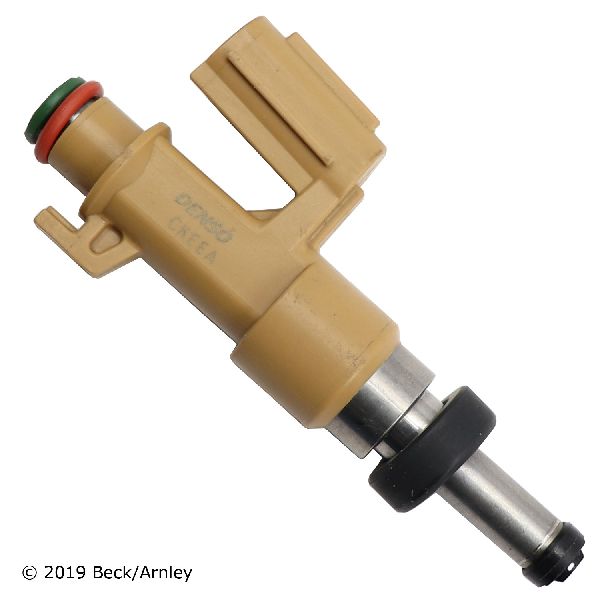
Est. part cost: $15-$25 (cleaner), $150-$300 (replacement sensor) - Leaking Fuel Injector(s) ⚪ Low Probability
How to confirm: Perform a fuel pressure leak-down test. After shutting the engine off, the fuel rail pressure should hold steady. A rapid drop suggests a leak, possibly from an injector. You can also remove the spark plugs on Bank 2 (driver's side) and check for one that is excessively black and sooty compared to the others.
Typical fix: Replace the leaking fuel injector(s). It is often recommended to replace them as a set on the affected bank to ensure balanced flow.
Est. part cost: $70-$200 per injector
Rare But Worth Checking
- High Fuel Pressure: A faulty fuel pressure regulator can cause excessive pressure, forcing too much fuel through the injectors. This should be checked with a fuel pressure gauge connected to the fuel rail.
- Faulty Engine Coolant Temperature (ECT) Sensor: If the sensor is stuck reading cold, the ECM will continuously command a richer fuel mixture, as if the engine is always warming up. This can also be caused by a thermostat that is stuck open.
- Exhaust Leak (before A/F sensor): A leak in the exhaust manifold or collector pipe before the Bank 2, Sensor 1 A/F sensor can draw in outside air. This 'fools' the sensor into thinking the engine is running lean, causing the ECM to add excessive fuel and create an actual rich condition.
Diagnosis Steps
- Connect an OBD-II scanner and confirm P0175 is present. Check for other codes like P0172, P1604, or P1605.
- Observe live data, specifically the Short-Term (STFT) and Long-Term Fuel Trims (LTFT) for Bank 2. For P0175, you will see highly negative numbers (e.g., -10% to -30%) as the ECM tries to remove fuel.
- If you have a Flex Fuel (3UR-FBE) model, use a capable scan tool to check the 'Alcohol Density Estimate' value. If it is incorrectly high, this is your primary suspect. Refer to TSB T-SB-0166-19 for the official ECM reprogramming procedure.
- Inspect the air intake system for any blockages and check the engine air filter.
- Remove and inspect the Mass Airflow (MAF) sensor. If dirty, clean it with dedicated MAF cleaner and re-evaluate fuel trims.
- Graph the Bank 2, Sensor 1 (upstream) Air/Fuel Ratio sensor's output. A slow or non-responsive sensor is faulty and needs replacement.
- Check for exhaust leaks before the Bank 2 A/F sensor, especially around the exhaust manifold gasket.
- Perform a fuel pressure test to ensure the pressure is within OEM specifications. Excessively high pressure points to a faulty fuel pressure regulator.
- If all else fails, perform a fuel injector leak-down test or have the injectors professionally cleaned and tested.
Parts You'll Likely Need
- Air/Fuel Ratio Sensor (Bank 2, Sensor 1)
(OEM #Denso 234-9051)— This is the primary sensor the ECM uses to determine the air-fuel mixture. It is a common failure part that directly causes rich or lean codes for a specific bank.
Trusted brands: Denso
OEM price range: $180-$250
Aftermarket price range: $100-$180 - Mass Airflow (MAF) Sensor
(OEM #22204-0F030)— A dirty or failing MAF sensor is a frequent cause of rich codes on both banks. It under-reports airflow, causing the ECM to add too much fuel.
Trusted brands: Denso
OEM price range: $200-$300
Aftermarket price range: $75-$150 - MAF Sensor Cleaner — Often, the MAF sensor is just dirty and does not need to be replaced. Cleaning it is a cheap and effective first step.
Trusted brands: CRC, WD-40
Aftermarket price range: $15-$25
Related Codes That Often Appear With This One
- P0172 — System Too Rich Bank 1. If both P0172 and P0175 are present, it points to a problem affecting both engine banks, such as the MAF sensor, fuel pressure regulator, or the Flex Fuel alcohol density issue.
- P1604 — Startability Malfunction. This code is specifically mentioned alongside P0175 in Toyota TSBs related to the alcohol density issue, indicating a hard-starting symptom. [10, 11, Bulletin #T-SB-0166-19_Rev, Bulletin #T-SB-0058-13 Rev]
- P1605 — Rough Idling. Also mentioned in the same TSBs, indicating a related symptom of the incorrect fuel mixture. [8, 12, Bulletin #T-SB-0058-13 Rev]
Technical Service Bulletins (TSBs) & Recalls
- T-SB-0166-19_Rev: Mentions P0175 as a possible DTC related to negative fuel trims and elevated alcohol density. This bulletin supersedes T-SB-0058-13 and expands the model years covered. The fix involves an ECM reprogram and potentially a fuel pump replacement. [10, 11, Bulletin #T-SB-0166-19_Rev]
- T-SB-0058-13 Rev: Details the MIL 'ON' condition with P0175 on 3UR-FBE engines due to alcohol density calculation and advises an ECM logic modification. This TSB is now considered obsolete and replaced
Platform-Specific Known Issues
- Flex Fuel (3UR-FBE) models from 2009-2014 may exhibit P0175 along with P0172, P1604, and P1605 due to the ECM incorrectly calculating the alcohol density in the fuel, as documented in TSB T-SB-0166-19. The official fix is an ECM software update and potentially a new fuel pump, which may be covered under the Federal Emission Warranty (96 months/80,000 miles).
Mechanic-Grade Diagnostic Values
- Long-Term Fuel Trim (Bank 2) — expected: Close to 0%. Failure: Consistently negative, in the range of -15% to -30%.
- Fuel Pressure (3UR-FBE Engine) — expected: High Pressure Mode: 370-430 kPa (53.7-62.4 psi). Low Pressure Mode: 270-330 kPa (39.2-47.9 psi).. Failure: Pressure significantly higher than specification points to a regulator issue. Pressure that drops off rapidly after engine shutoff (below 147 kPa / 21 psi) indicates a leak.
- Upstream A/F Sensor (Bank 2, Sensor 1) Voltage — expected: Fluctuates rapidly and constantly between approximately 0.1 and 0.9 volts.. Failure: Voltage is stuck high (e.g., above 0.8V), low, or does not fluctuate (lazy sensor).
- Mass Air Flow (MAF) Sensor Reading at Idle — expected: Approximately 4-7 g/s for a 5.7L V8 at normal idle (varies with conditions).. Failure: Reading is significantly lower than expected for the given RPM, which would cause the ECM to incorrectly add fuel.
Hidden / Shadow Codes Worth Checking
- Mode $06 Data: While not a shadow code, Mode $06 contains non-continuous monitor test results from the ECM. A technician can review the test results for the oxygen sensors (e.g., Test ID $01, Component ID $02 for Bank 2 Sensor 1) to see if they are passing or failing their internal self-tests, which can help confirm a sensor fault before it triggers a specific sensor code. (see via A professional scan tool with Mode $06 capability.)
Scan Tool Commands That Help
- Toyota Techstream (or capable bidirectional scanner): Fuel Density Learning Value Reset — This is the primary diagnostic and temporary repair step for Flex Fuel (3UR-FBE) models when P0175 is present and the 'Alcohol Density Estimate' PID is abnormally high despite using standard gasoline. The command path is typically Powertrain / Engine and ECT / Utility / Fuel Density Learning Value Reset.
- Toyota Techstream: Active Test: Activate the Fuel Pressure Switching Valve — For Flex Fuel models, this test allows a technician to command the fuel pressure switching valve on and off while monitoring the Short Term Fuel Trim (Short FT). A change of 10% or more in the Short FT value confirms the valve is functioning.
Wiring & Ground Locations
- Main Engine Grounds — On the Tundra/Sequoia platform, the main engine-to-chassis grounds are typically located at the rear of the cylinder heads, one on each side, near the transmission bell housing.. A poor ground on the driver's side (Bank 2) could potentially cause erratic readings from the Bank 2 A/F sensor or other engine sensors, leading to incorrect fuel calculations.
- Ground Points A1, A2 — For a 2014 Sequoia, wiring diagrams show ground points A1 and A2 located behind the left (driver's side) headlight assembly.. These grounds serve various components in the engine bay. Verifying they are clean and tight is a fundamental step in diagnosing any electrical issue, including sensor faults.
Real Owner Repair Stories
- User report summarized from multiple forum and article sources (2013 Toyota Tundra/Sequoia 5.7L Flex Fuel) — Check Engine Light with rich codes (P0172/P0175), extended crank/hard start, poor gas mileage, rough running.
❌ Tried (didn't work) Replacing parts without checking the alcohol density value.
✅ What actually fixed it The owner used a bidirectional scan tool (Autel, Launch, or Xtool) to view live data and found the 'Alcohol Density Estimate' was very high (e.g., >50%) despite only using E10 gasoline. The owner then used the scanner's special function 'Fuel Density Learning Value Reset' to set the value back to zero. This immediately resolved the starting and running issues. This is considered a temporary fix if the underlying ECM logic is not updated via the TSB.
OEM Part Supersession History
22204-75030→22204-0F030— Updated design or manufacturing process for the Mass Airflow (MAF) Sensor.
Heads up: Using the old part number is not advised as the new one is the official replacement.
Model Year Variations Within This Range
- 2009-2014: The 5.7L V8 was available with the E85 Flex Fuel (3UR-FBE) option starting in 2009. These specific models are the ones susceptible to the 'Alcohol Density' calculation issue described in TSBs.
- 2010-2012: The base 4.7L V8 was replaced by a 4.6L V8 (1UR-FE) for these model years. These non-Flex Fuel engines would not have the alcohol density issue, and diagnosis for P0175 should focus on more traditional causes like A/F sensors, MAF, and injectors.
- 2013-2016: The 4.6L V8 was discontinued, making the 5.7L V8 (both 3UR-FE and 3UR-FBE variants) the standard and only engine.
Helpful Videos

Used OEM Parts in Stock

New Aftermarket Parts Available


The information in this article is provided for general reference and educational purposes only. Vehicle specifications, procedures, and part compatibility can vary by production date, trim level, and region. Always consult your vehicle's factory service manual and verify part numbers before purchasing or performing repairs. Safety-critical components such as airbags, seat belts, and braking systems should be installed by a qualified professional.
- Toyota SEQUOIA:
- 🎬 Helpful Videos
- 🛍️ Shop This Part
- What's Unique About the 2009-2016 Toyota SEQUOIA
- Diagnostic Flowchart
- Symptoms You May Notice
- Most Likely Causes
- Rare But Worth Checking
- Diagnosis Steps
- Parts You'll Likely Need
- Related Codes That Often Appear With This One
- Technical Service Bulletins (TSBs) & Recalls
- Platform-Specific Known Issues
- Mechanic-Grade Diagnostic Values
- Hidden / Shadow Codes Worth Checking
- Scan Tool Commands That Help
- Wiring & Ground Locations
- Real Owner Repair Stories
- OEM Part Supersession History
- Model Year Variations Within This Range
- 🎟️ Get 5% Off