

P0175 on 2006-2013 Lexus IS250: System Too Rich Bank 2 Causes and Fixes
P0175 on a Lexus IS250 most often points to a dirty Mass Airflow (MAF) sensor or a failing upstream Air/Fuel Ratio (O2) sensor on Bank 2 (the driver's side). Cleaning the MAF sensor is a common first step. If codes return, replacement with a Denso-brand A/F sensor is the next likely fix. For 2006 models, an ECM software update may be required. In less common cases, a leaking high-pressure fuel pump or faulty PCV valve can be the culprit.
- P0175 means Bank 2 is running too rich; the engine is getting too much fuel or not enough air.
- Start your diagnosis by cleaning the Mass Airflow (MAF) sensor, as it's a common, easy, and cheap first step.
- The next most likely culprit is a failing upstream Air/Fuel Ratio sensor (Bank 2, Sensor 1).
- If you also have code P0172 (Bank 1 Rich), the problem is almost certainly a component shared by both banks, like the MAF sensor.
- For 2006 models, check if TSB L-SB-0061-09 (an ECM update) has been performed.
What's Unique About the 2006-2013 Lexus IS250

The 2006-2013 IS250's 4GR-FSE engine uses direct injection only, unlike the IS350 which has both port and direct injection. This design makes the intake valves susceptible to carbon buildup because fuel doesn't wash over them. While carbon buildup is a notorious issue on this engine, leading to rough idle and misfires, a P0175 code is more directly related to components that measure or deliver fuel and air, such as the MAF and A/F sensors. However, related issues like a faulty PCV system, which can be exacerbated by engine deposits, can also contribute to rich conditions. A leaking high-pressure fuel pump is also a notable issue on this direct-injection engine that can cause rich conditions.
Symptoms You May Notice
- Check Engine Light and "Check VSC" message on the dashboard.
- Poor fuel economy.
- Rough or fluctuating idle, sometimes dipping low on startup.
- Hesitation, sluggish acceleration, or a feeling of the car 'bucking' under load.
- Strong smell of fuel from the exhaust.
- Black smoke from the exhaust in severe cases.
- Replacing downstream (Sensor 2) oxygen sensors. The downstream sensors (after the catalytic converter) primarily monitor catalyst efficiency and have a minimal, slow-adjusting role in fuel trim. The problem is almost always with the upstream (Sensor 1) Air/Fuel sensor located on the exhaust manifold before the catalyst.
Most Likely Causes

- Dirty or Faulty Mass Airflow (MAF) Sensor 🔴 High Probability The MAF sensor measures the amount of air entering the engine. If it's dirty from oil vapors (often from the PCV system) or debris, it will under-report airflow, causing the ECM to think there is less air than there actually is. This leads the ECM to command a fuel delivery that is too rich for the actual amount of air. This is a very common starting point for diagnosis, especially if both P0172 (Bank 1) and P0175 (Bank 2) are present.
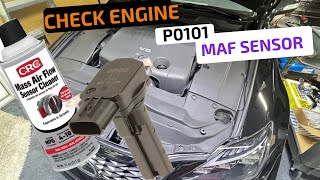
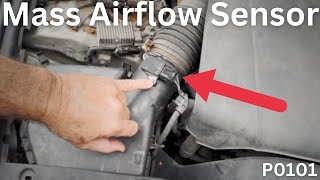
How to confirm: Inspect the MAF sensor wires for contamination. Use a scan tool to monitor MAF readings at idle; a healthy sensor on a warm engine should read around 3.4-4.5 g/s. Often, the easiest first step is to clean it with a dedicated MAF sensor cleaner. 🎬 Watch: How to properly clean your MAF sensor. If cleaning doesn't resolve the issue, especially if an aftermarket sensor was previously installed, replacement with a Denso OEM part is recommended.
Typical fix: Clean the MAF sensor with a specialized cleaner. If cleaning doesn't work, replace the sensor with a Denso part (P/N: 22204-31020). 🎬 See this walkthrough for replacing the MAF sensor. After cleaning or replacement, reset the ECU by disconnecting the battery for 30 minutes or using a scan tool's 'Reset Memory' function to clear learned fuel trims.
Est. part cost: $10-$15 for cleaner, $70-$150 for a new Denso sensor. - Faulty Air/Fuel Ratio Sensor (Bank 2, Sensor 1) 🔴 High Probability This sensor, also known as an upstream O2 sensor, provides the primary feedback for the air-fuel mixture on Bank 2. If it becomes slow, biased, or fails, it can send incorrect 'rich' signals to the ECM. These sensors have a finite life and failure is common. The Bank 2 sensor is on the driver's side (LHD) and is known to be more difficult to access than the Bank 1 sensor.
How to confirm: Use a scan tool to observe the sensor's voltage. A healthy sensor will fluctuate rapidly around a baseline of ~3.3V. A lazy or stuck sensor needs replacement. You can also check the sensor's internal heater resistance with a multimeter; a common spec shared by a dealer technician is between 0.8 and 1.4 ohms.
Typical fix: Replace the Bank 2, Sensor 1 Air/Fuel Ratio sensor. It is highly recommended to use an OEM brand like Denso (P/N: 89467-30010) for best results. Be prepared for a more difficult replacement compared to Bank 1.
Est. part cost: $100-$180 - Leaking Fuel Injector(s) on Bank 2 🟡 Medium Probability A fuel injector can get stuck partially open or develop a poor seal, causing it to leak excess fuel into a cylinder. This will create a rich condition isolated to that bank. While less common than sensor failures, it's a possibility on higher-mileage vehicles.
How to confirm: Perform a fuel pressure leak-down test. If pressure drops quickly after the engine is off, it could indicate a leaking injector. Another method is to pull the spark plugs on Bank 2 (driver's side) and inspect them; a plug from a cylinder with a leaking injector will be black, sooty, and may smell of raw fuel.
Typical fix: Replace the faulty fuel injector(s). It's often recommended to replace all three injectors on the affected bank at the same time, along with their seals.
Est. part cost: $80-$200 per injector - Faulty PCV Valve ⚪ Low Probability A stuck-open PCV (Positive Crankcase Ventilation) valve can disrupt airflow calculations and introduce unmetered air and oil vapor into the intake. While this often causes a lean code, an ALLDATA case study specifically identified a bad PCV valve causing P0172 and P0175 on a 2012 IS250 by creating a vacuum issue.
How to confirm: The most definitive test is to check for crankcase vacuum. A vacuum gauge attached to the dipstick tube should read around 17-20 in. Hg at idle on a healthy engine. A reading of 10 in. Hg or less strongly suggests a faulty PCV system.
Typical fix: Replace the PCV valve. It is an inexpensive part but can be difficult to access on the back of the engine.
Est. part cost: $10-$30
Rare But Worth Checking
- ECM Software Issue (2006 model year): For the 2006 model year specifically, Lexus issued Technical Service Bulletin L-SB-0061-09 on May 28, 2009. This TSB addresses a condition where the MIL comes on with DTCs P0172 and P0175. The fix is to reprogram the Engine Control Module (ECM) with an updated calibration. Dealers can check if this update has already been applied.
- High Fuel Pressure: A faulty fuel pressure regulator or a restriction in the fuel return line can cause system-wide high fuel pressure, leading to rich codes on both banks. This is less common than sensor issues but should be checked with a fuel pressure gauge if other causes are ruled out. The 4GR-FSE has both a low and high-pressure fuel system; a failure in either the low-pressure pump or high-pressure pump can cause this issue.
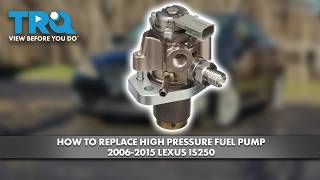
- Leaking High-Pressure Fuel Pump (HPFP): The direct-injection HPFP is mechanically driven by the camshaft. If its internal diaphragm fails, it can leak raw fuel directly into the engine crankcase. This contaminates the oil and the oil vapors are then ingested by the PCV system, causing a severe rich condition. A key symptom is a strong smell of fuel on the oil dipstick. 🎬 Watch: Step-by-step guide to replacing the high-pressure fuel pump.
- Stuck Open EVAP Purge Valve: The EVAP purge valve (or VSV) controls the flow of stored fuel vapors from the charcoal canister to the intake manifold. If it gets stuck open, it allows un-commanded fuel vapors into the engine, creating a rich condition, particularly at idle. This is often overlooked as EVAP faults usually trigger P04xx codes, not fuel trim codes.
Diagnosis Steps

- Check for other DTCs. If P0172 is also present, focus on components common to both banks (MAF, PCV, Fuel Pressure, HPFP). If only P0175 is present, focus on components specific to Bank 2 (A/F sensor, injectors).
- Using a scan tool, check the long-term and short-term fuel trims for Bank 2 at idle and at 2500 RPM. For P0175, you will see highly negative numbers (e.g., -20% or more), indicating the ECM is pulling fuel.
- Inspect the air intake system for any blockages or a severely clogged air filter.
- Clean the MAF sensor using a dedicated cleaner. Inspect the live data to see if the g/s reading is plausible (e.g., 3.4-4.5 g/s at warm idle). Reset the ECU using a scan tool or by disconnecting the battery for 30 minutes and re-test.
- If the code returns (or if only P0175 was present), test the Bank 2, Sensor 1 Air/Fuel Ratio sensor on the driver's side. Monitor its live data for rapid fluctuations around 3.3V and check its heater circuit resistance with a multimeter (target: 0.8-1.4 ohms).
- Check fuel pressure. Using a scan tool, monitor the high-side fuel pressure, which should be between 580 and 1885 psi (4-13 MPa) depending on engine load. A mechanical gauge can be used to check the low-side pressure (44-50 psi).
- Inspect for a leaking High-Pressure Fuel Pump (HPFP). Remove the oil filler cap or dipstick and check for a strong raw fuel smell, which indicates fuel is contaminating the engine oil.
- Test the PCV system by checking crankcase vacuum with a gauge on the dipstick tube. Look for a reading of 17-20 in. Hg at idle.
- If the problem is isolated to Bank 2 and sensors are good, inspect the fuel injectors on that bank for leaks by checking the spark plugs for soot and fuel smell.
Parts You'll Likely Need

- Air/Fuel Ratio Sensor (Bank 2, Sensor 1)
(OEM #89467-30010)— This is the primary sensor for fuel mixture feedback on Bank 2 (driver's side). They have a finite lifespan and are a very common failure item causing rich or lean codes. Owner forums strongly advise using the OEM Denso part to avoid compatibility issues.
Trusted brands: Denso
OEM price range: $150-$200
Aftermarket price range: $100-$150 - Mass Airflow (MAF) Sensor
(OEM #22204-31020)— A dirty or faulty MAF sensor is a very common cause for rich codes on both banks (P0172 & P0175). Cleaning is often sufficient, but if replacement is needed, the Denso OEM part is highly recommended by other owners to prevent compatibility problems.
Trusted brands: Denso
OEM price range: $70-$150
Aftermarket price range: $40-$90
Related Codes That Often Appear With This One
- P0172 — This is the code for 'System Too Rich' on Bank 1 (passenger side). If both P0172 and P0175 are present, the cause is almost certainly a component common to both banks, such as the MAF sensor, fuel pressure regulator, PCV system, or a leaking high-pressure fuel pump.
- P0101 — This code indicates a fault with the MAF sensor circuit range or performance. It strongly points to the MAF sensor being the root cause when seen with P0172 and P0175, as the ECM has detected that the sensor's output is illogical.
Technical Service Bulletins (TSBs) & Recalls
- L-SB-0061-09: For 2006 IS250 models, addresses a M.I.L. 'ON' with DTC P0172 & P0175 by reprogramming the ECM.
- LB-SB-0092-09: A manufacturer bulletin notes that for certain rich conditions involving DTCs P0172 and P0175, the corrective action may include replacing oxygen sensors and the computer, as referenced in NHTSA ODI #10483392.
Platform-Specific Known Issues
- The Importance of OEM Sensors: Multiple owner experiences on ClubLexus forums stress the importance of using Denso-branded MAF and Air/Fuel ratio sensors. In one case, a user installed an aftermarket MAF sensor which failed to resolve the P0172/P0175 codes; the issue was only fixed after installing a genuine Denso sensor. This suggests the ECM is sensitive to the precise calibration of OEM components.
- Difficulty of Bank 2 A/F Sensor Replacement: Owners who have performed the A/F sensor replacement themselves note that the Bank 2 (driver's side on LHD models) sensor is significantly more difficult to access than the Bank 1 sensor. The Bank 1 sensor replacement is often a quick, 15-20 minute job, while the Bank 2 sensor can take over an hour due to tighter clearances and components that need to be moved.
- ALLDATA Confirmed PCV Valve Fix: A 2012 IS250 with 139,000 miles presented with both P0172 and P0175 codes. Fuel trims were -20% at idle. After ruling out other causes, a technician, guided by ALLDATA Tech-Assist, tested crankcase vacuum at the dipstick tube and found it was only 10 in. Hg (spec is 17-20 in. Hg). Replacing the faulty PCV valve completely resolved the issue.
Mechanic-Grade Diagnostic Values
- High-Pressure Fuel System Pressure — expected: 580 to 1885 psi (4 to 13 MPa), varies with load. Failure: Pressure that is excessively high at idle or does not respond to load changes.
- Low-Pressure Fuel System Pressure — expected: 44 to 50 psi. Failure: Pressure significantly above or below this range.
- Crankcase Vacuum at Dipstick Tube — expected: 17-20 in. Hg at idle. Failure: A reading of 10 in. Hg or less indicates a faulty PCV system or other vacuum issue.
- A/F Sensor Heater Resistance — expected: 0.8 to 1.4 ohms at 68°F (20°C). Failure: A reading outside this range indicates a faulty heater circuit in the sensor.
- Mode $06 Test ID $81 — expected: Value should be below the maximum threshold specified in the scan tool.. Failure: If the measured value exceeds the maximum limit, it indicates a slow A/F sensor response rate, even if it hasn't set a specific sensor code yet.
Hidden / Shadow Codes Worth Checking
- Pending DTCs (Mode $07): A pending code is stored on the first trip a fault is detected. If the same fault is seen on a second consecutive trip, the MIL is illuminated and a permanent DTC is stored. Checking Mode $07 can reveal intermittent issues before they become hard faults. (see via Any professional scan tool or advanced OBD-II reader that supports Mode $07.)
- Mode $06 Test Data: Mode $06 provides raw test results for non-continuous monitors. For P0175, TID $81 (Test ID for O2/AF sensor monitor) is relevant. A value approaching or exceeding the manufacturer's limit can indicate a sensor is becoming slow or failing before a DTC is set. (see via A scan tool that can display Mode $06 data. The data is presented as Test IDs (TID) or Monitor IDs (MID).)
Scan Tool Commands That Help
- Toyota Techstream: Active Test: Control the Injection Volume for A/F sensor — This allows a technician to manually command a richer or leaner mixture and observe the live A/F sensor voltage to confirm if the sensor responds quickly and correctly. It's a definitive way to test sensor function.
- Toyota Techstream: Active Test: Control the Purge VSV — This command manually opens and closes the EVAP purge valve. A technician can use this to check if the valve is physically stuck open or closed, which can help diagnose an often-missed cause of rich conditions.
- Toyota Techstream: Utility: Reset Memory — After a repair (like cleaning the MAF or replacing a sensor), this function should be used to clear all learned fuel trim values from the ECM. This is more thorough than disconnecting the battery and forces the ECM to relearn fuel strategy immediately.
Wiring & Ground Locations

- EB (Ground Point) — On the driver's side of the engine block, near the starter motor.. This is a primary ground point for the engine wiring harness on the driver's side. A loose or corroded connection at 'EB' can cause erratic readings from sensors on Bank 2, including the A/F ratio sensor, leading to incorrect fuel trim adjustments and a P0175 code.
- A/F Sensor Connector (Bank 2) — On a bracket attached to the transmission bell housing on the driver's side of the vehicle.. Knowing the physical location is necessary for testing the sensor's wiring, checking for voltage, and measuring heater resistance directly at the connector without having to remove the sensor itself.
- ECM Connector E3, Pin 7 — At the Engine Control Module (ECM).. This pin provides the 5-volt reference signal to multiple sensors, including the fuel pressure sensor. A short-to-ground on this circuit can cause multiple codes and rich/lean issues.
Real Owner Repair Stories
- ALLDATA Case Study (2012 Lexus IS250, 139,007 miles) — Intermittent MIL with P0172 and P0175. Fuel trims were -20% at idle but improved when cruising.
❌ Tried (didn't work) Checked EVAP purge valve (was sealed shut).
✅ What actually fixed it The technician tested crankcase vacuum at the dipstick tube and found only 10 in. Hg (spec is 17-20). Replacing the faulty PCV valve resolved the issue. - ClubLexus Forum User (2006 IS250) — P0172 and P0175 codes, car would buck under heavy acceleration.
❌ Tried (didn't work) Cleaning the MAF sensor., Replacing both upstream A/F sensors with new Denso parts.
✅ What actually fixed it The final fix was replacing a leaking high-pressure fuel pump (HPFP). A key symptom the owner noted was a smell of fuel in the engine oil, indicating the pump's diaphragm had failed and was leaking fuel into the crankcase. - YouTube Repair Video (Vehicle unspecified, but codes P0172, P0175, P0442, P0455 present.) — Check engine light with both rich condition and EVAP leak codes.
❌ Tried (didn't work) Initial diagnosis pointed towards separate fuel and EVAP issues.
✅ What actually fixed it A single faulty EVAP purge solenoid was stuck open intermittently. This allowed raw fuel vapors into the intake manifold, causing the rich codes (P0172/P0175), and also registered as a leak in the EVAP system (P0442/P0455). Replacing the purge valve fixed all four codes. - NHTSA ODI #10483392 — An owner reported that for rich conditions involving DTCs P0172 and P0175, manufacturer service documentation suggests replacing oxygen sensors and the computer as part of the corrective action.
"I Checked Everything" — The Actual Cause
- A smoke test is used to find vacuum leaks, which cause lean codes (P0171/P0174). For a rich code like P0175, a smoke test is generally not the correct procedure. The more relevant pattern is 'all sensors test good, but the code persists.' In these cases, the cause is often a mechanical component delivering excess fuel, such as a leaking high-pressure fuel pump (leaking into the oil) or a stuck-open EVAP purge valve (leaking fuel vapor into the intake). Neither of these faults would be found with a standard intake smoke test.
When the Usual Fixes Don't Work
- Multiple owner reports confirm that simply cleaning the MAF sensor and replacing the Bank 2 A/F sensor did not fix their P0175 code. In one well-documented case, after replacing both common parts with no success, the root cause was identified as a leaking high-pressure fuel pump that was contaminating the engine oil. In another scenario, a faulty PCV valve was the confirmed fix after sensors were ruled out. These cases highlight the need to look beyond the most common electronic sensor failures and investigate mechanical components that can introduce un-metered fuel or disrupt crankcase vacuum.
OEM Part Supersession History
89467-30010→89467-30010 (current)— This part number has remained stable for the A/F Ratio Sensor.
Heads up: While the OEM part number is stable, owner and technician reports consistently warn against using aftermarket A/F sensors. Many aftermarket versions do not meet the precise calibration required by the Lexus ECM, leading to persistent or new fuel trim codes. Sticking with the Denso OEM part is critical.
Model Year Variations Within This Range
- 2006: A specific ECM calibration update was released under TSB L-SB-0061-09 to correct a logic issue that could falsely trigger P0172 and P0175. Later model years already have this or a newer calibration.
- 2006-2010: These model years were subject to a Lexus Customer Support Program (CSP) for excessive carbon buildup on intake valves and pistons. While this typically causes misfire codes (P030x), severe cases can affect engine breathing and contribute to overall fuel control problems. A vehicle's history should be checked to see if this service was performed.
Diagnostic Flowchart
Real Owner Stories
Aggregated from forums and TSBs cited above. Mileages and costs reflect what owners reported in those sources.
2012 Lexus IS250 — 139000 miles
Symptoms: Check engine light on with both P0172 and P0175 codes present. Fuel trims were reading -20% at idle.
What fixed it: Tested crankcase vacuum at the dipstick tube and found it was only 10 in. Hg. Replaced the faulty PCV valve, which completely resolved the issue.
Source hint: ALLDATA Confirmed PCV Valve Fix
2006-2013 Lexus IS250
Symptoms: Vehicle running rich with P0175 and P0172 codes returning shortly after installing a non-OEM replacement MAF sensor.
What fixed it: Removed the aftermarket MAF sensor and installed a genuine Denso OEM sensor.
Source hint: ClubLexus: P0175/P0172 Running Rich - Aftermarket MAF Failure
2006-2013 Lexus IS250
Symptoms: Experiencing rich codes on both engine banks (P0172, P0175) accompanied by a MAF-specific code (P0101).
What fixed it: Cleaned or replaced the MAF sensor with an OEM Denso part sourced from RockAuto.
Source hint: ClubLexus: P0172, p0175,.p0101 - MAF Discussion
2006 Lexus IS250
Symptoms: Malfunction Indicator Lamp (M.I.L.) illuminated with DTCs P0172 and P0175 stored in the computer.
What fixed it: Reprogrammed the Engine Control Module (ECM) with updated software.
Source hint: L-SB-0061-09
Related OBD-II Codes
Frequently Asked Questions
Is there a Technical Service Bulletin (TSB) for the P0175 code on my 2006 Lexus IS250?
Which brand of MAF or Air/Fuel sensor should I buy to fix this code?
Where is the Bank 2 Air/Fuel ratio sensor located on the IS250, and is it hard to replace?
Can a bad PCV valve cause a P0175 rich code on the 4GR-FSE engine?
Why is my IS250 displaying a 'Check VSC' message along with the Check Engine Light?
How can I test if my MAF sensor is causing the P0175 code before buying a new one?
Helpful Videos
Used OEM Parts in Stock
New Aftermarket Parts Available


The information in this article is provided for general reference and educational purposes only. Vehicle specifications, procedures, and part compatibility can vary by production date, trim level, and region. Always consult your vehicle's factory service manual and verify part numbers before purchasing or performing repairs. Safety-critical components such as airbags, seat belts, and braking systems should be installed by a qualified professional.
- Lexus IS250:
- 🎬 Helpful Videos
- 🛍️ Shop This Part
- What's Unique About the 2006-2013 Lexus IS250
- Symptoms You May Notice
- Most Likely Causes
- Rare But Worth Checking
- Diagnosis Steps
- Parts You'll Likely Need
- Related Codes That Often Appear With This One
- Technical Service Bulletins (TSBs) & Recalls
- Platform-Specific Known Issues
- Mechanic-Grade Diagnostic Values
- Hidden / Shadow Codes Worth Checking
- Scan Tool Commands That Help
- Wiring & Ground Locations
- Real Owner Repair Stories
- "I Checked Everything" — The Actual Cause
- When the Usual Fixes Don't Work
- OEM Part Supersession History
- Model Year Variations Within This Range
- Diagnostic Flowchart
- Real Owner Stories
- 2012 Lexus IS250 — 139000 miles
- 2006-2013 Lexus IS250
- 2006-2013 Lexus IS250
- 2006 Lexus IS250
- Related OBD-II Codes
- Frequently Asked Questions
- 🎟️ Get 5% Off