

P0175 on 2007-2011 Honda CR-V: Why It's Likely P0172 and How to Fix It
The code P0175 (System Too Rich, Bank 2) is incorrect for the 4-cylinder Honda CR-V, which only has one bank. The actual code is almost certainly P0172 (System Too Rich, Bank 1). The most common fix is replacing a faulty upstream Air/Fuel Ratio (O2) sensor, which costs about $100-$180 for a quality part. Leaking fuel injectors are the next most likely cause.
- P0175 is the wrong code for your 4-cylinder CR-V; the real code is P0172 (System Too Rich, Bank 1).
- The most probable cause is a failing upstream Air/Fuel Ratio sensor (also called an O2 sensor).
- If a new A/F sensor doesn't fix it, the next step is to investigate for leaking fuel injectors or a bad fuel pressure regulator.
- Check your engine oil. A strong smell of gasoline is a key symptom that points towards a rich condition, likely from leaking injectors.
- Do not replace the downstream (after-catalyst) O2 sensor to fix this code.
What's Unique About the 2007-2011 Honda CR-V

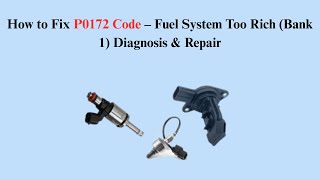
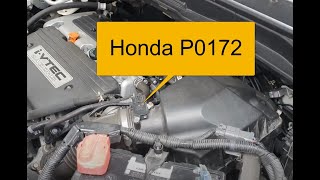
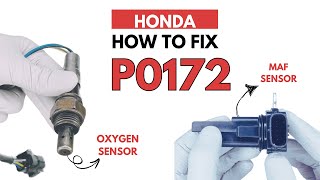
The third-generation CR-V with the K24Z engine is known for its general reliability. Unlike the later 1.5L turbo models which have widespread, documented issues with fuel injectors causing a rich condition and oil dilution, the problem is less common on this platform. For the 2007-2011 models, a P0172 code is most often a classic failure of a high-mileage Air/Fuel Ratio sensor. 🎬 Watch this video for a complete P0172 diagnosis and repair guide. However, as documented in owner forums, this code can sometimes be difficult to resolve, with some owners replacing multiple components before finding the root cause. Leaking fuel injectors or a faulty fuel pressure regulator are still distinct possibilities that should be investigated if a new A/F sensor doesn't solve the issue.
Symptoms You May Notice
- Check Engine Light is on
- Strong smell of raw gasoline from the exhaust or in the engine oil.
- Decreased fuel economy.
- Rough or unstable idle.
- Engine hesitation or reduced power, especially on initial acceleration.
- Black smoke from the tailpipe in severe cases.
- Black, sooty deposits on the exhaust tip.
- Replacing the downstream (post-catalytic converter) oxygen sensor. This sensor's primary role is to monitor catalyst efficiency and it does not control the primary air-fuel mixture.
- Searching for 'Bank 2' components. As this engine only has one bank, any time spent looking for Bank 2 sensors or injectors will be wasted.
Most Likely Causes


- Faulty Upstream Air/Fuel Ratio Sensor (Bank 1, Sensor 1) 🔴 High Probability The A/F sensor is a primary input for fuel mixture calculations and is a common wear-and-tear item. It can become lazy or biased over time, sending incorrect data that causes the computer to enrich the mixture. This is the most frequent cause of P0172 on K24 engines.
How to confirm: Use an OBD-II scanner to monitor the live data for the 'B1S1' O2 sensor. A healthy sensor's voltage should fluctuate rapidly. If the voltage is stuck high (e.g., above 0.8V) or responds very slowly, the sensor is likely faulty. On some Honda systems, the A/F sensor voltage may read around 2.5V at idle when faulty, while the downstream sensor reads around 0.5V. A sensor that is stuck near 0.9 volts or switches very slowly is likely aged and sending inaccurate rich readings.
Typical fix: Replace the upstream Air/Fuel Ratio sensor located in the exhaust manifold before the catalytic converter. Use of a quality OEM-brand part (like Denso or NTK) is highly recommended.
Est. part cost: $90-$180 - Leaking or Stuck Fuel Injector(s) 🟡 Medium Probability Injectors can fail mechanically or become clogged with deposits, causing them to leak fuel into a cylinder even when closed. This adds uncommanded fuel and creates a rich condition. Over time, this can lead to significant carbon buildup on the injector tips and spark plugs.
How to confirm: After the engine has been off for a while, pull the spark plugs. If one plug is wet with fuel or significantly blacker and sootier than the others, its corresponding injector is likely leaking. A professional can perform a fuel injector balance test or you can remove the fuel rail with injectors attached, prime the system, and watch for drips. You can also test the injector's coil resistance with a multimeter; for the K24 engine, high-impedance injectors should read around 12.2-12.3 Ohms.
Typical fix: Replace the faulty fuel injector(s). 🎬 See this walkthrough on how to replace 2.4L Honda fuel injectors. It is often recommended to replace all four as a matched set to ensure balanced performance, especially on a high-mileage vehicle.
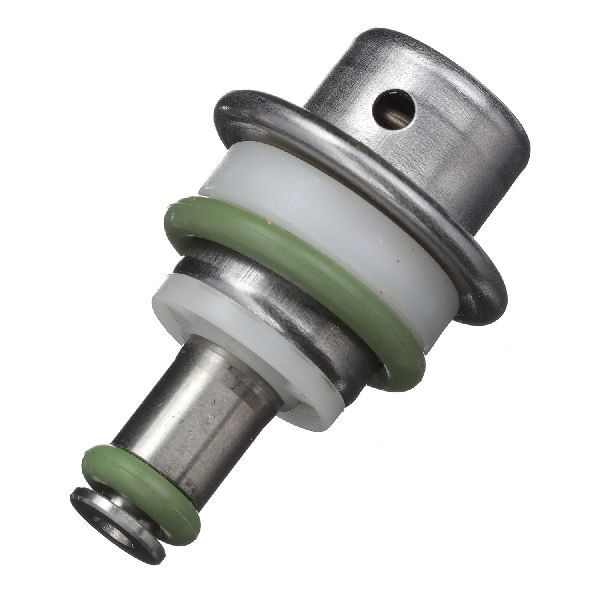
Est. part cost: $50-$100 per injector - Faulty Fuel Pressure Regulator ⚪ Low Probability The regulator maintains correct pressure in the fuel rail. If its internal diaphragm ruptures, it can allow fuel pressure to become excessive, forcing too much fuel through the injectors.
How to confirm: Connect a fuel pressure gauge to the fuel rail's service port. For this CR-V, fuel pressure should be around 50 psi. Compare the reading to the manufacturer's specification. Also, pull the vacuum line off the regulator; if raw fuel is present in the vacuum hose, the diaphragm has failed.
Typical fix: Replace the fuel pressure regulator.
Est. part cost: $40-$80 - Dirty or Faulty Mass Air Flow (MAF) Sensor ⚪ Low Probability While less common for causing a rich code (it usually causes a lean code), a contaminated MAF sensor can under-report the amount of air entering the engine, causing the computer to calculate an overly rich fuel mixture.
How to confirm: Inspect the sensor element for dirt or debris. Cleaning with a dedicated MAF sensor cleaner is a simple first step. If cleaning doesn't work, monitoring the sensor's output (grams/second) with a scanner can confirm if it's reading incorrectly for a given RPM. A normal reading at 2500 RPM should be between 4.1 and 5.7 g/s.
Typical fix: Clean the MAF sensor with a dedicated electronic cleaner. If the problem persists, replace the sensor.
Est. part cost: $15 (cleaner) or $70-$150 (sensor)
Rare But Worth Checking
- Fuel-Contaminated Engine Oil: This is usually a symptom of leaking injectors, but it can also become a cause itself. Fuel vapors from the oil are pulled through the PCV system into the intake, adding unmetered fuel and worsening the rich condition. Always smell the oil on the dipstick; if it smells strongly of gas, an oil change is critical along with fixing the root cause. A diagnostic test involves pinching the PCV hose at idle and observing the Short-Term Fuel Trim (STFT); if the value drops significantly, it suggests fuel vapor is being ingested from the crankcase.
- Faulty Engine Coolant Temperature (ECT) Sensor: A faulty ECT sensor stuck on a 'cold' reading will cause the ECU to permanently enrich the fuel mixture, as if the engine is always in its warm-up phase. This can be diagnosed by comparing the ECT reading on a scanner to the actual engine temperature.
Diagnosis Steps
- Confirm the code with a quality OBD-II scanner. If it shows P0175, assume it is a misreading of P0172.
- Check live data on the scanner. Look at Long-Term Fuel Trim (LTFT) for Bank 1. A strongly negative number (e.g., -15% to -25% or more) confirms the computer is trying to correct a rich condition.
- Check the engine oil dipstick. Note if the oil level is high or if it smells strongly of raw gasoline. If so, an oil change is necessary after the repair.
- Inspect the upstream Air/Fuel Ratio sensor (B1S1) data. If it is stuck high, slow to respond, or showing an abnormal fixed voltage, it is the most likely culprit.
- If the A/F sensor appears to be working, inspect for leaking fuel injectors by checking the spark plugs for heavy black soot or fuel fouling.
- Test the fuel pressure to rule out a faulty fuel pressure regulator. It should be near 50 psi.
- Inspect and clean the Mass Air Flow (MAF) sensor as a final, less likely step.
Parts You'll Likely Need
- Upstream Air/Fuel Ratio Sensor
(OEM #36531-RZA-013)— This is the primary sensor for air-fuel control and a common failure item that directly causes a rich condition. Also cross-references to 36531-RZA-003.
Trusted brands: Denso (OEM supplier), NGK/NTK
OEM price range: $180-$220
Aftermarket price range: $90-$160 - Fuel Injector
(OEM #16450-RAA-A01)— The second most likely cause, a leaking injector, will directly cause a rich condition.
Trusted brands: Honda (OEM), Hitachi (OEM supplier), Standard Motor Products
OEM price range: $75-$130
Aftermarket price range: $45-$80
Related Codes That Often Appear With This One
- P0300-P0304 — A severe rich condition can foul spark plugs and lead to random (P0300) or specific cylinder (P0301-P0304) misfires.
Technical Service Bulletins (TSBs) & Recalls
- TSB 09-007: Addresses a potential failure of the drive belt auto-tensioner pivot bolt by replacing the bolt and rerouting the belt to reduce stress.
Platform-Specific Known Issues
- There is a major safety recall (NHTSA Campaign Number: 23V-228) for 2007-2011 CR-Vs regarding rear frame corrosion in salt-belt states, which can cause the rear trailing arm to detach. This is unrelated to the P0172/P0175 code but is a critical safety issue for owners to be aware of.
Mechanic-Grade Diagnostic Values

- Long Term Fuel Trim (LTFT) — expected: -10% to +10%. Failure: Exceeds -20% to -25%, confirming a rich condition.
- Upstream A/F (O2) Sensor Voltage — expected: Rapidly fluctuating between ~0.1V and ~0.9V. Failure: Consistently reads high, above 0.8V, with slow or no switching activity.
- Fuel Injector Coil Resistance — expected: ~12.2 to 12.3 Ohms. Failure: Significantly higher or lower reading, or an open circuit (infinite resistance).
- Mass Air Flow (MAF) Sensor Reading at 2500 RPM (no load) — expected: 4.1 g/s to 5.7 g/s. Failure: Readings outside this range suggest a potential MAF sensor malfunction.
- EVAP Canister Purge Valve Vacuum Test (at idle) — expected: No vacuum should be present at the valve's canister-side port when the engine is idling and the valve is electrically disconnected.. Failure: Feeling any vacuum at the port indicates the valve is stuck open, allowing unmetered fuel vapor into the intake.
Scan Tool Commands That Help
- Honda Diagnostic System (HDS) or equivalent professional scanner: A/F Sensor Test — To directly test the response rate and output of the Air/Fuel ratio sensor, which is more definitive than just observing live data.
- Honda Diagnostic System (HDS) or equivalent professional scanner: EVAP Purge Valve ON/OFF — To command the purge valve to open and close while monitoring fuel trims or engine RPM. This helps confirm if the valve is functioning electrically and mechanically, or if it is stuck.
- Honda Diagnostic System (HDS) or equivalent professional scanner: PCM Reset — After replacing a component like an A/F sensor or fuel injectors, a PCM reset is required to clear the learned fuel trim values. Failure to do so can cause the code to return temporarily as the PCM uses old, incorrect data.
Wiring & Ground Locations
- G101 — On the engine block, typically at the left rear of the engine.. This is a primary ground point for multiple engine sensors, including the CKP, CMP, and Knock Sensor. A corroded or loose G101 can cause erratic sensor readings, potentially affecting fuel and timing calculations that could lead to a rich condition.
- G502 / G503 — Located under the center of the dashboard.. This is an interior ground point. While less likely to be the primary cause, poor interior grounds can affect the PCM and other control unit, leading to a variety of electrical issues, including incorrect data processing that could manifest as a fuel trim problem.
- PCM Signal Ground (DLC Pin 5) — Pin 5 of the Data Link Connector (OBD-II port).. This is the sensor ground reference circuit. A problem with this ground path back to the PCM can cause multiple sensors to read incorrectly. In rare cases, a bad PCM ground can cause a no-start or erratic running condition that might be temporarily resolved by the ground provided by a connected scan tool.
Real Owner Repair Stories
- CRV Owners Club Forum (2008 Honda CR-V) — Check engine light with P0172, rough idle, poor fuel economy.
❌ Tried (didn't work) Replaced upstream A/F sensor, Replaced downstream O2 sensor, Cleaned MAF sensor, Replaced spark plugs
✅ What actually fixed it The EVAP purge control solenoid valve was stuck partially open, allowing unmetered fuel vapors into the intake manifold. Replacing the valve (part number often cited as CP642 for this generation) and clearing the codes resolved the issue. - NHTSA ODI #11424526 — An owner reported a P0175 code alongside a P0301 misfire. Upon inspection, the spark plugs showed excessive fouling and required replacement to restore performance.
- NHTSA ODI #11670272 — A technician performing an A/F test for a P0175 code found that all fuel injectors had failed, necessitating a full replacement of the injector set.
"I Checked Everything" — The Actual Cause
- A common scenario for P0172 where a smoke test reveals no vacuum leaks is a faulty EVAP purge valve. The valve can stick open intermittently, allowing fuel vapors from the charcoal canister to be drawn into the intake manifold. This introduces unmetered fuel that the smoke test cannot detect, as it's not an external air leak. Testing involves commanding the valve closed with a scan tool or disconnecting it electrically and applying vacuum to see if it holds.
OEM Part Supersession History
36531-RZA-003→36531-RZA-013— Revision for improved performance or manufacturing process.
Model Year Variations Within This Range
- 2010-2011: The 2010 model year facelift included a minor update to the K24Z engine, increasing horsepower from 166 hp to 180 hp. This was achieved through a higher compression ratio, revised intake/exhaust tuning, and likely different PCM software. While the fundamental causes of P0172 remain the same, diagnostic values or software-related behaviors could differ slightly from 2007-2009 models.
Diagnostic Flowchart
Other Known Issues on This Vehicle
Issues unrelated to this code that are worth knowing about as an owner of this generation:
- VTC Actuator Rattle on Cold Start 🟠 Medium — Very common. A loud, metallic grinding or rattling noise for 1-2 seconds upon starting the engine, especially in colder weather. Caused by a worn locking pin inside the VTC actuator. (Ref: While TSBs like 16-012 exist for later models, the issue is mechanically identical and well-known on this generation. The only fix is replacing the VTC actuator with an updated OEM part.)
- A/C Compressor Clutch Failure 🟠 Medium — Common failure. The A/C may work intermittently or stop blowing cold air entirely. The issue is often the clutch relay or the clutch/coil assembly itself, not always the entire compressor. (Ref: Honda TSB 12-072 was issued, extending the warranty on the A/C compressor clutch to 7 years/100,000 miles, though this has since expired.)
- Power Door Lock Actuator Failure 🟡 Low — Extremely common. Actuators for one or more doors will fail, causing the lock to buzz, cycle repeatedly, or fail to lock/unlock electronically. It is common for multiple actuators to fail over the life of the vehicle. (Ref: A class-action lawsuit led to a warranty extension, and TSBs 14-083 and 14-084 address the diagnosis and replacement.)
- Excessive Oil Consumption 🔴 High — More prevalent on 2010-2011 models but can affect all years. Caused by piston rings that allow oil to bypass into the combustion chamber. Honda considered 1 quart per 1,000 miles 'within specification' for some time. (Ref: A class-action lawsuit was filed for this issue on later models, but the problem originates with the K24 engine design of this era. The cause is often attributed to thin piston rings combined with long oil change intervals.)
- Drive Belt Auto-Tensioner Bolt Failure 🟠 Medium — Rare but documented. The pivot bolt for the drive belt auto-tensioner can break, causing a loss of power steering and other belt-driven accessories. (Ref: Honda Product Update TSB 09-007 was issued to replace the pivot bolt and reroute the drive belt to reduce stress on the tensioner.)
Used vs. New Parts: Buying Guide for This Vehicle
When a used part is the smart pick: For this repair, obtaining used parts is generally not recommended for the most common failure items. However, a used EVAP purge valve from a low-mileage donor vehicle could be a cost-effective option if that is the diagnosed fault.
Donor-vehicle mileage cap: roughly under 80000 miles for the part to have meaningful remaining life.
What to inspect on the donor part:
- Check for a clean, rust-free donor vehicle, especially if sourcing electrical components or grounds.
- For a used purge valve, ensure the plastic housing is not cracked and the connector pins are clean.
- Ask for the VIN of the donor car to verify mileage and model year compatibility.
OEM-only on this vehicle (don't cheap out):
- Air/Fuel Ratio Sensor: Aftermarket sensors are notoriously problematic and can fail to meet the precise specifications required by the Honda PCM, often causing the code to return. Using an OEM supplier like Denso or NTK is critical.
- PCM/ECU: A used PCM must be reprogrammed by a dealer or a specialist with a Honda Diagnostic System (HDS) to match the vehicle's immobilizer system. This can be complex and costly.
Aftermarket brands forum-validated for this vehicle:
- Denso (for A/F Sensor - OEM supplier)
- NGK/NTK (for A/F Sensor - OEM supplier)
- Hitachi (for Fuel Injectors - OEM supplier)
Brands owners have reported issues with on this vehicle:
- Off-brand, un-named 'eBay special' or 'Amazon generic' Air/Fuel ratio sensors. These frequently have incorrect heater resistance or slow response times, leading to persistent fuel trim issues.
Real Owner Stories
Aggregated from forums and TSBs cited above. Mileages and costs reflect what owners reported in those sources.
2010 Honda CR-V 2.4L K24
Symptoms: The vehicle was running rich with a Long-Term Fuel Trim (LTFT) at -22%. The owner had already replaced the A/F sensor, MAF, MAP, spark plugs, and timing chain, but the issue persisted.
What fixed it: The owner confirmed fuel pressure was at 50-55 psi during the diagnostic process.
Source hint: r/MechanicAdvice: 2010 Honda CR-V (k24) P0172 Running Rich
Related OBD-II Codes
Frequently Asked Questions
My scanner shows P0175 on my 2010 CR-V, but this engine only has one bank. Is this a mistake?
Is there a specific brand of Air/Fuel Ratio sensor I should use for my 2007-2011 CR-V?
Could the rattling sound I hear on cold starts be related to my P0175 code?
Is there a recall for the 2007-2011 CR-V that I should be aware of while fixing this?
What should the fuel pressure be on my 2008 CR-V to rule out the regulator?
Can I just clean the sensor instead of replacing it?
Helpful Videos
Used OEM Parts in Stock
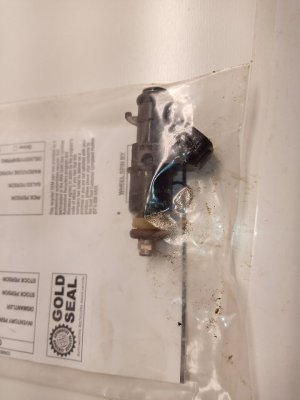

New Aftermarket Parts Available

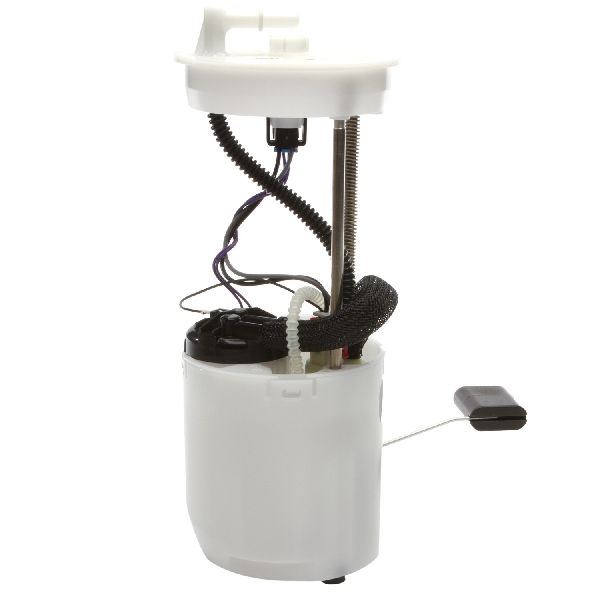

The information in this article is provided for general reference and educational purposes only. Vehicle specifications, procedures, and part compatibility can vary by production date, trim level, and region. Always consult your vehicle's factory service manual and verify part numbers before purchasing or performing repairs. Safety-critical components such as airbags, seat belts, and braking systems should be installed by a qualified professional.
- Honda CR-V:
- 🎬 Helpful Videos
- 🛍️ Shop This Part
- What's Unique About the 2007-2011 Honda CR-V
- Symptoms You May Notice
- Most Likely Causes
- Rare But Worth Checking
- Diagnosis Steps
- Parts You'll Likely Need
- Related Codes That Often Appear With This One
- Technical Service Bulletins (TSBs) & Recalls
- Platform-Specific Known Issues
- Mechanic-Grade Diagnostic Values
- Scan Tool Commands That Help
- Wiring & Ground Locations
- Real Owner Repair Stories
- "I Checked Everything" — The Actual Cause
- OEM Part Supersession History
- Model Year Variations Within This Range
- Diagnostic Flowchart
- Other Known Issues on This Vehicle
- Used vs. New Parts: Buying Guide for This Vehicle
- Real Owner Stories
- 2010 Honda CR-V 2.4L K24
- Related OBD-II Codes
- Frequently Asked Questions
- 🎟️ Get 5% Off