

P0175 on 2009-2016 GMC Yukon: System Too Rich (Bank 2) Causes and Fixes
On a 2009-2016 GMC Yukon, code P0175 (System Too Rich Bank 2) is frequently caused by an incorrect fuel alcohol content reading on Flex Fuel models or a dirty/faulty Mass Air Flow (MAF) sensor. Resetting the fuel composition with a scan tool or cleaning/replacing the MAF sensor are the most common fixes. For 2015+ models with direct injection, a leaking high-pressure fuel pump is also a primary suspect.
- For Flex Fuel GMC Yukons, the first step for a P0175 code should be checking the fuel alcohol percentage with a scan tool. An incorrect reading is a very common cause and is free to fix if you have the right tool.
- The second most likely cause is a dirty or faulty Mass Air Flow (MAF) sensor. Cleaning the sensor is a cheap and easy diagnostic step.
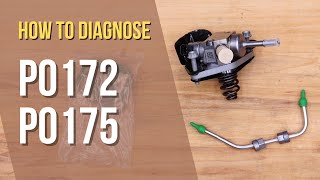
- If both engine banks are running rich (codes P0172 and P0175), the problem is almost certainly a system-wide issue like the MAF sensor or fuel composition, not a single bad injector or O2 sensor.
- Driving for too long with a rich condition can cause expensive damage to your catalytic converters, so it's best to address this code promptly.
What's Unique About the 2009-2016 Gmc YUKON
For this generation of GMC Yukon, especially Flex Fuel (E85-capable) models, the P0175 code is often not due to a simple part failure. The vehicle uses a 'virtual' sensor, an algorithm to estimate the ethanol percentage in the fuel, and this system can become skewed, causing the engine to inject too much fuel. A specific TSB (PIP4792D) addresses this exact issue, noting that if the scanned alcohol content is 17% or more different than the actual measured content, an ECM reprogram and reset are needed. Additionally, another TSB (PIP5446A) points to a unique manufacturing defect where casting flash in the intake tube can disrupt airflow across the Mass Air Flow (MAF) sensor, leading to a rich condition. For 2015 and newer models with direct injection, a leaking high-pressure fuel pump (HPFP) is a very common cause, leaking fuel internally into the crankcase.
Diagnostic Flowchart
Tap your situation to follow the diagnostic path that matches what you're seeing on this vehicle.
Generation note: This range covers the end of the third generation (2009-2014, GMT900 platform) and the beginning of the fourth generation (2015-2016, K2UG platform). The cited TSBs and common causes are relevant to engines used in both generations. However, the leaking high-pressure fuel pump issue is specific to the direct injection engines introduced in the 2015+ K2UG models. The fuel alcohol content and MAF sensor issues are common across the entire 2009-2016 range.
Symptoms You May Notice
- Check Engine Light is on
- Poor fuel economy
- Rough idle, especially on cold starts
- Black smoke from the exhaust
- Strong smell of gasoline from the exhaust
- Engine hesitation or reduced power
- Engine may continue to sputter or run-on for a few seconds after being turned off
- Hard starting or long crank times
- Harsh or jerky shifting
- Replacing oxygen sensors immediately. While an O2 sensor can be the cause, it's often just correctly reporting the rich condition caused by another component, like the MAF sensor, incorrect fuel alcohol reading, or a leaking HPFP.
Most Likely Causes
- Incorrect Fuel Alcohol Content Reading 🔴 High Probability These Yukons often use a 'virtual' flex fuel sensor that estimates ethanol content rather than measuring it directly. Refueling habits (like short-filling the tank) or software glitches can cause this calculated value to become incorrectly high, leading the PCM to command excessive fuel injection. TSB PIP4792D directly addresses this, recommending a check of the value and a potential ECM reprogram if it's off by more than 17%.
How to confirm: Use a scan tool to view the "Fuel Alcohol Content" or "Ethanol Percentage" PID. If the vehicle has standard E10/E15 gasoline in the tank but the reading is high (e.g., over 20-30% or more), the reading is incorrect. One owner on YouTube with a 2010 Escalade showed a reading of 57% ethanol, which caused severe negative fuel trims until it was reset.
Typical fix: Use a capable scan tool to perform a "Fuel Composition Reset" or "Fuel Alcohol Content Reset". This resets the learned value back to a baseline, typically around 3-10%. The tank should contain standard gasoline (E10 or less) when performing the reset. It is also wise to reset the fuel trims at the same time.
Est. part cost: $0 - Dirty or Faulty Mass Air Flow (MAF) Sensor 🔴 High Probability The MAF sensor measures the air entering the engine. If it's dirty (especially from oiled air filters) or faulty, it can send incorrect data, causing the PCM to miscalculate the fuel needed. TSB PIP5446A specifically notes that excess casting flash in the air filter housing can disrupt airflow and cause this code, along with P0101.
How to confirm: Inspect the MAF sensor for dirt or debris. Check the intake tube for any obstructions, paying close attention to the area around the sensor for casting flash as noted in the TSB. A scan tool can show MAF readings; abnormally high readings at idle can indicate a problem. Unplugging the MAF sensor and seeing if the fuel trims improve can be a quick diagnostic test, though it will set other codes.
Typical fix: Clean the MAF sensor with a dedicated MAF sensor cleaner spray. If cleaning doesn't work, or if the intake housing has casting flash, the sensor or air filter housing lid may need to be replaced.
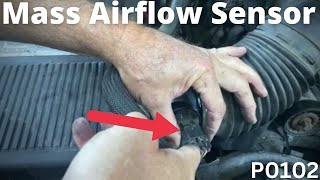
Est. part cost: $10-$15 for cleaner, $70-$180 for a new sensor 🎬 See how to clean or replace your MAF sensor.
- Leaking High-Pressure Fuel Pump (Direct Injection Engines) 🔴 High Probability On 2015+ models with direct injection, the high-pressure fuel pump (HPFP) is driven by the camshaft and located under the intake manifold. A common failure is an internal seal leak, which dumps raw fuel directly into the crankcase. These fuel vapors are then drawn into the intake via the PCV system, creating a severe rich condition that is not metered by the MAF sensor.
How to confirm: The most definitive symptom is a strong smell of gasoline in the engine oil and a rising oil level on the dipstick. A diagnostic step involves disconnecting and capping the PCV line to the intake manifold; if the fuel trims quickly return to normal, it confirms that unmetered fuel vapors from the crankcase are the cause. This was discussed in a Tahoe Yukon Forum thread where a user with P0172/P0175 suspected the HPFP.
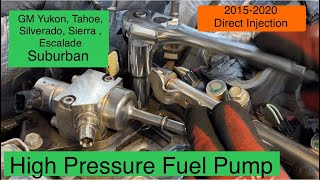
Typical fix: Replacement of the high-pressure fuel pump. This is an involved repair as it requires removing the intake manifold. 🎬 Watch: Step-by-step high pressure fuel pump replacement guide. An oil change is mandatory after the repair to remove the fuel-contaminated oil.
Est. part cost: $250-$500 - Leaking Fuel Injector(s) 🟡 Medium Probability
How to confirm: Perform a fuel pressure leak-down test. After pressurizing the fuel rail, turn the engine off and monitor the pressure. A steady drop in pressure can indicate one or more leaking injectors. You can also remove the spark plugs on Bank 2 and check for a strong fuel smell or a single plug that is excessively black and sooty compared to the others.
Typical fix: Replace the faulty fuel injector(s). It's often recommended to replace them as a set for the affected bank or all at once.
Est. part cost: $50-$120 per injector - Faulty Upstream Oxygen (O2) Sensor ⚪ Low Probability
How to confirm: A faulty O2 sensor can get 'stuck' reading a lean condition (low voltage), causing the PCM to add more fuel than necessary until it creates a rich condition. Use a scan tool to monitor the Bank 2 Sensor 1 voltage. It should fluctuate rapidly between approximately 0.1V and 0.9V. If it's stuck at a low voltage or is very slow to respond, it may be faulty.
Typical fix: Replace the Bank 2, Sensor 1 (upstream) oxygen sensor.
Est. part cost: $50-$100
Rare But Worth Checking
- Leaking EVAP Purge Valve: A purge valve stuck open can allow un-metered fuel vapors from the charcoal canister to enter the intake manifold at idle, creating a rich condition. This would typically affect both banks, also causing a P0172. 🎬 Watch: A professional walkthrough of GM rich condition troubleshooting. A technician can command the valve closed with a scan tool and see if fuel trims improve.
- High Fuel Pressure: A failing fuel pressure regulator (on models where it is separate) can cause system-wide high fuel pressure, forcing too much fuel through the injectors. This usually sets codes for both banks (P0172 and P0175).
Diagnosis Steps
- Use an OBD-II scanner to confirm P0175 and check for any other codes, like P0172 or P0101.
- If it's a Flex Fuel model, check the 'Fuel Alcohol Content' percentage on the scan tool. If it's high (e.g., >20%) and you're using regular gasoline, perform a 'Fuel Composition Reset'. Then, reset fuel trims.
- If the alcohol content is normal, inspect the air intake system. Check the air filter and look for any obstructions or debris in the intake tube.
- Carefully remove and inspect the MAF sensor. Clean it with dedicated MAF cleaner spray. Inspect the MAF housing for any casting flash as described in TSB PIP5446A.
- For 2015+ models, check the engine oil for a strong gasoline smell and check if the oil level is overfull on the dipstick. This points to a leaking High-Pressure Fuel Pump (HPFP).
- Use the scan tool to monitor live data. Watch the Short Term and Long Term Fuel Trims for Bank 2 (STFT2 and LTFT2). They will be significantly negative (e.g., -15% to -30%).
- Isolate other potential vapor sources. Disconnect and plug the EVAP purge valve line and the PCV line to the intake manifold one at a time, observing if the fuel trims improve.
- Test the fuel pressure to ensure it is within the manufacturer's specified range.
Parts You'll Likely Need
- Mass Air Flow (MAF) Sensor
(OEM #ACDelco 23256991 (for many 2009-2014 models), ACDelco 12671610 (for many 2015-2016 models))— A dirty or faulty MAF sensor is a primary cause of incorrect air-fuel ratio calculations on these trucks. It's a common failure point and is specifically mentioned in TSB PIP5446A.
Trusted brands: ACDelco, Delphi, Denso
OEM price range: $120-$180
Aftermarket price range: $70-$150 - High-Pressure Fuel Pump — For 2015+ direct injection models, this is a very common failure point that leaks fuel into the crankcase, causing rich codes P0172 and P0175.
Trusted brands: ACDelco, Bosch
OEM price range: $300-$500
Aftermarket price range: $200-$400 - Upstream Oxygen Sensor (Bank 2, Sensor 1) — If the sensor itself fails and gets stuck in a lean-reading state, it will cause the computer to command excess fuel, triggering a rich code. This is less common than other causes.
Trusted brands: ACDelco, Denso, Bosch
OEM price range: $70-$120
Aftermarket price range: $50-$100 - Fuel Injector — An injector can leak or get stuck open, dumping excess fuel into a single cylinder on Bank 2. This is more likely if only P0175 is present without P0172.
Trusted brands: ACDelco, Bosch, Standard Motor Products
OEM price range: $80-$150
Aftermarket price range: $50-$120
Related Codes That Often Appear With This One
- P0172 — System Too Rich (Bank 1). When both P0172 and P0175 are present, it strongly suggests a problem that affects the entire engine, such as the MAF sensor, fuel pressure, fuel alcohol content, or a leaking HPFP, rather than a component specific to one bank (like a single injector).
- P0101 — Mass Air Flow (MAF) Circuit Range/Performance. This code often appears with P0175 when the MAF sensor is the root cause, as noted in TSB PIP5446A.
Technical Service Bulletins (TSBs) & Recalls
- PIP4792D: Addresses incorrect fuel alcohol content readings causing rich codes. Recommends checking the scanned value against a physical sample and reprogramming the ECM if the deviation is over 17%.
- PIP5446A: Points to excessive casting flash in the air filter housing near the MAF sensor, which disrupts airflow and can cause rich or lean codes (P0171, P0172, P0174, P0175) and P0101.
Platform-Specific Known Issues
- TSB #PIP4792D: Addresses an issue where the calculated fuel alcohol content can be incorrect, causing rich codes P0172 and/or P0175, black smoke, and rough running on a cold start. The fix is to check the actual ethanol content and perform a 'Fuel Composition Reset' with a scan tool.
- TSB #PIP5446: Points to potential casting flash near the Mass Air Flow (MAF) sensor in the intake tube, which can disrupt airflow and cause rich codes (P0172/P0175) and/or a MAF performance code (P0101). The fix is to inspect for and remove the flashing.
Mechanic-Grade Diagnostic Values
- Low-Side Fuel Pressure (2009-2014 models) — expected: Approximately 55-65 PSI (Key On, Engine Off). May drop to around 45-55 PSI at idle.. Failure: Significantly higher pressure could indicate a regulator issue. Pressure that bleeds down quickly after turning the engine off can indicate a leaking injector.
- Mass Air Flow (MAF) Sensor Reading at Idle — expected: Approximately 4-9 g/s for a fully warm 5.3L or 6.2L V8 engine.. Failure: Readings that are significantly higher or lower, or do not increase smoothly with RPM, suggest a dirty or faulty sensor. A reading of 128 g/s on a snap throttle test was considered low for a 6.2L engine.
- Long Term Fuel Trim (LTFT) with P0175 — expected: Normally within +/- 10%.. Failure: Will be strongly negative, often hitting the PCM's limit around -25% to -35%. One owner reported a value of -19.5% at idle.
- Fuel Alcohol Content PID — expected: Should be ~10% or less when running standard E10 gasoline.. Failure: A reading significantly higher than the actual ethanol content in the fuel (e.g., 30% or more) will cause the PCM to incorrectly enrich the fuel mixture.
Scan Tool Commands That Help
- GDS2, Tech2, or capable aftermarket scanner (Autel, Launch, Foxwell, etc.): Fuel Composition Reset — This is a primary diagnostic step for any P0172/P0175 code on a Flex Fuel Yukon. Use when the scanned alcohol percentage is higher than the actual fuel in the tank. This resets the learned value.
- Bidirectional Scan Tool: EVAP Purge/Seal — To diagnose a stuck-open EVAP purge valve. Command the valve closed and monitor fuel trims. If the negative trims improve, the purge valve is leaking fuel vapors into the intake at idle.
- Scan Tool with Live Data Graphing: Monitor Fuel Rail Pressure (2015+ DI Engines) — To check for leaking injectors. After shutting off the warm engine, monitor the high-side fuel pressure. A steady drop indicates a leak. A slight increase due to heat soak is normal.
Wiring & Ground Locations
- MAF Sensor Fuses (2007-2014) — In the underhood fuse block, located on the driver's side of the engine bay.. A video guide specifies checking fuse #4 (15A) and fuse #5 for MAF sensor power. Loss of power could cause erratic readings and fuel trim issues.
Real Owner Repair Stories
- YouTube user jakefriedrich110 (2012 Chevrolet Suburban 5.3L Flex Fuel) — Recurring hard start/long crank issue for months, which eventually led to a no-start. The issue would return almost monthly.
❌ Tried (didn't work) The problem was persistent, indicating a recurring software or learning issue rather than a one-time fix.
✅ What actually fixed it The owner found the 'Fuel Alcohol Content' had climbed to 50% while using regular gasoline, flooding the engine. The temporary but repeatable fix was to use a Foxwell NT510 Elite scanner to perform a 'Fuel Composition Reset' under the special functions menu, which returned the value to a normal 3%. - YouTube channel 'House Doctor Ray' (GM SUV/Truck (e.g., Tahoe, Yukon, Silverado)) — P0172 and P0175 codes present simultaneously.
❌ Tried (didn't work) Assuming it was a simple issue without proper diagnosis.
✅ What actually fixed it A systematic diagnostic process was shown. After confirming fuel trims were highly negative at idle but corrected at 2000 RPM, the technician disconnected and capped the PCV line from the valve cover to the intake. The fuel trims quickly returned to normal, proving that unmetered fuel vapor from the crankcase (caused by a leaking high-pressure fuel pump) was the root cause.
"I Checked Everything" — The Actual Cause
- A common scenario for P0175 on this platform is that a smoke test for vacuum leaks will come back clean. The actual cause is often an un-metered *fuel* source, not an un-metered air source. The two most frequent culprits are: 1) A leaking high-pressure fuel pump (2015+ models) dumping fuel into the crankcase, with vapors then ingested by the PCV system. 2) A stuck-open EVAP purge solenoid allowing fuel tank vapors into the intake manifold at idle.
When the Usual Fixes Don't Work
- In a Tahoe Yukon Forum thread, a user with a 2015 model experiencing P0172 & P0175 noted that the check engine light went away temporarily after an oil change. This is strong anecdotal evidence pointing away from a simple sensor or software issue and towards the high-pressure fuel pump (HPFP). A leaking HPFP contaminates the oil with fuel; changing the oil temporarily removes the source of the fuel vapors being ingested by the PCV system, causing the fuel trims to normalize until the new oil becomes saturated with fuel again.
OEM Part Supersession History
15865791 (GM)→N/A— This is the current and widely used part number for the MAF sensor in many 2009-2014 V8 Yukons.
Heads up: The corresponding ACDelco part is 213-4222. Be cautious of other part numbers like 12671616, which are for different GM engines (e.g., 1.4L Turbo) and are not compatible.
Model Year Variations Within This Range
- 2015-2016: The introduction of direct injection engines (L83 5.3L, L86 6.2L) added the camshaft-driven high-pressure fuel pump (HPFP). Failure of this pump's internal seals is a primary cause of P0175 on these model years, a problem that does not exist on earlier port-injected engines.
- 2009-2014: These models use a returnless, low-pressure fuel system (relative to DI systems). Fuel pressure is regulated by the fuel pump module in the tank. Rich conditions are therefore not caused by an HPFP but are more likely related to the fuel alcohol reading, MAF sensor, or leaking injectors.
Helpful Videos
Used OEM Parts in Stock
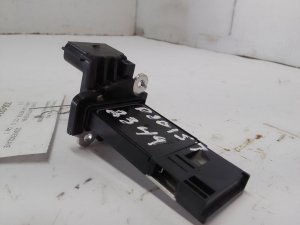

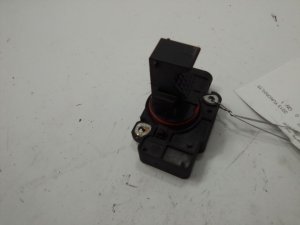
New Aftermarket Parts Available


The information in this article is provided for general reference and educational purposes only. Vehicle specifications, procedures, and part compatibility can vary by production date, trim level, and region. Always consult your vehicle's factory service manual and verify part numbers before purchasing or performing repairs. Safety-critical components such as airbags, seat belts, and braking systems should be installed by a qualified professional.
- Gmc YUKON:
- 🎬 Helpful Videos
- 🛍️ Shop This Part
- What's Unique About the 2009-2016 Gmc YUKON
- Diagnostic Flowchart
- Symptoms You May Notice
- Most Likely Causes
- Rare But Worth Checking
- Diagnosis Steps
- Parts You'll Likely Need
- Related Codes That Often Appear With This One
- Technical Service Bulletins (TSBs) & Recalls
- Platform-Specific Known Issues
- Mechanic-Grade Diagnostic Values
- Scan Tool Commands That Help
- Wiring & Ground Locations
- Real Owner Repair Stories
- "I Checked Everything" — The Actual Cause
- When the Usual Fixes Don't Work
- OEM Part Supersession History
- Model Year Variations Within This Range
- 🎟️ Get 5% Off