

P0174 on 2014-2019 Lexus GX460: Lean Condition Causes and Fixes
P0174 on a Lexus GX460 means the engine is running lean on Bank 2 (driver's side). The most common causes are a dirty Mass Airflow (MAF) sensor or a vacuum leak from a cracked hose or intake gasket. Cleaning the MAF sensor with a dedicated cleaner is a simple, inexpensive first step that often resolves the issue. If both P0171 and P0174 are present, the cause is likely shared between both banks, such as the MAF sensor or a major vacuum leak.
- P0174 means your GX460's engine has too much air or not enough fuel on the driver's side (Bank 2).
- Start your diagnosis by cleaning the Mass Airflow (MAF) sensor with a dedicated cleaner; this is a common, easy, and inexpensive fix.
- If cleaning the MAF doesn't work, the next most likely causes are a vacuum leak (from a cracked hose or gasket) or a failing upstream Air/Fuel ratio sensor.
- If you also have a P0171 code (both banks lean), the issue is almost certainly the MAF sensor or a large vacuum leak.
- If you experience hard starting along with the code, pay close attention to fuel pressure, as a weak fuel pump could be the root cause.
What's Unique About the 2014-2019 Lexus GX460
The 4.6L V8 (1UR-FE) engine in the GX460 is generally very reliable, but like many modern engines, it is sensitive to unmetered air entering the intake system after the MAF sensor. Owners on forums like ClubLexus and IH8MUD frequently report that a simple cleaning of the Mass Airflow (MAF) sensor resolves lean codes. A Technical Service Bulletin (TSB LSB000523) issued by Lexus for this platform specifically links P0174 with potential fuel pressure issues, which may also cause hard starting. This suggests that while vacuum leaks and dirty MAF sensors are the most common culprits, fuel delivery should not be overlooked, especially if P0087 is also present.
Diagnostic Flowchart
Tap your situation to follow the diagnostic path that matches what you're seeing on this vehicle.
Symptoms You May Notice
- Check Engine Light is on
- VSC (Vehicle Stability Control) and/or TRAC OFF lights may also illuminate
- Rough or unstable idle, sometimes vibrating the vehicle
- Engine hesitation or stumbling during acceleration
- Reduced fuel economy
- Hard starting (may also be accompanied by code P0087) [TSB LSB000523]
- Hissing or sucking noise from the engine bay, indicating a vacuum leak
- Replacing the downstream (post-catalyst) O2 sensor. The downstream sensor's primary role is to monitor catalytic converter efficiency, while the upstream A/F sensor (Sensor 1) is used for fuel trim adjustments.
- Replacing the gas cap. A loose or faulty gas cap typically causes EVAP system codes (e.g., P0442, P0456), not lean codes like P0174.
Most Likely Causes
- Dirty or Faulty Mass Airflow (MAF) Sensor 🔴 High Probability The MAF sensor measures the amount of air entering the engine. If its delicate platinum wire is contaminated with dust or oil (sometimes from over-oiled aftermarket air filters), it will under-report the amount of air, causing the ECM to inject too little fuel. This is a very common first-step fix reported by GX460 owners.
How to confirm: Inspect the sensor wires for contamination. A diagnostic scan tool will show long-term fuel trims (LTFT) that are highly positive (e.g., >+20%) at idle but may improve (move closer to 0) at higher RPMs. If both P0171 and P0174 are present, a faulty MAF is a prime suspect.
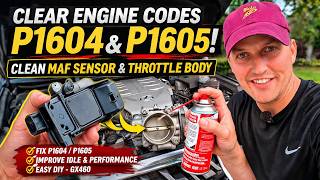
Typical fix: Remove and clean the sensor using a dedicated MAF sensor cleaner spray 🎬 Watch: How to clean your MAF sensor and throttle body., such as from CRC. Do not touch the delicate sensor wires. Allow it to dry completely before reinstalling. If cleaning doesn't resolve the issue after a reset, the sensor may need to be replaced.
Est. part cost: $10-$15 for cleaner, $90-$160 for a new Denso sensor. - Vacuum Leak 🟡 Medium Probability Rubber and plastic components in the engine bay degrade over time from heat and age. A crack in a vacuum hose, PCV hose, or a leaking intake manifold gasket allows unmetered air to enter the engine after the MAF sensor, creating a lean condition. The intake manifold gaskets are a known failure point on higher-mileage 1UR-FE engines.
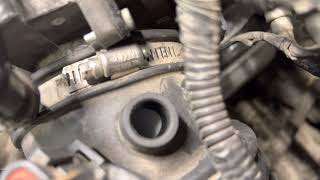
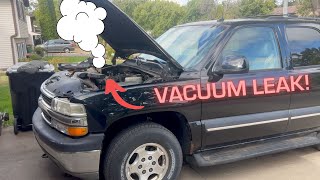
How to confirm: Visually inspect all vacuum lines and the air intake tube for cracks or loose connections. A professional can perform a smoke test to pinpoint the exact location of the leak. 🎬 See how to find vacuum leaks using a smoke machine. A DIY method is to carefully spray carburetor cleaner near suspected areas (like the intake manifold gasket edges) with the engine idling; a change in engine RPM indicates you've found the leak.
Typical fix: Replace the cracked hose or faulty gasket. Intake manifold gasket replacement is more involved but is a common fix for persistent dual lean codes.
Est. part cost: $10-$100 depending on the specific hose or gasket set. - Failing Air/Fuel Ratio Sensor (Upstream O2 Sensor) 🟡 Medium Probability The A/F sensor for Bank 2 (driver's side, before the catalytic converter) directly measures the air-fuel mixture. If the sensor becomes old and sluggish, it can send inaccurate (lean) readings to the ECM, causing the code. Since P0174 is a single-bank code, a faulty sensor on that bank is a strong possibility.
How to confirm: Use a scan tool to graph the sensor's voltage or equivalence ratio. A healthy sensor will fluctuate rapidly around the stoichiometric point (e.g., Lambda 1.0 or ~3.3V). A slow or flat-lining sensor is likely faulty. Bank 2 is the driver's side on a US-spec GX460.
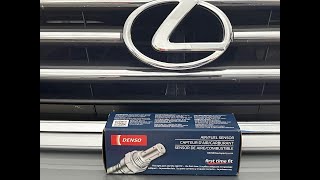
Typical fix: Replace the Bank 2, Sensor 1 Air/Fuel Ratio sensor. Denso is the original equipment manufacturer. Access can be tight but it is often done as a DIY repair.
Est. part cost: $150-$225 - Low Fuel Pressure ⚪ Low Probability As highlighted in TSB LSB000523, low fuel pressure can cause lean codes. This could be due to a weak fuel pump or a clogged fuel filter/strainer. This is more likely if the code appears with P0171 (lean Bank 1) and especially P0087 (Fuel Rail Pressure Too Low). Some Tundra owners with similar engines have had fuel pumps replaced under a special service campaign to fix these codes.
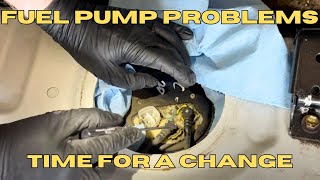
How to confirm: Connect a fuel pressure gauge to the fuel rail and check if the pressure is within the manufacturer's specifications (typically around 46-47 PSI for this model 🎬 Watch: Step-by-step Lexus fuel pump testing and replacement procedure.). A scan tool can also monitor fuel pressure.
Typical fix: Replace the failing fuel pump assembly.
Est. part cost: $200-$500 for a fuel pump assembly.
Rare But Worth Checking
- Exhaust Leak: An exhaust leak before the Bank 2 A/F sensor can draw in outside air, tricking the sensor into thinking the engine is running lean. This is less common than intake-side leaks but worth checking, especially around the exhaust manifold gasket.
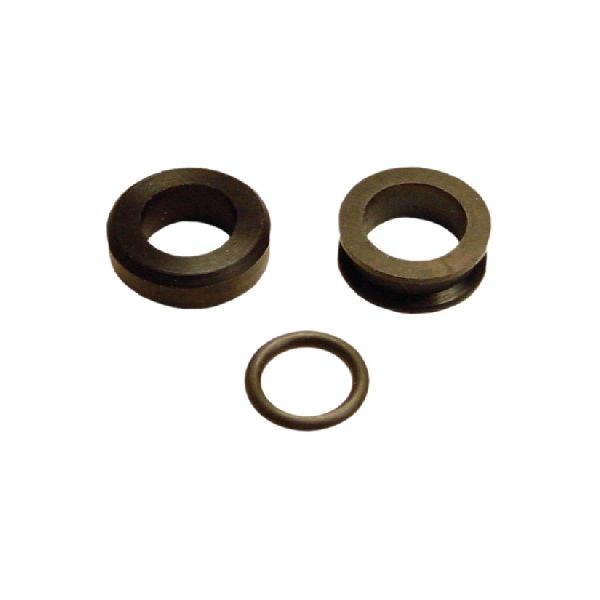
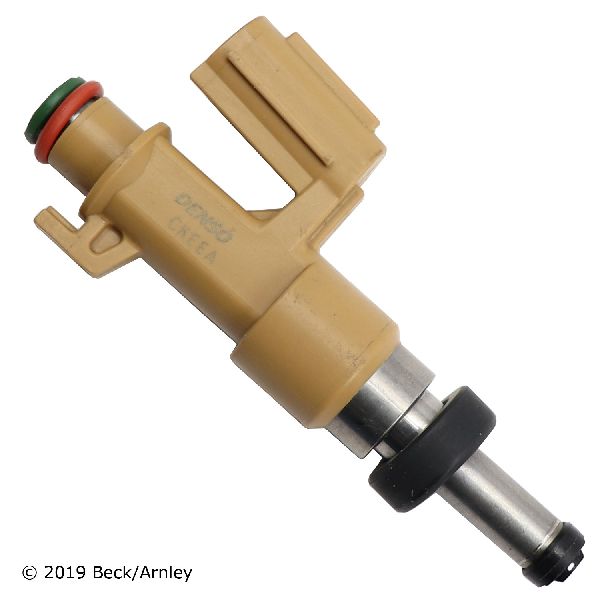
- Clogged Fuel Injector(s) on Bank 2: If one or more injectors on the driver's side are partially clogged, they won't deliver enough fuel, leading to a lean condition on that bank only. This is more likely if the issue is isolated to P0174 and other causes have been ruled out.
- Oil Contamination on A/F Sensor: In one documented case on a ClubLexus forum, a valve cover gasket leak dripped oil directly onto the Bank 2 A/F sensor connector, causing the P0174 code. Fixing the oil leak and replacing the sensor resolved the issue.
Diagnosis Steps
- Check for other stored trouble codes. The presence of P0171 or P0087 can help narrow down the cause.
- Using a scan tool, observe the Long-Term Fuel Trim (LTFT) and Short-Term Fuel Trim (STFT) for Bank 2 at idle and at 2500 RPM. Consistently high positive numbers (e.g., LTFT > +20%) confirm the lean condition.
- Inspect the air filter and air intake hose between the air filter box and the throttle body for any cracks, loose clamps, or blockages like leaves.
- Inspect all accessible vacuum and PCV hoses for cracks, brittleness, or disconnection. Flex the hoses to reveal hidden cracks.
- Remove and clean the Mass Airflow (MAF) sensor using a dedicated MAF sensor cleaner. Allow it to dry completely before reinstalling. Reset the ECU by disconnecting the battery for 20 minutes and re-check fuel trims.
- If fuel trims are still high, perform a smoke test to find hard-to-see vacuum leaks, especially around the intake manifold gaskets.
- If no vacuum leaks are found and the code is only for Bank 2, test the Bank 2, Sensor 1 (Air/Fuel Ratio Sensor) using a scan tool to ensure it is switching correctly. Consider it a likely culprit if it's original and the vehicle has over 100k miles.
- Check for oil leaks from the valve cover gasket above the Bank 2 A/F sensor that could be contaminating the sensor or its connector.
- If all else fails, or if P0087 is present, test the fuel pressure to rule out a weak fuel pump or clogged filter.
Parts You'll Likely Need
- Mass Airflow (MAF) Sensor Cleaner — This is the cheapest and easiest first step, and a dirty MAF sensor is a very common cause for this code on the GX460.
Trusted brands: CRC, Liqui Moly
OEM price range: N/A
Aftermarket price range: $10-$15 - Air/Fuel Ratio Sensor (Bank 2, Sensor 1)
(OEM #89467-60140)— This is the upstream sensor on the driver's side that measures the air-fuel mixture. It can become sluggish with age and send false lean readings.
Trusted brands: Denso
OEM price range: $200-$250
Aftermarket price range: $150-$225
Related Codes That Often Appear With This One
- P0171 — System Too Lean (Bank 1). When both P0171 and P0174 are present, it strongly suggests a problem affecting both engine banks, such as a dirty MAF sensor, a major vacuum leak at the intake manifold, or a fuel delivery problem.
- P0087 — Fuel Rail / System Pressure – Too Low. As noted in TSB LSB000523, this code can appear with P0174, pointing directly to a fuel delivery issue like a weak fuel pump.
Technical Service Bulletins (TSBs) & Recalls
- LSB000523: Notes that a hard start and/or MIL ON with DTCs P0171, P0174, and P0087 may be present, indicating a potential fuel pressure issue.
Platform-Specific Known Issues
- Lexus issued Technical Service Bulletin #LSB000523 which notes that P0174 (and P0171) can appear alongside P0087 (Fuel Rail / System Pressure – Too Low) and may be accompanied by a hard start condition, pointing towards a fuel delivery problem.
- A ClubLexus forum member with P0171 and P0174 reported extremely high fuel trims (+44% LTFT). After replacing the MAF and fuel pump with no success, the community advised a smoke test for vacuum leaks and checking the fuel pressure regulator.
- Another user on ClubLexus fixed their persistent P0174 code by discovering a valve cover gasket leaking oil onto the Bank 2 A/F sensor. Replacing the gasket and the fouled sensor solved the problem.
Mechanic-Grade Diagnostic Values
- Fuel Pressure (Low Pressure Side) — expected: 196 to 588 kPa (28 to 85 psi) per general service data; forum data suggests a tighter range of 46-47 PSI at idle is normal for this platform.. Failure: Pressure consistently below the specified range, especially under load, indicates a weak fuel pump or clogged filter.
- Mass Airflow (MAF) Sensor Reading — expected: Approximately 4.0 to 5.5 g/s at a stable, warm idle with no electrical load.. Failure: A significantly lower reading (e.g., <3.0 g/s) at idle suggests a vacuum leak (unmetered air entering after the sensor). A significantly higher reading suggests a faulty sensor.
- Fuel Injector Resistance — expected: 11.6 to 12.4 Ω at 20°C (68°F).. Failure: Resistance outside of this range indicates a faulty injector coil.
- Long Term Fuel Trim (LTFT) - Bank 2 — expected: Ideally between -5% and +5%. Small adjustments up to +/-10% can be normal.. Failure: Sustained values greater than +20% to +25% will trigger the P0174 code.
Hidden / Shadow Codes Worth Checking
- Freeze Frame Data: When the P0174 code is set, the ECM stores a snapshot of all major sensor readings at that exact moment. This data is invaluable for diagnosis. (see via Access via any standard OBD-II scan tool. Look for engine RPM, vehicle speed, coolant temperature, and short/long term fuel trims to understand the conditions when the fault occurred (e.g., at idle, during acceleration, when cold).)
- Mode $06 Data: Provides results from the ECM's self-tests on various components, including the A/F sensors. It can show a component that is performing poorly and is close to a failure threshold, even before it's bad enough to set a DTC. (see via Requires an advanced scan tool with Mode $06 capability. A technician can analyze the test values against the manufacturer's acceptable minimum and maximum limits to identify marginal components.)
Scan Tool Commands That Help
- Toyota Techstream: Active Test: Control the Injection Volume for A/F sensor — This is a definitive test for the Bank 2 A/F sensor. It allows the technician to command the fuel mixture rich or lean and watch the sensor's live data response. If the sensor voltage or Lambda value does not change accordingly, the sensor is faulty.
- Toyota Techstream: Reset Memory — After a repair (like cleaning the MAF or fixing a leak), this function should be used to clear the long-term fuel trim values stored in the ECM. This forces the computer to relearn the fuel strategy immediately with the new, correct parameters, rather than slowly adapting over many drive cycles.
Wiring & Ground Locations
- ECM (Engine Control Module) — Located on the right side of the dashboard, typically behind the glove box.. The ECM is the brain of the system. All sensor inputs (A/F, MAF) are processed here. A poor connection or corrosion at the ECM connector could cause erroneous readings.
- Engine Block Grounds — Key ground straps connect the engine block to the chassis/firewall. On similar Toyota V8s, a primary ground is often on the right side of the block near the firewall.. The A/F sensors and other engine sensors rely on a solid ground connection to the engine block. A corroded or loose engine ground can create a floating ground, causing erratic and incorrect sensor voltage readings, which can mimic a lean condition.
- Cowl/Fender Ground Points — Inside the engine bay, on the inner fender aprons near the shock towers.. These points provide a ground for various components in the engine bay wiring harness. Verifying they are clean and tight is a crucial step in diagnosing any electrical issue, including sensor faults.
Real Owner Repair Stories
- Reddit user u/clickyspinny in r/GXOR (Lexus GX (year not specified, but platform relevant)) — P0171 and P0174 codes, terrible fuel economy (10-11 mpg), engine stumbling at certain RPMs under acceleration. Long Term Fuel Trims were over +35%.
❌ Tried (didn't work) Clearing codes (they would return immediately), Initial diagnosis focused on vacuum leaks, which were not the cause.
✅ What actually fixed it Replacement of the fuel pump. The user confirmed that a fuel pressure test early in the diagnosis would have saved significant time and money.
"I Checked Everything" — The Actual Cause
- In a documented case on Reddit, a GX owner was chasing both P0171 and P0174. Standard procedure dictates a smoke test to find vacuum leaks, which was performed. However, the system was found to be sealed. The actual root cause was insufficient fuel delivery from a failing fuel pump, a condition a smoke test cannot identify.
- A notorious issue within the Lexus community involves a hairline crack in the plastic upper intake manifold/plenum. This crack may only open under specific thermal conditions (when the engine is hot) and under vacuum, causing it to be missed during a typical smoke test performed on a cold engine. This leads to a persistent lean code that defies standard vacuum leak detection methods.
When the Usual Fixes Don't Work
- While the most common advice for dual lean codes (P0171 & P0174) is to search for a vacuum leak or clean the MAF sensor, there is strong evidence that these codes can be set by a fuel-side problem alone. One owner confirmed that after extensive and unsuccessful troubleshooting of the intake system, including a smoke test, the final fix was a new fuel pump. This aligns with the NHTSA TSB LSB000523, which directly connects lean codes to potential fuel pressure issues on this platform, reminding technicians that a lean code means an incorrect ratio, which can be caused by 'not enough fuel' just as easily as 'too much air'.
Model Year Variations Within This Range
- 2014-2019: There were no significant mechanical changes to the 4.6L 1UR-FE engine, fuel system, or emissions components within this model year range that would alter the diagnosis or common causes of a P0174 code. A cosmetic facelift occurred in 2020, outside this range.
Helpful Videos
Used OEM Parts in Stock

New Aftermarket Parts Available

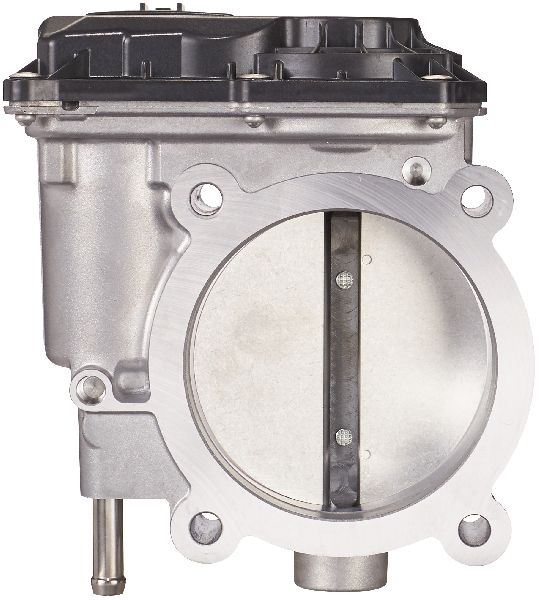
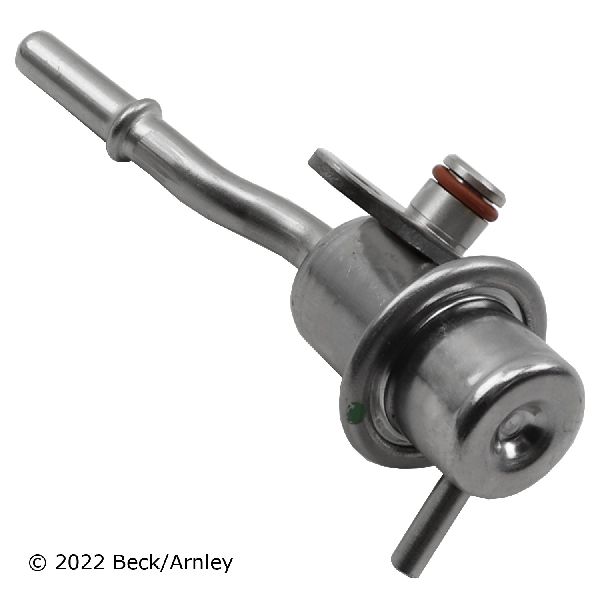

The information in this article is provided for general reference and educational purposes only. Vehicle specifications, procedures, and part compatibility can vary by production date, trim level, and region. Always consult your vehicle's factory service manual and verify part numbers before purchasing or performing repairs. Safety-critical components such as airbags, seat belts, and braking systems should be installed by a qualified professional.
- Lexus GX460:
- 🎬 Helpful Videos
- 🛍️ Shop This Part
- What's Unique About the 2014-2019 Lexus GX460
- Diagnostic Flowchart
- Symptoms You May Notice
- Most Likely Causes
- Rare But Worth Checking
- Diagnosis Steps
- Parts You'll Likely Need
- Related Codes That Often Appear With This One
- Technical Service Bulletins (TSBs) & Recalls
- Platform-Specific Known Issues
- Mechanic-Grade Diagnostic Values
- Hidden / Shadow Codes Worth Checking
- Scan Tool Commands That Help
- Wiring & Ground Locations
- Real Owner Repair Stories
- "I Checked Everything" — The Actual Cause
- When the Usual Fixes Don't Work
- Model Year Variations Within This Range
- 🎟️ Get 5% Off