

P0172 on 2017-2018 Toyota Sequoia: "System Too Rich" Causes and Fixes
P0172 means your Sequoia's engine is getting too much fuel on Bank 1 (passenger side). The most common causes are a dirty Mass Airflow (MAF) sensor or a failing Air/Fuel ratio sensor (upstream O2 sensor). For Flex-Fuel models, a known ECU glitch can also be the culprit, requiring a dealer visit. Cleaning the MAF sensor is a good first step and may solve the problem for under $15.
- P0172 on a 2017-2018 Sequoia means the passenger side of the engine is running too rich.
- The easiest and most common fix is to clean the Mass Airflow (MAF) sensor, which costs less than $15.
- If cleaning the MAF doesn't work, the next most likely culprit is a failing Air/Fuel Ratio sensor (Bank 1, Sensor 1).
- If you own a Flex-Fuel model and also have hard starting issues, the problem may be a known software glitch that a Toyota dealer needs to fix per TSB T-SB-0166-19.
- Do not replace the downstream O2 sensor (after the catalytic converter) to fix this code; it will not solve the problem.
What's Unique About the 2017-2018 Toyota SEQUOIA
For the 2017-2018 Sequoia, particularly Flex-Fuel (3UR-FBE) models, P0172 can be linked to a specific issue identified by Toyota. Technical Service Bulletin T-SB-0166-19 addresses cases where the engine's alcohol density estimate becomes incorrect, leading to rich/lean codes and hard starting. This is a known software issue that can be resolved by a dealer reprogramming the ECM. This issue is common enough that it should be a primary consideration for Flex-Fuel owners experiencing these symptoms. Outside of this TSB, the causes are typical for many modern V8 engines, with the MAF and A/F sensors being primary suspects.
Diagnostic Flowchart
Tap your situation to follow the diagnostic path that matches what you're seeing on this vehicle.
Symptoms You May Notice
- Check Engine Light is on
- Poor fuel economy
- Rough idle
- Hesitation or stumbling on acceleration
- Black smoke from the exhaust
- A strong smell of gasoline from the exhaust
- "Traction Control Off" light may illuminate along with the Check Engine Light
- Hard starting, especially on Flex-Fuel models
- Replacing the downstream oxygen sensor (Bank 1, Sensor 2). The downstream sensor's primary role is to monitor catalytic converter efficiency, not to control the air-fuel mixture. Replacing it will not fix a P0172 code.
- Assuming an expensive repair is needed before performing the simple and cheap MAF sensor cleaning, which resolves the issue in a high number of cases.
Most Likely Causes
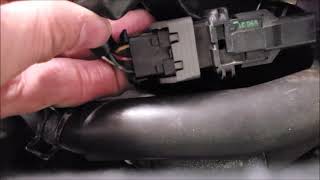
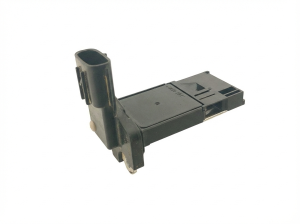
- Dirty or Faulty Mass Airflow (MAF) Sensor 🔴 High Probability The MAF sensor is located in the intake tract and can become contaminated with dirt, oil, or debris over time, especially if an aftermarket oiled air filter is used. This contamination causes it to under-report airflow, leading the ECU to calculate a fuel mixture that is too rich for the actual amount of air. This is widely cited in owner forums as the most common cause and first thing to check.
How to confirm: Inspect the sensor's sensing wires for dirt or grime. With a scan tool, monitor the MAF reading (g/s) at idle and while revving; compare to specified values. A faulty sensor may give erratic or out-of-range readings. A simple and effective test is to clean the sensor and see if the code resolves.
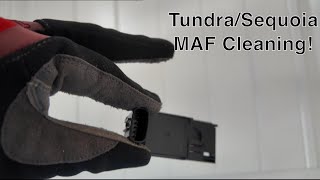
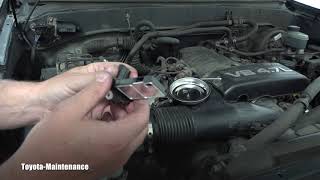
Typical fix: Remove the sensor and clean it carefully with a dedicated MAF sensor cleaner spray. 🎬 Watch: How to clean the MAF sensor on your 5.7L Sequoia. Do not touch the delicate wires with anything. If cleaning doesn't work, the sensor must be replaced. Owners strongly recommend using an OEM Denso part if replacement is necessary.
Est. part cost: $10-$15 (cleaner), $70-$150 (new sensor) - Failing Air/Fuel Ratio Sensor (Bank 1, Sensor 1) 🟡 Medium Probability This sensor, also known as the upstream oxygen sensor, is a critical input for fuel control. It operates in a high-heat environment and can degrade over time, sending slow or inaccurate signals to the ECU. A failing sensor can default to a rich reading, directly causing a P0172.
How to confirm: Use a scan tool to graph the sensor's voltage. A healthy sensor should fluctuate rapidly. A lazy or stuck sensor will show slow or no voltage changes, or be biased high (rich). Compare Bank 1 Sensor 1 data to Bank 2 Sensor 1 data to spot the outlier.
Typical fix: Replace the Bank 1, Sensor 1 Air/Fuel Ratio sensor. Bank 1 is on the passenger side of the engine. A special O2 sensor socket is recommended for removal. Some owners suggest cutting the wire of the old sensor to fit a standard deep well socket for removal only. 🎬 See this walkthrough on how to replace an Air/Fuel ratio sensor. Sticking with a Denso brand replacement is highly recommended by the community.
Est. part cost: $100-$200 - Incorrect Fuel Alcohol Content Reading (Flex-Fuel Models) 🟡 Medium Probability As per TSB T-SB-0166-19, the ECM on 3UR-FBE engines can develop an incorrect alcohol density estimate, especially after short trips or changes in fuel type, causing it to command an overly rich mixture. This is a well-documented software issue specific to these Toyota V8s.
How to confirm: A Toyota dealer or a shop with a Techstream scan tool can check the alcohol density parameter. If the estimate is high (e.g., ≥ 15% or even as high as 85%) when running on standard gasoline (E0-E10), this is the likely cause. This condition is often accompanied by hard starting (long crank times).
Typical fix: The fix involves reprogramming the ECM with an updated calibration, and resetting the fuel alcohol learn value using a scan tool. This is typically a dealer-level repair, though some advanced bidirectional scan tools can perform the reset. The repair may be covered under the Toyota Federal Emission Warranty (96 months or 80,000 miles).
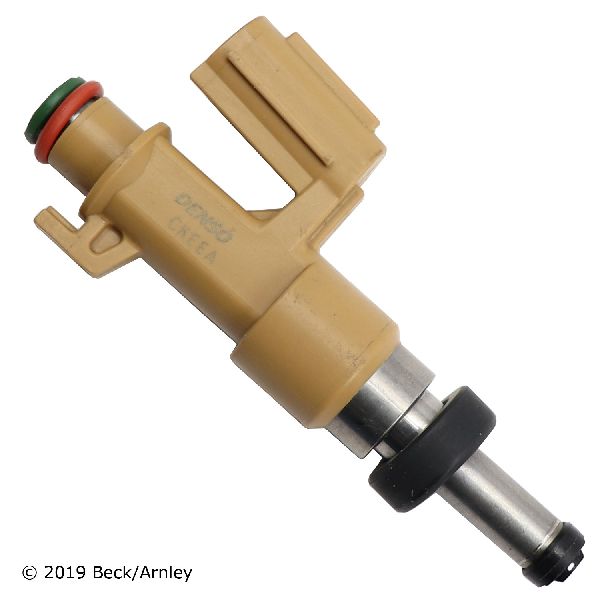
Est. part cost: $0 (if under warranty), otherwise diagnostic and labor fees apply. - Leaking Fuel Injector(s) ⚪ Low Probability While not as common as sensor issues, an injector can stick open or leak, dumping excess fuel into a single cylinder. This can happen after the engine is shut off, leading to a rich code on the next startup.
How to confirm: Check spark plugs on Bank 1; a black, sooty plug indicates a rich condition in that cylinder. A fuel pressure leak-down test can also be performed. If pressure drops quickly after the engine is off, it may indicate a leaking injector. Fuel smell in the engine oil is another sign.
Typical fix: Identify and replace the faulty fuel injector(s) on Bank 1. This can be a more involved repair.
Est. part cost: $50-$150 per injector
Rare But Worth Checking
- High Fuel Pressure: A faulty fuel pressure regulator can cause system-wide high pressure, forcing too much fuel through the injectors. This would usually trigger codes for both banks (P0172 and P0175) but can sometimes appear on only one.
- Leaking EVAP Purge Valve: If the purge valve sticks open, it can allow un-metered fuel vapors from the charcoal canister to enter the intake manifold, creating a rich condition. 🎬 Watch: How a faulty purge valve can cause rich codes.
- Stuck Open Thermostat: If the thermostat is stuck open, the engine may not reach its proper operating temperature. The ECU will then intentionally run a richer mixture, which can eventually trigger a P0172 code, especially in cold weather.
Diagnosis Steps
- Read the codes with an OBD-II scanner and note any other codes present. Freeze frame data can be very helpful to see the engine conditions when the code was set.
- Check live data for Short-Term Fuel Trim (STFT) and Long-Term Fuel Trim (LTFT) on both banks. For P0172, you will see highly negative numbers on Bank 1 (e.g., -20% or more) as the ECU tries to pull fuel.
- Inspect the engine air filter. A severely clogged filter can restrict airflow and contribute to a rich condition.
- Inspect the MAF sensor. Look for any visible contamination on the sensor wires. If it looks dirty, clean it with dedicated MAF cleaner and clear the codes. This is the most common fix.
- If you have a Flex-Fuel (3UR-FBE) model and are experiencing hard starts, consult a dealer regarding TSB T-SB-0166-19 before proceeding with parts replacement. A key step is to check the 'Alcohol Density' value with a capable scan tool; a high value (e.g., 85%) on regular gas indicates this is the problem.
- If cleaning the MAF doesn't help, use the scanner to monitor MAF readings (g/s) and A/F sensor voltage for Bank 1, Sensor 1. Compare Bank 1 to Bank 2; the faulty bank will likely show different readings. A lazy or biased A/F sensor is a likely culprit.
- Check fuel pressure to ensure it is within the manufacturer's specifications. High pressure can cause a rich condition.
- Inspect spark plugs on Bank 1 for black, sooty deposits, which would indicate a leaking fuel injector in a specific cylinder.
- Check for a stuck-open EVAP purge valve or a thermostat that is stuck open, causing the engine to run cool.
Parts You'll Likely Need
- Mass Airflow (MAF) Sensor Cleaner — This is the cheapest and easiest first step. Often, cleaning a dirty MAF sensor is all that is needed to resolve the rich condition.
Trusted brands: CRC, WD-40 Specialist
Aftermarket price range: $10-$15 - Air/Fuel Ratio Sensor (Bank 1, Sensor 1)
(OEM #89467-0C050)— This is the upstream oxygen sensor on the passenger side. It is a primary input for fuel control and a common failure item that directly causes rich or lean codes. If MAF cleaning doesn't work, this is the next logical part to replace.
Trusted brands: Denso (OEM), NTK
OEM price range: $210-$220
Aftermarket price range: $100-$200 - Mass Airflow (MAF) Sensor
(OEM #22204-0F030)— If cleaning the original sensor does not resolve the issue, the sensor itself may have failed electronically and will need to be replaced.
Trusted brands: Denso (OEM), Bosch, API
OEM price range: $70-$100
Aftermarket price range: $30-$80
Related Codes That Often Appear With This One
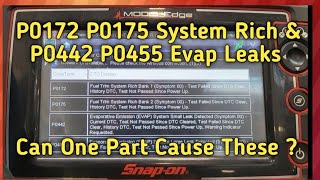
- P0175 — System Too Rich, Bank 2. If both P0172 and P0175 are present, it points to a problem affecting the entire engine, such as the MAF sensor, fuel pressure, or the TSB-related alcohol reading issue.
- P1604 — Startability Malfunction. This code is specifically mentioned in Toyota TSB T-SB-0166-19 along with the rich/lean codes, pointing to the alcohol density reading issue on Flex-Fuel models.
- P0101 — Mass Air Flow (MAF) Circuit Range/Performance. If this code is present with P0172, it strongly suggests the MAF sensor is the root cause of the problem.
Technical Service Bulletins (TSBs) & Recalls
- source — Addresses hard start and/or MIL ON with rich/lean codes (P0171, P0172, P0174, P0175) and P1604 on 2009-2018 Sequoia and 2009-2019 Tundra with the 3UR-FBE (Flex-Fuel) engine. Caused by an incorrect alcohol density estimate. The fix is an ECM reprogram, fuel alcohol learn value reset, and possible fuel pump replacement.
Platform-Specific Known Issues
- For Flex-Fuel (3UR-FBE) models, an incorrect fuel alcohol density estimation by the ECU is a well-known issue documented in TSB T-SB-0166-19. This can cause P0172/P0175 and hard starting. The fix is a dealer-performed ECU reflash and potentially a fuel pump replacement, which may be covered under the federal emissions warranty (8yr/80k miles).
Mechanic-Grade Diagnostic Values
- Long Term Fuel Trim (Bank 1) — expected: Close to 0%, typically within +/- 10%. Failure: Sustained negative values, often -20% or more, indicate the ECM is consistently reducing fuel to combat a rich condition.
- Alcohol Density (Flex-Fuel Models) — expected: 0-10% when using standard gasoline. Failure: A reading of 15% to 85% while using standard gasoline points directly to the TSB-related software issue.
- Upstream A/F Sensor (O2 Sensor) Voltage — expected: Healthy sensor voltage fluctuates rapidly between approximately 0.1V and 0.9V.. Failure: A sensor stuck high (e.g., above 0.8V) or with very slow, lazy fluctuations indicates a failure causing a rich reading.
- Engine Compression (3UR-FE) — expected: Standard: 1300 kPa (189 psi). Minimum: 1000 kPa (145 psi).. Failure: While not a direct cause of P0172, low or uneven compression can affect combustion efficiency and contribute to fuel issues. The difference between cylinders should be less than 100 kPa (15 psi).
Scan Tool Commands That Help
- Toyota Techstream: Fuel Density Learning Value Reset — This is the specific function required to fix the incorrect alcohol percentage reading on Flex-Fuel (3UR-FBE) models, as described in TSB T-SB-0166-19. It is found under Powertrain -> Engine and ECT -> Utility.
- Toyota Techstream: Active Test: Fuel Pump Speed Control — This allows a technician to manually command the fuel pump to run at a specific speed, helping to diagnose if a fuel pressure issue is caused by the pump or its control module, separate from the ECU's commands.
- Autel/Launch/Xtool Bidirectional Scanners: Special Functions -> Fuel Density Learning Value Reset — Several higher-end consumer bidirectional scan tools have the ability to perform the same alcohol density reset as the dealer's Techstream, which can resolve the P0172 code on Flex-Fuel models without a trip to the dealer.
Wiring & Ground Locations
- A1 / A2 Ground Points — Located in the left front of the engine compartment, behind the left headlight assembly.. These are primary ground distribution points for various engine components and sensors. A corroded or loose connection here could potentially cause erratic sensor readings, contributing to fuel trim issues.
- Instrument Panel Fuse Box — Located under the instrument panel on the driver's side, behind a cover.. This box contains fuses for critical components like the cigarette lighter (CIG) and power outlets (PWR OUTLET), which are sometimes used to power diagnostic tools. It also contains ECU-related fuses.
Real Owner Repair Stories
- Tundra forum user (2005 Tundra Doublecab 4.7L (shares similar systems)) — P0172 and P0175 codes appearing simultaneously, hesitation on acceleration, random misfiring.
❌ Tried (didn't work) Replaced injectors (Denso), Replaced MAF sensor (Denso), Replaced spark plugs, Replaced Air/Fuel sensor (Denso), Cleaned throttle body, Replaced alternator, Replaced ECU with a remanufactured unit, Replaced thermostat and coolant temp sensor
✅ What actually fixed it The issue was traced back to a faulty aftermarket Secondary Air Injection bypass kit. After the dealer disconnected the kit, the fuel trims returned to normal and the rich codes were resolved. This highlights how aftermarket electronic modifications can unexpectedly cause rich conditions. - Blog post citing a user experience (2013 Tundra 5.7L Flex Fuel (3UR-FBE)) — Long crank/hard start, poor gas mileage, rough running, and likely rich codes (P0172/P0175).
❌ Tried (didn't work) Living with the problem, considering an expensive dealer visit.
✅ What actually fixed it The owner purchased a bidirectional scan tool (Autel), found the Alcohol Fuel Density was at 85%, and used the 'Fuel Density Learning Value Reset' function. This reset the value to zero and immediately fixed the starting and running issues. The long-term fuel trim went from -23% back to 0% after the reset.
OEM Part Supersession History
89467-22030→89467-0C050— Standard part revision by the manufacturer.
Heads up: The new part number (89467-0C050) is the correct replacement for the Bank 1 (Passenger Side) upstream A/F Ratio sensor.
Model Year Variations Within This Range
- 2018: The 2018 Sequoia received a mid-cycle refresh that included updated grilles, LED headlights, and a new instrument cluster. Crucially, it made the Toyota Safety Sense-P suite (automatic emergency braking, adaptive cruise control) standard. However, the 5.7L V8 powertrain (3UR-FE/3UR-FBE) and the systems related to code P0172 remained unchanged from the 2017 model.
Helpful Videos
Used OEM Parts in Stock
New Aftermarket Parts Available


The information in this article is provided for general reference and educational purposes only. Vehicle specifications, procedures, and part compatibility can vary by production date, trim level, and region. Always consult your vehicle's factory service manual and verify part numbers before purchasing or performing repairs. Safety-critical components such as airbags, seat belts, and braking systems should be installed by a qualified professional.
- Toyota SEQUOIA:
- 🎬 Helpful Videos
- 🛍️ Shop This Part
- What's Unique About the 2017-2018 Toyota SEQUOIA
- Diagnostic Flowchart
- Symptoms You May Notice
- Most Likely Causes
- Rare But Worth Checking
- Diagnosis Steps
- Parts You'll Likely Need
- Related Codes That Often Appear With This One
- Technical Service Bulletins (TSBs) & Recalls
- Platform-Specific Known Issues
- Mechanic-Grade Diagnostic Values
- Scan Tool Commands That Help
- Wiring & Ground Locations
- Real Owner Repair Stories
- OEM Part Supersession History
- Model Year Variations Within This Range
- 🎟️ Get 5% Off