

P0172 on 2017-2022 Honda CR-V: System Too Rich Causes and Fixes
P0172 on a 2017-2022 Honda CR-V with the 1.5L Turbo engine is most often caused by faulty fuel injectors that leak excess fuel into the engine. This leads to a rich running condition and can cause fuel to mix with the engine oil (oil dilution). The most common fix is replacing all four fuel injectors with the updated part number and changing the oil. Honda has issued warranty extensions and software updates to address this widespread problem.
- For a 2017-2022 Honda CR-V with the 1.5L Turbo engine, P0172 strongly points to faulty fuel injectors.
- Always check your oil level and smell for gas. A rising oil level is a critical symptom of this issue.
- When replacing the injectors, it is mandatory to also change the engine oil and filter to remove contaminants.
- While other causes like a dirty MAF or bad O2 sensor are possible, they are far less likely on this specific vehicle.
- Honda has issued a TSB (ATI&10062022902) acknowledging they are investigating this exact issue, indicating it's a known problem.
What's Unique About the 2017-2022 Honda CR-V

The 2017-2022 CR-V's 1.5L direct-injection turbo engine is notoriously prone to issues that cause a P0172 code. Unlike many vehicles where this code points to a sensor, on this specific CR-V it is very frequently caused by failing fuel injectors. These injectors can leak or stick open, leading to excess fuel in the combustion chamber. This causes a related, well-documented problem of fuel diluting the engine oil, which is especially common in cold climates or with frequent short trips. Honda has acknowledged these issues by issuing multiple Technical Service Bulletins (TSBs) like 19-032 and 19-037, which provide software updates and warranty extensions to 6 years/unlimited miles for affected engine components on 2017-18 models. A class-action lawsuit, Wolf et al. v. American Honda Motor Co., Inc., also cites the P0172 code as a primary symptom of this defect.
Diagnostic Flowchart

Tap your situation to follow the diagnostic path that matches what you're seeing on this vehicle.
Symptoms You May Notice

- Check Engine Light is on
- Multiple other warning lights may illuminate on the dashboard (e.g., emissions, power steering, brake system, collision mitigation) creating a 'Christmas tree' effect. This is a common secondary reaction to the primary engine fault.
- Strong smell of gasoline from the exhaust or inside the oil filler cap.
- Engine oil level on the dipstick is rising or over the full mark.
- Engine oil appears thin and smells strongly of fuel.
- Rough or unstable idle.
- Engine misfires (may feel like shaking or stumbling).
- Reduced fuel economy.
- Black smoke from the exhaust.
- Replacing the oxygen (A/F) sensor first. While it can be the cause, on this specific vehicle, fuel injectors are a much more likely culprit. The O2 sensor is often just correctly reporting the rich condition caused by the injectors.
- Performing only an oil change. As seen in owner complaints and forum discussions, changing the fuel-diluted oil can make the code disappear temporarily, but it will return within a few hundred or thousand miles if the underlying injector problem isn't fixed.
- Cleaning the MAF sensor. While a good maintenance step, it is rarely the root cause of this specific code on the 1.5L Turbo engine.
Most Likely Causes

- Leaking or Faulty Fuel Injectors 🔴 High Probability The direct-injection fuel injectors on the 1.5L Turbo engine are a well-known failure point, often leaking fuel directly into the cylinders and crankcase. This is corroborated by multiple NHTSA owner complaints, a manufacturer TSB requesting parts for investigation (Bulletin #ATI&10062022902), and numerous forum discussions where replacement is the confirmed fix. Honda has superseded the original part number due to this issue.
How to confirm: Check the engine oil for a strong gasoline smell and a level that is above the full mark. Negative long-term fuel trims (e.g., -20% or lower) on a scan tool at idle are a strong indicator. While a professional fuel injector balance test can identify a leaking injector, many technicians on forums note the dealer's A/F test can be inconclusive, and the combination of symptoms is often enough for a confident diagnosis.
Typical fix: Replace all four fuel injectors as a set with the updated OEM part. It is critical to change the engine oil and filter at the same time to remove the fuel-contaminated oil.
Est. part cost: $450-$800 - Fuel-Diluted Engine Oil 🟡 Medium Probability This is a direct symptom of leaking injectors or, less commonly, frequent short trips in cold weather that prevent the engine from reaching full operating temperature. Fuel vapors from the contaminated oil are drawn into the intake through the Positive Crankcase Ventilation (PCV) system, creating an artificially rich mixture that the ECM cannot fully compensate for, triggering P0172.
How to confirm: Smell the oil on the dipstick for a strong gasoline odor. An oil analysis can confirm the percentage of fuel dilution. An oil change often makes the code disappear temporarily, as noted in NHTSA complaint ODI #11437520, but it will return if the root cause (leaking injectors) is not addressed.
Typical fix: Change the engine oil and filter. This is a mandatory step when replacing injectors but is only a temporary fix on its own.
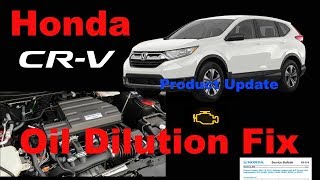
Est. part cost: $40-$90 - Outdated Engine Software (PGM-FI) 🟡 Medium Probability Honda released software updates specifically to address the oil dilution issue and rich running conditions on 2017-2018 models. TSB 19-032 details a procedure to update the PGM-FI (engine) and TCM (transmission) software and replace the A/C control unit to change engine warm-up characteristics. 🎬 Watch: Overview of the Honda oil dilution recall and software updates
How to confirm: A Honda dealership can check your vehicle's VIN against their service records to see if TSB 19-032 or other related software updates have been performed.
Typical fix: Have a Honda dealer perform the software updates as specified in the relevant TSB. This is often the first step dealers will take.
Est. part cost: $0 if covered under warranty/campaign, otherwise $150-$300 for labor. - Faulty High-Pressure Fuel Pump ⚪ Low Probability
How to confirm: The high-pressure fuel pump, driven by the camshaft, can fail internally and leak fuel directly into the engine crankcase, causing severe oil dilution. A technician can monitor fuel pressure decay after shutting off the engine; a rapid drop can indicate a leak. This was also mentioned as a possibility in NHTSA complaint ODI #11609255.
Typical fix: Replace the high-pressure fuel pump and perform an oil and filter change.
Est. part cost: $300-$600
Rare But Worth Checking
- Faulty Front Air/Fuel Ratio Sensor (Oxygen Sensor): A failing sensor can send incorrect signals to the ECM, causing it to enrich the fuel mixture unnecessarily. However, on this platform, the sensor is far more likely to be correctly reporting a rich condition caused by injectors. Many owners on forums report replacing this sensor with no success.
- Stuck Open EVAP Purge Valve: If the canister purge valve sticks open, it can allow unmetered fuel vapors from the charcoal canister to enter the engine, causing a rich condition. Diagnosis involves applying vacuum to the valve with the engine running to see if it holds.
- Dirty or Faulty Mass Airflow (MAF) Sensor: A dirty MAF sensor can under-report the amount of air entering the engine, causing the ECM to inject too much fuel. It can be inspected and cleaned with a dedicated MAF sensor cleaner, but this is an uncommon fix for P0172 on this engine.
Diagnosis Steps
- Check the engine oil level and smell it for gasoline. A high oil level that smells of fuel is the strongest indicator of the common injector failure.
- Use an OBD-II scanner to check for other stored trouble codes, particularly misfire codes (P030x).
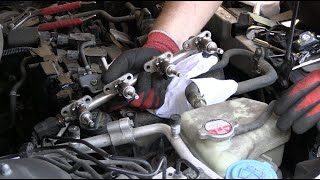
- Monitor live data with the scanner. At idle, observe Short-Term Fuel Trim (STFT) and Long-Term Fuel Trim (LTFT). For P0172, you will see highly negative numbers (e.g., -15% to -30%) as the ECM tries to pull fuel. 🎬 See a technician diagnose P0172 and misfire codes on this engine Note if the trims return closer to zero at higher RPMs.
- Check with a Honda dealer if your VIN has had the relevant software updates (e.g., TSB 19-032) performed. If not, this is a recommended early step.
- Inspect the air intake system and air filter for any blockages.
- If fuel dilution is confirmed and software is up to date, the fuel injectors are the most likely cause. Given the high failure rate, many owners and independent shops proceed with replacement based on these symptoms alone.
- For further confirmation, a fuel pressure decay test can be performed to check the high-pressure fuel pump, and the EVAP purge valve can be tested for leaks.
Parts You'll Likely Need
- Fuel Injector Set (4)
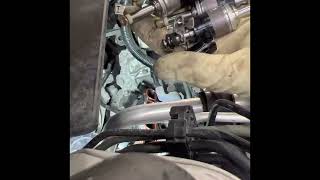
(OEM #06160-5PA-305)— This is the most common failure part for P0172 on the 1.5L Turbo CR-V. This is a kit that includes all 4 injectors and supers 🎬 Watch: Step-by-step guide to replacing the fuel injectors yourself
Related Codes That Often Appear With This One
- P0300, P0301, P0302, P0303, P0304 — These are cylinder misfire codes. Leaking injectors can foul spark plugs with fuel and carbon, leading to poor combustion and misfires. This is documented in NHTSA complaints ODI #11705539 and #11609255 and TSB 19-032.
- P219C — This code indicates a Bank 1 Air-Fuel Ratio Imbalance. It often appears with P0172 when there's a significant fueling problem, as noted in NHTSA complaint ODI #11618748.
- U0401, U0416, C1870 — These are communication and system codes (ABS, Power Steering, etc.). Owners report that when the P0172 fault is severe, it can cause a cascade of other warning lights. These are typically ancillary faults that resolve once the primary engine problem (injectors) is fixed.
Technical Service Bulletins (TSBs) & Recalls
- ATI&10062022902: Request for parts (fuel injectors) from 2019-2022 CR-V and Accord models with P0172 or misfire codes to investigate the root cause.
- 19-032: Warranty Extension for 2017-18 CR-V. Details a fix involving an oil change, software updates for the PGM-FI and TCM, and replacing the A/C control unit to address P0172 and misfire codes.
- 19-037: A related warranty extension bulletin for 2017-18 CR-Vs that have already had previous updates, providing further diagnostic steps for recurring P0172/misfire issues.
- 21-007: While for the Honda Fit, it details a procedure for cleaning carbon buildup from intake valves, which can be a contributing factor in direct-injection engines experiencing misfires.
Platform-Specific Known Issues
- Fuel Injector Failures & Oil Dilution: As documented extensively in NHTSA complaints, TSBs, and owner forums, the fuel injectors on the 1.5L Turbo engine are a significant weak point. They leak fuel, causing P0172, misfires, and dangerous dilution of the engine oil. Honda has addressed this with software updates (TSB 19-032, 19-037) and a warranty extension for 2017-2018 models.
- Software Updates: For 2017-2018 models, Honda's first step is often to apply a software update (TSB 19-032) that changes engine and A/C control logic to help the engine warm up faster, reducing the window for oil dilution to occur. For many, this is not a permanent fix if the injectors are already failing.
- Warranty Extension: Honda extended the powertrain warranty to 6 years/unlimited miles for certain engine components on 2017-18 CR-Vs and Civics related to this issue, acknowledging the problem's severity.
Mechanic-Grade Diagnostic Values
- High-Pressure Fuel Rail Pressure — expected: Maximum operating pressure is 200 bar (approx. 2900 psi).. Failure: While a specific idle pressure isn't commonly cited, a P0087 code (Fuel Rail/System Pressure Too Low) may accompany P0172 if the high-pressure pump is failing. A pressure decay test is more indicative of leaks.
- Low-Side Fuel Pressure (at pump) — expected: 48 - 55 psi (330 - 380 kPa) on similar Honda systems. Note: This is for the low-pressure pump feeding the high-pressure pump.. Failure: Pressure significantly below this range could indicate a weak in-tank fuel pump, though this is not a common cause for P0172 on this vehicle.
- Short-Term Fuel Trim (STFT) at idle — expected: Ideally close to 0%. Honda's diagnostic documentation for P0172 uses a threshold of 0.79 (or -21%) as the trigger point for concern.. Failure: A consistent STFT value below 0.79 (more negative than -21%) at idle indicates the ECM is pulling a large amount of fuel, confirming a rich condition.
Scan Tool Commands That Help
- Honda Diagnostic System (HDS): Fuel System Test — The HDS has a guided diagnostic routine for P0172 that walks a technician through checking live data (like STFT), fuel pressures, and other parameters in a specific order to isolate the cause.
- Honda Diagnostic System (HDS): PCM Idle Learn Procedure — This procedure must be performed after replacing components like fuel injectors or updating the PGM-FI software. It allows the PCM to relearn the engine's idle characteristics with the new parts or software. TSB 19-032 explicitly requires this step.
Wiring & Ground Locations
- G101 — Located on or near the thermostat housing, providing a ground for the fuel injection harness.. A poor or corroded G101 ground can cause erratic behavior in the fuel injection system, including potential issues with injector timing or other sensor readings that the ECM relies on for fuel calculation. While not a primary cause for P0172, checking major engine grounds is a fundamental step in diagnosing electrical issues.
Real Owner Repair Stories
- Reddit user /u/hondatech93 on r/Honda (2017 CR-V) — P0172 code, misfire codes, and a dashboard full of warning lights ('Christmas tree' effect).
❌ Tried (didn't work) The user, a Honda tech, notes that fuel injector cleaner is ineffective because it's a direct injection engine.
✅ What actually fixed it Replacement of all four fuel injectors. The user confirms this is a very common failure on the 1.5T engine in CR-Vs and Accords and that the reported symptoms and codes are classic indicators of injector failure. - Reddit user /u/hondatech93 on r/crv (Unspecified 1.5T Honda) — P0172 code and misfire codes (P0300-P0303).
❌ Tried (didn't work) Waiting to perform the repair.
✅ What actually fixed it The user strongly advises immediate dealer service for P0172, stating it is a fuel injector issue. Waiting can lead to further complications like camshaft damage. This confirms the severity and the root cause from a professional perspective.
OEM Part Supersession History
16010-5PA-305→06160-5PA-305— The original injectors were prone to leaking/failure, causing the P0172 and oil dilution issues. The new part number is a kit containing all four updated injectors, seals, and the fuel feed pipe.
Heads up: The original part number 16010-5PA-305 was discontinued. The new kit, 06160-5PA-305, is the correct replacement. Due to high failure rates, this part has experienced significant backorders.
Model Year Variations Within This Range
- 2017-2018: These model years are the primary focus of Honda's TSB 19-032, which involves software updates for the PGM-FI (ECU) and TCU, and replacement of the A/C control unit to alter engine warm-up behavior and combat oil dilution. A warranty extension to 6 years/unlimited miles was also offered for these specific years for related engine component damage.
- 2019-2022: Models from 2019 and later received the updated software and potential hardware changes from the factory to address the oil dilution problem. While failures can still occur, they are considered less common than on the 2017-2018 models.
Helpful Videos

Used OEM Parts in Stock

New Aftermarket Parts Available




The information in this article is provided for general reference and educational purposes only. Vehicle specifications, procedures, and part compatibility can vary by production date, trim level, and region. Always consult your vehicle's factory service manual and verify part numbers before purchasing or performing repairs. Safety-critical components such as airbags, seat belts, and braking systems should be installed by a qualified professional.
- Honda CR-V:
- 🎬 Helpful Videos
- 🛍️ Shop This Part
- What's Unique About the 2017-2022 Honda CR-V
- Diagnostic Flowchart
- Symptoms You May Notice
- Most Likely Causes
- Rare But Worth Checking
- Diagnosis Steps
- Parts You'll Likely Need
- Related Codes That Often Appear With This One
- Technical Service Bulletins (TSBs) & Recalls
- Platform-Specific Known Issues
- Mechanic-Grade Diagnostic Values
- Scan Tool Commands That Help
- Wiring & Ground Locations
- Real Owner Repair Stories
- OEM Part Supersession History
- Model Year Variations Within This Range
- 🎟️ Get 5% Off