

P0171 on 2009-2016 Toyota Sequoia: System Too Lean Causes and Fixes
For a 2009-2016 Toyota Sequoia, code P0171 is most often caused by a dirty Mass Airflow (MAF) sensor or a vacuum leak from failing intake manifold gaskets. Start by cleaning the MAF sensor, which costs under $15 and is an easy DIY job. If you have a Flex Fuel (3UR-FBE) engine, the issue could also be a known software glitch related to alcohol fuel detection, addressed by a Toyota TSB.
- Always start diagnosis for P0171 by cleaning the Mass Airflow (MAF) sensor; it's cheap, easy, and a very common fix.
- If P0171 is paired with P0174 (lean on both banks), the problem is almost certainly a vacuum leak before the cylinders (like intake gaskets) or a faulty MAF sensor.
- For Sequoias with the 5.7L Flex Fuel (3UR-FBE) engine, be aware of official Toyota TSBs that link this code to hard starting issues, which may require a dealer-level fix.
- When replacing the Air/Fuel ratio sensor, use an OEM or Denso part to avoid compatibility issues.
What's Unique About the 2009-2016 Toyota SEQUOIA
On the Toyota Sequoia, particularly models with the 5.7L 3UR-FBE Flex Fuel V8, P0171 is a well-documented issue. Toyota has issued Technical Service Bulletins (TSBs) that link this code with hard starting problems. The cause is often not a physical part failure, but the ECM's 'alcohol density learning value' becoming incorrect, even when running on regular gasoline. This leads the ECM to command an incorrect air-fuel ratio. The fix is a specific dealer procedure to reset the value or reprogram the ECM. Additionally, owners on forums like TundraSolutions frequently report that vacuum leaks from aging intake manifold gaskets are a primary cause of P0171/P0174 on this platform.
Diagnostic Flowchart
Tap your situation to follow the diagnostic path that matches what you're seeing on this vehicle.
Symptoms You May Notice
- Check Engine Light is on
- Rough idle or stalling
- Hesitation or poor acceleration
- Reduced fuel economy
- Hard starting, especially on 3UR-FBE Flex Fuel engines
- Engine knocking or pinging sounds
- Replacing the oxygen (A/F) sensor immediately without first checking for vacuum leaks or cleaning the MAF sensor. A vacuum leak is a very common cause and the sensor is often just doing its job by reporting the resulting lean condition.
Most Likely Causes
- Dirty Mass Airflow (MAF) Sensor 🔴 High Probability The MAF sensor is located in the intake tract and can become contaminated with dirt, oil, and fibers over time, causing it to send inaccurate (lower than actual) airflow readings to the computer.
How to confirm: Remove the sensor and visually inspect the small wires for contamination. Cleaning it with a dedicated MAF sensor cleaner is a simple and effective first diagnostic step. If fuel trims are high across all RPMs, the MAF is a likely suspect.
Typical fix: Clean the sensor with CRC MAF sensor cleaner or an equivalent. If cleaning doesn't resolve the issue, the sensor may need to be replaced, preferably with a Denso part.
Est. part cost: $10-$15 for cleaner, $70-$150 for a new sensor. - Vacuum Leak (Intake Manifold Gaskets) 🔴 High Probability The intake manifold gaskets on the 4.6L and 5.7L V8 engines are a well-known failure point. They become brittle and crack with age and heat cycles, allowing unmetered air to enter the engine. This is a very common cause for P0171 and P0174 on this platform.
How to confirm: A smoke test is the most effective way to confirm a leak at the intake manifold. A common DIY method is to carefully spray carburetor cleaner or a propane torch (unlit) around the gasket area with the engine idling; a noticeable change in engine RPM or fuel trims indicates a leak. If long-term fuel trims are very high at idle (+20% or more) but decrease significantly as RPMs increase, a vacuum leak is strongly indicated.
Typical fix: Replace the intake manifold gaskets. This involves removing the intake manifold. The OEM part number for the gasket is 17171-0S030 (or a superseding number).
Est. part cost: $40-$80 for a set of gaskets. - Failing Air/Fuel Ratio Sensor (Bank 1, Sensor 1) 🟡 Medium Probability The A/F sensor is a wear item that degrades over time. It can become slow to respond or send incorrect voltage signals, leading the computer to believe there's a lean condition when there isn't one.
How to confirm: Use a scan tool to graph the sensor's voltage. A healthy sensor will switch rapidly between less than 0.4V and more than 0.55V. A slow or flat-lined sensor is likely faulty. Swapping the Bank 1 and Bank 2 sensors and seeing if the code follows (to P0174) can also confirm the issue.
Typical fix: Replace the Bank 1, Sensor 1 Air/Fuel Ratio Sensor. It is highly recommended to use OEM or Denso parts, as Toyota ECUs can be picky about off-brand sensors.
Est. part cost: $120-$200 - Cracked PCV Hose or Faulty PCV Valve ⚪ Low Probability Rubber hoses in the engine bay, especially the PCV hose, become brittle with age and heat cycles, leading to cracks and vacuum leaks. The PCV valve itself can also get stuck open, creating a constant vacuum leak.
How to confirm: Visually inspect the PCV hose and other vacuum lines connected to the intake for obvious cracks, splits, or loose fittings. The PCV valve can be removed and shaken; if it doesn't rattle, it's likely stuck.
Typical fix: Replace the cracked hose or faulty PCV valve. The OEM part number for the valve is typically 12204-38030.
Est. part cost: $15-$50
Rare But Worth Checking
- Weak Fuel Pump: If the fuel pump isn't delivering adequate pressure, the entire system can run lean, often triggering both P0171 and P0174. Toyota has acknowledged fuel pump issues on some Tundras and Sequoias, sometimes in conjunction with the Flex Fuel TSBs.
- Clogged Fuel Injectors: A restriction in one or more fuel injectors on Bank 1 can prevent enough fuel from being delivered to those cylinders, causing a localized lean condition.
- Exhaust Leak: A leak in the exhaust manifold or pipe before the first oxygen sensor can draw in outside air, making the sensor incorrectly report a lean condition.
Diagnosis Steps
- Check for additional codes. If P0174 is also present, focus on causes that affect the whole engine (MAF, fuel pressure, large vacuum leak from intake gaskets).
- Visually inspect the air intake tube between the air filter box and throttle body for cracks or loose clamps.
- Inspect all accessible vacuum hoses, especially the PCV hose, for cracks or disconnection.
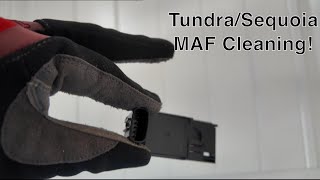
- Remove and clean the Mass Airflow (MAF) sensor using a dedicated MAF sensor cleaner. 🎬 Watch: How to clean the MAF sensor on your 5.7L engine. Do not touch the sensor wires.
- With a scan tool, monitor Short Term Fuel Trim (STFT) and Long Term Fuel Trim (LTFT) for Bank 1. High positive values (e.g., LTFT >15%) confirm the lean condition. If trims are high at idle but drop towards normal (0-5%) around 2500-3000 RPM, a vacuum leak is the most likely cause.
- If a vacuum leak is suspected, perform a smoke test to definitively locate it, paying close attention to the intake manifold gaskets.
- For 3UR-FBE (Flex Fuel) engines, check the 'Alcohol Density' value with a capable scan tool. If the value is high (e.g., >20%) but you only use regular gasoline, this is a likely cause. The fix may require a dealer visit for an ECM reflash per TSB T-SB-0166-19_Rev or a reset using a bidirectional scan tool.
- If no vacuum leaks are found, test the Bank 1 Sensor 1 (Air/Fuel Ratio) sensor's response using a scan tool.
- Check fuel pressure to rule out a weak fuel pump or clogged filter.
Parts You'll Likely Need
- Intake Manifold Gasket Set
(OEM #17171-0S030 (replaces 17171-0S010, 17171-38010, 17171-38030))— These gaskets are a very common failure point on the Sequoia's V8 engines, causing vacuum leaks that trigger P0171/P0174.
Trusted brands: Toyota OE, Fel-Pro (MS 97044), Mahle
OEM price range: $60-$90
Aftermarket price range: $30-$50 - Air/Fuel Ratio Sensor (Bank 1, Sensor 1)
(OEM #89467-0C050)— This is the upstream sensor that measures the air-fuel mixture. It can fail or degrade, causing incorrect readings. Using a Denso brand replacement (e.g., Denso 234-9144) is highly recommended as they are the original equipment manufacturer.
Trusted brands: Denso
OEM price range: $180-$250
Aftermarket price range: $130-$180 - Mass Airflow (MAF) Sensor
(OEM #22204-0P020)— If cleaning the original sensor doesn't resolve the issue, the sensor itself may have failed and requires replacement. Denso is the OEM for this part as well.
Trusted brands: Denso, Hitachi
OEM price range: $120-$180
Aftermarket price range: $60-$110
Related Codes That Often Appear With This One
- P0174 — System Too Lean (Bank 2). When both P0171 and P0174 are present, it strongly suggests a problem common to both engine banks, such as a dirty MAF sensor, a large vacuum leak at the intake plenum (like the intake manifold gaskets), or low fuel pressure.
- P1604 — Startability Malfunction. Toyota TSBs T-SB-0166-19_Rev and T-SB-0058-13 Rev specifically link this code with P0171 on 3UR-FBE engines, indicating the alcohol density learning value issue.
- P1605 — Rough Idling. This code is also mentioned alongside P0171 in TSB T-SB-0058-13 Rev for the 3UR-FBE engine, related to the same alcohol density problem.
Technical Service Bulletins (TSBs) & Recalls
- T-SB-0166-19_Rev: Supersedes the earlier TSB. For 2009-2018 Sequoias with the 3UR-FBE engine, it addresses P0171/P0174 and P1604 (Startability Malfunction) caused by incorrect alcohol density values. The procedure may involve an ECM reprogram and/or fuel pump replacement.
- T-SB-0058-13 Rev 2: An earlier version of the bulletin for 2012-2015 Sequoias with the 3UR-FBE engine, also linking P0171/P0174 with rough idling (P1605) and startability issues due to incorrect alcohol density calculations.
Platform-Specific Known Issues
- Flex Fuel (3UR-FBE) Alcohol Density Issue: According to Toyota Technical Service Bulletin T-SB-0166-19_Rev, some 2009–2016 Sequoias with the 3UR-FBE engine may exhibit a hard start and/or MIL ON with DTC P0171. This is caused by an elevated 'alcohol density estimate' in the ECM, even when using standard gasoline. The ECM incorrectly enriches the fuel mixture to compensate for non-existent ethanol, but the A/F sensor reports a lean condition, triggering the code. The fix requires resetting the 'Fuel Density Learning Value' with a capable scan tool like Toyota Techstream or certain aftermarket bidirectional scanners.
Mechanic-Grade Diagnostic Values
- Long-Term + Short-Term Fuel Trim Total — expected: Between -30% and +33%. Failure: A sustained value greater than +33% will trigger a P0171 DTC.
- Fuel Pressure (3UR-FBE Flex Fuel Engine) — expected: 270 to 330 kPa (low pressure mode), 370 to 430 kPa (high pressure mode). Failure: Pressure consistently below the expected range for the active mode indicates a fuel delivery issue (pump, filter, leak).
- Air/Fuel Ratio Sensor Voltage (at idle, warmed up) — expected: Alternates rapidly between less than 0.4V and more than 0.55V.. Failure: A sensor with slow switching, or voltage that is flat-lined or stuck, is likely faulty.
- Alcohol Density Estimate (3UR-FBE Flex Fuel Engine) — expected: Close to 0% when using standard E0-E10 gasoline.. Failure: A value of 15% or higher when using regular gasoline strongly suggests the TSB-related software issue is the cause.
Hidden / Shadow Codes Worth Checking
- Alcohol Density Percentage: This is not a trouble code, but a critical live data parameter that functions like a hidden code. On 3UR-FBE engines, the ECM can incorrectly 'learn' a high ethanol content (e.g., 85%) even with regular gas, causing lean codes and hard starts. This value is not visible on basic code readers. (see via Toyota Techstream software or advanced bidirectional scan tools (e.g., Launch CRP919E, Autel, Xtool D7/D8).)
Scan Tool Commands That Help
- Toyota Techstream, Launch, Autel, Xtool: Fuel Density Learning Value Reset — Use on a 3UR-FBE Flex Fuel engine when P0171/P0174 and/or P1604 are present and the 'Alcohol Density' data parameter is abnormally high (>15%) despite using regular gasoline. This command resets the learned value to zero.
- Toyota Techstream: Active Test: A/F CONTROL — This test manually forces the fuel injection volume to increase by 25% or decrease by 12.5%. It is used to verify the A/F sensor's response to a commanded change in mixture, helping to confirm if the sensor is functioning correctly.
Wiring & Ground Locations
- ECM (Engine Control Module) — Located on the right side of the dashboard.. The ECM is the central computer that receives data from the MAF and A/F sensors and controls the fuel injectors. All related wiring terminates here.
- Driver Side J/B (Junction Block/Fuse Box) — Located at the left end of the dashboard, under the instrument panel.. Contains fuses and relays essential for the engine control system, such as the EFI and IGN fuses. A poor connection or blown fuse here can cause a variety of engine running issues.
- Engine Harness Ground Points — General locations for Toyota V-engines include grounds from the valve covers to the chassis near the strut towers and from the wiring harness directly to the side of the cylinder heads.. A poor or corroded engine ground can cause incorrect sensor readings, including from the A/F and MAF sensors, leading to false lean codes.
Real Owner Repair Stories
- Reddit user Top-Guitar-7096 (2002 Toyota Sequoia (Note: older than the target range, but the engine architecture and gasket failure mode are identical for the V8s)) — P0171 & P0174 codes at idle.
❌ Tried (didn't work) Cleaned MAF sensor, Propane test to find vacuum leak (was unsuccessful)
✅ What actually fixed it A smoke test was performed, which immediately revealed a vacuum leak at the intake manifold. The user confirmed this was the source of the problem. - Toyota Tundra Forum user (2013 Toyota Tundra 5.7L Flex Fuel (Same 3UR-FBE engine and issue as Sequoia)) — Extended starter cranking, poor gas mileage, rough running, and associated lean codes.
❌ Tried (didn't work) Dealer attempts to fix the issue were unsuccessful long-term.
✅ What actually fixed it The owner purchased a Launch CRP919E bidirectional scan tool, read the 'Alcohol Fuel Density' which was at 85%, and used the 'Fuel Density Learning Value Reset' special function. This reset the value to zero and immediately fixed the starting and running issues.
"I Checked Everything" — The Actual Cause
- A technician may perform a smoke test and find no vacuum leaks, leading to a dead end. On 3UR-FBE Flex Fuel models, the root cause is often not a leak but the incorrect 'Alcohol Density' value stored in the ECM. This software-level issue requires a scan tool to diagnose and reset, and will not be found with a smoke machine.
OEM Part Supersession History
17171-0S010, 17171-38010, 17171-38030→17171-0S030— Standard part evolution and revision by the manufacturer.
Heads up: The new part number is the correct and current replacement for all previous versions.
Model Year Variations Within This Range
- 2009-2016: The 5.7L 3UR-FBE (Flex Fuel) engine was introduced in 2009 for certain states. This engine is susceptible to the 'Alcohol Density' learning issue described in TSBs, which does not affect the standard 3UR-FE or the 4.6L 1UR-FE.
- 2010-2012: During these years, a 4.6L 1UR-FE V8 was available as a base engine. P0171 causes on this engine are limited to typical vacuum leaks, MAF, or fuel system issues, not the Flex Fuel-specific TSB.
- 2013-2016: The 5.7L V8 (both FE and FBE versions) became the sole engine option, making the potential for the Flex Fuel TSB issue more widespread across the lineup.
Helpful Videos
Used OEM Parts in Stock
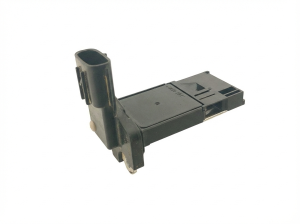

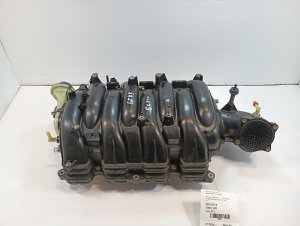
New Aftermarket Parts Available


The information in this article is provided for general reference and educational purposes only. Vehicle specifications, procedures, and part compatibility can vary by production date, trim level, and region. Always consult your vehicle's factory service manual and verify part numbers before purchasing or performing repairs. Safety-critical components such as airbags, seat belts, and braking systems should be installed by a qualified professional.
- Toyota SEQUOIA:
- 🎬 Helpful Videos
- 🛍️ Shop This Part
- What's Unique About the 2009-2016 Toyota SEQUOIA
- Diagnostic Flowchart
- Symptoms You May Notice
- Most Likely Causes
- Rare But Worth Checking
- Diagnosis Steps
- Parts You'll Likely Need
- Related Codes That Often Appear With This One
- Technical Service Bulletins (TSBs) & Recalls
- Platform-Specific Known Issues
- Mechanic-Grade Diagnostic Values
- Hidden / Shadow Codes Worth Checking
- Scan Tool Commands That Help
- Wiring & Ground Locations
- Real Owner Repair Stories
- "I Checked Everything" — The Actual Cause
- OEM Part Supersession History
- Model Year Variations Within This Range
- 🎟️ Get 5% Off