

P0171 on 2007-2011 Mercedes-Benz E-Class: M272 Engine Lean Code Causes and Fixes
This code indicates the engine is running too lean on Bank 1. For the M272 V6 engine, the most common causes are vacuum leaks from aged PCV hoses or a faulty intake manifold. A dirty Mass Airflow (MAF) sensor is also a frequent culprit. Expect to spend $20-$150 on hoses or a sensor, but up to $800+ if the intake manifold needs replacement.
- P0171 on this Mercedes is almost always caused by unmetered air entering the engine after the MAF sensor.
- Start your diagnosis by looking for vacuum leaks. A smoke test is the most effective tool for this.
- The most likely culprits for vacuum leaks are the PCV hoses and the oil separator cover.
- Before replacing any parts, try cleaning the Mass Airflow (MAF) sensor with a dedicated spray cleaner.
- Do not replace the oxygen sensor unless you have definitively ruled out all other potential causes.
What's Unique About the 2007-2011 Mercedes-Benz E-Class

On the M272 V6 engine, P0171 is very frequently caused by age-related failures of plastic and rubber components in the intake and PCV systems. These parts become brittle from constant exposure to heat and oil vapor, leading to cracks and vacuum leaks. The complex variable-length intake manifold is also a known weak point; its internal plastic swirl flap actuating lever can break, or the housing itself can develop hairline cracks, creating difficult-to-diagnose lean conditions.
Generation note: This range covers the late facelift W211 generation (2007-2009) and the early W212 generation (2010-2011). As both generations in this period used the M272 V6 engine, the causes, symptoms, and diagnostic procedures for P0171 are largely identical.
Symptoms You May Notice

- Check Engine Light is on
- Rough or unstable idle
- Hesitation or stumbling during acceleration
- Reduced fuel economy
- A whistling or hissing sound from the engine bay, indicating a vacuum leak
- Slight surging or choppiness at steady highway speeds.
- Replacing the oxygen (O2) sensor. While a faulty O2 sensor *can* cause this code, it is far more likely that the sensor is accurately reporting a lean condition caused by a vacuum leak or MAF issue. Forum users frequently report replacing O2 sensors with no change, only to later find a vacuum leak. The O2 sensor should be one of the last parts replaced after all other possibilities are ruled out.
Most Likely Causes

- Vacuum Leaks (PCV Hoses, Intake Gaskets) 🔴 High Probability The M272's PCV system has multiple plastic and rubber components that become extremely brittle with age and heat cycles, leading to cracks. The main failure points are the rear oil separator cover on the passenger side bank and the associated breather hoses. Oil residue around the throttle body is a strong indicator of a failing PCV system.
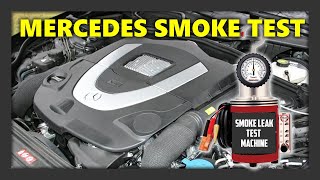
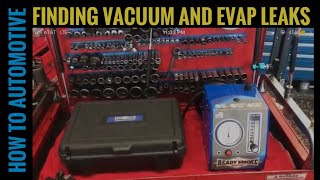
How to confirm: Perform a smoke test on the intake system. This involves introducing smoke into the intake and watching for where it escapes. 🎬 See how to perform a smoke test on this engine. Pay close attention to the rear of the engine near the firewall where the main oil separator is located. Alternatively, with the engine running, carefully spray short bursts of brake cleaner or a propane torch (unlit) around vacuum lines and gaskets; a change in engine idle indicates a leak has been found.
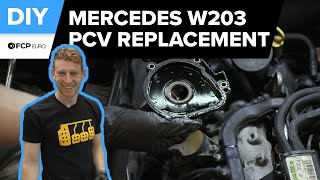
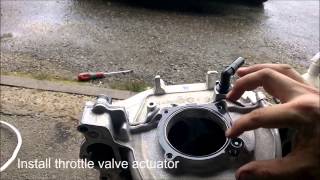
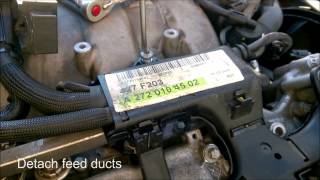
Typical fix: Replace the cracked hose(s) or faulty gasket(s). The PCV system is often sold as a comprehensive kit including the main oil separator cover, breather hoses, and seals. It is recommended to replace all related components at once. 🎬 Watch: Step-by-step guide to replacing the PCV system and hoses.
Est. part cost: $50-$200 - Dirty or Faulty Mass Airflow (MAF) Sensor 🔴 High Probability The MAF sensor measures the air entering the engine. If its sensitive wire becomes contaminated with dirt or oil (often from a failing PCV system), it will under-report the amount of air, causing the ECM to inject too little fuel, leading to a lean condition.
How to confirm: First, try cleaning the sensor. Remove it from the intake tube and spray the delicate internal wires with a dedicated MAF sensor cleaner. Do not touch the wires. If cleaning doesn't resolve the issue, monitor the sensor's output with a scan tool. If P0171 and P0174 appear together, a faulty MAF is a very strong suspect as it affects both banks.
Typical fix: Clean the MAF sensor. If the problem persists, replace the sensor. Bosch is the OEM supplier for this part.
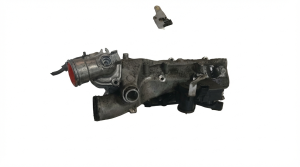
Est. part cost: $10 for cleaner, $100-$250 for a new sensor - Leaking or Faulty Intake Manifold 🟡 Medium Probability The M272's plastic intake manifold is a known failure point. The most common failure is the plastic lever for the internal swirl flaps breaking. This can cause the flaps to get stuck, but can also create a vacuum leak. Additionally, the manifold itself can develop hairline cracks or the seals around the flaps can wear out, allowing unmetered air to enter.
How to confirm: A smoke test is the most effective way to confirm a leak in the manifold itself. Often, codes P2004, P2005, or P2006 related to the runner flaps will accompany the lean code, pointing directly to the manifold. A broken actuator lever may also be visible with a mirror at the front of the manifold.
Typical fix: The intake manifold must be replaced. While repair kits for the external lever exist, they don't address internal wear or cracks. Replacement is the only guaranteed long-term fix. Pierburg is the OEM manufacturer for this part.
Est. part cost: $400-$800 - Clogged Fuel Filter or Weak Fuel Pump ⚪ Low Probability While not specific to this platform, a restriction in fuel delivery will cause a lean condition. The fuel filter is integrated with the pump and sending unit in the fuel tank and can become clogged over time, or the fuel pump can weaken with age. In some cases, a P0171 code has been reported to coincide with a fuel smell and gasoline puddling in the fuel sender area (NHTSA ODI #10906902).
How to confirm: Connect a fuel pressure gauge to the fuel rail's Schrader valve. The M272 engine should have a fuel pressure of approximately 50-55 psi (3.8 bar) at idle. If pressure is low or drops significantly under load, the pump/filter assembly is suspect.
Typical fix: Replace the in-tank fuel pump and filter assembly. This is a more involved job requiring access to the top of the fuel tank, usually under the rear seat.
Est. part cost: $200-$500 for a pump assembly
Rare But Worth Checking
- Leaking Fuel Injector O-rings: The O-rings that seal the fuel injectors can dry out and crack, allowing unmetered air to enter the intake ports. This is a type of vacuum leak that can be hard to pinpoint without a smoke test directly at the injector base.
- Exhaust Leak Before the Oxygen Sensor: A crack in the exhaust manifold or a leaking gasket before the primary O2 sensor can allow outside air to be drawn into the exhaust stream. This tricks the O2 sensor into thinking the engine is running lean, even if it isn't.
Diagnosis Steps

- Check for other stored trouble codes. If P0174 is also present, focus on causes that affect both cylinder banks. If P2004-P2006 are present, the intake manifold is the primary suspect. Note that P0171 can also appear alongside multiple misfire codes (P0300-P0305) and secondary air injection codes (P0410), as documented in NHTSA ODI #11621516.
- With a scan tool, observe Long Term Fuel Trim (LTFT) for Bank 1. A value significantly above +10% (often +20% or more) confirms the ECM is compensating for a lean condition.
- Perform a thorough visual inspection of the engine bay. Look for obviously cracked, disconnected, or oil-soaked rubber hoses, particularly around the PCV system at the rear of the cylinder heads and the intake air ducting.
- With the engine running, listen for a distinct hissing or whistling sound that could indicate a vacuum leak.
- Perform a smoke test. This is the most reliable method for finding vacuum leaks. Feed smoke into the intake system after the MAF sensor and watch for where it escapes. Pay close attention to the intake manifold gaskets, PCV hoses, and the oil separator cover at the rear of the passenger-side cylinder head.
- If no vacuum leaks are found, remove and clean the Mass Airflow (MAF) sensor using a dedicated cleaner. Allow it to dry completely before reinstalling. Inspect the intake boot for oil residue, which points to a failing PCV system.
- If the code returns, test the fuel pressure to rule out a weak fuel pump or clogged filter. Pressure should be around 50-55 psi at idle.
- As a final step, test the upstream oxygen sensor on Bank 1 to ensure it is functioning correctly and not sending false lean readings.
Parts You'll Likely Need
- Crankcase Breather Hose Kit (PCV Kit)
(OEM #2720100631 (Oil Separator/Cover))— The hoses and oil separator in the PCV system are the most common source of vacuum leaks on the M272 engine due to heat-induced brittleness. It is highly recommended to replace the entire system of hoses and covers at once.
Trusted brands: Mercedes-Benz (OEM), Febi Bilstein, Rein
OEM price range: $100-$150
Aftermarket price range: $50-$100 - Mass Airflow (MAF) Sensor
(OEM #A2730940948 (Bosch P/N: 0280218190))— A dirty or failed MAF sensor is a very common cause of lean codes on this engine, especially when P0171 and P0174 are present together.
Trusted brands: Bosch, Continental/VDO
OEM price range: $150-$250
Aftermarket price range: $70-$150 - Intake Manifold Assembly
(OEM #2721402401)— The variable length intake manifold is a complex plastic part prone to failure, either from internal swirl flap linkage breaking or the housing itself cracking, causing vacuum leaks.
Related Codes That Often Appear With This One
- P0174 — System Too Lean (Bank 2). This code is very commonly seen with P0171. When both appear together, it strongly suggests a vacuum leak that affects the entire engine, such as a faulty MAF sensor, a cracked intake manifold, or a major PCV system failure.
- P0300-P0306 — Misfire codes (e.g., P0301 for Cylinder 1). A severe lean condition can prevent proper combustion, leading to engine misfires on one or more cylinders.
- P2004, P2005, P2006 — Intake Manifold Runner Control Stuck. These codes point directly to a failure of the swirl flap mechanism inside the intake manifold, a common cause of lean codes on the M272.
- P0016, P0017 — Camshaft/Crankshaft Position Correlation. These codes may occasionally appear alongside lean codes P0171 and P0174 during engine performance issues (NHTSA ODI #11055077).
Platform-Specific Known Issues
- PCV System Complexity and Failure: The M272 engine's PCV system is not a single valve but a collection of plastic covers, chambers, and hoses integrated into the rear of the engine. The main oil separator cover (P/N 2720100631) is located in a tight space against the firewall and its diaphragm or the surrounding plastic is a very common failure point causing a significant vacuum leak. Many DIY videos exist showing this specific repair.
- Intake Manifold Swirl Flap Lever Failure: The variable-length intake manifold uses an external vacuum-actuated lever to control internal flaps. This plastic lever is notorious for breaking, causing the flaps to become inoperative. While this often throws runner-specific codes (P2004-P2006), the resulting incorrect airflow or associated vacuum leaks from worn flap seals can also be a primary cause for P0171/P0174.
Mechanic-Grade Diagnostic Values
- Fuel Pressure at Idle — expected: ~50-55 psi (3.8 bar). Failure: Pressure is significantly below 50 psi or drops under load, indicating a weak pump or clogged filter.
- Long Term Fuel Trim (LTFT) & Short Term Fuel Trim (STFT) — expected: The sum of LTFT and STFT should be within +/- 10%. Normal values hover near 0%.. Failure: Sustained positive values, especially LTFT above +15% to +25%, indicate the ECU is adding significant fuel to compensate for a lean condition, which will trigger the P0171 code.
- Upstream O2 Sensor Voltage — expected: Should fluctuate rapidly between 0.1 and 0.9 volts on a healthy engine.. Failure: A sensor that is stuck low (e.g., below 0.4V) or has a slow, lazy response is either faulty or correctly reading a persistent lean condition.
Hidden / Shadow Codes Worth Checking
- P2187 / P2189: These codes for 'System Too Lean at Idle' for Bank 1 and Bank 2 respectively are more specific than the generic P0171/P0174. When seen on a Mercedes-specific scanner like XENTRY, they often point directly to a large vacuum leak that has its most significant effect at idle RPM, such as a faulty PCV system or intake manifold gasket. (see via Mercedes-Benz XENTRY/DAS or other advanced diagnostic tools.)
Scan Tool Commands That Help
- XENTRY / DAS: Reset of mixture adaptation values — This function should be used after replacing components that affect the air-fuel mixture, such as the MAF sensor, fuel injectors, or fixing a major vacuum leak. It clears the learned long-term fuel trim values, forcing the ECU to relearn from a baseline of zero. This can resolve rough running or prevent the code from returning immediately after a repair.
- XENTRY / DAS: Actuation of intake manifold tumble flaps — If an intake manifold failure is suspected (e.g., P2006 codes are present), this bidirectional test can command the swirl flaps to open and close. This helps a technician verify if the actuator motor is working and if the flap linkage is intact without removing the manifold.
Wiring & Ground Locations
- Engine to Chassis Ground Strap — A braided cable typically located between the engine bell housing and the vehicle's chassis/frame rail.. A corroded or loose main engine ground can cause erratic voltage for all engine sensors, including the MAF and O2 sensors. This can lead to incorrect readings and trigger false lean or rich codes. A voltage drop test between the engine block and battery negative terminal should show less than 0.5V while cranking.
- W10 - Right Front Battery Ground Point — Located in the engine bay, this is a primary ground point for various components.. This is a specified ground point for the M272 engine's electrical system. Ensuring it is clean and tight is crucial for stable sensor operation.
- MAF Sensor Connector (B2/5) — On the MAF sensor, located in the intake tube between the air filter box and the throttle body.. Pin 5 (on some diagrams) carries the primary signal voltage to the ECU. Checking for proper voltage (which varies with airflow) and a stable ground at this connector is a key diagnostic step. Oil contamination from a failing PCV system can also foul this connector.
Real Owner Repair Stories
- MBWorld.org Forums (Mercedes-Benz with M272 engine) — P0171 and P0174 codes, rough running.
❌ Tried (didn't work) Replacing PCV components, Replacing Cam Plugs
✅ What actually fixed it The final resolution was replacing a faulty oxygen sensor. The user noted that while driving and monitoring live data, the sensor's readings were off, leading to the diagnosis. - PeachParts Mercedes-Benz Forum (2006 ML350 with M272 engine) — P2187 and P2189 (Lean at idle, banks 1 and 2).
❌ Tried (didn't work) Replaced MAF sensor, Performed smoke test (results not specified but intake was removed next)
✅ What actually fixed it Upon removing the intake manifold to change gaskets, the technician found a hole worn through the manifold housing by the internal swirl flaps, which had broken apart. The entire intake manifold assembly had to be replaced. - NHTSA ODI #11055077 — An owner reported a persistent check engine light with codes P0171 and P0174, along with camshaft correlation codes P0016 and P0017, noting that multiple mechanics struggled to resolve the underlying issue.
"I Checked Everything" — The Actual Cause
- A user on MBClub UK forums noted that a breather pipe under the intake manifold has a one-way valve that often fails. This allows crankcase air to flow in the wrong direction, causing MAF and O2 sensor faults and lean codes, but may not be easily detected by a standard smoke test. Getting to this pipe is difficult.
OEM Part Supersession History
2721402201, 2721402101, etc.→2721402401 (or remanufactured 272140240164)— The original intake manifolds were prone to failure of the internal plastic swirl flap linkage. The updated part from OEM Pierburg is intended to be more durable.
Heads up: While multiple part numbers exist, 2721402401 is the most current replacement for the M272 engine across various chassis. Always verify with VIN, but this is the widely accepted service replacement part.
Model Year Variations Within This Range
- 2007-2011: The M272 V6 engine was used in the late W211 E-Class (2007-2009) and the early W212 E-Class (2010-2011). While the engine itself is fundamentally the same, leading to identical causes for P0171, be aware that some chassis-related wiring or component locations may differ slightly between the W211 and W212 generations. The M272 was replaced by the M276 starting in the 2012 model year.
Diagnostic Flowchart
Real Owner Stories
Aggregated from forums and TSBs cited above. Mileages and costs reflect what owners reported in those sources.
Mercedes-Benz C-Class (W204) with M272 engine
Symptoms: Experienced lean codes P0171 and P0174 alongside a random misfire code (P0300) due to severe combustion instability.
What fixed it: Found and repaired a vacuum leak at the oil separator. The user had previously replaced the O2 sensors, which did not resolve the issue.
Source hint: MBWorld.org thread titled 'Code p0300, p0171 and p0174'
Mercedes-Benz E-Class (W212) with M272 engine
Symptoms: Triggered both P0171 and P0174 lean codes simultaneously.
What fixed it: Focused diagnostics on components affecting both banks, identifying issues with the MAF sensor and PCV system rather than replacing individual O2 sensors.
Source hint: MBWorld.org thread titled 'Running lean p0171 p0174'
Mercedes-Benz E-Class (W212) with M272 engine
Symptoms: Check engine light illuminated with a single P0171 lean code.
What fixed it: Used a scan tool to check fuel trims and performed a smoke test to locate a vacuum leak.
Source hint: MBWorld.org thread titled 'M272 Running lean with DTC P0171'
Mercedes-Benz C300 (M272 Engine)
Symptoms: An OBD-based emissions test flagged multiple codes including P0171, P219A, P0410, and misfire codes P0300, P0301, P0303, P0304, and P0305 with the check engine light on (NHTSA ODI #11621516).
Related OBD-II Codes
Frequently Asked Questions
Why is the PCV system a common cause for P0171 on my M272 engine?
I have codes P0171 and P2004 on my 2007-2011 E-Class. Are they related?
Should I replace the oxygen sensors if I get a P0171 code on my E350?
How can I test for a vacuum leak on the M272 V6?
What is the correct fuel pressure for the M272 engine to rule out a fuel delivery issue?
What parts do I need to fix the intake manifold swirl flap issue?
Helpful Videos
Used OEM Parts in Stock


New Aftermarket Parts Available



The information in this article is provided for general reference and educational purposes only. Vehicle specifications, procedures, and part compatibility can vary by production date, trim level, and region. Always consult your vehicle's factory service manual and verify part numbers before purchasing or performing repairs. Safety-critical components such as airbags, seat belts, and braking systems should be installed by a qualified professional.
- Mercedes-Benz E-Class:
- 🎬 Helpful Videos
- 🛍️ Shop This Part
- What's Unique About the 2007-2011 Mercedes-Benz E-Class
- Symptoms You May Notice
- Most Likely Causes
- Rare But Worth Checking
- Diagnosis Steps
- Parts You'll Likely Need
- Related Codes That Often Appear With This One
- Platform-Specific Known Issues
- Mechanic-Grade Diagnostic Values
- Hidden / Shadow Codes Worth Checking
- Scan Tool Commands That Help
- Wiring & Ground Locations
- Real Owner Repair Stories
- "I Checked Everything" — The Actual Cause
- OEM Part Supersession History
- Model Year Variations Within This Range
- Diagnostic Flowchart
- Real Owner Stories
- Mercedes-Benz C-Class (W204) with M272 engine
- Mercedes-Benz E-Class (W212) with M272 engine
- Mercedes-Benz E-Class (W212) with M272 engine
- Mercedes-Benz C300 (M272 Engine)
- Related OBD-II Codes
- Frequently Asked Questions
- 🎟️ Get 5% Off