

P0162 on 2013-2016 Land Rover Range Rover Evoque: Causes and Fixes
On a 2013-2016 Evoque, code P0162 almost always indicates a failed downstream oxygen sensor. This is often due to a known manufacturing defect cited in Land Rover Technical Service Bulletins (SSM63157, SSM72448). Replacing the correct O2 sensor (post-catalyst) is the most common and effective solution.
- P0162 on a 2013-2016 Evoque is almost certainly a failed downstream oxygen sensor.
- The failure is well-documented by Land Rover in TSBs as a supplier manufacturing defect.
- Do not replace the catalytic converter; diagnose the sensor and its circuit first.
- While the code says 'Bank 2', this is a quirk of the diagnostic system for the I4 engine. The part you need is the downstream (post-catalytic converter) O2 sensor.
- This is a manageable DIY repair for those with basic tools, but rusted bolts can be a challenge.
What's Unique About the 2013-2016 Land Rover RANGE ROVER EVOQUE
The 2013-2016 Range Rover Evoque is particularly susceptible to this code due to a known manufacturing issue. Land Rover issued Technical Service Bulletin #SSM63157, which states that a 'Manufacturing fault at the supplier' caused a misalignment within the oxygen sensors, leading to premature failure. Another bulletin, #SSM72448, reinforces this by noting that when this and other related codes appear, the fault is typically with the sensor itself, not the wiring, although the root cause was still under investigation at the time of publication. This makes a faulty O2 sensor a much higher probability on this vehicle than on others.
Diagnostic Flowchart
Tap your situation to follow the diagnostic path that matches what you're seeing on this vehicle.
Symptoms You May Notice
- Check Engine Light is on
- Reduced fuel economy
- Rough or unstable idle
- Hesitation during acceleration
- Black smoke from the exhaust
- Failure to pass an emissions test
- Replacing the wrong O2 sensor. The Evoque has multiple O2 sensors (upstream/pre-catalyst and downstream/post-catalyst). It is critical to identify the correct sensor (downstream) before replacement.
- Replacing the catalytic converter. This code points to a fault in the sensor's circuit, not the efficiency of the converter itself. The sensor and its wiring should always be diagnosed first.
- Ignoring potential PCM software updates. On some JLR vehicles, a software update is required to address sensor sensitivity issues. While not explicitly cited for this specific code on the Evoque, it's a common JLR practice.
Most Likely Causes
- Faulty Downstream Oxygen Sensor 🔴 High Probability Land Rover TSB #SSM63157 explicitly identifies a 'Manufacturing fault at the supplier' causing 'misalignment with in the sensor' that leads to premature failure. TSB #SSM72448 further states that upon diagnosis, the fault is determined to be with the sensor, not the wiring or connectors.
How to confirm: Use an OBD-II scanner to monitor live data for the downstream O2 sensor. A healthy downstream sensor should show a relatively stable voltage between 0.6V and 0.8V. A sensor that shows no voltage (flatline), is stuck low (near 0.1V), stuck high (near 0.9V), or has erratic readings is faulty and needs replacement. The sensor's heater circuit resistance can also be tested and should be between 11.7-14.5 Ω for a post-catalyst sensor.
Typical fix: Replace the faulty downstream (post-catalyst) oxygen sensor. For the 2.0L I4 engine, this is the sensor located after the catalytic converter. The correct OEM part number is LR028931.
Est. part cost: $50-$120 - Wiring or Connector Issue ⚪ Low Probability While possible due to exposure to exhaust heat and road debris, TSB #SSM72448 specifically notes that diagnosis often reveals no fault with the wiring harness or connector, pointing instead to the sensor. However, a visual inspection is still a critical first step.
How to confirm: Visually inspect the entire wiring harness for the O2 sensor, from the sensor itself to the main harness connection. Look for any signs of melting, chafing, corrosion, or physical damage. Check for secure connection at the plug. A voltage drop test between the ECU and sensor connector should show less than 0.2V; a higher value indicates a wiring problem.
Typical fix: Repair the damaged section of wiring or replace the connector pigtail.
Est. part cost: $10-$50
Rare But Worth Checking
- Exhaust Leak: An exhaust leak upstream of the O2 sensor can allow outside air into the exhaust stream, skewing the sensor's readings and potentially triggering a circuit code. This should be checked before replacing parts.
- Powertrain Control Module (PCM) Fault: In very rare cases, the fault can be with the PCM's internal circuit for reading the O2 sensor. This should only be considered after all other possibilities have been exhaustively ruled out by a professional. A damaged ECU input channel can produce erroneous readings even with a healthy sensor.
Diagnosis Steps
- Confirm the code: Use an OBD-II scanner to verify that P0162 is the active code.
- Inspect the sensor and wiring: Visually inspect the downstream oxygen sensor (located after the catalytic converter), its connector, and wiring harness. Look for any obvious signs of damage, melting from the exhaust, or corrosion in the connector.
- Check for exhaust leaks: With the engine running, carefully check for any audible or visible leaks in the exhaust system, especially between the engine and the O2 sensor.
- Analyze live data: Use a scan tool to view the live voltage data from the O2 sensor in question. A healthy downstream sensor should show a fairly steady voltage. A flat line at 0V, a fixed high voltage, or no activity at all points to a failed sensor. 🎬 See this step-by-step guide on testing O2 sensor voltage.
- Test the circuit: If the sensor appears dead, disconnect it and use a multimeter to check for reference voltage (typically ~0.45V) and a good ground at the connector coming from the PCM. If voltage and ground are present, the sensor is confirmed to be the fault. If not, the wiring or PCM is the issue.
- Replace the sensor: If the sensor is determined to be faulty, replace it with a quality part. The OEM part number is LR028931.
Parts You'll Likely Need
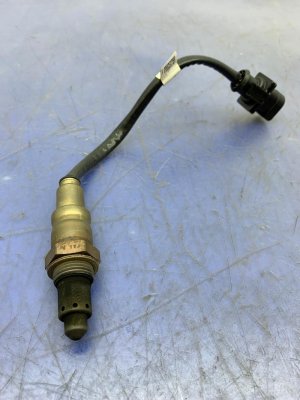
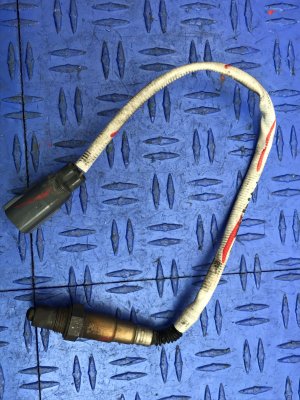
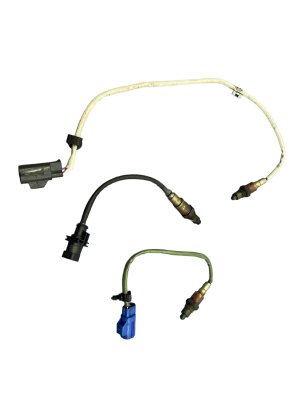
- Downstream Oxygen Sensor
(OEM #LR028931)— This is the component identified in manufacturer TSBs as having a high failure rate due to a manufacturing defect. It is the post-catalytic converter sensor.
Trusted brands: Bosch, Denso, Walker, NGK, Genuine Land Rover
OEM price range: $150-$220
Aftermarket price range: $50-$120
Related Codes That Often Appear With This One
- P0156 — This code is for 'O2 Sensor Circuit Malfunction (Bank 2 Sensor 2)'. Both codes are listed in TSB #SSM72448 as being related to the same sensor manufacturing defect.
- P0142 — This code is for 'O2 Sensor Circuit Malfunction (Bank 1 Sensor 3)'. It is also listed in TSBs #SSM63157 and #SSM72448, indicating it stems from the same root cause of faulty sensors.
- P0163 — This code indicates 'O2 Sensor Circuit Low Voltage (Bank 2 Sensor 3)'. It points to a similar failure of the sensor or its wiring.
- P0167 — This code is for the 'O2 Sensor Heater Circuit (Bank 2 Sensor 3)'. It is also listed in TSB #SSM72448 and often appears when the sensor fails internally.
Technical Service Bulletins (TSBs) & Recalls
- SSM72448: Confirms the fault is typically with the O2 sensor itself, not the wiring or connectors.
- SSM63157: Identifies a supplier manufacturing fault as the root cause of premature O2 sensor failure.
Platform-Specific Known Issues
- TSB #SSM63157: Notes that a 'Manufacturing fault at the supplier' is the cause for this and other related O2 sensor codes, leading to premature failure.
- TSB #SSM72448: States that when a group of O2 sensor codes including P0162 are present, diagnosis typically finds no fault with the wiring, and the problem is with the sensor itself.
- Confusing Code Definition: JLR's use of 'Bank 2, Sensor 3' for a 4-cylinder engine causes confusion. For this platform, it refers to the single downstream (post-catalyst) sensor. 🎬 Watch: Locating the Bank 2 Sensor 3 on a Range Rover.
Mechanic-Grade Diagnostic Values
- Downstream O2 Sensor Heater Circuit Resistance — expected: 11.7-14.5 Ohms at ambient temperature. Failure: A reading outside this range, especially 0 Ω (short) or infinite/OL (open circuit), confirms a failed heater element within the sensor.
- Downstream O2 Sensor Voltage (at idle, warm engine) — expected: Relatively stable voltage between 0.6V and 0.8V. Failure: Voltage is stuck low (near 0.1V), stuck high (near 0.9V), or is completely flat and unresponsive.
- Wiring Harness Voltage Drop — expected: Less than 0.2V. Failure: A voltage drop greater than 0.2V between the PCM connector and the sensor connector indicates high resistance in the wiring harness itself.
Hidden / Shadow Codes Worth Checking
- P0162-00: This is the full code format often seen on JLR-specific diagnostic tools. The '-00' suffix indicates 'no sub type information,' pointing directly to the general circuit malfunction described by the base code. (see via JLR SDD (Symptom Driven Diagnostics) or other advanced, manufacturer-specific scan tools.)
Scan Tool Commands That Help
- JLR SDD (Symptom Driven Diagnostics): Configure existing module – Powertrain control module — This function is used to apply a software update to the PCM. On some 2014-2015 models, this may be required after replacing an O2 sensor to prevent repeat failures caused by 'thermal shock' sensitivity, as noted in TSB LTB00671NAS3 for similar models.
Wiring & Ground Locations
- Engine Ground Point — A primary engine ground point, recommended for jump-starting, is a bolt on an engine mounting on the right-hand side of the engine bay, just behind the windscreen washer filler cap.. A poor engine ground can cause a variety of electrical faults and erratic sensor readings. Verifying this and other main ground connections are clean and tight is a crucial step in diagnosing any circuit malfunction code like P0162.
- G1D129B — Lower left front of the engine compartment.. This is a major ground distribution point for several engine components. While not exclusively for the O2 sensor, a fault at this location could cause widespread electrical issues affecting sensor circuits.
OEM Part Supersession History
LR028931→LR049884— Standard part evolution and potential design improvements.
Heads up: LR028931 is specified for 2012-2018 models with the Ford EcoBoost-derived engine. LR049884 is also listed for these years. Always verify the correct part with a VIN, as later Ingenium engines use different sensors (e.g., LR096522).
Model Year Variations Within This Range
- 2013-2017: These models primarily use the Ford-derived 2.0L EcoBoost engine. The downstream O2 sensor is typically part number LR028931 or its supersession. The TSBs regarding manufacturing faults are most relevant to this engine family.
- 2018+: Starting around 2016 and more broadly by 2018, Land Rover switched to its own 2.0L Ingenium petrol engine. This engine uses different O2 sensors (e.g., LR096522) and may have different software-related issues.
Helpful Videos
We Have This Part in Stock



The information in this article is provided for general reference and educational purposes only. Vehicle specifications, procedures, and part compatibility can vary by production date, trim level, and region. Always consult your vehicle's factory service manual and verify part numbers before purchasing or performing repairs. Safety-critical components such as airbags, seat belts, and braking systems should be installed by a qualified professional.
- Land Rover RANGE ROVER EVOQUE:
- 🎬 Helpful Videos
- 🛍️ Shop This Part
- What's Unique About the 2013-2016 Land Rover RANGE ROVER EVOQUE
- Diagnostic Flowchart
- Symptoms You May Notice
- Most Likely Causes
- Rare But Worth Checking
- Diagnosis Steps
- Parts You'll Likely Need
- Related Codes That Often Appear With This One
- Technical Service Bulletins (TSBs) & Recalls
- Platform-Specific Known Issues
- Mechanic-Grade Diagnostic Values
- Hidden / Shadow Codes Worth Checking
- Scan Tool Commands That Help
- Wiring & Ground Locations
- OEM Part Supersession History
- Model Year Variations Within This Range
- 🎟️ Get 5% Off