

OBD-II Code P0159: O2 Sensor Slow Response (Bank 2, Sensor 2)
What P0159 means, why it triggers, and how to fix it for good
- Replacing the Bank 2, Sensor 2 downstream oxygen sensor resolves code P0159 in over 80% of cases for vehicles with more than 100,000 miles.
- Inspect the exhaust manifold and pipes for leaks before buying parts, as a $20 blown gasket introduces unmetered air that perfectly mimics a failed $150 O2 sensor.
- Expect a 2-4 MPG drop in fuel economy and an automatic emissions test failure until the slow-responding sensor is replaced and the code is cleared.
- Fix this code within 30 days to prevent the engine from running rich, which permanently damages the catalytic converter and escalates a $250 repair into a $1,500+ replacement.
What Does P0159 Mean?

P0159 means your Engine Control Module (ECM) detected a sluggish downstream oxygen sensor on engine Bank 2. Specifically, the sensor located after the catalytic converter is not responding to exhaust gas changes fast enough. This 'slow response' hurts gas mileage and increases emissions because the ECM cannot verify the catalytic converter's efficiency in real-time.
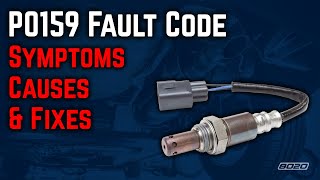
Technical definition: The SAE/ISO definition for P0159 is "O2 Sensor Circuit Slow Response (Bank 2, Sensor 2)". This indicates the downstream oxygen sensor on the second bank of cylinders fails to switch between high and low voltage readings within the ECM's expected timeframe. 🎬 Watch: A quick breakdown of what P0159 really means. The ECM triggers this code when the sensor's rich-to-lean transition time exceeds 0.5 to 1.0 seconds.
Can I Drive With P0159?
Yes, But With Caution. You can continue to drive for a short period, but do not exceed a few hundred miles. Prolonged driving with P0159 causes poor fuel economy (a 2-4 MPG drop) and guarantees an emissions test failure. The most significant risk is long-term damage to the catalytic converter from an overly rich fuel mixture, a repair costing $800 to $2,500. Address the issue within 30 days to prevent expensive collateral damage.
Common Causes

- Failing or contaminated O2 sensor (Very Common) — Oxygen sensors degrade naturally after 80,000-100,000 miles. Contamination from engine oil, coolant, carbon buildup, or silicone sealants coats the sensor's porous ceramic element, insulating it and causing a delayed voltage reaction.
- Exhaust system leak (Common) — A crack or failing gasket in the exhaust manifold or pipes near the sensor draws outside oxygen into the exhaust stream. This unmetered oxygen skews the sensor's readings, making it appear slow or biased.
- Faulty O2 sensor heater circuit (Common) — O2 sensors use an internal heater to reach their 600°F (315°C) operating temperature quickly. If the heater element fails, its fuse blows, or the relay dies, the sensor takes too long to start working, triggering a slow response code on cold starts.
- Damaged wiring or connectors (Common) — The wiring harness lives in a harsh environment. Frayed wires touching hot exhaust components, corroded connector pins, or loose connections create high electrical resistance, delaying the signal's transmission to the ECM.
- Deteriorating catalytic converter (Less Common) — A partially clogged or inefficient catalytic converter alters exhaust flow and chemical composition. This causes the downstream O2 sensor to provide erratic or slow readings, which the ECM interprets as a sensor fault.
- Use of aftermarket performance parts (Less Common) — Installing high-flow catalytic converters or headers changes exhaust gas velocity and temperature. This causes the downstream O2 sensor to behave in ways the stock ECM programming does not expect, leading to a false P0159.
- Engine Control Module (ECM) software issue (Rare) — Occasionally, the ECM's software calibration for monitoring the O2 sensor is overly sensitive. Manufacturers release Technical Service Bulletins (TSBs) with software updates to correct this logic flaw.
Symptoms

- Check Engine Light is on — The ECM illuminates the light as soon as it detects the slow response fault over two consecutive drive cycles.
- Poor fuel economy — The vehicle consumes more fuel, typically dropping 2-4 MPG, because the ECM defaults to a richer fuel mixture as a failsafe.
- Unusual exhaust smell — Because the engine runs rich, you smell raw, unburnt gasoline from the tailpipe.
- Hesitation or rough idle — An incorrect downstream signal occasionally causes the ECM to make poor fuel trim adjustments, leading to a rough idle or slight hesitation when accelerating.
- Failed emissions test (scan-tool only — no driver-felt sign) — Bank 2, Sensor 2 monitors catalytic converter efficiency. A P0159 code triggers an automatic emissions test failure because this critical monitoring function is compromised.
Diagnostic Flowchart
Tap your situation to follow the diagnostic path that matches what you're seeing on this code.
Common Fixes & Costs
- Replace the Bank 2, Sensor 2 Oxygen Sensor — Parts: $60-$150, Labor: $120-$200, ~1 hr book time (DIY)
- Repair Exhaust Leak — Parts: $20-$100, Labor: $150-$400, ~2 hr book time (Intermediate)
- Replace Blown Fuse for Heater Circuit — Parts: $1-$5, Labor: $0-$50, ~0.2 hr book time (DIY)
- Repair Damaged Wiring or Connector — Parts: $10-$50, Labor: $120-$250, ~1.5 hr book time (Intermediate)
- Update or Reprogram Powertrain Control Module (PCM/ECM) — Parts: $0, Labor: $150-$250, ~1 hr book time (Pro Only)
Used vs. New Parts: Buying Guide
When a used part is worth it: NEVER buy a used oxygen sensor. They are wear-and-tear parts with a finite lifespan. A used catalytic converter is a budget-friendly option only if sourced from a low-mileage (<80k miles) collision-totaled vehicle.
Donor-vehicle mileage cap: roughly under 80000 miles for the part to have meaningful remaining life.
Donor quality checklist:
- For O2 sensors, buy new from a premium brand (Denso, NTK, Bosch). Avoid no-name online parts.
- For catalytic converters, verify the donor vehicle's mileage and ensure it was not scrapped for engine failure.
- Avoid exhaust parts from the 'Rust Belt' as corrosion compromises longevity.
- Ensure the part number is an exact match.
Decision logic:
- If The part is an oxygen sensor → Always buy new. The low cost of a new sensor does not justify the risk and repeat labor of installing a used one.
- If The part is a catalytic converter AND the vehicle is over 150K miles with a tight budget → A used part from a verified low-mileage donor is a reasonable risk; expect 40-70% of a new part's lifespan.
- If The part is a catalytic converter AND the vehicle is newer or has lower mileage → Favor a new aftermarket or OEM part to maximize lifespan and warranty coverage.
Warranty tradeoff: Used parts offer a 30-90 day warranty for the part only. New aftermarket parts have a 1-3 year warranty. New OEM parts carry a 1-year warranty.
Worst-case if a used part fails: $200-$400 if a used O2 sensor fails shortly after installation. $800-$1500 if a used catalytic converter fails.
What Happens If You Wait — Timeline
- 0-2 weeks: Code P0159 sets and the Check Engine Light turns on. No other symptoms are perceived by the driver. (MPG impact: 0-3%% · Added cost: $0)
- 2 weeks - 3 months: The ECM defaults to a richer fuel map. A noticeable drop in fuel economy occurs. The vehicle automatically fails OBD-II emissions tests. (MPG impact: 5-10%% · Added cost: $30-$80 in wasted fuel)
- 3-8 months: Sustained rich operation damages the catalytic converter. Excess fuel overheats the ceramic substrate, causing it to crack or melt. A P0430 code appears. (MPG impact: 8-15%% · Added cost: $800-$1500 (catalytic converter replacement required))
- 8+ months: Catastrophic catalytic converter failure. The internal substrate melts into a blockage, causing severe lack of engine power and extreme backpressure. (MPG impact: 15-25%+% · Added cost: $1500-$3000 (converter replacement plus secondary engine damage))
Cost of Not Fixing It
- 0-1 month: Noticeable drop in fuel economy (5-10%) and guaranteed failure of any emissions test. (Added cost: $20-$50 in wasted fuel.)
- 1-6 months: The engine runs persistently rich, causing the catalytic converter to overheat and degrade internally, reducing its lifespan. (Added cost: $1200-$2800 for catalytic converter replacement if damage becomes irreversible.)
- 6+ months: Catastrophic failure of the catalytic converter. The internal substrate melts and clogs the exhaust, causing severe lack of power and potential engine damage. (Added cost: $1500-$3500+ for catalytic converter replacement plus secondary exhaust repairs.)
Diagnosis Steps

- Read Codes and Review Freeze Frame Data
Use an OBD-II scanner to confirm P0159. Look for related codes (P0161, P0430, P0174) that provide critical diagnostic clues. Review the freeze frame data to see the exact engine RPM, temperature, and load when the code triggered.
Tools: OBD-II Scanner (Beginner) - Thorough Visual Inspection
Inspect the Bank 2, Sensor 2 O2 sensor and its wiring harness. Look for melted wires, corrosion on the connector pins, and physical damage. Check the exhaust system around the sensor for black soot marks, which indicate an exhaust leak.
Tools: Flashlight, Safety Glasses, Inspection Mirror (Beginner) - Check for Exhaust Leaks
With the engine cold, start the car and feel or listen for leaks around the exhaust manifold gaskets and pipe connections leading to the sensor. For precision, use an automotive smoke machine to fill the exhaust and visually locate pinhole leaks.
Tools: Mechanic's Stethoscope or Automotive Smoke Machine (Intermediate) - Analyze Live Sensor Data
Use a scan tool to graph the voltage of Bank 2, Sensor 2. A healthy downstream sensor shows a steady voltage between 0.6V and 0.8V. Briefly snap the throttle; the voltage must drop quickly towards 0.1V and recover. If the voltage is flat or takes over a second to change, the sensor is dead.
Tools: Advanced OBD-II Scanner with Live Data Graphing (Advanced) - Test the Sensor's Heater Circuit
Check the fuse for the O2 sensor heater circuit (labeled 'A/F Heater' or 'O2 HTR'). Unplug the sensor and use a multimeter to verify 12V on the heater power wire with the key on. Check the resistance of the heater element through the sensor's pins; a healthy circuit reads 4-14 Ohms. Infinite resistance confirms a failed heater.
Tools: Multimeter, Vehicle-specific Wiring Diagram (Advanced) - Test Wiring Integrity to the ECM
Perform a continuity test on the signal wire between the O2 sensor connector and the ECM connector to rule out a hidden break (resistance must be < 0.5 Ohms). Check for a short to ground or power on the signal wire.
Tools: Multimeter, Vehicle-specific Wiring Diagram (Advanced) - Perform a "Propane Test"
Introduce a small amount of unlit propane into the engine's intake via a vacuum line to force a rich condition. The upstream O2 sensor reacts instantly (>0.8V). The downstream sensor (B2S2) must react shortly after. If it fails to respond or takes >1 second, the sensor is faulty.
Tools: Unlit Propane Torch, Vacuum Hose (Advanced) - Check for Technical Service Bulletins (TSBs)
Check manufacturer TSBs for your specific year and model. A known software issue causing overly sensitive O2 monitoring requires an ECM reflash at a dealership, not a hardware replacement.
Tools: Online TSB Database (Intermediate)
When This Code Triggers (Freeze-Frame Conditions)
- Engine Coolant Temp: 180-200°F (82-93°C) (Engine is fully warmed up and operating in closed-loop.)
- RPM: 1500-2500 RPM (Steady-state cruise conditions, not during heavy acceleration or deceleration.)
- Engine Load: 30-60% (Corresponds to light to moderate throttle input during highway cruising.)
- Vehicle Speed: 35-55 mph (56-88 km/h) (Typical highway or steady-speed driving where the monitor is designed to run.)
Related Codes
- P0139 — The identical code for Bank 1, Sensor 2. If both P0139 and P0159 appear together, suspect a systemic issue like contaminated fuel, a massive exhaust leak, or incompatible aftermarket exhaust headers.
- P0430 — Catalyst System Efficiency Below Threshold (Bank 2). A slow sensor (P0159) cannot properly monitor the catalytic converter, triggering a false P0430. Conversely, a failing converter disrupts exhaust flow, causing the sensor to respond slowly. Diagnose the sensor first.
- P0174 — System Too Lean (Bank 2). An exhaust leak near the downstream sensor causes P0159, while a leak further upstream causes P0174. If you have both, a major exhaust or vacuum leak is affecting the entire bank. Check for high positive fuel trims.
- P0161 — O2 Sensor Heater Circuit Malfunction (Bank 2, Sensor 2). P0161 is a direct cause of P0159. If the heater fails, the sensor responds slowly. Fixing the P0161 electrical fault almost always resolves the P0159.
Climate & Environmental Factors
- Cold Weather: In cold climates, a weak O2 sensor heater circuit fails to bring the sensor to its 600°F operating temperature quickly. This directly causes a slow response time and triggers P0159 exclusively on cold starts.
- High Humidity: Prolonged exposure to high humidity causes moisture ingress and corrosion in the O2 sensor's connector pins, increasing electrical resistance and slowing down the voltage signal.
- High Altitude: Lower atmospheric oxygen at high altitudes results in a lower baseline oxygen level in the exhaust. A marginally performing sensor struggles to respond accurately to this altered mixture, exposing an impending failure.
How to Talk to a Mechanic About This Code
Say this: "I have a P0159 code and I'd like to schedule a diagnostic. Please check for exhaust leaks and verify the O2 sensor's heater circuit and response time before recommending part replacement. If the catalytic converter is suspected, I'd like to see the Mode $06 test results."
This signals you are an informed customer. It directs the technician to follow a logical diagnostic path (leaks and wiring first) instead of just replacing the most obvious part. Requesting Mode $06 results prevents unnecessary catalytic converter upsells.
Avoid saying:
- 'My check engine light is on, can you just fix it?' (Invites unnecessary diagnostics or parts.)
- 'I think I need a new oxygen sensor.' (Don't diagnose it for them; you might pay for a part you don't need.)
- 'Just do whatever you think is best.' (Makes you an easy target for upselling.)
Questions to ask before authorizing the repair:
- Did you find any exhaust leaks or wiring issues during your inspection?
- If you are recommending a new catalytic converter, can you show me the failed Mode $06 catalyst efficiency test results?
- Can you provide me with the freeze-frame data for the P0159 code?
- What is the warranty on the parts and labor for this repair?
Where to Take It: Dealer vs Independent vs Chain
- Dealer:
Best for: Vehicles under the 8-year/80,000-mile federal emissions warranty., Complex electrical issues or when a TSB requires an ECM reflash., Newer German vehicles requiring specialized diagnostic tools.
Downsides: Highest labor rates, often 1.5x to 2x more than independent shops., Quicker to recommend replacing whole component assemblies. (Typical cost: +50% vs. baseline) - Independent Shop:
Best overall fit. A reputable independent shop correctly diagnoses the common causes of P0159 at a reasonable price.
Best for: Most out-of-warranty vehicles., Diagnosing common codes like P0159 using standard procedures like smoke testing and multimeter tests.
Downsides: Quality varies; find a shop with good reviews and ASE-certified technicians. (Typical cost: +0% vs. baseline) - Chain Shop:
Use with caution. Acceptable for a straightforward O2 sensor replacement, but avoid for initial diagnosis.
Best for: Simple part replacements where you have already diagnosed the issue with certainty.
Downsides: Technician skill varies dramatically., Business model relies on high-pressure upselling; a P0159 diagnosis easily escalates to an unnecessary catalytic converter recommendation. (Typical cost: -10% vs. baseline)
When to Walk Away From the Repair
If the total estimated repair cost exceeds 50% of your car's private-party value, seriously consider selling or trading it in.
- Car worth $4000, fix is $2200: Walk away. The repair cost is over 50% of the car's value.
- Car worth $12000, fix is $350: Fix it. A $350 repair for a new O2 sensor is well below the threshold and is standard maintenance.
- Car worth $2500, fix is $1500: Walk away. The repair, likely a catalytic converter, costs 60% of the car's value.
What Scan Tool You Need for This Code

Minimum: A scanner that reads/clears codes, shows live data streams for O2 sensors, and accesses Mode $06 diagnostic monitor test results.
A basic $20 code reader only shows 'P0159'. It cannot graph live sensor voltage to identify a 'lazy' sensor, nor can it show Mode $06 data to distinguish a bad sensor from a failing catalytic converter.
Budget: BlueDriver Pro Scan Tool (~$100) — Connects via Bluetooth to your phone. Graphs live O2 sensor voltage, reads freeze frame data, and accesses Mode $06 test results.
Mid-range: Foxwell NT510 Elite (~$180) — A powerful handheld unit offering bi-directional controls to actively test the O2 sensor heater circuit, plus OE-level diagnostics for one chosen car brand.
Professional: Autel MaxiCOM MK808 (~$450-550) — A professional-grade tablet scanner offering full system diagnostics, comprehensive live data, and bi-directional control to test any related component.
How to Clear the Code After You Fix It
- Use an OBD-II scan tool to clear the code.
- Perform a complete OBD-II drive cycle to run the readiness monitors.
Drive cycle (~30 minutes): Start the engine cold and idle for 3 minutes. Drive for 20 minutes with a mix of city and highway speeds, including 5 minutes of steady cruising between 45-60 mph. Allow the vehicle to cool down completely.
Readiness monitors affected: Catalyst monitor, O2 sensor monitor
Before emissions retest: drive at least 100 miles to fully set monitors.
Watch out for:
- Disconnecting the battery clears the code but resets all readiness monitors, guaranteeing an emissions test failure until a full drive cycle is completed.
- The code returns within two drive cycles if the root cause was not correctly repaired.
- Failing to drive at a steady highway cruise prevents the O2 sensor monitor from running.
Will This Fail Emissions / State Inspection?
Yes — this code typically fails an OBD-II emissions inspection.
- California: An illuminated Check Engine Light is an automatic failure. CARB requires all readiness monitors to be 'Ready'; you must complete a full drive cycle after repairs.
- New York: Any active Check Engine Light results in an automatic failure. Having two or more readiness monitors 'Not Ready' also causes a failure.
- Texas: In the 17 counties requiring emissions testing, an active P0159 code causes the vehicle to fail the inspection.
Most Commonly Affected Vehicles
- Honda Accord, Odyssey, Pilot (2003-2017) — On V6 models, exhaust leaks at the front pre-catalyst or flex pipe are common triggers. For 2012-2017 Accords, deterioration of the sensor itself is the primary cause.
- Toyota Camry, FJ Cruiser, Tacoma (2005-2016) — Very frequently resolved by replacing the original downstream O2 sensor after 100,000 miles. Using OEM or Denso brand sensors is mandatory; cheap aftermarket sensors cause the code to return immediately.
- Chevrolet / GM Silverado, Tahoe, Suburban, Equinox (2000-2014) — Check for TSBs related to wiring harnesses chafing against the frame or engine components, causing intermittent shorts before replacing the sensor.
- BMW 3 Series (E46/E90), 5 Series (E60/F10), X5 (E53) (2000-2015) — Frequently reported due to sensor aging or heater circuit faults. The Bank 2 Sensor 2 location is notoriously difficult to access, increasing labor times.
- Ford F-150, Focus, Explorer (2004-2018) — On F-150 trucks with V8 engines, exhaust manifold leaks (cracked manifolds or broken studs) are a significant cause of P0159.
- Nissan Titan, Altima, Maxima (2004-2015) — The cause is almost always an aging sensor becoming slow to respond on vehicles exceeding 120,000 miles.
- Audi / Volkswagen A4, A6, Golf, Passat (1999-2016) — Prone to this code due to small, hard-to-find exhaust leaks from turbo gaskets or flex pipes, rather than just sensor failure.
Manufacturer-Specific Notes
- General Motors (GM): GM trucks and SUVs frequently suffer from wiring harnesses chafing against the frame, causing intermittent shorts and P0159 codes. Inspect the harness routing before buying parts.
- Toyota/Lexus: Notoriously sensitive to aftermarket O2 sensors. Using an OEM or Denso sensor is required to resolve the code permanently. Generic sensors have different heater resistances that re-trigger the code.
- Honda/Acura: Aftermarket high-flow catalytic converters or Pre-Cat Deletes (PCDs) cause persistent P0159 codes because the altered exhaust flow prevents the sensor from operating as the ECU expects.
- Chrysler/Dodge/Jeep: The PCM uses an aggressive O2 sensor diagnostic strategy during deceleration fuel cut-off. If the sensor voltage doesn't drop to near zero instantly during deceleration, it triggers P0159 even if it performs normally otherwise.
Real Owner Stories
2007 Porsche Cayman S with ~75K miles
Check Engine Light appeared three months after purchase. The selling dealer claimed to have replaced the O2 sensor.
What they tried:
- Owner attempted to replace the Bank 2 downstream O2 sensor.
- Discovered the existing sensor had a 'spacer' installed, an improper trick to pull the sensor out of the exhaust stream to hide a catalytic converter issue.
Outcome: The owner confronted the dealer with photo evidence. The dealer replaced the catalytic converters free of charge. The spacer itself was causing the P0159 slow response code.
Lesson: A 'spacer' or 'non-fouler' on a downstream O2 sensor is a major red flag that a seller hid a much more expensive catalytic converter problem.
2016 Honda Pilot with intermittent P0159
Check Engine Light for P0159 appeared, but after clearing it, took weeks to return. No other symptoms were present.
What they tried:
- Owner suspected complex issues like failing fuel injectors due to the intermittent nature.
Outcome: Community feedback pointed to an aging O2 sensor on the edge of the ECM's response time threshold. Replacing the Bank 2, Sensor 2 O2 sensor permanently resolved the issue.
Lesson: An intermittent P0159 code that takes a long time to return points to a sensor failing due to age, rather than a complex engine issue.
Land Rover Discovery II with multiple codes
Vehicle had P0159 (Slow Response B2S2), P0150 (O2 Sensor Circuit B2S1), and P0174 (System Too Lean Bank 2).
What they tried:
- Replaced the Bank 2 upstream O2 sensor.
- Replaced the Mass Airflow (MAF) sensor.
- Codes persisted.
Outcome: The combination of a lean code (P0174) and O2 sensor codes on the same bank indicated a massive vacuum or exhaust leak on Bank 2, which was not addressed by replacing sensors.
Lesson: Never chase one code at a time. Codes like P0174 (lean) appearing with P0159 point to an unmetered air leak, not a bad sensor. Diagnose the leak first.
How to Prevent This Code From Triggering
- Use Top Tier certified gasoline (Every fill-up) — Gasolines with higher detergent levels prevent carbon buildup on injectors, ensuring complete combustion and preventing unburnt fuel from overloading the catalytic converter.
- Address engine misfires immediately (As needed) — Misfires dump raw fuel into the exhaust, which ignites in the catalytic converter and rapidly melts its internal structure.
- Avoid driving through deep standing water (During heavy rain) — Deep water causes 'thermal shock' by rapidly cooling the extremely hot catalytic converter housing, cracking the fragile ceramic substrate inside.
- Replace upstream O2 sensors proactively (Once per 100,000 miles) — Upstream sensors control fuel mixture. As they age, their response slows, causing the engine to run rich and stressing the catalytic converter over time.
Frequently Asked Questions
What is the most common misdiagnosis for P0159?
The most common mistake is replacing the oxygen sensor without checking for exhaust leaks or testing the heater circuit first. A small, inexpensive-to-fix exhaust leak causes the exact same symptoms as a failed sensor.
Will a P0159 code clear itself?
Rarely. In over 95% of cases, P0159 indicates a hard fault requiring physical repair. You must fix the underlying issue and clear the code with a scan tool.
What is Bank 2 and where is Sensor 2?
On a V-shaped engine, Bank 1 is the side with cylinder #1, and Bank 2 is the opposite side. Sensor 2 is the 'downstream' sensor located after the catalytic converter. Its primary job is monitoring converter efficiency.
Can I clean an O2 sensor to fix P0159?
No, cleaning an O2 sensor is not a reliable fix. The internal ceramic sensing element degrades or gets permanently contaminated, which cannot be cleaned from the outside. Replacement is the only guaranteed solution.
What's the difference between an upstream and downstream O2 sensor?
The upstream sensor (Sensor 1) sits before the catalytic converter, switching rapidly to control the air-fuel ratio. The downstream sensor (Sensor 2) sits after the converter to monitor its efficiency. Sensor 2 produces a much slower, more stable voltage signal.
What happens if I ignore code P0159 for too long?
Ignoring this code causes consistently poor fuel mileage and forces the engine to run rich. Over thousands of miles, this excess fuel overheats and permanently destroys the catalytic converter. Replacing a ruined converter costs between $800 and $2,500.
Is replacing an O2 sensor hard to do myself?
Difficulty depends entirely on the sensor's location and rust levels. You need a specialized slotted O2 sensor socket, and often a blowtorch to heat the exhaust bung if the threads are seized. If the sensor is easily accessible and rust-free, it takes under an hour.
Why did the code come back after replacing the sensor?
If the code returns, the sensor itself was not the root cause. The most likely culprits are an undiscovered exhaust leak, a blown heater circuit fuse, or damaged wiring. Using cheap aftermarket sensors on sensitive vehicles like Toyotas also triggers repeat codes.
Key Takeaways
- Replacing the Bank 2, Sensor 2 downstream oxygen sensor resolves code P0159 in over 80% of cases for vehicles with more than 100,000 miles.
- Inspect the exhaust manifold and pipes for leaks before buying parts, as a $20 blown gasket introduces unmetered air that perfectly mimics a failed $150 O2 sensor.
- Expect a 2-4 MPG drop in fuel economy and an automatic emissions test failure until the slow-responding sensor is replaced and the code is cleared.
- Fix this code within 30 days to prevent the engine from running rich, which permanently damages the catalytic converter and escalates a $250 repair into a $1,500+ replacement.
Helpful Videos

The information in this article is provided for general reference and educational purposes only. Vehicle specifications, procedures, and part compatibility can vary by production date, trim level, and region. Always consult your vehicle's factory service manual and verify part numbers before purchasing or performing repairs. Safety-critical components such as airbags, seat belts, and braking systems should be installed by a qualified professional.
- 🎬 Helpful Videos
- What Does P0159 Mean?
- Can I Drive With P0159?
- Common Causes
- Symptoms
- Diagnostic Flowchart
- Common Fixes & Costs
- Used vs. New Parts: Buying Guide
- What Happens If You Wait — Timeline
- Cost of Not Fixing It
- Diagnosis Steps
- When This Code Triggers (Freeze-Frame Conditions)
- Related Codes
- Climate & Environmental Factors
- How to Talk to a Mechanic About This Code
- Where to Take It: Dealer vs Independent vs Chain
- When to Walk Away From the Repair
- What Scan Tool You Need for This Code
- How to Clear the Code After You Fix It
- Will This Fail Emissions / State Inspection?
- Most Commonly Affected Vehicles
- Manufacturer-Specific Notes
- Real Owner Stories
- 2007 Porsche Cayman S with ~75K miles
- 2016 Honda Pilot with intermittent P0159
- Land Rover Discovery II with multiple codes
- How to Prevent This Code From Triggering
- Frequently Asked Questions
- What is the most common misdiagnosis for P0159?
- Will a P0159 code clear itself?
- What is Bank 2 and where is Sensor 2?
- Can I clean an O2 sensor to fix P0159?
- What's the difference between an upstream and downstream O2 sensor?
- What happens if I ignore code P0159 for too long?
- Is replacing an O2 sensor hard to do myself?
- Why did the code come back after replacing the sensor?
- Key Takeaways
- 🎟️ Get 5% Off