

OBD-II Code P0156: O2 Sensor Circuit Malfunction (Bank 2, Sensor 2)
The Ultimate Guide to Diagnosing and Fixing P0156: Causes, Pro-Level Diagnostics, and Repair Costs
- Diagnosing P0156 requires testing the Bank 2 Sensor 2 oxygen sensor, which costs $150 to $350 to replace at a repair shop.
- Inspect the wiring harness and check for exhaust leaks before buying parts, as damaged wires account for up to 30% of false O2 sensor codes.
- Driving with an active P0156 code guarantees a failed emissions test and decreases fuel economy by 10% to 15%.
- Ignoring a P0156 code for over 8 months risks destroying the catalytic converter, escalating a $200 repair into a $1,500+ replacement.
What Does P0156 Mean?

Your vehicle's Powertrain Control Module (PCM) detected a circuit malfunction in the Bank 2, Sensor 2 oxygen sensor. This downstream sensor sits after the catalytic converter on the engine side opposite cylinder #1. Its sole job is monitoring catalytic converter efficiency. 🎬 Watch this video for a breakdown of P0156 causes. P0156 triggers when the PCM sees the sensor's voltage signal stuck low (near 0.1V), inactive, or failing to fluctuate for over 20 seconds, indicating a dead sensor, broken wiring, or an exhaust leak.
Technical definition: SAE/OBD-II defines P0156 as "O2 Sensor Circuit Malfunction (Bank 2 Sensor 2)." The PCM expects a stable voltage between 0.4V and 0.8V from a healthy downstream sensor. This code sets when the signal drops below a calibrated threshold (typically under 0.2V) for an excessive period, usually exceeding 20 seconds.
Can I Drive With P0156?
Yes, But With Caution. Yes, you can drive for short trips. However, prolonged driving (over 200 miles) decreases fuel economy by 10-20%, guarantees a failed smog test, and risks permanent damage to the catalytic converter—a repair costing $800 to $2,500.
Common Causes

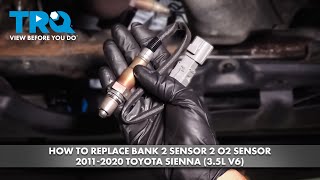
- Faulty Oxygen (O2) Sensor (Very Common) — The sensor itself is the most frequent culprit. 🎬 See this walkthrough on how to replace the oxygen sensor. Internal components wear out from extreme heat, or the sensor becomes contaminated by oil, coolant, or carbon, causing slow or dead signals.
- Damaged Wiring or Connectors (Common) — Positioned under the vehicle, the wiring harness melts against hot exhaust, frays from road debris, or suffers rodent damage. Corroded connectors also cause signal loss.
- Exhaust System Leaks (Common) — Cracks in the exhaust manifold or gaskets upstream of the sensor draw unmetered oxygen into the exhaust. This extra oxygen forces a false lean reading (low voltage), triggering the code.
- Blown Fuse or Faulty Heater Circuit (Less Common) — O2 sensors use an internal heater to reach operating temperature. A blown fuse or broken heater wire prevents warmup, skewing readings.
- Contaminated Sensor from Internal Engine Leaks (Uncommon) — Coolant from a blown head gasket coats the sensor in white deposits, while oil from worn valve seals leaves black soot. Both destroy the sensor.
- Outdated PCM Software (Rare) — Some factory PCM calibrations are too sensitive. Manufacturers issue Technical Service Bulletins (TSBs) requiring a software re-flash to fix false codes.
- Faulty Powertrain Control Module (PCM) (Very Rare) — A failed PCM driver circuit is extremely rare. Only consider this after exhaustively ruling out wiring and sensor failures.
Symptoms

- Check Engine Light (CEL) is On — The dashboard Malfunction Indicator Lamp (MIL) illuminates immediately.
- Failed Emissions Test — P0156 triggers an automatic failure for any OBD-II emissions inspection.
- Decreased Fuel Economy — Underlying issues causing the code decrease fuel efficiency by 10% to 15%.
- Rotten Egg Smell from Exhaust — A malfunctioning downstream sensor masks a failing catalytic converter, which produces a distinct sulfur smell when inefficient.
- Rough Idle or Hesitation (also visible on scanner) — Significant exhaust or vacuum leaks causing the code also create erratic idling or hesitation during acceleration.
Diagnostic Flowchart
Tap your situation to follow the diagnostic path that matches what you're seeing on this code.
DIY vs Professional
- Replace Oxygen (O2) Sensor — Beginner: Yes
Tools: O2 sensor socket set, ratchet, penetrating oil, anti-seize lubricant, safety glasses. - Replace Blown Fuse — Beginner: Yes
Tools: Fuse puller, multimeter, replacement fuse. - Repair Damaged Wiring — Beginner: No
Tools: Soldering iron, heat shrink tubing, wire strippers, multimeter, wiring diagram. - Repair Exhaust Leak — Beginner: No
Tools: Welder, pipe cutter, new gaskets, high-temperature sealant, wrenches. - Perform PCM Software Update — Beginner: No
Tools: Dealership-level scan tool, battery maintainer, software subscription.
Used vs. New Parts: Buying Guide
When a used part is worth it: Buying used O2 sensors is never recommended. For a related catalytic converter repair, a used part from a low-mileage donor vehicle (under 80,000 miles) is a viable budget option.
Donor-vehicle mileage cap: roughly under 80000 miles for the part to have meaningful remaining life.
Donor quality checklist:
- Verify the donor vehicle's mileage and salvage reason.
- Match the part number exactly to ensure correct calibration.
- Avoid parts from heavy road salt regions to prevent hidden corrosion.
Decision logic:
- If The required part is an O2 sensor → always buy new. Cost savings are negligible compared to the risk of premature failure.
- If The required part is a catalytic converter and the vehicle is over 150,000 miles → a used part from a low-mileage donor is acceptable, but expect a shorter lifespan.
- If The vehicle is in a state with strict emissions laws (e.g., California) → buy a new OEM or CARB-compliant aftermarket catalytic converter to guarantee passing.
Warranty tradeoff: Used parts offer a 30-90 day warranty. New aftermarket parts provide a 1-year warranty, while new OEM parts carry the manufacturer's warranty.
Worst-case if a used part fails: $500-1500 if a used catalytic converter fails, factoring in repeat labor and sourcing another part.
What Happens If You Wait — Timeline
- 0-2 weeks: The Check Engine Light illuminates. There are no noticeable driving symptoms, but the car automatically fails an emissions test. (MPG impact: 0-5%% · Added cost: $0)
- 2 weeks - 3 months: Fuel economy drops by 2-4 MPG. A mild, intermittent rough idle occurs once the engine is warm. (MPG impact: 5-10%% · Added cost: $25-$75 in wasted fuel)
- 3-8 months: The faulty sensor stops reporting the catalytic converter's status. The converter operates outside its ideal temperature range, accelerating wear. (MPG impact: 10-15%% · Added cost: $75-$200 in wasted fuel)
- 8+ months: Sustained incorrect air-fuel ratios melt the catalytic converter's internal substrate. This causes a major exhaust restriction, power loss, and escalates the repair to a full converter replacement. (MPG impact: 15-25%% · Added cost: $1200-$2800)
Cost of Not Fixing It
- 0-2 months: Guaranteed emissions test failure. Fuel economy decreases by 5-15%, costing an extra $20-$50 per month. (Added cost: $20-$100)
- 2-8 months: Incorrect data masks a degrading catalytic converter. The converter overheats and loses efficiency due to imbalanced exhaust chemistry. (Added cost: $0)
- 8+ months: Prolonged operation melts the catalytic converter substrate, causing a major exhaust restriction. This turns a $200 sensor repair into a major system replacement. (Added cost: $1200-$2800)
When This Code Triggers (Freeze-Frame Conditions)
- Engine Coolant Temp: 180-210°F (The engine must be fully warmed up and operating in closed loop.)
- RPM: 1500-2500 RPM (Occurs during steady-state cruising, not during heavy acceleration or deceleration.)
- Vehicle Speed: 40-65 mph (The fault registers during highway or steady suburban driving.)
- Engine Load: 20-60% (Occurs under light to moderate engine load.)
Related Codes
- P0157 — 'O2 Sensor Circuit Low Voltage (Bank 2 Sensor 2)'. A specific version of P0156 confirming the voltage signal is consistently stuck below the minimum threshold (e.g., < 0.2V).
- P0158 — 'O2 Sensor Circuit High Voltage (Bank 2 Sensor 2)'. The opposite problem. Live data shows a reading stuck high (> 0.8V), indicating a short to power or a very rich condition.
- P0160 — 'O2 Sensor Circuit No Activity Detected (Bank 2 Sensor 2)'. More severe than P0156. A flat line or 0V reading points to a dead sensor, severed wire, or blown fuse.
- P0430 — 'Catalyst System Efficiency Below Threshold (Bank 2)'. A faulty Bank 2 Sensor 2 falsely triggers P0430. Always fix O2 sensor codes before diagnosing catalyst efficiency.
Climate & Environmental Factors
- Cold Climates / Road Salt: Road salt and moisture accelerate corrosion on wiring connectors and the sensor body, leading to short or open circuits.
- High Humidity: Moisture penetrates non-sealed connectors, causing pin corrosion or creating a path to ground that disrupts the low-voltage O2 signal.
- Extreme Cold Starts: Repeated cycling in extreme cold stresses the O2 sensor's internal heater, causing premature failure. Some TSBs address false codes triggered only in cold weather.
- High Altitude: High altitudes cause a naturally leaner air-fuel mixture, occasionally pushing sensitive O2 sensors to the edge of normal parameters and triggering intermittent codes.
How to Talk to a Mechanic About This Code
Say this: "I have a P0156 code for the Bank 2 Sensor 2 oxygen sensor. Please check the sensor's live data, inspect the wiring for damage, and check for exhaust leaks before recommending a part replacement."
This signals you expect a thorough diagnosis, not a quick part swap. It directs the shop to check common failure points and prevents immediate upselling on a catalytic converter.
Avoid saying:
- 'My check engine light is on, can you just fix it?'
- 'I'm pretty sure it's the O2 sensor, can you just replace it?'
- 'Just do whatever you think is best.'
Questions to ask before authorizing the repair:
- What was the O2 sensor voltage reading on the scan tool? Was it stuck or fluctuating?
- Did you find visible damage to the wiring or corrosion in the connector?
- Did you perform a smoke test to check for exhaust leaks upstream of the sensor?
- What is the warranty on the recommended parts and labor?
Where to Take It: Dealer vs Independent vs Chain
- Dealer:
Best for: Vehicles under a powertrain or emissions warranty., Known issues requiring a manufacturer-specific software update (TSB)., Complex electrical issues on newer European vehicles.
Downsides: Highest labor rate, often 1.5x to 2x an independent shop., May recommend replacing whole assemblies instead of single components. (Typical cost: +50% vs. baseline) - Independent Shop:
Best fit. A reputable independent shop easily diagnoses and repairs the common causes of P0156 at a reasonable cost.
Best for: Out-of-warranty vehicles where cost is a primary concern., Diagnosing and repairing common codes like P0156., Building a long-term relationship with a trusted mechanic.
Downsides: Diagnostic skill varies; always check reviews and look for ASE certifications., May lack access to the latest manufacturer-specific software. (Typical cost: +0% vs. baseline) - Chain Shop:
Acceptable with caution. They handle simple O2 sensor replacements, but avoid them for complex wiring or catalytic converter diagnostics.
Best for: Straightforward repairs like brake jobs or oil changes., If you have confirmed the fix is a simple sensor swap.
Downsides: Technician skill is inconsistent., High pressure to upsell unnecessary services or parts. (Typical cost: -10% vs. baseline)
When to Walk Away From the Repair
If the estimated repair cost exceeds 40-50% of the car's private-party value, seriously consider selling the vehicle.
- Car worth $4000, fix is $2000: Borderline. This hits the 50% threshold. Get a second opinion and evaluate the car's overall condition before authorizing repair.
- Car worth $12000, fix is $1800: Fix it. The repair cost is 15% of the vehicle's value, well below the walk-away threshold.
- Car worth $2500, fix is $1500: Walk away. The repair is 60% of the car's value. It is not a sound financial decision to proceed.
What Scan Tool You Need for This Code

Minimum: A scanner that reads codes, shows live data streams (specifically O2 sensor voltage), and accesses Mode $06 test results.
A basic $20 code reader only provides the P0156 code. Viewing live data is essential to see if the sensor is actually dead or just reading a lean exhaust condition.
Budget: BlueDriver Pro Scan Tool (~$100) — Connects via Bluetooth to graph live O2 sensor voltage and access Mode $06 data, proving if the sensor is functioning.
Mid-range: Foxwell NT510 Elite (~$180) — Provides bidirectional controls to command the sensor's heater circuit directly, offering deeper diagnostics than a basic reader.
Professional: Autel MaxiCOM MK808 (~$500) — Offers full-system diagnostics, extensive live data graphing, and bidirectional control to quickly pinpoint the exact cause of P0156.
Rent vs buy: For a one-time fix, borrow a scanner for free from AutoZone. Buy a scanner only if you diagnose issues multiple times a year.
How to Clear the Code After You Fix It
- Use an OBD-II scan tool to clear the P0156 code.
- Perform a complete OBD-II drive cycle to run the readiness monitors.
- Do not disconnect the battery, as this clears adaptive memory without properly resetting readiness monitors.
Drive cycle (~30 minutes): A full drive cycle requires: 1) A cold start with a 3-minute idle. 2) 10 minutes of stop-and-go city driving. 3) 15 minutes of steady highway driving (55-60 mph). 4) A complete cooldown. This allows the O2 sensor and catalyst monitors to run self-tests.
Readiness monitors affected: Oxygen (O2) Sensor Monitor, Catalyst Monitor
Before emissions retest: drive at least 50 miles to fully set monitors.
Watch out for:
- The code returns immediately if the underlying fault (wiring short or exhaust leak) wasn't fixed.
- Failing to complete the specific drive cycle prevents readiness monitors from setting to 'Ready'.
- Testing before readiness monitors complete results in a 'Not Ready' failure.
Will This Fail Emissions / State Inspection?
Yes — this code typically fails an OBD-II emissions inspection.
- California: An active P0156 code is an automatic failure. All OBD-II readiness monitors must be set to 'Ready'. Complete a full drive cycle after the repair before re-testing.
- New York: The NYS DMV inspection includes an OBD-II scan. P0156 causes immediate failure. The O2 sensor and Catalyst readiness monitors must complete before passing.
- Texas: In emissions-testing counties, P0156 fails the OBD inspection. The vehicle cannot pass until the code is fixed and readiness monitors are set.
Most Commonly Affected Vehicles
- Ford F-150, Explorer, Mustang (2005-2018) — Common on the 5.4L 3V Triton V8. The wiring harness routes poorly and melts on the exhaust. Verify part numbers with VIN.
- Chevrolet / GMC Silverado / Sierra, Tahoe / Yukon (1999-2007) — Wiring damage from corrosion is frequent. The harness connector fills with water, causing pin failure. Check the ground connection on GMT800 platforms.
- Jeep Grand Cherokee, Wrangler (1999-2013) — The 4.7L and 5.7L V8 engines are prone to sensor failure and exhaust manifold leaks. 2005-2010 Grand Cherokees require a specific angled-head sensor.
- Toyota 4Runner / Tundra / Sequoia (2000-2007) — On the 2UZ-FE 4.7L V8, this code triggers from aging sensors or small exhaust leaks at the manifold gaskets.
- Honda Accord / Odyssey / Pilot (2005-2012) — On J-series V6 engines, access to the Bank 2 sensor is challenging. The failure is almost always the sensor itself.
- Nissan Altima, Pathfinder, Titan, Maxima (2002-2015) — Common on VQ-series V6 engines. Check for cracks in the exhaust manifold, a known issue that triggers P0156.
- BMW 3-Series (E46/E90), 5-Series (E39/E60), X3, X5 (2000-2015) — Occurs on higher-mileage models. Oil leaks from the valve cover gasket dripping onto the sensor and wiring frequently cause this code.
- Hyundai / Kia Tucson, Santa Fe, Sorento (2005-2012) — Triggered by sensor failure or wiring problems. In high-mileage cases, it indicates a degrading catalytic converter before P0430 appears.
- Subaru Outback, Forester, Legacy (2005-2014) — The exhaust system develops leaks at the flange gaskets after the catalytic converter, causing P0156 more often than sensor failure.
Manufacturer-Specific Notes
- Ford: On F-150 and Explorer models, the wiring harness chafes over the transmission crossmember, shorting the sensor wires. TSB 05-10-9 addresses water intrusion into connectors.
- Toyota: On V8 models, a slow-responding upstream (Sensor 1) O2 sensor alters exhaust chemistry, causing the downstream (Sensor 2) to read incorrectly. Investigate Sensor 1 if replacing Sensor 2 fails.
- General Motors (GM): On 2005-2007 trucks and SUVs, a PCM software glitch causes false P0156 codes in cold weather. TSB 06-06-04-033H requires a dealer PCM re-flash.
- Nissan: On V6 vehicles, a pre-catalyst failure in the exhaust manifold sends debris downstream, physically destroying the Sensor 2 O2 sensor. Inspect the manifold cat if the sensor is physically damaged.
Real Owner Stories
2002 Toyota Sequoia with recurring P0156
Bought a Sequoia with a P0156 code. Visual inspection revealed torn sensor wiring from a previous incorrect axle installation.
What they tried:
- Replaced the damaged O2 sensor, but the code returned after 100 miles.
- Installed a second new sensor, assuming the first was faulty. Code persisted.
- Live data showed 0V from Bank 2 Sensor 2, while the other three sensors worked perfectly.
Outcome: The owner traced the issue to a damaged wiring harness upstream from the sensor. The 0V reading confirmed an open circuit, not a bad sensor.
Lesson: When a new sensor doesn't fix a 0V reading, the problem is in the wiring or fuse circuit. Always test for 12V at the heater circuit and check continuity on the signal wire before replacing parts.
1998 Ford Mustang with persistent P0156
The check engine light for P0156 kept returning after clearing the code, even after replacing the rear passenger side O2 sensor.
What they tried:
- Replaced the Bank 2, Sensor 2 O2 sensor.
Outcome: Forum diagnostics pointed to an inefficient catalytic converter or an exhaust leak between the cat and the downstream sensor.
Lesson: A recurring P0156 after sensor replacement points to a failing catalytic converter or an exhaust leak. The downstream sensor reports on the cat; if the cat fails, the sensor triggers the code.
Lexus with coolant contamination causing P0156
A P0156 code appeared consistently two weeks after replacing head gaskets to fix a coolant leak.
What they tried:
- Fitted a new O2 sensor, but the code returned.
- Cleared the code multiple times, but it reappeared weekly.
Outcome: Coolant had contaminated and damaged the catalytic converter, causing the downstream O2 sensor to generate the P0156 code.
Lesson: If you experience an O2 sensor code after an internal engine coolant leak, the catalytic converter is likely contaminated. Coolant additives coat the catalyst substrate, ruining efficiency.
How to Prevent This Code From Triggering
- Use Top Tier certified gasoline (Every fill-up) — Advanced detergents prevent carbon buildup on fuel injectors and valves, ensuring complete combustion and reducing contamination of the catalytic converter and O2 sensors.
- Perform regular exhaust inspections (Annually or every 15,000 miles) — Visually inspect the exhaust system for cracks or loose clamps. Repairing small leaks early prevents them from skewing O2 sensor readings.
- Change engine oil at recommended intervals (Per manufacturer's schedule) — Regular oil changes prevent sludge and reduce oil blow-by from worn piston rings, which contaminates oxygen sensors.
- Address engine leaks promptly (As needed) — Fixing oil and coolant leaks prevents fluids from dripping onto O2 sensor wiring or permanently fouling the sensor element internally.
Frequently Asked Questions
Can I replace just the one bad O2 sensor?
Yes, only replace the specific Bank 2 Sensor 2 unit. There is no need to replace sensors in pairs unless both suffered contamination from a major fluid leak.
What is the most common mistake when fixing a P0156 code?
The most costly mistake is replacing the oxygen sensor without checking the wiring or exhaust first. Technicians often overlook small exhaust leaks or corroded connector pins, causing the code to return immediately.
Why did the P0156 code come back after I replaced the sensor?
A returning code means the sensor was not the root cause. The actual problem is likely an undetected exhaust leak, high resistance in the wiring harness, or a failing catalytic converter.
What is 'Bank 2' and where is it?
On a V-shaped engine, Bank 2 is the side of the engine that does not contain cylinder #1. Consult your vehicle's repair manual to confirm the exact firing order and layout.
What's the difference between Sensor 1 and Sensor 2?
Sensor 1 is upstream of the catalytic converter and controls the engine's air-fuel mixture. Sensor 2 is downstream and strictly monitors the catalytic converter's efficiency.
Can a bad gas cap cause a P0156 code?
No, a loose gas cap triggers evaporative emissions (EVAP) codes like P0455. It has no impact on the oxygen sensor circuit.
Can a dirty air filter cause P0156?
No. A severely clogged air filter creates a rich running condition, which forces the O2 sensor voltage high, not low. It does not trigger a circuit malfunction code like P0156.
Key Takeaways
- Diagnosing P0156 requires testing the Bank 2 Sensor 2 oxygen sensor, which costs $150 to $350 to replace at a repair shop.
- Inspect the wiring harness and check for exhaust leaks before buying parts, as damaged wires account for up to 30% of false O2 sensor codes.
- Driving with an active P0156 code guarantees a failed emissions test and decreases fuel economy by 10% to 15%.
- Ignoring a P0156 code for over 8 months risks destroying the catalytic converter, escalating a $200 repair into a $1,500+ replacement.
Helpful Videos
![How to Fix SUBARU P0156 Engine Code in 4 Minutes [3 DIY Methods / Only $9.49]](https://img.youtube.com/vi/JDXZiGOu3kg/mqdefault.jpg)
![How to Fix P0156 Engine Code in 4 Minutes [3 DIY Methods / Only $9.49]](https://img.youtube.com/vi/VEnAhTN_N_s/mqdefault.jpg)

The information in this article is provided for general reference and educational purposes only. Vehicle specifications, procedures, and part compatibility can vary by production date, trim level, and region. Always consult your vehicle's factory service manual and verify part numbers before purchasing or performing repairs. Safety-critical components such as airbags, seat belts, and braking systems should be installed by a qualified professional.
- 🎬 Helpful Videos
- What Does P0156 Mean?
- Can I Drive With P0156?
- Common Causes
- Symptoms
- Diagnostic Flowchart
- DIY vs Professional
- Used vs. New Parts: Buying Guide
- What Happens If You Wait — Timeline
- Cost of Not Fixing It
- When This Code Triggers (Freeze-Frame Conditions)
- Related Codes
- Climate & Environmental Factors
- How to Talk to a Mechanic About This Code
- Where to Take It: Dealer vs Independent vs Chain
- When to Walk Away From the Repair
- What Scan Tool You Need for This Code
- How to Clear the Code After You Fix It
- Will This Fail Emissions / State Inspection?
- Most Commonly Affected Vehicles
- Manufacturer-Specific Notes
- Real Owner Stories
- 2002 Toyota Sequoia with recurring P0156
- 1998 Ford Mustang with persistent P0156
- Lexus with coolant contamination causing P0156
- How to Prevent This Code From Triggering
- Frequently Asked Questions
- Can I replace just the one bad O2 sensor?
- What is the most common mistake when fixing a P0156 code?
- Why did the P0156 code come back after I replaced the sensor?
- What is 'Bank 2' and where is it?
- What's the difference between Sensor 1 and Sensor 2?
- Can a bad gas cap cause a P0156 code?
- Can a dirty air filter cause P0156?
- Key Takeaways
- 🎟️ Get 5% Off