

P0154 on 2014-2015 Acura RLX: A/F Sensor Heater Malfunction Causes and Fixes
This code indicates a faulty heater in the front air/fuel ratio sensor on Bank 2. The most common fix is replacing the sensor itself. Acura issued TSB B15-035 for this issue, which may also require a PCM software update. Expect to pay $80-$150 for an aftermarket sensor and $200-$300 for an OEM part.
- P0154 on a 2014-2015 RLX points directly to a heater failure in the upstream A/F sensor on the radiator side of the engine (Bank 2).
- The most common fix is replacing the sensor, but check for a PCM software update first, as per Acura TSB B15-035.
- This code is often seen with P0134 for the other bank; if both are present, consider replacing both upstream sensors.
- The job is DIY-friendly with a special oxygen sensor socket, and the primary part is the sensor itself. Use only OEM, Denso, or NTK parts.
- Ignoring this code will lead to poor fuel mileage and can eventually damage the expensive catalytic converter.
What's Unique About the 2014-2015 Acura RLX
The 2014-2015 Acura RLX, equipped with the 3.5L V6 engine (J35Y4), is known for this specific issue. American Honda issued multiple Technical Service Bulletins (TSBs), most notably B15-035, acknowledging that the Malfunction Indicator Lamp (MIL) can come on with code P0154, often accompanied by P0134 for the opposite bank. TSB documentation suggests the PCM can misinterpret the heater system input from the A/F sensor, setting the code. This indicates a potential batch of susceptible sensors or a sensitivity in the system's software, sometimes requiring a PCM update in addition to or instead of sensor replacement.
Diagnostic Flowchart
Tap your situation to follow the diagnostic path that matches what you're seeing on this vehicle.
Symptoms You May Notice
- Check Engine Light is on
- Decreased fuel economy
- Engine may hesitate during acceleration
- Rough idle or stalling when the engine is cold
- Black smoke from the exhaust in severe cases, indicating a rich fuel mixture
- Replacing the sensor without checking if the PCM software update from TSB B15-035 is needed.
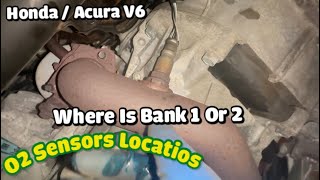
- Replacing the wrong sensor (e.g., the downstream Sensor 2, or the sensor on Bank 1). Bank 2 is the front bank by the radiator. 🎬 Watch: How to locate every sensor on your Acura V6
- Using a cheap, non-OEM brand sensor, which can fail quickly or not work at all in sensitive Honda/Acura systems.
Most Likely Causes
- Failed Air/Fuel Ratio Sensor (Bank 2, Sensor 1) 🔴 High Probability Acura issued TSB B15-035 specifically for this failure on 2014-2015 RLX and MDX models, suggesting a known weakness in the sensor's internal heater element or a PCM software misinterpretation.
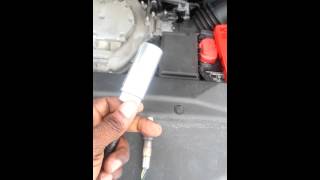
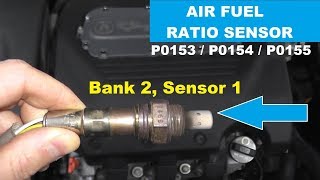
How to confirm: After checking fuses and wiring, test the resistance of the sensor's heater circuit with a multimeter. An out-of-spec or open circuit reading (infinite resistance) confirms a failed sensor. 🎬 See this walkthrough on testing and replacing the Bank 2 sensor The sensor for Bank 2 is located on the cylinder bank closer to the radiator.
Typical fix: Replace the Bank 2, Sensor 1 Air/Fuel Ratio sensor. It is highly recommended to use OEM (Acura) or OEM-supplier brands like Denso or NGK/NTK, as Honda/Acura vehicles are sensitive to off-brand sensors.
Est. part cost: $80-$300 - Damaged Wiring or Corroded Connector 🟡 Medium Probability
How to confirm: Visually inspect the wiring harness and connector leading to the Bank 2, Sensor 1 A/F sensor for any signs of melting, fraying, or corrosion. Use a multimeter to check for proper voltage and ground at the connector.
Typical fix: Repair the damaged section of the wiring harness or clean/replace the connector.
Est. part cost: $10-$50 - Blown Fuse for Sensor Heater Circuit ⚪ Low Probability
How to confirm: Locate the fuse for the A/F sensor heater circuit in the vehicle's fuse box and check for continuity. A blown fuse often indicates a short in the wiring or the sensor itself.
Typical fix: Replace the blown fuse. If it blows again, a short circuit in the wiring or sensor must be diagnosed.
Est. part cost: $1-$5
Rare But Worth Checking
- Powertrain Control Module (PCM) Software Issue: Acura TSB B15-035 explicitly states the cause can be the engine computer misinterpreting sensor data. Before replacing the sensor, it's critical to check with an Acura dealer (with your VIN) if the PCM software update from this TSB has been performed.
- Exhaust Leak: A leak in the exhaust manifold or gasket before the sensor can introduce extra oxygen, causing incorrect readings and potentially triggering this code.
- Leaking Air Intake Duct: On Honda/Acura vehicles, a common and often overlooked cause for oxygen sensor codes is a cracked or leaking air intake duct between the mass airflow (MAF) sensor and the throttle body. This allows unmetered air into the engine, throwing off the air/fuel ratio and causing the computer to set codes.
Diagnosis Steps
- Read the trouble codes with an OBD-II scanner to confirm P0154 is present.
- Check for TSB B15-035 history. Contact an Acura dealer with your VIN to see if the PCM software update has been performed.
- Inspect the flexible air intake duct between the air filter box and the throttle body for any cracks or leaks.
- Locate the A/F Sensor for Bank 2, Sensor 1. On the 3.5L V6, Bank 2 is the cylinder bank closer to the radiator. Sensor 1 is the upstream sensor before the catalytic converter.
- Inspect the sensor's wiring harness and connector for any visible damage, melting, or corrosion.
- Check the fuse for the A/F sensor heater circuit in the fuse panel, often labeled 'A/F Heater' or similar.
- If wiring and fuse are okay, disconnect the sensor and measure the resistance across the two heater pins of the sensor. Compare the reading to the manufacturer's specification (typically a low single-digit Ohm reading). An open circuit (infinite resistance) indicates a failed heater.
- If the sensor's resistance is within spec, check for battery voltage and a good ground at the vehicle's harness connector.
- If all checks pass and the PCM software is up to date, the sensor is likely intermittently faulty and should be replaced with a quality OEM or Denso/NTK part.
Parts You'll Likely Need
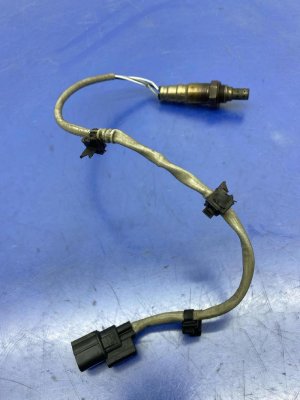
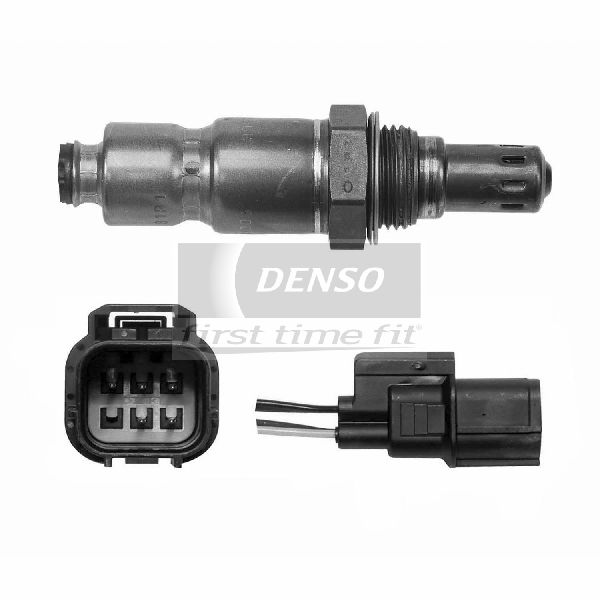
- Front Air/Fuel Ratio Sensor (Bank 2, Sensor 1)
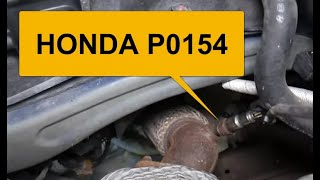
(OEM #36531-R9P-A01)🎬 Watch: A quick guide to fixing the P0154 heater malfunction — This is the component identified by the trouble code and multiple Acura TSBs as the primary point of failure.
Trusted brands: Denso (OEM supplier, e.g., 234-5010), NGK/NTK (OEM supplier)
OEM price range: $200-$300
Aftermarket price range: $80-$150
Related Codes That Often Appear With This One
- P0134 — This code is for the same heater circuit malfunction but on the opposite bank (Bank 1, Sensor 1). Acura's TSBs explicitly mention that P0154 and P0134 often appear together, pointing to a common issue with the upstream A/F sensors on this vehicle.
- P2254 — This code for 'O2 Sensor Negative Current Control Circuit/Open Bank 2 Sensor 1' can sometimes appear with P0154. It points more specifically to an open circuit in the sensor's wiring or the sensor itself.
Technical Service Bulletins (TSBs) & Recalls
- B15-035: States the MIL comes on with DTC P0134 and/or P0154 and that the cause is the PCM misinterpreting the heater system input. The fix is a PCM software update.
- ENG REQ - BER141, DLR MSG - RFP - (2015 ENGINE), DLR MSG - RFI - (2014 ELECTRICAL SYSTEM), DLR MSG - RFP - (2015 ELECTRICAL SYSTEM): All are dealer communications from late 2014/early 2015 indicating an active investigation by American Honda into this specific code on 2014-2015 RLX and MDX models.
Platform-Specific Known Issues
- Acura has issued multiple dealer messages and Technical Service Bulletin B15-035 for the 2014-2015 RLX due to the MIL illuminating with DTC P0154 and/or P0134. The fix may involve a PCM software update, sensor replacement, or both.
- Owners on forums often recommend replacing both upstream sensors (Bank 1 and Bank 2) at the same time if one fails, especially if codes for both banks are present.
Mechanic-Grade Diagnostic Values
- A/F Sensor Signal Voltage (Live Data) — expected: On many Honda/Acura systems using Denso sensors, the scan tool will show a voltage that fluctuates around a stoichiometric point. This can be around 3.3V or 1.8V depending on the system. The key is seeing activity and response to throttle changes, not a flat line.. Failure: A flat, unchanging voltage (e.g., stuck at 0.1V, 1.8V, or 3.3V) indicates no activity, triggering the code.
- A/F Sensor Heater Current — expected: The ECM expects to see a specific amount of current draw from the heater. While not always available on all scan tools, related heater circuit codes trigger if the current is outside a specific range (e.g., less than 0.8 A or more than 10 A).. Failure: A current reading of 0A indicates an open circuit (bad heater, blown fuse, or broken wire). An excessively high current reading indicates a short circuit.
- A/F Sensor Heater Resistance — expected: A low, single-digit Ohm reading when measured across the two heater pins on the sensor connector (usually the two same-colored wires). The exact spec can vary, but it should not be an open or short circuit.. Failure: Infinite resistance (OL) indicates a broken heater element inside the sensor. Zero resistance indicates an internal short circuit.
Hidden / Shadow Codes Worth Checking
- Mode $06: Mode $06 data allows a technician to view the results of the PCM's self-tests for various components, including the oxygen sensor heaters. For Honda/Acura, this data is often presented with a Test ID (TID) and Component ID (CID). A technician can check if the HO2S (Heated Oxygen Sensor) monitor has completed and passed its test. (see via A professional-grade OBD-II scan tool with Mode $06 capabilities.)
Scan Tool Commands That Help
- Honda HDS / Professional Scan Tool: Live Data / Data Stream (Parameter IDs: O2S B2S1, A/F Sensor B2S1) — This is the primary method to diagnose P0154. Graphing the sensor's voltage allows a technician to see if it is flat-lined (inactive) or responding correctly to changes in air/fuel mixture, such as snapping the throttle.
- Honda HDS / Professional Scan Tool: Check TSB / Software Update History — Crucial first step for 2014-2015 models. Before replacing any parts, the technician must verify if the PCM software update from TSB B15-035 has been performed, as the software itself could be the root cause.
Wiring & Ground Locations
- G101 — Located at the right front of the engine.. This is a primary engine ground. A loose or corroded ground at this location can cause a host of electrical issues, including erratic or missing signals from engine sensors like the A/F sensor.
- A/F Heater Fuse — Typically located in the under-hood fuse/relay box.. This fuse supplies power to the A/F sensor's heater element. If this fuse is blown, the heater will not operate, directly causing a P0154 (or P0134) code. A blown fuse often points to a short in the wiring or the sensor itself.
- PCM Location — Located in the right front of the engine compartment.. Knowing the PCM location is necessary for advanced diagnostics, such as checking for continuity on the sensor signal and heater control wires between the sensor connector and the PCM connector.
Real Owner Repair Stories
- Honda-Tech forum user (Acura TL (similar J-series engine and electronics)) — Check engine light with code P0154 returned shortly after replacing the Bank 2, Sensor 1 A/F sensor.
❌ Tried (didn't work) Replacing the A/F sensor with a non-OEM brand.
✅ What actually fixed it The community strongly advised that Honda/Acura ECUs are extremely sensitive to the brand of A/F sensor used. The fix is to replace the sensor again, but this time using the specific OEM supplier brand (Denso or NGK/NTK) to ensure compatibility and prevent the code from returning.
OEM Part Supersession History
36531-R9P-A01 (Acura OEM)→No supersession found, but a direct OEM-equivalent is widely available.— N/A
Heads up: The OEM equivalent is Denso part number 234-5010. This is a 5-wire, heated, wideband sensor with an 11.5-inch wire length. Using other brands or universal sensors is highly discouraged as it often leads to repeat failures or new codes on Honda/Acura vehicles.
Model Year Variations Within This Range
- 2014-2015: These specific model years are covered by Acura TSB B15-035. For these years, a PCM software update may be the required fix instead of, or in addition to, sensor replacement. This is less likely to be the cause on later model years.
Helpful Videos
Used OEM Parts in Stock
New Aftermarket Parts Available


The information in this article is provided for general reference and educational purposes only. Vehicle specifications, procedures, and part compatibility can vary by production date, trim level, and region. Always consult your vehicle's factory service manual and verify part numbers before purchasing or performing repairs. Safety-critical components such as airbags, seat belts, and braking systems should be installed by a qualified professional.
- Acura RLX:
- 🎬 Helpful Videos
- 🛍️ Shop This Part
- What's Unique About the 2014-2015 Acura RLX
- Diagnostic Flowchart
- Symptoms You May Notice
- Most Likely Causes
- Rare But Worth Checking
- Diagnosis Steps
- Parts You'll Likely Need
- Related Codes That Often Appear With This One
- Technical Service Bulletins (TSBs) & Recalls
- Platform-Specific Known Issues
- Mechanic-Grade Diagnostic Values
- Hidden / Shadow Codes Worth Checking
- Scan Tool Commands That Help
- Wiring & Ground Locations
- Real Owner Repair Stories
- OEM Part Supersession History
- Model Year Variations Within This Range
- 🎟️ Get 5% Off