

OBD-II Code P0145: O2 Sensor Slow Response (Bank 1 Sensor 3)
The Ultimate Guide to Diagnosing and Fixing P0145
- A faulty Bank 1 Sensor 3 oxygen sensor causes 80% of P0145 codes, typically requiring a $150 to $400 replacement.
- Ignoring P0145 drops fuel economy by up to 10% and risks melting the catalytic converter, a repair exceeding $2,000.
- Inspect the exhaust manifold for soot and listen for hissing leaks before buying parts, as unmetered oxygen perfectly mimics a dead sensor.
- Install only OEM or direct-fit Denso/NTK replacement sensors, as aftermarket universal sensors frequently trigger immediate return codes on Honda and Toyota vehicles.
What Does P0145 Mean?
The P0145 code means the Powertrain Control Module (PCM) detects the third oxygen sensor on engine bank 1 responds too slowly to exhaust oxygen changes. Bank 1 Sensor 3 sits after the catalytic converter to monitor its efficiency. A 'slow response' means the sensor's voltage signal lags during fuel cut-off events like deceleration, indicating a degraded sensor or skewed exhaust chemistry.
Technical definition: O2 Sensor Circuit Slow Response (Bank 1 Sensor 3). The PCM sets this code when the Bank 1, Sensor 3 oxygen sensor's voltage fails to switch from high to low within a specified timeframe. Specifically, the code triggers if the sensor's voltage stays above 0.2 volts for over 7 seconds during a deceleration fuel cut-off event.
Can I Drive With P0145?
Yes, But With Caution. You can drive with a P0145 code, but address it within two weeks. Ignoring it reduces fuel economy by up to 10% and guarantees an emissions test failure. Prolonged driving with a faulty sensor causes expensive damage to the catalytic converter, a repair costing between $1,000 and $3,000.
Common Causes
- Faulty or aging oxygen sensor (Very Common) — The O2 sensor itself accounts for 80% of P0145 cases. Over time, sensors suffer thermal wear or become contaminated by carbon, causing their internal elements to respond sluggishly to oxygen changes.
- Exhaust system leaks (Common) — A crack or blown gasket in the exhaust manifold or pipes before the O2 sensor allows unmetered oxygen into the exhaust stream. This fresh air skews the sensor's readings, perfectly mimicking a sluggish sensor. 🎬 See this guide on how to easily find exhaust leaks
- Damaged wiring or connectors (Common) — The O2 sensor wiring harness is exposed to extreme heat and road debris. Melted, corroded, or frayed wires create high electrical resistance, delaying the voltage signal to the PCM.
- Contamination from fluid leaks (Less Common) — Engine oil or coolant leaking from failing gaskets can drip onto the exhaust system and foul the oxygen sensor externally. You must repair the fluid leak before replacing the sensor, or the new part will fail immediately.
- Leaking fuel injectors (Less Common) — A stuck-open fuel injector continuously drips fuel, creating a persistently rich exhaust mixture. This overwhelms the O2 sensor and prevents its voltage from dropping correctly during deceleration.
- Vacuum Leaks (Less Common) — A significant intake manifold vacuum leak introduces excess air, leading to a lean running condition. This alters exhaust chemistry enough to cause sluggish downstream sensor readings.
- Clogged catalytic converter (Rare) — A failing catalytic converter alters exhaust flow and temperature, causing the downstream O2 sensor to respond slowly. Always diagnose the sensor first 🎬 Watch: Step-by-step walkthrough for replacing an oxygen sensor before replacing the converter.
- PCM Software/Calibration Issue (Rare) — The PCM's monitoring strategy is sometimes overly sensitive due to a software bug, causing it to flag a healthy sensor. Manufacturers issue Technical Service Bulletins (TSBs) with software updates to correct this logic.
- Faulty Powertrain Control Module (PCM) (Very Rare) — An internal PCM fault, such as a failing analog-to-digital converter, prevents the computer from correctly processing the signal from a perfectly healthy O2 sensor.
Symptoms
- Check Engine Light is on — This is the most common and often the only symptom. The light illuminates as soon as the PCM logs the P0145 fault for two consecutive drive cycles.
- Reduced fuel economy — A faulty sensor sends incorrect data to the PCM, disrupting the ideal air-fuel mixture and dropping fuel efficiency by 5-10%.
- Rough idle or engine hesitation — Incorrect sensor data skews fuel trims and engine timing, causing a noticeable stumble when accelerating or an uneven idle.
- Black smoke from exhaust — If the sensor failure forces the engine to run excessively rich, unburnt fuel exits the tailpipe as black smoke during hard acceleration.
- Failed emissions test (scan-tool only — no driver-felt sign) — An active P0145 code automatically fails the oxygen sensor monitoring portion of a state emissions inspection.
Diagnostic Flowchart
Tap your situation to follow the diagnostic path that matches what you're seeing on this code.
Common Fixes & Costs
- Replace the Bank 1 Sensor 3 Oxygen Sensor — Parts: $50-$200, Labor: $120-$300, ~0.5 hr book time (DIY)
- Repair Exhaust Leak — Parts: $30-$100, Labor: $150-$450, ~2 hr book time (Intermediate)
- Repair Damaged Wiring or Connector — Parts: $20-$75, Labor: $100-$250, ~1 hr book time (Intermediate)
- Replace Catalytic Converter — Parts: $600-$2000, Labor: $200-$500, ~1.5 hr book time (Professional)
- Replace Leaking Fuel Injector(s) — Parts: $400-$1500, Labor: $250-$600, ~3 hr book time (Professional)
Used vs. New Parts: Buying Guide
When a used part is worth it: Buying a used oxygen sensor is never recommended. They are wear-and-tear items with a finite lifespan. A used catalytic converter from a low-mileage vehicle (under 80k miles) is a cost-effective option if the new part is prohibitively expensive.
Donor-vehicle mileage cap: roughly under 80000 miles for the part to have meaningful remaining life.
Donor quality checklist:
- Verify the donor vehicle was not scrapped for an emissions-related failure.
- Avoid parts from regions with heavy road salt use due to severe corrosion.
- Match the part number exactly; visually identical parts have different internal specifications.
Decision logic:
- If The part is an oxygen sensor → Always buy new. The savings are minimal and not worth the risk of premature failure.
- If The part is a catalytic converter and the vehicle is over 150K miles → A used converter from a verified low-mileage donor is an acceptable budget choice.
- If The part is a catalytic converter for a California (CARB) emissions vehicle → Buy a new, CARB-compliant part to guarantee it passes the strict emissions test.
Warranty tradeoff: Used parts typically have a 30-day warranty. New aftermarket parts carry a 1-3 year warranty. New OEM parts have a 1-year warranty.
Worst-case if a used part fails: $200-$500 if a used oxygen sensor fails, requiring repeat labor costs.
What Happens If You Wait — Timeline
- 0-2 weeks: Check Engine Light is on. Vehicle fails emissions tests. No drivability symptoms are noticed. (MPG impact: 0-3%% · Added cost: $0)
- 2 weeks - 3 months: Fuel economy drops. The engine computer makes incorrect fuel adjustments, causing a slightly rich condition and fuel smells. (MPG impact: 3-8%% · Added cost: $20-$60 in wasted fuel per month)
- 3-8 months: The persistent rich condition overheats the catalytic converter. The catalyst substrate degrades, and a P0420 code appears. (MPG impact: 5-12%% · Added cost: $500-$1,500 (catalytic converter damage begins))
- 8+ months: The catalytic converter melts and clogs, creating severe exhaust backpressure. Symptoms include massive power loss and engine overheating. (MPG impact: 10-25%% · Added cost: $1,500-$3,500+ (guaranteed catalytic converter replacement))
Cost of Not Fixing It
- 0-1 month: Guaranteed failure of state emissions tests and a fuel economy drop of 5-10%. (Added cost: $20-$50 per month in wasted fuel.)
- 1-6 months: The engine running too rich overheats the catalytic converter, causing its internal structure to melt and clog. (Added cost: $1,200-$2,800 for catalytic converter replacement.)
- 6+ months: A severely clogged catalytic converter creates excessive exhaust backpressure, leading to engine overheating and internal valve damage. (Added cost: $3,000-$7,000+ for catalytic converter and engine repairs.)
Diagnosis Steps
- Read the Code and Review Freeze Frame Data
Use an OBD-II scanner to confirm P0145 is present and check for related codes. Analyze the freeze frame data to capture the exact engine RPM, temperature, and load at the moment the fault triggered.
Tools: OBD-II Scanner (Beginner) - Analyze Live Sensor Data (Voltage Thresholds)
Using a scanner with live data, graph the 'O2 Bank 1 Sensor 3 Voltage' PID. During a hard deceleration from a higher RPM, the voltage must drop swiftly below 0.2 volts. If it hangs above 0.2V for more than 7 seconds, the sensor is definitively slow.
Tools: OBD-II Scanner with Live Data (Intermediate) - Visually Inspect the Sensor and Wiring
Safely raise the vehicle and locate the Bank 1, Sensor 3 O2 sensor. Inspect the wiring harness for melting, corrosion, chafing, or loose connections. Look for oil or coolant leaks dripping onto the sensor body.
Tools: Jack and jack stands, flashlight (Beginner) - Check for Exhaust Leaks
With the engine running, listen and feel for hissing sounds around gaskets and welds between the engine and the O2 sensor. Look for black soot marks indicating escaping exhaust gases.
Tools: Safety glasses, smoke machine or soapy water (Intermediate) - Test Sensor Heater Circuit Resistance
Disconnect the sensor and set a multimeter to the 200Ω range. Probe the two heater pins on the sensor side. A good heater shows resistance between 4 and 25 ohms. An infinite reading means the heater is open; a zero reading means it's shorted. Both require replacement.
Tools: Digital Multimeter, back-probe pins (Advanced) - Test Heater Circuit Power and Ground
With the sensor unplugged and the key 'on' (engine off), use a multimeter set to 20V DC to probe the harness-side connector. One pin must have 12V power, and the other must have continuity to ground (<0.1 Ω). Missing power or ground indicates a vehicle wiring fault.
Tools: Digital Multimeter (Advanced) - Analyze the Waveform with an Oscilloscope (Pro Tip)
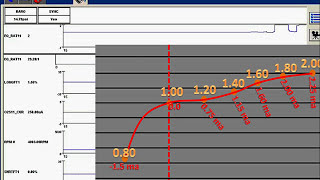
Connect an oscilloscope to the sensor's signal wire. During a throttle snap, a healthy sensor's voltage rises above 0.9V and falls below 0.1V in less than 300 milliseconds. A lazy waveform taking over 1 second confirms a degraded sensor.
Tools: Oscilloscope, piercing probes (Professional) - Perform a Cylinder Leak-Down Test
If you suspect a leaking fuel injector is fouling the O2 sensor, pressurize the cylinder with compressed air at Top Dead Center. Leakage over 20% heard hissing from the fuel rail indicates a bad injector.
Tools: Cylinder leak-down tester, air compressor, socket wrench (Professional) - Check for PCM Updates
Check a professional database for Technical Service Bulletins (TSBs) regarding P0145 on your specific vehicle. A PCM software update is often the required fix for newer models.
Tools: Professional scan tool, access to TSB database (Professional)
When This Code Triggers (Freeze-Frame Conditions)
- Engine Coolant Temp: 170-220°F (77-104°C) (Fully warmed up, in closed-loop operation.)
- RPM: 1200-3000 RPM (Steady cruise or during deceleration.)
- Engine Load: 20-60% (Light to moderate load during steady driving.)
- Vehicle Speed: 40-60 mph (Steady highway driving.)
Related Codes
- P0143 — P0143 indicates 'Circuit Low Voltage.' While P0145 is a slow response, P0143 means the signal voltage is stuck below 0.1V, indicating a dead sensor or a short to ground.
- P0144 — P0144 indicates 'Circuit High Voltage.' The PCM sees a signal stuck above 0.9V. This points to a short to power or a severe rich condition, whereas P0145 is about signal speed.
- P0146 — P0146 means 'No Activity Detected.' The PCM sees a completely flat signal, suggesting the sensor is unplugged or the wiring is broken. A P0145 sensor still works, just poorly.
- P0420 — P0420 means 'Catalyst System Efficiency Below Threshold.' A slow P0145 sensor is a primary cause of a false P0420 code. Always diagnose and fix P0145 before replacing a catalytic converter.
Climate & Environmental Factors
- Cold Weather: Extremely cold temperatures cause aging sensors to trigger P0145. A weak internal heater struggles to reach the required 600°F operating temperature quickly, causing the PCM to register a 'slow response' during warm-up.
- Road Salt and Humidity: Salt and moisture accelerate corrosion on the sensor's body, seizing it in the exhaust pipe. More critically, salt infiltrates the wiring connector, increasing electrical resistance and delaying the signal.
- High Altitude: Less oxygen at high altitudes forces the engine to make significant fuel adjustments. This pushes downstream sensor readings to the edge of their expected parameters, triggering a fault if the sensor is already weak.
How to Talk to a Mechanic About This Code
Say this: "I have a P0145 code for a slow response on the Bank 1 Sensor 3 oxygen sensor. Please check for exhaust leaks and inspect the sensor wiring before recommending a new sensor. If a P0420 code is present, please diagnose the P0145 first."
This signals you understand the common causes beyond just a bad sensor. It directs the mechanic to perform a thorough diagnosis. Mentioning P0420 prevents the expensive misdiagnosis of replacing the catalytic converter when the sensor is the real problem.
Avoid saying:
- 'My check engine light is on, can you just fix it?' (Invites unnecessary diagnostics or part replacements.)
- 'I think I need a new catalytic converter.' (Never suggest the most expensive fix first.)
- 'Just do whatever you think is best.' (Gives up all control and leads to being oversold.)
Questions to ask before authorizing the repair:
- Did you find any exhaust leaks or wiring damage causing the code?
- Can you show me the live data graph for the O2 sensor voltage during deceleration?
- Are you installing an OEM part or a quality aftermarket brand like Denso, NTK, or Bosch?
- What is the warranty on the parts and labor?
Where to Take It: Dealer vs Independent vs Chain
- Dealer:
Recommended only if the vehicle is under warranty or has a known TSB. Otherwise, it is not cost-effective for a common code like P0145.
Best for: Vehicles under powertrain or emissions warranty., Newer vehicles where manufacturer-specific TSBs or software updates are required., Complex European brands requiring specialized diagnostic equipment.
Downsides: Significantly higher labor rates, often 40% more than independent shops., May recommend replacing entire assemblies instead of smaller components. (Typical cost: +50% vs. baseline) - Independent Shop:
Best fit for most vehicles. A reputable independent shop easily diagnoses bad sensors, exhaust leaks, or wiring issues at a reasonable price.
Best for: Out-of-warranty vehicles where cost is a major factor., Diagnosing common codes like P0145 that don't require brand-exclusive tools., Building a long-term relationship with a mechanic.
Downsides: Quality varies widely; vet the shop through reviews and ASE certifications., May lack the latest diagnostic software for brand-new models. (Typical cost: +0% vs. baseline) - Chain Shop:
Acceptable only if you are certain the O2 sensor needs replacement. AVOID for initial diagnosis due to high upsell risks.
Best for: Simple, routine maintenance like oil changes and brake pads.
Downsides: Technicians face sales quotas, leading to high risks of unnecessary upsells (e.g., pushing a catalytic converter for a P0145)., Diagnostic skill levels are inconsistent. (Typical cost: -10% vs. baseline)
When to Walk Away From the Repair
If the estimated repair cost exceeds 50% of the car's private-party value, sell or trade it in instead of repairing it.
- Car worth $4000, fix is $2200: Walk away. The repair cost is over 50% of the car's value.
- Car worth $12000, fix is $800: Fix it. The repair cost is well below the threshold.
- Car worth $2500, fix is $1500: Walk away. The repair cost is 60% of the car's value.
What Scan Tool You Need for This Code
Minimum: A scanner that reads/clears codes, shows freeze frame data, and displays live data graphing for O2 sensor voltage.
A $20 code reader only gives the 'P0145' code. It cannot show live sensor voltage, which is essential to confirm if the sensor is truly 'slow.' Without live data, you risk wasting money replacing a good sensor when the real issue is a wiring fault.
Budget: BlueDriver Pro Scan Tool (~$100) — Connects via Bluetooth to graph live O2 sensor data and read freeze frame data, allowing DIYers to confirm a slow sensor before buying parts.
Mid-range: Foxwell NT510 Elite (~$180) — A handheld scanner offering live data graphing and bi-directional tests to command the sensor heater, pinpointing wiring issues.
Professional: Autel MaxiCOM MK808BT (~$550) — A professional tablet scanner with full bi-directional control, OE-level diagnostics, and advanced data logging to diagnose difficult intermittent wiring faults.
Rent vs buy: Auto parts stores loan basic scanners for free, but they often lack live data graphing. Buying a tool like the BlueDriver is a mandatory investment for proper P0145 diagnosis.
How to Clear the Code After You Fix It
- Use an OBD-II scan tool to clear the P0145 code.
- Ensure the fuel tank is between 1/4 and 3/4 full.
- Perform a complete drive cycle to run the onboard diagnostic tests.
Drive cycle (~30 minutes): Start the engine cold (sit for 8+ hours). Idle for 3 minutes with A/C and rear defroster on. Drive at a steady 55 mph for 10 minutes. Perform 15 minutes of stop-and-go city driving.
Readiness monitors affected: Catalyst monitor, O2 sensor monitor, O2 sensor heater monitor
Before emissions retest: drive at least 100 miles to fully set monitors.
Watch out for:
- Disconnecting the battery clears the code but resets all readiness monitors to 'Not Ready', guaranteeing an emissions test failure.
- The code returns immediately if an underlying exhaust leak or wiring issue was ignored.
- Failing to meet specific enabling criteria (like steady highway speeds) prevents the O2 sensor monitor from running.
Will This Fail Emissions / State Inspection?
Yes — this code typically fails an OBD-II emissions inspection.
- California: An illuminated Check Engine Light is an automatic failure. After repair, all required readiness monitors must be 'complete,' requiring 100+ miles of driving.
- New York: The NYVIP3 inspection includes an OBD-II scan. An active P0145 code causes an automatic failure.
- Texas: In the 17 counties requiring emissions testing, an active P0145 code fails the OBD portion of the inspection.
Most Commonly Affected Vehicles
- Ford Explorer, F-150 (2002-2010) — Often related to aging sensors and exhaust manifold leaks. On newer models, check for PCM software updates via TSBs before replacing parts.
- Chevrolet / GMC Silverado, Sierra, Tahoe (1999-2007) — Wiring harnesses become brittle and damaged from heat exposure and chafing against the frame or heat shields.
- Honda Accord, Civic (2003-2007) — Almost always caused by a failed sensor due to age. Aftermarket sensors cause immediate return codes; OEM (Denso, NTK) is mandatory.
- Toyota Camry, Corolla (2002-2011) — Frequently caused by the original Denso oxygen sensor reaching the end of its 100,000-mile service life.
- Jeep Wrangler (TJ/JK), Grand Cherokee (2000-2018) — Sensors and wiring are highly vulnerable to physical damage from off-road use and water intrusion.
- Subaru WRX (2015-2021) — Owners report this code appearing consistently as the vehicle passes 60,000 miles, indicating the original sensor has worn out.
- Volkswagen GTI (MK6) (2010-2014) — Triggered during high-load conditions. Investigate carefully for small cracks in the exhaust or a failing gasket near the sensor flange.
- Kia / Hyundai Optima, Forte, Soul, Elantra (2011-2018) — Commonly caused by the original oxygen sensor failing due to age and mileage rather than complex wiring issues.
Manufacturer-Specific Notes
- Ram/Chrysler (Cummins): On 2010-2012 Ram 2500/3500 trucks with the 6.7L Cummins, O2 sensor codes are caused by wiring issues. TSB 25-002-14 instructs technicians to install an overlay harness (P/N 68250763AA) to bypass factory wiring before replacing sensors.
- General Motors (Chevrolet/GMC): On V8 trucks and SUVs, the downstream O2 sensor wiring harness routes near the frame cross-member, where it rubs through and causes a short circuit.
- Ford: For the 6.7L Power Stroke in 2023-2024 Super Duty trucks, P0145 is triggered by software errors. TSB 24-2066 requires a PCM calibration update as the primary fix.
- Honda/Acura: Honda PCMs are highly sensitive to aftermarket oxygen sensor response times. Use an OEM sensor from Denso or NTK to prevent the code from returning immediately.
Real Owner Stories
2008 Ford F-150 with 115K miles
Owner heard a ticking sound on acceleration and got a P0145 code.
What they tried:
- A shop misdiagnosed the noise as a cam phaser issue and replaced timing components.
- The noise and P0145 code remained after the $2,000 repair.
Outcome: A second shop found a cracked passenger-side exhaust manifold. Replacing the manifold for $600 fixed the ticking noise and cleared the P0145 code. The exhaust leak was introducing air, skewing the O2 sensor.
Lesson: A ticking noise that sounds like an exhaust leak usually is. Exhaust manifold leaks directly cause O2 sensor codes. Diagnose audible leaks before replacing sensors.
2016 Subaru WRX with 65K miles
Check Engine Light for P0145 appeared during a cold snap with no drivability symptoms.
What they tried:
- Owner cleared the code, but it returned the next day.
- Researched forums and found this is a common failure point at 60,000 miles.
Outcome: Owner replaced the Bank 1 Sensor 3 O2 sensor with an OEM Denso part for $120. The code cleared permanently.
Lesson: O2 sensors are wear items. If your car is over 60,000 miles and throws a lone P0145 code, the sensor has likely reached the end of its service life.
2011 Mitsubishi Outlander Sport with 100K+ miles
Car had a persistent P0145 code, poor MPG, a pulsating idle, and a dying battery.
What they tried:
- Replaced the O2 sensor with an OEM part, but the code and symptoms returned.
Outcome: After replacing the dead battery, the idle stabilized and the P0145 code did not return. The dying battery caused erratic ECU behavior.
Lesson: A failing battery causes erratic ECU behavior and generates false trouble codes. Ensure your charging system is healthy before replacing sensors.
2007 Honda Odyssey with 113K miles
Check Engine Light came on with P0145, then went off on its own a few days later.
What they tried:
- Owner ignored it until the light returned a month later.
- Replaced the downstream O2 sensor with an NTK sensor.
Outcome: Replacing the aging sensor fixed the issue. The intermittent fault occurred because the sensor was on the edge of failure.
Lesson: An intermittent Check Engine Light for an O2 sensor code points to a failing sensor. Don't assume the problem is gone just because the light turns off.
How to Prevent This Code From Triggering
- Replace upstream (pre-catalyst) O2 sensors (Every 100,000 miles) — Aging upstream sensors cause rich mixtures that overheat and destroy the catalytic converter and downstream sensors.
- Use Top Tier certified gasoline (Every fill-up) — Detergents prevent carbon deposits on fuel injectors, preventing rich conditions that foul O2 sensors.
- Address engine misfires immediately (As needed) — Misfires dump raw fuel into the exhaust, superheating the catalytic converter and permanently damaging downstream O2 sensors.
- Perform regular highway driving (At least once a month) — Highway driving brings the exhaust to optimal temperature, burning off carbon deposits from the O2 sensor.
- Avoid extended idling (Daily habit) — Idling causes incomplete combustion and carbon buildup, coating the O2 sensor and slowing its response time.
Frequently Asked Questions
What does Bank 1 and Sensor 3 mean?
Bank 1 is the side of the engine containing cylinder number one. Sensor 3 refers to the third oxygen sensor in that exhaust stream. It is located after the final catalytic converter, making it a 'post-catalyst' sensor.
Can I replace the oxygen sensor myself?
Yes, this is a common DIY repair requiring a special O2 sensor socket. The biggest challenge is the sensor seizing in the exhaust pipe due to rust. Applying penetrating oil and letting it soak for hours is essential.
Will a fuel additive or 'O2 sensor cleaner' fix this code?
No. A P0145 code is a hardware or electrical failure caused by sensor age, fluid contamination, or a wiring fault. Additives cannot repair a degraded internal element or a broken wire.
What are the most common mistakes when diagnosing P0145?
The biggest mistake is immediately replacing the O2 sensor without checking for exhaust leaks or damaged wiring. Both issues perfectly mimic a slow sensor and cause the code to return immediately.
Why did the code come back after I replaced the sensor?
The root cause was misdiagnosed. The most probable culprits are an undiscovered exhaust leak, a wiring short, or using a cheap aftermarket sensor that the vehicle's computer rejects.
Can a dirty air filter cause a P0145 code?
Not directly. A clogged air filter restricts airflow, causing a rich condition that triggers upstream O2 sensor codes. It is highly unlikely to cause a P0145 fault, which is specific to the downstream sensor's response time.
How often should oxygen sensors be replaced?
Oxygen sensors are wear items with a typical service life of 60,000 to 100,000 miles. If your vehicle is in this range and throws an O2 code, the sensor has likely reached the end of its life.
Key Takeaways
- A faulty Bank 1 Sensor 3 oxygen sensor causes 80% of P0145 codes, typically requiring a $150 to $400 replacement.
- Ignoring P0145 drops fuel economy by up to 10% and risks melting the catalytic converter, a repair exceeding $2,000.
- Inspect the exhaust manifold for soot and listen for hissing leaks before buying parts, as unmetered oxygen perfectly mimics a dead sensor.
- Install only OEM or direct-fit Denso/NTK replacement sensors, as aftermarket universal sensors frequently trigger immediate return codes on Honda and Toyota vehicles.
Helpful Videos


The information in this article is provided for general reference and educational purposes only. Vehicle specifications, procedures, and part compatibility can vary by production date, trim level, and region. Always consult your vehicle's factory service manual and verify part numbers before purchasing or performing repairs. Safety-critical components such as airbags, seat belts, and braking systems should be installed by a qualified professional.
- 🎬 Helpful Videos
- What Does P0145 Mean?
- Can I Drive With P0145?
- Common Causes
- Symptoms
- Diagnostic Flowchart
- Common Fixes & Costs
- Used vs. New Parts: Buying Guide
- What Happens If You Wait — Timeline
- Cost of Not Fixing It
- Diagnosis Steps
- When This Code Triggers (Freeze-Frame Conditions)
- Related Codes
- Climate & Environmental Factors
- How to Talk to a Mechanic About This Code
- Where to Take It: Dealer vs Independent vs Chain
- When to Walk Away From the Repair
- What Scan Tool You Need for This Code
- How to Clear the Code After You Fix It
- Will This Fail Emissions / State Inspection?
- Most Commonly Affected Vehicles
- Manufacturer-Specific Notes
- Real Owner Stories
- 2008 Ford F-150 with 115K miles
- 2016 Subaru WRX with 65K miles
- 2011 Mitsubishi Outlander Sport with 100K+ miles
- 2007 Honda Odyssey with 113K miles
- How to Prevent This Code From Triggering
- Frequently Asked Questions
- What does Bank 1 and Sensor 3 mean?
- Can I replace the oxygen sensor myself?
- Will a fuel additive or 'O2 sensor cleaner' fix this code?
- What are the most common mistakes when diagnosing P0145?
- Why did the code come back after I replaced the sensor?
- Can a dirty air filter cause a P0145 code?
- How often should oxygen sensors be replaced?
- Key Takeaways
- 🎟️ Get 5% Off