

P0144 on 2013-2016 Land Rover Range Rover Evoque: O2 Sensor High Voltage Fixes
On a 2013-2016 Evoque, P0144 almost always means the downstream oxygen sensor has failed. This is often due to a known manufacturing defect confirmed by a Land Rover TSB. Replacing the sensor is the most common fix, costing around $80-$150 for an aftermarket part like Bosch or NTK, and over $300 for an OEM one.
- P0144 on a 2013-2016 Evoque is almost always caused by a failed downstream oxygen sensor.
- A Land Rover TSB confirms a known manufacturing defect is responsible for these sensor failures.
- Do not suspect the catalytic converter; the fault lies with the sensor circuit.
- Diagnosis is straightforward: use a scan tool to confirm the sensor's voltage is stuck high (above 0.8V).
- The repair is a direct replacement of the sensor, which is accessible from under the vehicle.
What's Unique About the 2013-2016 Land Rover RANGE ROVER EVOQUE
The 2013-2016 Land Rover Range Rover Evoque, which uses a Ford-derived 2.0L EcoBoost engine, is particularly susceptible to this code due to a documented supplier issue. A Technical Service Bulletin (TSB SSM63157) confirms a manufacturing fault that causes 'misalignment with in the sensor' leading to 'side load on the ceramic internal to the sensor' and premature failure. This makes a faulty sensor the overwhelmingly likely cause, more so than on other vehicles where wiring or other issues might be more common.
Diagnostic Flowchart
Tap your situation to follow the diagnostic path that matches what you're seeing on this vehicle.
Symptoms You May Notice
- Check Engine Light is on
- Vehicle will fail an emissions test
- Potential for slightly decreased fuel efficiency
- In rare cases, rough idling or hesitation
- Replacing the catalytic converter. A P0144 code points to a sensor circuit issue, not the efficiency of the converter itself. A bad converter would typically trigger a different code, like P0420.
- Replacing the upstream (pre-catalytic converter) oxygen sensor. This code is specific to the downstream sensor circuit (Bank 1, Sensor 3).
Most Likely Causes
- Faulty Downstream Oxygen Sensor 🔴 High Probability TSB #SSM63157 explicitly cites a 'Manufacturing fault at the supplier' causing 'misalignment with in the sensor' that leads to premature failure under normal use. The bulletin advises technicians to check the date code on replacement sensors to ensure they were made after the defect was corrected (e.g., after June 1st, 2013 in one revision).
How to confirm: Use a scan tool to monitor live data for the downstream O2 sensor (often labeled Bank 1, Sensor 3). A healthy sensor shows a relatively stable, low voltage. If the voltage is stuck high (e.g., above 0.8V, with some owners reporting a constant 1.2V), the sensor is faulty.
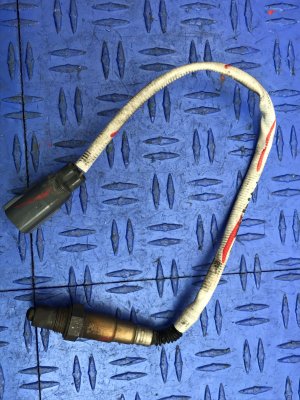
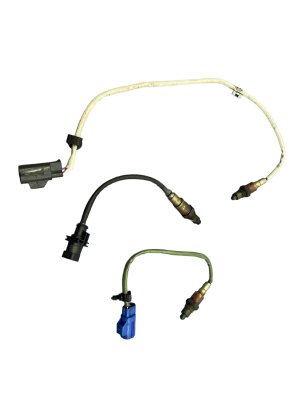
Typical fix: Replace the downstream (post-catalytic converter) oxygen sensor. The OEM part number is LR028931, which was superseded by LR052993. Reputable aftermarket brands include Bosch (16086) and NTK (25756).
Est. part cost: $80-$350 - Wiring or Connector Issue ⚪ Low Probability While possible, TSB #SSM72448 notes that for a group of O2 sensor codes including P0144, 'NO FAULT IS FOUND WITH THE WIRING HARNESS OR CONN...' during diagnosis, suggesting it's less common than sensor failure. The harness is routed near the hot exhaust, making it susceptible to melting or chafing.
How to confirm: Visually inspect the wiring harness and connector leading to the downstream O2 sensor for any signs of melting, corrosion, or physical damage. Check for a short to power in the signal wire using a multimeter.
Typical fix: Repair or replace the damaged section of the wiring harness or the connector.
Est. part cost: $10-$100
Rare But Worth Checking
- Exhaust Leak: An exhaust leak between the catalytic converter and the downstream O2 sensor can sometimes introduce oxygen and skew readings, though it's less likely to cause a persistent high voltage code.
- Engine Control Module (ECM) Fault: In very rare cases, the ECM itself may be the problem, failing to correctly interpret the sensor's signal. This should only be considered after all other possibilities have been exhausted. Some other Land Rover models have required PCM software updates for O2 sensor issues per Service Action N346, but this is not directly tied to P0144 on the Evoque.
Diagnosis Steps
- Connect an OBD-II scanner to the vehicle and confirm that P0144 is the primary code stored.
- Use the scanner's live data function to observe the voltage from the downstream oxygen sensor (Bank 1, Sensor 3).
- Confirm the voltage is stuck high (typically >0.8V) and does not fluctuate. Some owners 🎬 Watch: Understanding P0144 high voltage circuit readings have reported seeing a steady 1.2V.
- If the voltage is stuck high, perform a thorough visual inspection of the sensor's wiring harness and connector. Look for any signs of damage, melting on the exhaust, or corrosion.
- Check for any exhaust leaks between the catalytic converter and the downstream sensor.
- If the wiring is intact and there are no exhaust leaks, the oxygen sensor is almost certainly faulty and should be replaced, which is consistent with the known TSB. 🎬 See: Two simple DIY methods to address this code
- After replacement, clear the trouble codes and perform a test drive to ensure the code does not return.
Parts You'll Likely Need
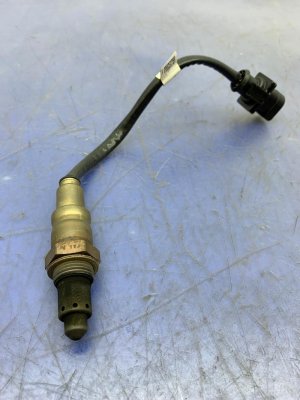
- Downstream Oxygen Sensor
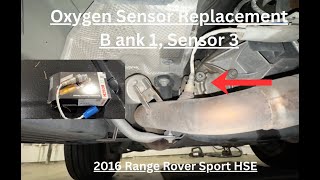
(OEM #LR028931, superseded by LR052993)— This is the component that fails most often, as confirmed by Land Rover TSBs. It directly causes the high voltage reading. 🎬 Watch: Step-by-step oxygen sensor replacement walkthrough
Trusted brands: Bosch (p/n 16086), Denso, NTK (p/n 25756)
OEM price range: $300-$350
Aftermarket price range: $80-$150
Related Codes That Often Appear With This One
- P0142 — Both codes relate to the same oxygen sensor (Bank 1, Sensor 3), with P0142 indicating a circuit malfunction. A user on LandyZone reported having P0144 and P0142 together.
- P0143 — Indicates low voltage from the same sensor circuit, suggesting an intermittent or related electrical fault.
- P0164 — This is the equivalent high voltage code for Bank 2, Sensor 3. While the Evoque only has one bank, on V-engine Land Rovers suffering from the same TSB issue, it was common to see both P0144 and P0164 appear together.
- P0042, P0043, P0055, P0061, P0062, P0063, P0162 — These codes are listed alongside P0144 in TSB #SSM63157 as being related to the same batch of faulty oxygen sensors from the supplier.
Technical Service Bulletins (TSBs) & Recalls
- SSM63157: Notes that a manufacturing fault at the supplier causes 'misalignment with in the sensor', leading to premature failure and triggering codes like P0144. It instructs dealers to check date codes on new parts.
- SSM72448: Mentions that for a wide range of O2 sensor codes, including P0144, diagnosis often reveals no faults with the wiring harness or connectors, pointing towards the sensor itself as the culprit.
Platform-Specific Known Issues
- A known manufacturing defect in the oxygen sensors for this platform is the leading cause of failure, as documented in TSB #SSM63157. The bulletin describes an internal misalignment that causes the sensor to fail under normal operating conditions.
- The 2.0L engine in these Evoque models is a Ford EcoBoost engine, meaning it shares some parts and potential issues with Ford models using the same engine.
Mechanic-Grade Diagnostic Values
- Downstream O2 Sensor (B1S3) Voltage — expected: A healthy downstream sensor should show a relatively stable voltage, typically between 0.6V and 0.8V, when the catalytic converter is hot and working efficiently.. Failure: Voltage is stuck high, consistently reading above 0.8V. Readings of >1.0V or even a constant 1.2V confirm the fault.
- Oxygen Sensor Heater Resistance — expected: Between 4 and 19 Ohms when tested with a multimeter at the sensor's connector.. Failure: A reading outside this range, such as an open circuit (infinite resistance), indicates a failed internal heater element, requiring sensor replacement.
Scan Tool Commands That Help
- JLR SDD (Symptom Driven Diagnostics): Live Data Monitoring / Datalogger — To confirm the P0144 fault, a technician uses the live data function to select and graph the 'O2S B1S3' voltage. This allows for real-time observation to see if the voltage is stuck high, as opposed to fluctuating normally, which is the primary confirmation step before replacing the part.
Wiring & Ground Locations
- Engine Bay Chassis Ground — A bolt on an engine mounting bracket, located on the right-hand side of the engine bay just behind the windscreen washer filler cap.. This is a known, reliable chassis ground point specified in the owner's manual for jump-starting. It can be used as a reference point when testing the O2 sensor circuit for good ground with a multimeter.
- G1D122B — Lower left front of the engine compartment.. This is a main ground point in the engine compartment. A poor connection here could potentially cause erratic voltage readings in various sensor circuits, although it is an unlikely cause for a single, specific sensor code like P0144.
- O2 Sensor Wire Splice Repair — Anywhere on the wiring harness between the sensor connector and the ECM.. If a wiring repair is necessary due to damage, the wires must be repaired using crimp connectors, not solder. Soldering can alter the resistance of the circuit and interfere with the sensitive low-voltage signal from the sensor, potentially causing the code to persist even after repair.
OEM Part Supersession History
LR028931→LR052993— Standard part evolution and potential revision to address reliability issues.
Heads up: LR028931 is the correct part for the 2013-2017 Evoque models with the Ford-derived 2.0L EcoBoost engine. Ensure you are not using parts for the later JLR Ingenium engine (2018+), which use different part numbers like LR096522.
Model Year Variations Within This Range
- 2014-2016: For the 2014 model year, Land Rover replaced the 6-speed automatic transmission with a new ZF 9-speed automatic. While this does not change the function of the O2 sensor, it altered the physical layout of the drivetrain and may result in slight differences in exhaust hanger locations and wiring harness routing near the transmission crossmember, which could affect access to the downstream sensor connector.
Helpful Videos
![How to Fix P0144 Engine Code in 3 Minutes [2 DIY Methods / Only $8.55]](https://img.youtube.com/vi/viAFr3gWhLE/mqdefault.jpg)
We Have This Part in Stock



The information in this article is provided for general reference and educational purposes only. Vehicle specifications, procedures, and part compatibility can vary by production date, trim level, and region. Always consult your vehicle's factory service manual and verify part numbers before purchasing or performing repairs. Safety-critical components such as airbags, seat belts, and braking systems should be installed by a qualified professional.
- Land Rover RANGE ROVER EVOQUE:
- 🎬 Helpful Videos
- 🛍️ Shop This Part
- What's Unique About the 2013-2016 Land Rover RANGE ROVER EVOQUE
- Diagnostic Flowchart
- Symptoms You May Notice
- Most Likely Causes
- Rare But Worth Checking
- Diagnosis Steps
- Parts You'll Likely Need
- Related Codes That Often Appear With This One
- Technical Service Bulletins (TSBs) & Recalls
- Platform-Specific Known Issues
- Mechanic-Grade Diagnostic Values
- Scan Tool Commands That Help
- Wiring & Ground Locations
- OEM Part Supersession History
- Model Year Variations Within This Range
- 🎟️ Get 5% Off