

OBD-II Code P0143: O2 Sensor Circuit Low Voltage (Bank 1, Sensor 3)
The Ultimate 2026 Guide: What P0143 Means, Why It Triggers, and How to Fix It
- P0143 triggers when the Bank 1, Sensor 3 oxygen sensor sends a persistent low voltage signal below 0.2V, indicating a circuit fault.
- Inspect the exhaust system for leaks and test the wiring for a short-to-ground before spending $50-$180 on a replacement sensor.
- You can safely drive with a P0143 code, but you will automatically fail state emissions tests and lose 5-15% in fuel economy.
- Check the dedicated 'A/F Heater' fuse and test the sensor's heater circuit for 12V power, as a blown fuse directly causes this low-voltage code.
- Owners of 2013-2016 Jaguar and Land Rover models must check TSB JTB00392NAS3, which requires a $100-$250 PCM software update rather than a parts replacement.
What Does P0143 Mean?
The Powertrain Control Module (PCM) detects that the voltage from the third oxygen sensor on engine bank 1 is too low. This sensor acts as the final check on the exhaust, verifying how well the last catalytic converter cleans the gases. A low voltage signal, typically below 0.1-0.2 volts for an extended period, tells the PCM that something is wrong with the sensor, its wiring, or the exhaust stream it measures.
Technical definition: The official SAE/OBD-II definition is "O2 Sensor Circuit Low Voltage (Bank 1 Sensor 3)". This means the Powertrain Control Module (PCM) detects that the signal voltage from the Bank 1, Sensor 3 oxygen sensor remains below the normal expected range (typically under 150-200mV) for a specific period, such as 28 seconds. This sensor is a post-catalyst monitor used to verify the efficiency of the emissions system.
🎬 Watch: A quick overview of P0143 symptoms and common solutions.Can I Drive With P0143?
Yes, But With Caution. Yes, you can drive with a P0143 code, as it rarely causes severe performance issues. However, you will automatically fail any emissions test, and your fuel economy decreases by 5-15%. While this specific sensor fault rarely causes direct damage, it masks other serious problems. A prolonged fault in the emissions system eventually contributes to catalytic converter damage, a repair costing between $1,000 and $4,000.
Common Causes
- Failed or contaminated oxygen sensor (Very Common) — Oxygen sensors are consumable parts living in a harsh exhaust environment. They fail internally over time or become contaminated by oil, coolant, or excessive fuel, preventing them from generating a correct voltage signal.
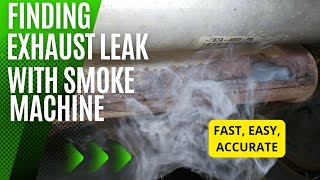
- Exhaust leak (Common) — A crack or hole in the exhaust pipe or a failed gasket located before the O2 sensor pulls outside air (oxygen) into the exhaust stream. This extra oxygen causes the sensor to generate a false low voltage (lean) signal. 🎬 See how to find hidden exhaust leaks using a smoke machine.
- Damaged wiring, corroded connector, or poor ground (Common) — The sensor's wiring sits under the car, exposed to heat, road debris, and moisture. Wires melt, fray, or cut, while connectors corrode. A loose ground strap or corroded connector creates high resistance or a short to ground, resulting in a low voltage reading.
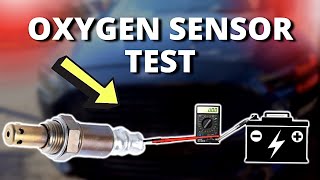
- Faulty oxygen sensor heater circuit or blown fuse (Less Common) — The sensor contains a heater to reach operating temperature quickly, often protected by a dedicated fuse (like the 'A/F Heater' fuse on Toyotas). If this fuse blows or the heater circuit fails, the sensor does not operate correctly and produces an inaccurate low voltage signal. 🎬 Watch: How to test oxygen sensor heater circuits with a multimeter.
- PCM software error (Rare) — On certain vehicles, most notably 2013-2016 Jaguar and Land Rover models, a software glitch in the PCM falsely triggers a P0143 code. A software update from a dealer is the required fix.
- Sustained lean condition (Rare) — Significant upstream problems like low fuel pressure or failing fuel injectors cause a persistently lean exhaust. If severe enough, the post-catalyst sensor detects this as a low voltage reading.
- Faulty Powertrain Control Module (PCM) (Very Rare) — An internal fault within the PCM's circuitry prevents it from correctly reading the sensor's voltage. Consider this only after exhaustively ruling out wiring, sensors, and software updates.
Symptoms
- Check Engine Light is on — This is the most common, and often the only, symptom you notice.
- Failed emissions test — With an active P0143 code, your vehicle automatically fails state-mandated emissions inspections due to increased Nitrogen Oxide (NOx) pollutants.
- Reduced fuel economy — While Sensor 3 has minimal impact on active fuel trimming, a fault in the overall emissions monitoring system leads to a minor decrease in fuel efficiency, typically 5-15%.
- Rough idle or poor engine performance — In some vehicle control systems, a severe circuit fault causes a mild rough idle or hesitation during steady cruising.
- Noticeable exhaust or fuel smell — If the fault stems from an exhaust leak, you smell fumes. If the issue causes a rich fuel mixture, you smell a 'rotten egg' odor from the exhaust.
Diagnostic Flowchart
Tap your situation to follow the diagnostic path that matches what you're seeing on this code.
Common Fixes & Costs
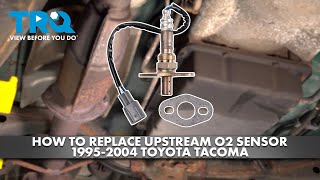
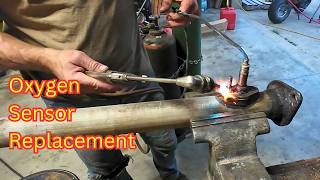
- Replace the Bank 1, Sensor 3 Oxygen Sensor
— Parts: $50-$180, Labor: $100-$250, ~1.2 hr book time
(DIY)
Jaguar F-TYPE/XF/XJ (2013-2016): OEM C2D23702 (superseded by T2H48050, C2D54165). OEM Price: ~$280-$340. (Alt: Bosch 16043, Denso 234-4792. Aftermarket Price: ~$70-$195.)
Chevrolet/GMC Silverado/Sierra (2007-2014): OEM GM 12609457, 12612459. OEM Price: ~$70-$100. (Alt: NTK 23162, Denso 234-4668, Bosch 15510.)
Toyota Tacoma/Tundra (2002-2012): OEM Toyota 89465-04280, 89465-04340. OEM Price: ~$100-$140. (Alt: Denso 234-4260, Bosch 13768.) - Repair Exhaust Leak — Parts: $20-$100, Labor: $150-$400, ~1.5 hr book time (Intermediate)
- Repair Damaged Wiring or Connector — Parts: $10-$50, Labor: $150-$300, ~1.8 hr book time (Intermediate)
- Replace Blown Fuse — Parts: $1-$10, Labor: $0-$75, ~0.1 hr book time (Beginner)
- Update/Reprogram Powertrain Control Module (PCM) — Parts: $0, Labor: $100-$250, ~1 hr book time (Professional)
DIY vs Professional
- Replace Oxygen Sensor — Beginner: Yes, with caution.
Tools: Jack and jack stands, penetrating oil, 22mm (or 7/8") oxygen sensor socket, ratchet, torque wrench. - Repair Exhaust Leak — Beginner: No.
Tools: Welder, pipe cutter, new gaskets, exhaust putty, various wrenches. - Repair Damaged Wiring — Beginner: No.
Tools: Multimeter, wire strippers, soldering iron or quality crimp connectors, heat shrink tubing, vehicle-specific wiring diagrams. - Replace Blown Fuse — Beginner: Yes.
Tools: Fuse puller or small pliers.
Used vs. New Parts: Buying Guide
When a used part is worth it: Buying a used oxygen sensor is not recommended. The risk of receiving a part near the end of its service life or completely non-functional is very high. The small cost savings are not worth the risk of repeat labor.
Donor-vehicle mileage cap: roughly under 40000 miles for the part to have meaningful remaining life.
Donor quality checklist:
- If considering used, only select from a very low-mileage vehicle that was wrecked.
- Avoid parts from vehicles in the rust belt, as corrosion is a primary failure mode.
- Never buy used sensors from online marketplaces like eBay or Amazon, as their history is unknown.
Decision logic:
- If The cost of a new, quality aftermarket (e.g., Denso, NTK, Bosch) or OEM sensor is under $200 → Always buy new. The reliability and warranty outweigh any potential savings from a used part.
- If The vehicle is very old and has high mileage (>150k miles) → A new aftermarket sensor is still the best choice. A used sensor has a high probability of failing quickly.
- If The part is an extremely expensive, dealer-only sensor → A used part from a reputable auto recycler with a good warranty (e.g., 90 days) is an option only after exhausting new aftermarket options.
Warranty tradeoff: Used parts from a junkyard typically have a 30-day warranty at best. New aftermarket sensors often carry a 1-year to limited lifetime warranty.
Worst-case if a used part fails: $200-$400. If the used sensor fails after the labor warranty period, you pay for the diagnosis and replacement labor again, plus another part.
What Happens If You Wait — Timeline
- 0-2 months: Code P0143 is stored and the Check Engine Light is on. The vehicle fails an emissions test. No other symptoms are likely to be noticeable. (MPG impact: 0-5%% · Added cost: $0)
- 2-6 months: A minor but consistent decrease in fuel economy becomes apparent. The faulty sensor reading prevents the PCM from accurately monitoring catalyst efficiency, masking the start of other issues. (MPG impact: 5-10%% · Added cost: $50-$150 in wasted fuel)
- 6-12 months: If the sensor fault masks a developing issue (like a rich fuel condition), the catalytic converter begins to suffer damage from overheating or contamination. This damage is irreversible. (MPG impact: 5-15%% · Added cost: $1,000-$2,500 (potential catalytic converter replacement))
- 12+ months: Prolonged operation with a faulty emissions control system leads to complete catalytic converter failure (meltdown or clogging). A clogged converter creates significant exhaust backpressure, leading to severe engine performance loss. (MPG impact: 10-20%+% · Added cost: $2,500-$4,000+ (catalytic converter plus potential exhaust manifold or engine repairs))
Cost of Not Fixing It
- 0-3 months: Guaranteed failure of any emissions/smog test. Potential for a 5-15% decrease in fuel economy. The Check Engine Light remains on, masking new, more serious problems. (Added cost: $20-$60 per month in extra fuel costs, plus the cost of a failed emissions test.)
- 3-12 months: A persistently incorrect signal causes the PCM to run a suboptimal fuel mixture, increasing strain and heat on the catalytic converter. This leads to premature failure of the converter. (Added cost: $1,000-$2,500 for catalytic converter replacement.)
- 12+ months: Prolonged operation with a faulty emissions sensor contributes to internal engine wear and potential damage to other exhaust components. The vehicle's performance degrades noticeably. (Added cost: $2,500+ for catalytic converter and potential other engine or exhaust repairs.)
Diagnosis Steps
- Read Codes and Freeze Frame Data
Using an OBD-II scanner, verify P0143 is present and check for related codes (e.g., heater circuit codes like P0147). Review the freeze frame data to understand the engine conditions when the fault triggered.
Tools: OBD-II Scanner (Beginner) - Check for Technical Service Bulletins (TSBs)
Before replacing parts, check for manufacturer TSBs. For specific vehicles, like 2013-2016 Jaguar models, the official fix is a PCM software update to correct a known error that falsely triggers P0143.
Tools: Online Access or Dealer Inquiry (Beginner) - Visually Inspect the Exhaust System
Look and listen for exhaust leaks between the catalytic converter and Sensor 3. Check for black soot marks, cracks, or rusted-through sections around welds and gaskets. A leak is a highly common cause.
Tools: Flashlight, Safety Glasses (Beginner) - Inspect the O2 Sensor and Wiring
Safely raise the vehicle and locate the Bank 1, Sensor 3 O2 sensor. Visually inspect the sensor for damage and its wiring harness for melting, chafing, or exhaust contact. Check the connector for corrosion or pushed-out pins.
Tools: Jack and Jack Stands, Flashlight, Safety Glasses (Beginner) - Check Live Sensor Data
With the engine running and warmed up, use a scanner to observe the voltage for Bank 1, Sensor 3. A healthy post-catalyst sensor shows a steady voltage between 0.4V and 0.6V. A voltage stuck below 0.2 volts confirms the P0143 fault condition.
Tools: OBD-II Scanner with Live Data (Intermediate) - Test the Sensor Heater Circuit Power and Fuse
Check the fuse for the O2 sensor heater circuit. With the key on (engine off), use a multimeter to check for battery voltage (10V-14V) at the heater power wire on the sensor's harness-side connector. A lack of voltage points to a blown fuse or broken power wire.
Tools: Multimeter, Vehicle-specific Wiring Diagram (Intermediate) - Test Sensor Heater Resistance
Disconnect the sensor and measure resistance (Ohms) across the two heater pins on the sensor. A good sensor has a resistance between 4 and 6 ohms. An infinite reading (OL) means the heater is open, and a zero reading means it is shorted. Both require replacement.
Tools: Multimeter (Advanced) - Perform Advanced Circuit Testing (Short-to-Ground)
Disconnect the O2 sensor and the PCM (battery disconnected). Place one multimeter lead on the sensor's signal wire pin at the harness connector and the other on a chassis ground. The reading must be infinite (OL). Low resistance indicates a short to ground in the signal wire.
Tools: Multimeter, Vehicle-specific Wiring Diagram (Advanced) - Analyze Sensor Waveform (Oscilloscope Test)
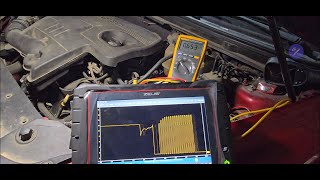
Use an oscilloscope to backprobe the sensor's signal wire. A healthy, warm, post-catalyst O2 sensor produces a steady voltage line (~0.4V-0.6V). For a P0143 fault, you see a persistent flatline near zero volts (<0.1V), visually confirming the circuit failure.
Tools: Oscilloscope, Backprobe Pins (Advanced)
When This Code Triggers (Freeze-Frame Conditions)
- Engine Coolant Temp: 180-200°F (82-93°C) (The engine must be fully warmed up for the O2 sensor monitors to run.)
- RPM: 1500-2500 RPM (A steady cruise or light acceleration is typically when the PCM actively monitors the post-catalyst sensor.)
- Engine Load: 20-60% (This indicates a steady throttle position, not heavy acceleration or deceleration, allowing for stable readings.)
- Vehicle Speed: 40-60 mph (65-97 km/h) (Highway driving provides the stable operating conditions needed for the PCM to complete the O2 sensor diagnostic tests.)
Related Codes
- P0144 — This code means 'O2 Sensor Circuit High Voltage (Bank 1 Sensor 3)', the opposite of P0143. P0143 often points to a short to ground, while P0144 typically points to an open signal wire or a short to voltage.
- P0145 — This code indicates the sensor's voltage is not switching as quickly as the PCM expects. This points to a 'lazy' sensor, whereas P0143 indicates a hard fault with a persistently low signal.
- P0147 — This code stands for 'O2 Sensor Heater Circuit Malfunction (Bank 1 Sensor 3)'. A faulty heater prevents the sensor from working correctly and causes the P0143 low voltage reading.
- P0420 — This code means 'Catalyst System Efficiency Below Threshold (Bank 1)'. A faulty O2 sensor causes a false P0420, but P0143 is a more direct indicator of an electrical problem with the sensor circuit.
Climate & Environmental Factors
- Cold Climates / Road Salt: Regions using road salt see a higher incidence of O2 sensor codes. Salt and moisture accelerate corrosion of the sensor body, connector, and wiring, creating high resistance or a short to ground that directly causes the P0143 low voltage condition.
- High Humidity: Sustained high humidity promotes moisture intrusion into the O2 sensor's electrical connector. This moisture leads to pin corrosion and intermittent signal loss or low voltage readings.
How to Talk to a Mechanic About This Code
Say this: "I have a P0143 code for the Bank 1 Sensor 3 oxygen sensor. I'd like to schedule a diagnostic to confirm if the issue is the sensor itself, the wiring, or an exhaust leak. Please check the live data for the sensor and inspect the wiring for any damage before recommending a replacement part."
This signals to the shop that you have done your research and understand the common causes. It directs them to perform a thorough diagnosis rather than immediately replacing the most likely part, saving you money if the issue is a simple wiring problem.
Avoid saying:
- 'My check engine light is on.' (This is too vague and leads to a more expensive, open-ended diagnostic process.)
- 'Just replace the O2 sensor.' (This prevents them from diagnosing the true cause, and the code returns if the problem was wiring or an exhaust leak.)
- 'Do whatever you think is best.' (This gives the shop a blank check and leads to unnecessary repairs or upselling.)
Questions to ask before authorizing the repair:
- Did you observe the live voltage from the O2 sensor, and was it consistently low?
- Did you inspect the wiring harness and connector for shorts, corrosion, or damage?
- Did you check for any exhaust leaks upstream of the sensor?
- What is the warranty on the recommended repair, both for the part and the labor?
Where to Take It: Dealer vs Independent vs Chain
- Dealer:
Recommended only if warranty or a specific TSB applies. Otherwise, an independent shop is more cost-effective.
Best for: Vehicles still under an emissions or powertrain warranty., Specific vehicles with known TSBs, like 2013-2016 Jaguar/Land Rover models that require a PCM software update.
Downsides: Typically higher labor rates (1.5-2x more than independent shops)., Recommends more expensive OEM parts when quality aftermarket options are sufficient. (Typical cost: +50% vs. baseline) - Independent Shop:
Best fit for most P0143 repairs. A reputable independent shop effectively diagnoses and repairs the common causes (sensor, wiring, exhaust leak) at a reasonable price.
Best for: Out-of-warranty vehicles where cost is a primary concern., Straightforward diagnosis and replacement of sensors, wiring, or exhaust components.
Downsides: Quality varies significantly; it's important to choose a shop with good reviews and ASE-certified technicians., Lacks access to the latest manufacturer-specific software for updates. (Typical cost: +0% vs. baseline) - Chain Shop:
Acceptable for a straightforward O2 sensor replacement, but use caution for diagnosis. If the problem is anything other than a bad sensor, they struggle to find the root cause.
Best for: Simple, clear-cut part replacements when you have already diagnosed the issue yourself.
Downsides: Technician skill and diagnostic capabilities are inconsistent., Pressures to upsell services, and they are not equipped for in-depth electrical diagnosis or TSB-related software updates. (Typical cost: -10% vs. baseline)
When to Walk Away From the Repair
If the estimated repair cost exceeds 50% of your car's private-party value (from a source like Kelley Blue Book), you should seriously consider selling or trading in the vehicle instead of repairing it.
- Car worth $4000, fix is $2200: Walk away. The repair cost is over 50% of the car's value.
- Car worth $12000, fix is $1800: Fix it. The repair cost is well below the 50% threshold and is a reasonable investment to keep a more valuable car on the road.
- Car worth $2500, fix is $1500: Walk away. The repair cost is 60% of the car's value, making it a poor financial decision.
What Scan Tool You Need for This Code
Minimum: A scanner that reads and clears codes, and most importantly, displays live sensor data. For P0143, you need to see the real-time voltage output of the Bank 1, Sensor 3 O2 sensor to confirm it is stuck low.
A basic $20 code reader only tells you the P0143 code is present. It cannot show you the live voltage data from the sensor, which is essential to confirm the fault and avoid replacing a perfectly good sensor when the problem is actually in the wiring.
Budget: BlueDriver Pro (~$100) — Connects to your smartphone via Bluetooth and provides live data graphing for the O2 sensor. It reads codes from other modules like ABS and SRS and offers repair suggestions based on a database of verified fixes.
Mid-range: Innova 5610 (~$330) — A powerful handheld scanner that offers live data, graphing, and some bidirectional controls. It helps you perform more advanced diagnostics without needing a professional-level tool.
Professional: Autel MaxiCOM MK808 (~$500) — Provides full system diagnostics, advanced bidirectional controls, and special functions. This level of tool allows you to perform deep diagnostics typically only available at a repair shop. Note that professional scanners often require annual subscription fees for updates.
Rent vs buy: Most major auto parts stores like AutoZone lend you a basic OBD-II scanner for free with a refundable deposit. This is a good option if you just want to confirm the code. However, their loaner tools typically do not offer live data. To properly diagnose P0143, you need a scanner with live data capabilities, making a budget-friendly purchase like the BlueDriver Pro a worthwhile investment for DIYers.
How to Clear the Code After You Fix It
- Use an OBD-II scan tool to clear the P0143 trouble code.
- If the battery was disconnected for the repair, reconnect it.
- Perform a complete OBD-II drive cycle to allow the system's readiness monitors to run.
Drive cycle (~20 minutes): A generic drive cycle includes a cold start (engine temp below 122°F), a 2-3 minute idle with electrical loads on (A/C, defroster), followed by 10-15 minutes of mixed city/highway driving including steady-state cruising around 55 mph, and at least one coast-down (deceleration without brakes).
Readiness monitors affected: Catalyst monitor, O2 sensor monitor, O2 sensor heater monitor
Before emissions retest: drive at least 50 miles to fully set monitors.
Watch out for:
- Disconnecting the battery clears the code but resets all emissions readiness monitors, causing an immediate emissions test failure.
- The code returns if the underlying problem (like a wiring short or exhaust leak) is not correctly fixed.
- Some monitors, like the catalyst monitor, require multiple drive cycles over several days to complete.
Will This Fail Emissions / State Inspection?
Yes — this code typically fails an OBD-II emissions inspection.
- California: An active P0143 code results in an automatic smog check failure. After repair, a full drive cycle must be completed to set all readiness monitors before a re-test is possible.
- New York: The NYS DMV inspection includes an OBD-II scan. An illuminated Check Engine Light and an active P0143 code causes the vehicle to fail the emissions portion of the inspection.
- Texas: In the 17 counties requiring emissions testing, a vehicle with code P0143 fails the OBD-II portion of the annual state inspection.
Most Commonly Affected Vehicles
- Jaguar F-TYPE, XF, XJ (2013-2016) — Technical Service Bulletin JTB00392NAS3 identifies a PCM software error causing this code. A dealer software update is the required fix.
- Chevrolet / GMC Silverado, Sierra, Suburban, Tahoe (2007-2014) — Causes are typically aged sensors or damage to the underbody wiring harness, which is vulnerable to debris and corrosion.
- Toyota Tacoma, Tundra, Sequoia (2002-2012) — Before replacing the sensor, always check the 'A/F Heater' fuse and relay in the vehicle's fuse box, as a failure there is a known issue.
- Honda CR-V, Accord, Odyssey (2005-2015) — The cause is typically a failed sensor, but small exhaust leaks are also a common culprit that require checking first.
- Nissan Titan, Frontier, Altima (2004-2015) — Common causes include the sensor itself or small, hard-to-find exhaust leaks.
- BMW 3 Series, 5 Series, X3, X5 (2000-2010) — Frequently reported due to sensor age or wiring issues in the underbody.
- Mercedes-Benz C-Class, E-Class, ML-Class (2002-2012) — Typically points to a failed sensor, but wiring requires inspection.
- Ford Focus, Mondeo, Kuga (2004-2014) — Common causes are the sensor itself or wiring harness damage.
- Audi / Volkswagen A4, A6, Golf, Passat (2000-2011) — Usually due to a failed downstream oxygen sensor.
Manufacturer-Specific Notes
- Jaguar/Land Rover: For 2013-2016 models, a PCM software update is the official fix for a false P0143 code, as noted in TSB JTB00392NAS3. Always check for TSBs before replacing parts.
- Toyota: On many Toyota trucks and SUVs, the O2 sensor heater circuits are protected by a dedicated 'A/F Heater' fuse. This fuse blowing is a known cause for O2 sensor codes.
- General Motors (GM): On many GM trucks and SUVs, this sensor is used strictly for catalyst monitoring diagnostics and has no impact on real-time fuel trim, meaning no change in engine performance.
- Chrysler/Dodge/Jeep: The downstream O2 sensor wiring harness is routed in a way that makes it susceptible to damage from road debris or contact with driveshafts, especially on lifted trucks.
Real Owner Stories
2013 Land Rover Discovery, mileage unknown
Check Engine Light on with code P0143. Owner was confused by the 'Sensor 3' designation as they were only aware of two sensors.
What they tried:
- Owner posted on a forum for clarification.
- Another user suggested that on newer Rovers, 'Sensor 3' is the post-catalyst sensor and that a code appears if the catalytic converters are removed.
Outcome: The owner had previously removed the catalytic converters. The forum members concluded that without the converters, the sensor never reads correctly, and the Check Engine Light remains on.
Lesson: Modifications to the exhaust system, such as removing catalytic converters, cause emissions-related trouble codes like P0143 that cannot be fixed by replacing sensors.
2015 Jaguar F-TYPE, mileage unknown
P0143 code appeared, causing the Check Engine Light to illuminate. There were no noticeable performance issues.
What they tried:
- Research indicated a Technical Service Bulletin (JTB00392NAS3) for this exact issue on 2014-2015 models.
- The TSB identified a software glitch in the Powertrain Control Module (PCM) as the root cause.
Outcome: The recommended fix was a PCM software update performed by a Jaguar dealer. This resolved the code without needing to replace the sensor itself.
Lesson: Always check for manufacturer TSBs before replacing parts. For specific vehicles, a simple software update is the correct and only fix, saving hundreds on unnecessary sensor replacement.
General Motors Vehicle with P0143 and P0420
Vehicle presented with both P0143 (O2 Sensor Circuit Low Voltage) and P0420 (Catalyst Efficiency Below Threshold) codes.
What they tried:
- The owner replaced the O2 sensor hoping to clear the codes.
- The codes returned shortly after replacement.
Outcome: The underlying issue was a failing catalytic converter. The P0143 code was a symptom of the exhaust gas changes caused by the bad converter, not a primary sensor failure. Replacing the catalytic converter resolved both codes.
Lesson: When P0143 appears with a catalyst efficiency code like P0420, the catalytic converter itself is a strong suspect. Diagnose the converter's health before replacing sensors.
How to Prevent This Code From Triggering
- Use Top-Tier certified gasoline (Every fill-up) — High-quality fuels contain detergents that prevent carbon deposits on fuel injectors and in the combustion chamber. This leads to cleaner combustion, reducing soot that fouls the O2 sensor and overloads the catalytic converter.
- Replace upstream (Bank 1, Sensor 1) O2 sensor (Every 60,000-100,000 miles) — The upstream sensor controls the air-fuel mixture. As it ages, its response slows, leading to a richer mixture. This excess fuel overheats and damages the catalytic converter, which is monitored by the Sensor 3 that triggers P0143.
- Use a fuel system/catalytic converter cleaner additive (Every 3,000-5,000 miles) — Additives costing less than $20 remove light carbon and soot deposits from the O2 sensor tip and catalytic converter substrate, maintaining their efficiency and preventing buildup that leads to false readings.
- Avoid frequent short trips and extended idling (Daily habit) — The exhaust system needs to reach and maintain a high operating temperature (over 700°C) to burn off deposits. Short trips and long idles prevent this, allowing soot and moisture to accumulate.
- Address engine misfires and oil/coolant leaks immediately (As needed) — Unburnt fuel from misfires, or contaminants like oil and silicone from leaks, permanently poison and destroy the oxygen sensor's delicate sensing element.
Frequently Asked Questions
What is the most common misdiagnosis for code P0143?
The most common mistake is immediately replacing the oxygen sensor without performing a full diagnosis. Technicians and DIYers often overlook small exhaust leaks or a short in the wiring harness, leading to the code returning after the new sensor is installed. Always inspect for leaks and test the wiring before buying parts.
I replaced the sensor and the code came back. What now?
If a new sensor didn't fix the code, the problem lies elsewhere. The top two culprits are an undetected exhaust leak upstream of the sensor or an intermittent short to ground in the wiring harness. Perform a smoke test on the exhaust and a 'wiggle test' on the wiring harness while monitoring voltage to find the intermittent short.
How much does it cost to fix code P0143?
Repair costs range from $50 to $500 depending on the root cause. A DIY O2 sensor replacement costs $50-$180 for the part, while a repair shop charges $150-$430 total. Exhaust or wiring repairs range from $150 to $400 depending on labor time.
Where is the Bank 1, Sensor 3 oxygen sensor?
'Bank 1' is the side of the engine containing cylinder #1, usually the passenger side for US V-type engines. 'Sensor 3' is the third sensor in line from the engine, located downstream after the final catalytic converter. This makes it the rearmost oxygen sensor on that specific bank.
Will a P0143 code cause my car to fail an emissions test?
Yes, absolutely. The presence of this active trouble code and the illuminated Check Engine Light causes an automatic failure of any state emissions inspection.
Can a vacuum leak cause a P0143 code?
It is highly unlikely. A vacuum leak occurs at the intake manifold, affecting the upstream (Sensor 1) O2 sensor. P0143 is for Sensor 3, which is far downstream and primarily affected by post-catalyst exhaust composition and exhaust pipe integrity.
What's the difference between P0143 and P0420?
P0143 is an electrical fault code indicating the sensor's circuit itself is sending a low voltage signal due to a bad sensor, wiring, or software issue. P0420 is a performance fault code meaning the catalytic converter is not working efficiently. While a bad sensor causes a false P0420, P0143 points directly to a problem with the sensor's electrical circuit.
Key Takeaways
- P0143 triggers when the Bank 1, Sensor 3 oxygen sensor sends a persistent low voltage signal below 0.2V, indicating a circuit fault.
- Inspect the exhaust system for leaks and test the wiring for a short-to-ground before spending $50-$180 on a replacement sensor.
- You can safely drive with a P0143 code, but you will automatically fail state emissions tests and lose 5-15% in fuel economy.
- Check the dedicated 'A/F Heater' fuse and test the sensor's heater circuit for 12V power, as a blown fuse directly causes this low-voltage code.
- Owners of 2013-2016 Jaguar and Land Rover models must check TSB JTB00392NAS3, which requires a $100-$250 PCM software update rather than a parts replacement.
Helpful Videos



The information in this article is provided for general reference and educational purposes only. Vehicle specifications, procedures, and part compatibility can vary by production date, trim level, and region. Always consult your vehicle's factory service manual and verify part numbers before purchasing or performing repairs. Safety-critical components such as airbags, seat belts, and braking systems should be installed by a qualified professional.
- 🎬 Helpful Videos
- What Does P0143 Mean?
- Can I Drive With P0143?
- Common Causes
- Symptoms
- Diagnostic Flowchart
- Common Fixes & Costs
- DIY vs Professional
- Used vs. New Parts: Buying Guide
- What Happens If You Wait — Timeline
- Cost of Not Fixing It
- Diagnosis Steps
- When This Code Triggers (Freeze-Frame Conditions)
- Related Codes
- Climate & Environmental Factors
- How to Talk to a Mechanic About This Code
- Where to Take It: Dealer vs Independent vs Chain
- When to Walk Away From the Repair
- What Scan Tool You Need for This Code
- How to Clear the Code After You Fix It
- Will This Fail Emissions / State Inspection?
- Most Commonly Affected Vehicles
- Manufacturer-Specific Notes
- Real Owner Stories
- 2013 Land Rover Discovery, mileage unknown
- 2015 Jaguar F-TYPE, mileage unknown
- General Motors Vehicle with P0143 and P0420
- How to Prevent This Code From Triggering
- Frequently Asked Questions
- What is the most common misdiagnosis for code P0143?
- I replaced the sensor and the code came back. What now?
- How much does it cost to fix code P0143?
- Where is the Bank 1, Sensor 3 oxygen sensor?
- Will a P0143 code cause my car to fail an emissions test?
- Can a vacuum leak cause a P0143 code?
- What's the difference between P0143 and P0420?
- Key Takeaways
- 🎟️ Get 5% Off