

P0135 on 2008-2012 Audi Q5 3.2L V6: O2 Sensor Heater Malfunction Causes and Fixes
For a 2008-2012 Audi Q5 3.2L, code P0135 almost always means the heater inside the Bank 1 Sensor 1 (passenger side, upstream) oxygen sensor has failed. The most common fix is replacing the sensor itself. Expect to pay $70-$150 for an OEM-quality sensor from a brand like Bosch. Before replacing, check the fuse in the left-side dash fuse panel.
- P0135 on this Audi Q5 points directly to a problem with the heater in the passenger-side, pre-catalytic converter O2 sensor.
- The most probable cause is the failure of the sensor itself, which is a common maintenance item.
- Before ordering a new sensor, it's wise to check the 10A fuse in the driver-side dash fuse panel (position 10) and visually inspect the sensor's wiring for obvious damage.
- Use a quality OEM-supplier brand like Bosch for the replacement part (OEM #06E906265S or Bosch #17351) to ensure compatibility and longevity.
- A special 22mm slotted O2 sensor socket will be needed for a DIY replacement.
What's Unique About the 2008-2012 Audi Q5
On the Audi Q5 with the 3.2L CALB V6 engine, this code is a well-documented issue. Bank 1 is definitively the passenger side of the engine, and Sensor 1 is the upstream sensor located in the exhaust manifold before the catalytic converter. Audi has acknowledged issues with O2 sensor heaters on this engine platform by issuing a Technical Service Bulletin (TSB) that includes this specific code, suggesting a higher-than-average failure rate. A noteworthy issue for the 3.2L V6 is the potential for oil leaks from the oil filter housing gasket to drip directly onto the Bank 1 Sensor 1 wiring harness, saturating it and causing the P0135 fault.
Symptoms You May Notice
- Check Engine Light is on
- Reduced fuel efficiency
- Possible rough idle, especially during cold starts
- Increased exhaust emissions / failed emissions test
- Bad or rotten egg smell from exhaust on startup
- Replacing the wrong sensor (e.g., Bank 2 or Sensor 2). It is critical to confirm Bank 1 is the passenger side and Sensor 1 is upstream (pre-catalytic converter).
- Replacing the sensor when the actual fault is a blown fuse or a damaged wire.
Most Likely Causes
- Failed Oxygen Sensor Heater Element 🔴 High Probability The internal heater element in the O2 sensor is a common failure point due to constant, rapid heat cycles. The element is a resistor that simply burns out over time, creating an open circuit. Audi has issued a TSB related to heater circuit faults on this engine, indicating a known pattern of failure.
How to confirm: Disconnect the sensor and measure the resistance across the two heater circuit pins (usually the two same-colored wires) with a multimeter. A healthy sensor will have a low resistance (typically 2.5-10 ohms). An open circuit (infinite resistance) confirms the heater has failed and the sensor must be replaced.
Typical fix: Replace the Bank 1, Sensor 1 oxygen sensor.
Est. part cost: $70-$180 - Damaged Wiring or Connector 🟡 Medium Probability Engine bay wiring is exposed to heat and vibration. On the 3.2L V6, a common oil leak from the oil filter housing can drip onto the O2 sensor harness, degrading the insulation and causing a short. The harness can also become brittle, melt if it contacts hot exhaust components, or the connector pins can corrode from moisture and road salt.
How to confirm: Visually inspect the entire wiring harness from the O2 sensor to the main engine harness for signs of melting, chafing, oil saturation, or corrosion in the connector.
Typical fix: Repair the damaged section of wiring or replace the connector pigtail.
Est. part cost: $15-$40 - Blown Fuse ⚪ Low Probability
How to confirm: Check the fuse for the oxygen sensor heater circuit. On the 2009-2012 Q5, this is typically a 10A or 15A fuse located in the fuse panel on the left (driver's) side of the dashboard. Specifically, fuse #10 in the left-side panel is often designated for the Lambda probe heater.
Typical fix: Replace the blown fuse. If it blows again immediately, it indicates a short circuit in the wiring or the sensor itself which must be diagnosed.
Est. part cost: $1-$5
Rare But Worth Checking
- Faulty Powertrain Control Module (ECM/PCM): This is extremely rare. The ECM driver for the heater circuit can fail, but this should only be considered if a known-good sensor has been installed and the wiring and fuse have been confirmed to be perfect.
Diagnosis Steps
- Confirm the code P0135 is present using an OBD-II scanner.
- Check the fuse for the O2 sensor heater circuit. In the 2008-2012 Q5, inspect the fuse box on the driver's side of the dashboard; specifically look at the 10A fuse in position 10. Replace if blown and re-test.
- Locate the Bank 1, Sensor 1 O2 sensor. On the 3.2L V6, it is on the passenger (right) side, in the exhaust manifold before the catalytic converter.
- Visually inspect the sensor's wiring harness and electrical connector for any signs of melting, burns, chafing, oil saturation, or corrosion. Trace it as far back as possible.
- Disconnect the sensor's electrical connector. Test the resistance of the heater circuit on the sensor side (usually across the two same-colored wires). A healthy sensor will have a low resistance (typically under 10 ohms); an infinite reading means the heater is broken and the sensor must be replaced.
- With the key on and engine off, test the vehicle-side of the connector for power (should be ~12V) and ground to verify the integrity of the circuit from the ECM. The ECM supplies power and monitors the current draw, which should be between 0.5 and 2.0 amps during operation.
- If the sensor's heater element tests good and the circuit has power and ground, the issue may be intermittent or, in very rare cases, related to the ECM.
Parts You'll Likely Need
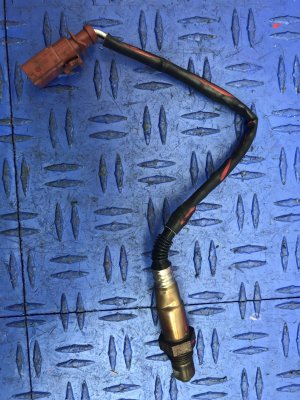
- Oxygen Sensor (Bank 1, Sensor 1)
(OEM #06E906265S)— This is the upstream (pre-catalyst) sensor for the passenger side. The internal heater element is the component that fails, triggering code P0135. This part number is the correct revision for this application and replaces the older 6E906265F.
Trusted brands: Bosch (OEM supplier), Denso, NGK
OEM price range: $150-$200
Aftermarket price range: $70-$150
Related Codes That Often Appear With This One
- P0133 — This code indicates 'O2 Sensor Circuit Slow Response (Bank 1, Sensor 1)'. A failing heater can prevent the sensor from reaching operating temperature and responding quickly, potentially triggering this code alongside P0135.
- P2414 — Indicates 'O2 Sensor Exhaust Sample Error (Bank 1, Sensor 1)'. This can be triggered along with heater circuit faults, as seen in some owner reports, suggesting a comprehensive failure of the sensor.
Technical Service Bulletins (TSBs) & Recalls
- TSB #01139020337671 (also cited as VAG TSB 2033767/1): MIL on, DTCs P1196, P1197, P0135 (lambda sensor heater circuit faults) stored in ECM.
- Bulletin #01139020337671 notes that a "Repair Authorization" may be required when the MIL is on with DTC P0135 and heater circuit faults for the lambda sensor.
Platform-Specific Known Issues
- Audi has issued Technical Service Bulletin (TSB) #01139020337671, which references DTC P0135 and other heater circuit faults for this engine, confirming it is a recognized issue by the manufacturer. The TSB often guides technicians to test the circuit before replacing the sensor, as wiring issues are not uncommon.
- A known oil leak from the oil filter housing gasket on the 3.2L V6 can drip onto the Bank 1, Sensor 1 wiring harness. This oil saturation degrades the wire insulation and connector, often causing P0135. Any diagnosis of this code on the 3.2L engine should include an inspection for this oil leak.
Mechanic-Grade Diagnostic Values
- O2 Sensor Heater Element Resistance (cold) — expected: 2.5 to 10.0 Ohms at room temperature (approx. 20°C/68°F). Some sources state up to 20 Ohms is acceptable.. Failure: A reading of infinite resistance (Open Loop/OL) or zero Ohms (short circuit) confirms a failed heater element.
- Voltage at Harness Connector (Heater Power Feed) — expected: Battery voltage (approx. 11-14V) with Key On, Engine Off.. Failure: No voltage or significantly low voltage points to a blown fuse, faulty relay, or a break in the power supply wire.
- VCDS Measuring Block Group 036 (Heater Status) — expected: The status 'B1-S1 Htg. ON' should be displayed during the engine warm-up phase.. Failure: A status of 'Htg. OFF' or a test failure message when the heater should be active points to a fault detected by the ECU.
- VCDS Advanced Measuring Values (UDS ECUs) — expected: Live data for 'Lambda probe heater' for Bank 1 Sensor 1 should show a resistance value that is not excessively high and a status of 'Heater ON' when commanded.. Failure: An extremely high resistance value (e.g., 235 Ohms) reported by the ECU indicates a likely fault.
Scan Tool Commands That Help
- VCDS (VAG-COM): Engine -> Measuring Blocks -> Group 036 — Use this on a cold start to monitor the heater status for Bank 1, Sensor 1. The ECU will report if the heater is commanded 'ON' or 'OFF', which helps verify if the ECU is attempting to activate the circuit.
- VCDS (VAG-COM): Engine -> Adv. Meas. Values — For newer UDS protocol ECUs (approx. 2010+), this is the modern way to view live data. Search for terms like 'Lambda' and 'heater' to find the heater status, duty cycle, and ECU-calculated resistance for Bank 1 Sensor 1. This provides a more detailed view than simple measuring blocks.
Wiring & Ground Locations
- Ground Connection 12 — In the engine compartment, on the left side.. This is a primary engine compartment ground point. While a failure here would likely cause multiple issues, ensuring it is clean and tight is a crucial step in diagnosing any electrical fault, including sensor circuit problems.
- Ground Connection 615 — On the left suspension strut tower in the engine bay.. This is another key grounding point for components in the engine bay. It is also used as the negative terminal for jump-starting and should be checked for corrosion.
- Ground Connection 671 / 672 — On the left front longitudinal member (frame rail).. These are main chassis ground points. A poor connection here can lead to intermittent and hard-to-diagnose electrical issues across various systems, including sensor circuits that rely on a stable ground reference.
- J623 Connector (ECM) — The Engine Control Module (J623) is located in the plenum chamber (the area under the windshield wipers). The O2 sensor heater circuit wires terminate at specific pins on its 94-pin connector.. For advanced diagnosis of a persistent wiring fault, a technician would perform a continuity test from the O2 sensor connector directly to the corresponding pins at the J623 connector to isolate a break in the harness.
OEM Part Supersession History
06E906265F→06E906265S— Standard part revision and update by the manufacturer.
Model Year Variations Within This Range
- 2008-2012: There are no significant mechanical changes to the 3.2L CALB engine itself within this date range that would affect the diagnosis or repair of code P0135. A 2012 CALB engine is a direct swap for a 2009-2011 model. The 3.2L V6 was replaced by a supercharged 3.0L V6 starting in the 2013 model year facelift.
Diagnostic Flowchart
Other Known Issues on This Vehicle
Issues unrelated to this code that are worth knowing about as an owner of this generation:
- Intake Valve Carbon Buildup 🔴 High — Extremely common on all FSI direct-injection engines. Typically requires cleaning every 60,000-80,000 miles to resolve rough idle, misfires, and power loss. (Ref: Audi TSB 2012848/11 addresses issues caused by fuel deposits and carbon buildup.)
- Upper Timing Chain Tensioner Wear 🔴 High — A known weakness for the 3.2L V6. Presents as a distinct 'rattle' noise from the back of the engine for 1-3 seconds on a cold start. If ignored, can lead to jumped timing and catastrophic engine failure. (Ref: No specific recall, but it is a widely documented failure pattern discussed in class-action lawsuits for similar Audi engines.)
- Water Pump and Thermostat Failure 🟠 Medium — The water pump and/or thermostat are common failure points, leading to coolant leaks (pink fluid) under the front of the engine or overheating conditions. Often occurs between 70,000-100,000 miles.
- PCV Valve (Oil Separator) Failure 🟠 Medium — The diaphragm inside the PCV can tear, causing a large vacuum leak. Symptoms include a loud whistling noise at idle, lean codes (P0171/P0174), and high oil consumption.
Used vs. New Parts: Buying Guide for This Vehicle
When a used part is the smart pick: For this repair, buying a used oxygen sensor is strongly discouraged. The part is a wear item with a finite lifespan, and its internal heater element is the most common failure point. A used sensor has unknown remaining life and could fail shortly after installation. A used wiring harness pigtail or connector from a junkyard could be a viable option if only the connector is damaged and the donor vehicle's wiring is in good condition.
Donor-vehicle mileage cap: roughly under 100000 miles for the part to have meaningful remaining life.
What to inspect on the donor part:
- For a connector/pigtail: Ensure the plastic is not brittle or cracked.
- Check that the locking tab is intact.
- Inspect the wire insulation for any signs of melting, cracking, or oil saturation.
- Look at the connector pins to ensure they are straight and free of corrosion.
Aftermarket brands forum-validated for this vehicle:
- Bosch (often the original OEM supplier)
- NTK
- Denso
Brands owners have reported issues with on this vehicle:
- Unnamed or generic 'white-box' brands from online marketplaces should be avoided, as their quality control and compatibility can be highly inconsistent.
Real Owner Stories
Aggregated from forums and TSBs cited above. Mileages and costs reflect what owners reported in those sources.
2009 Audi Q5 3.2L V6
Symptoms: Owner reported P0135 along with several other codes, including the equivalent code for Bank 2 (P0155) and secondary air injection codes, showing multiple emission system faults appearing at once.
What fixed it: Not specified, but confirmed as a multi-fault emission system issue.
Source hint: Reddit r/AskMechanics - Thread '2009 Audi Q5 - DTCs: P0135, P0155...'
Audi Q5 3.2L V6
Symptoms: The Check Engine Light (CEL) was intermittent, occurring most frequently when the vehicle was cold.
What fixed it: Sensor replacement was confirmed as the correct fix for the internal heating element failure.
Source hint: AudiWorld Forums - Thread 'Getting CEL --- P0135 O2 Sensor heater circuit malfunction'
Related OBD-II Codes
Frequently Asked Questions
Does Audi TSB #01139020337671 apply to my 3.2L V6 Q5 regarding the P0135 code?
I have a 2009 Audi Q5; where is the fuse for the O2 sensor heater located?
Could an oil leak on my 3.2L V6 be causing the P0135 heater circuit code?
Which oxygen sensor do I need to replace for a P0135 code on my Audi Q5?
What resistance should I see when testing the O2 sensor heater on my CALB engine?
Can I use a used oxygen sensor from a donor A4 or A5 to fix this?
Helpful Videos
We Have This Part in Stock


The information in this article is provided for general reference and educational purposes only. Vehicle specifications, procedures, and part compatibility can vary by production date, trim level, and region. Always consult your vehicle's factory service manual and verify part numbers before purchasing or performing repairs. Safety-critical components such as airbags, seat belts, and braking systems should be installed by a qualified professional.
- Audi Q5:
- 🎬 Helpful Videos
- 🛍️ Shop This Part
- What's Unique About the 2008-2012 Audi Q5
- Symptoms You May Notice
- Most Likely Causes
- Rare But Worth Checking
- Diagnosis Steps
- Parts You'll Likely Need
- Related Codes That Often Appear With This One
- Technical Service Bulletins (TSBs) & Recalls
- Platform-Specific Known Issues
- Mechanic-Grade Diagnostic Values
- Scan Tool Commands That Help
- Wiring & Ground Locations
- OEM Part Supersession History
- Model Year Variations Within This Range
- Diagnostic Flowchart
- Other Known Issues on This Vehicle
- Used vs. New Parts: Buying Guide for This Vehicle
- Real Owner Stories
- 2009 Audi Q5 3.2L V6
- Audi Q5 3.2L V6
- Related OBD-II Codes
- Frequently Asked Questions
- 🎟️ Get 5% Off