

P0134 on 2011-2016 Hyundai Elantra 1.8L: Causes and Fixes for O2 Sensor Inactivity
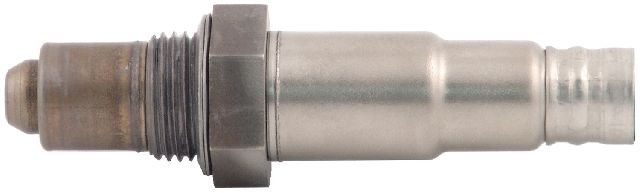
This code almost always means the upstream oxygen sensor (Bank 1, Sensor 1) has failed. The engine computer isn't seeing the expected voltage signal. Before replacing the sensor, check the 15A 'SENSOR 1' fuse. Replacing the sensor is the most common fix, costing around $60-$120 for the part.
- P0134 means the upstream oxygen sensor (before the catalytic converter) is not sending a signal.
- The most likely cause by far is that the sensor itself has failed and needs to be replaced.
- Before buying a new sensor, perform a quick visual inspection of the wiring for any obvious damage and check the 15A 'SENSOR 1' fuse in the engine bay fuse box.
- Driving with this code will hurt your gas mileage and can eventually damage your expensive catalytic converter.
- The correct OEM part number for the upstream sensor is 39210-2E100.
What's Unique About the 2011-2016 Hyundai Elantra
For the 2011-2016 Elantra with the 1.8L Nu engine, the P0134 code is straightforward and overwhelmingly points to a failed upstream O2 sensor. There are no widespread, unique platform issues like software glitches or unusual wiring problems that commonly cause this specific code. The failure is typically due to the sensor reaching the end of its service life, and is not related to the more serious, well-documented engine ticking or steering coupler issues on this platform.
Symptoms You May Notice
- Check Engine Light is on
- Poor fuel economy
- Rough or unstable idle
- Engine hesitation during acceleration
- Replacing the downstream (Bank 1, Sensor 2) oxygen sensor. The P0134 code specifically refers to Sensor 1, which is the upstream sensor before the catalytic converter.
Most Likely Causes
- Failed Upstream Oxygen Sensor (Bank 1, Sensor 1) 🔴 High Probability This is a standard wear-and-tear item. Contamination from engine byproducts or simple age can cause the internal sensing element or heater to fail.
How to confirm: Use an OBD-II scanner with live data to monitor the 'B1S1' voltage. A healthy sensor's voltage should fluctuate rapidly between ~0.1V and ~0.9V. If the voltage is flat, stuck (often around 0.45V), or responds very slowly, the sensor is bad.
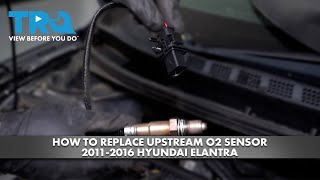
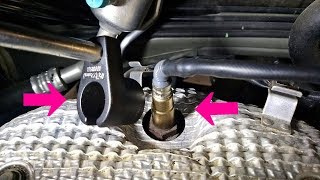
Typical fix: Replace the upstream oxygen sensor. This sensor is located on the front of the engine in the exhaust manifold. A special 22mm (7/8") slotted socket is often required for rem 🎬 Watch: Step-by-step guide to replacing the upstream O2 sensor.oval.
Est. part cost: $60-$120 - Damaged Wiring or Connector 🟡 Medium Probability The wiring harness is close to hot exhaust components and can become brittle, melted, or corroded over time. An intermittent code that comes and goes could point to a wiring short.
How to confirm: Visually inspect the entire wiring harness from the O2 sensor to where it connects to the main engine harness. Look for any signs of melting, chafing, corrosion in the connector pins, or broken wires.
Typical fix: Repair the damaged section of the wire or replace the connector pigtail.
Est. part cost: $15-$40 - Blown Fuse for O2 Sensor Heater ⚪ Low Probability
How to confirm: The oxygen sensor has an internal heater to bring it to operating temperature quickly. This heater is on a fused circuit. Check the engine compartment fuse box for a 15A fuse, often labeled 'SENSOR 1', and verify it is not blown.
Typical fix: Replace the blown fuse. If the fuse blows again immediately, it indicates a short circuit in the heater element of the O2 sensor or its wiring, which must be diagnosed.
Est. part cost: $1-$5 - Exhaust Leak Before the Sensor ⚪ Low Probability
How to confirm: Listen for a ticking or puffing noise from the exhaust manifold area, especially when the engine is cold. A leak can introduce fresh air, which can confuse the sensor and cause it to read incorrectly, sometimes leading to an inactivity code.
Typical fix: Replace the exhaust manifold gasket or repair the crack in the manifold.
Est. part cost: $20-$100
Rare But Worth Checking
- Faulty Powertrain Control Module (PCM): This is extremely rare. Before condemning the PCM, all other possibilities (sensor, wiring, fuses, exhaust leaks) must be exhaustively ruled out.
Diagnosis Steps
- Read the code with an OBD-II scanner to confirm P0134 is the only code present.
- Visually inspect the Bank 1 Sensor 1 (upstream) oxygen sensor's wiring and connector for any obvious damage, melting, or corrosion.
- Check the fuse for the oxygen sensor heater circuit. Specifically, locate the 15A fuse labeled 'SENSOR 1' in the engine bay fuse box and confirm it's intact.
- Use a scan tool with live data to observe the voltage of 'O2S B1S1'. At operating temperature and idle, the voltage should be actively fluctuating between approximately 0.1V and 0.9V. If it is stuck at a steady voltage (e.g., 0.45V) or shows no activity, this points to a failed sensor or wiring issue.
- (Advanced) To definitively test sensor response, carefully introduce a small amount of propane into the air intake while monitoring live data. A good sensor's voltage will immediately jump high (rich condition). No response confirms a dead sensor or circuit issue.
- If the scanner shows no activity, test the wiring for continuity and check for voltage at the connector's heater circuit pins to rule out a wiring problem.
- Check for any exhaust leaks between the cylinder head and the upstream O2 sensor.
- If the wiring, fuse, and exhaust system are all confirmed to be in good condition, the oxygen sensor itself is faulty and should be replaced.
Parts You'll Likely Need
- Upstream Oxygen Sensor (Air/Fuel Ratio Sensor)
(OEM #39210-2E100)— This is the sensor that the code identifies as inactive. It is a common wear item and the most frequent cause of P0134.
Trusted brands: Hyundai (OEM), Denso, Bosch, NTK
OEM price range: $180-$270
Aftermarket price range: $60-$120
Related Codes That Often Appear With This One
- P1166 —
Mechanic-Grade Diagnostic Values
- O2 Sensor Heater Circuit Resistance — expected: 2.5 - 10 ohms at 68°F (20°C). Failure: An infinite reading (OL) indicates an open circuit/failed heater. A reading outside the specified range also indicates a fault.
- O2 Sensor Signal Circuit Reference Voltage (KOEO) — expected: Approximately 0.45V. Failure: A significantly different voltage reading with the key on, engine off, points to a wiring issue or a problem with the PCM's reference voltage supply.
- O2 Sensor Voltage During Fuel Cut-Off (Deceleration) — expected: Less than 0.1V. Failure: If the sensor voltage remains high (e.g., > 0.1V) during a fuel cut event like coasting down from high RPM, it indicates the sensor is not responding correctly to the lean condition.
Scan Tool Commands That Help
- Hyundai GDS (or equivalent advanced scan tool): Active Test: A/F Control — This function allows a technician to command a rich or lean fuel mixture (+25% or -12.5%) while observing the B1S1 voltage on the live data graph. A healthy sensor will show an immediate and corresponding voltage swing. A lazy or dead sensor will show little to no change, confirming the sensor is faulty without needing to perform a propane test.
Wiring & Ground Locations
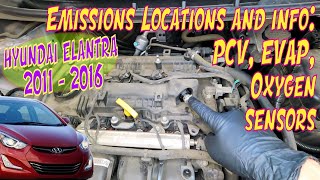
- Upstream O2 Sensor Connector (C15-1) — On the front of the engine, connected to the O2 sensor located in the exhaust manifold.. 🎬 Watch: Locate your O2 sensors and other emission components. This is the primary connection point to test. The four pins are typically: Heater Power (12V), Heater Control (PCM Ground), Signal, and Signal Ground. Testing for power, ground, and continuity happens at this connector.
- ECM Connector Pin 7 — At the Engine Control Module (ECM).. Based on wiring diagrams for the Elantra of this generation, Pin 7 is the 'Heated Oxygen Sensor (Sensor 1) control output'. A continuity check between this pin and the corresponding pin at the sensor connector can definitively rule out a broken wire.
- Ground Point GC501 — Location varies, but typically on the cylinder head or engine block near the intake manifold.. A wiring diagram for the 2012-2015 Elantra references 'Grounding point GC501' for engine sensor circuits. While a bad ground here would likely cause multiple sensor codes, it's a critical point to check for looseness or corrosion if multiple, seemingly unrelated engine codes are present with P0134.
"I Checked Everything" — The Actual Cause
- In one documented case, a technician performed a visual inspection for vacuum leaks and a smoke test on the intake manifold, both of which revealed no issues. An exhaust leak check also came back clean. The final confirmation of the bad O2 sensor was made by introducing propane into the intake; the B1S1 sensor voltage did not respond at all to the rich condition, proving it was electrically dead despite no visible leaks in the system.
When the Usual Fixes Don't Work
- While replacing the sensor is the most common fix, it is not always a permanent solution. There are documented owner experiences where a P0134 code returned intermittently even after replacing the sensor with a new OEM part. In one case, the recurring code was also accompanied by new symptoms of severe engine hesitation, pointing to an underlying, hard-to-diagnose intermittent short or bad connection in the wiring harness that was not resolved by the sensor replacement alone.
OEM Part Supersession History
39210-2E100→N/A— This part number appears to be stable for the specified vehicle range.
Heads up: Aftermarket interchange part numbers include 234-5082. While many aftermarket brands work, using non-OEM equivalent brands like Denso or NTK can sometimes lead to recurring codes or slightly different performance characteristics that can complicate diagnosis if the code returns.
Model Year Variations Within This Range
- 2014-2016: For the 2014 model year facelift, Hyundai introduced a new 2.0L GDI engine for the Elantra Sport, Coupe, and GT models. However, the popular SE and Limited sedan trims retained the same Nu 1.8L MPi engine. This article and its part numbers remain correct for the 1.8L engine across the entire 2011-2016 range, but technicians should confirm the engine displacement before ordering parts for 2014+ models.
Diagnostic Flowchart
Other Known Issues on This Vehicle
Issues unrelated to this code that are worth knowing about as an owner of this generation:
- Engine Ticking / Piston Slap 🔴 High — Very common, often starting between 50,000 and 100,000 miles. The noise is typically a metallic ticking or knocking sound, especially on cold starts, that can lead to excessive oil consumption and eventual engine failure. (Ref: Subject of class-action lawsuit (Brown v. Hyundai). Hyundai issued warranty extension TXXK (TSB 21-EM-002H) and TSB 22-EM-007H for engine inspection and replacement.)
- Steering Coupler Failure 🟠 Medium — Extremely common. The flexible rubber coupler inside the Motor-Driven Power Steering (MDPS) column disintegrates over time, causing a distinct clicking, clunking, or notchy feeling in the steering wheel when turning. (Ref: Hyundai TSB 17-ST-001 describes the replacement procedure. The part (56315-2K000-FFF) is inexpensive, but labor is required to lower the steering column.)
- Premature Alternator Failure 🟠 Medium — This platform has reports of alternators failing earlier than expected, leading to a battery warning light on the dash and eventual loss of electrical power.
Used vs. New Parts: Buying Guide for This Vehicle
When a used part is the smart pick: For this specific repair, using a part from a junkyard is NOT recommended for the oxygen sensor itself. However, if diagnosis points to a damaged connector pigtail, a used pigtail from a donor vehicle harness is a perfectly acceptable and cost-effective repair.
Donor-vehicle mileage cap: roughly under 100000 miles for the part to have meaningful remaining life.
What to inspect on the donor part:
- For a connector pigtail: ensure the locking tab is intact and not brittle.
- Check for any signs of melting or heat stress on the plastic connector body.
- Inspect the wire insulation for cracking or brittleness.
- Ensure the pins inside the connector are clean and free of green or white corrosion.
Aftermarket brands forum-validated for this vehicle:
- Denso
- NTK / NGK
- Bosch
Brands owners have reported issues with on this vehicle:
- Generic, unbranded 'white box' sensors from online marketplaces. While they may work initially, they have a higher reported failure rate and can have different response characteristics, potentially causing fuel trim issues or a recurring code.
Real Owner Stories
Aggregated from forums and TSBs cited above. Mileages and costs reflect what owners reported in those sources.
2012 Hyundai Elantra Touring GLS 1.8L
Symptoms: The P0134 code was coming on and off for months. After replacing the sensor, the code returned and was accompanied by severe hesitation on acceleration.
What fixed it: The report suggests a more complex underlying wiring issue was the cause, as the code persisted even after sensor replacement.
Source hint: r/AskMechanics: 'P00134 code coming off and on after replacement (2012 Hyundai Elantra touring GLS)'
Related OBD-II Codes
Frequently Asked Questions
Where is the Bank 1 Sensor 1 oxygen sensor located on my 1.8L Elantra?
My 2012 Elantra has an intermittent P0134 code that comes and goes. What should I check?
Which fuse controls the O2 sensor heater circuit on the 2011-2016 Elantra?
Are there any specific aftermarket brands recommended for replacing the O2 sensor on the Nu 1.8L engine?
Could a ticking noise from my engine be related to the P0134 code?
Can I use a used oxygen sensor from a junkyard to fix this code?
Helpful Videos

We Have This Part in Stock


The information in this article is provided for general reference and educational purposes only. Vehicle specifications, procedures, and part compatibility can vary by production date, trim level, and region. Always consult your vehicle's factory service manual and verify part numbers before purchasing or performing repairs. Safety-critical components such as airbags, seat belts, and braking systems should be installed by a qualified professional.
- Hyundai Elantra:
- 🎬 Helpful Videos
- 🛍️ Shop This Part
- What's Unique About the 2011-2016 Hyundai Elantra
- Symptoms You May Notice
- Most Likely Causes
- Rare But Worth Checking
- Diagnosis Steps
- Parts You'll Likely Need
- Related Codes That Often Appear With This One
- Mechanic-Grade Diagnostic Values
- Scan Tool Commands That Help
- Wiring & Ground Locations
- "I Checked Everything" — The Actual Cause
- When the Usual Fixes Don't Work
- OEM Part Supersession History
- Model Year Variations Within This Range
- Diagnostic Flowchart
- Other Known Issues on This Vehicle
- Used vs. New Parts: Buying Guide for This Vehicle
- Real Owner Stories
- 2012 Hyundai Elantra Touring GLS 1.8L
- Related OBD-II Codes
- Frequently Asked Questions
- 🎟️ Get 5% Off