

P0134 on 2014-2015 Acura MDX: A/F Sensor Heater Malfunction Causes and Fixes
On a 2014-2015 Acura MDX, code P0134 almost always means the Rear Air/Fuel Ratio Sensor (Bank 1, Sensor 1) has failed. This is a known issue confirmed by multiple Acura TSBs. Before replacing the sensor, check if TSB 15-007 (a PCM software update) applies to your vehicle, as it was issued to fix erroneously reported P0134 codes. If the update is not applicable or already done, the fix is to replace the sensor, which costs about $180-$260 for an OEM-equivalent part.
- P0134 on a 2014-15 MDX specifically means the heater in the REAR (Bank 1) UPSTREAM (Sensor 1) Air/Fuel Ratio sensor has failed.
- This is a very common and well-documented problem for this vehicle, confirmed by multiple manufacturer service bulletins.
- CRITICAL: Before replacing the sensor, check with an Acura dealer if TSB 15-007 (a software update) applies to your VIN, as it was issued to fix this exact code.
- The most likely fix is replacing the sensor with an OEM or Denso equivalent if the software update is not applicable or has already been done.
- Access to the rear sensor is tight but manageable for a DIY repair.
What's Unique About the 2014-2015 Acura MDX
Acura/Honda issued multiple Technical Service Bulletins (TSBs) for the 2014-2015 MDX specifically for code P0134 and its Bank 2 equivalent, P0154. This indicates a higher-than-normal failure rate of the heater element within the original equipment A/F ratio sensors. Critically, Acura also released TSB 15-007, which states the PCM can misinterpret the sensor's heater system input and falsely trigger the code. The official remedy for this specific TSB is a PGM-FI software update performed by a dealership, making it crucial to check for this before replacing hardware.
Diagnostic Flowchart
Tap your situation to follow the diagnostic path that matches what you're seeing on this vehicle.
Symptoms You May Notice
- Check Engine Light (Malfunction Indicator Lamp) is on
- Decreased fuel economy
- Rough or unstable idle, especially on startup
- Failure to pass an emissions test
- Sluggish acceleration or hesitation
- Replacing the wrong sensor (e.g., the downstream Sensor 2, or the Bank 2 sensor). P0134 is specifically for Bank 1 (rear, by the firewall) and Sensor 1 (upstream, before the catalytic converter).
- Replacing the sensor without first checking if TSB 15-007 (software update) is applicable and has been performed.
Most Likely Causes
- Failed Rear Air/Fuel Ratio Sensor (Bank 1, Sensor 1) 🔴 High Probability As documented in Acura TSBs, the internal heater element of the original sensor is a common failure point on this specific model and year range. This is the most frequent cause if the software update from TSB 15-007 has already been performed or is not applicable.
How to confirm: Using a multimeter, test the resistance between the two heater circuit pins on the sensor's connector (typically the two wires of the same color). A healthy sensor should have a low resistance value (e.g., typically between 2 and 15 ohms when cold). An open circuit (infinite resistance) or a resistance value over a specific threshold (e.g., 200 Ω) confirms the heater has failed.
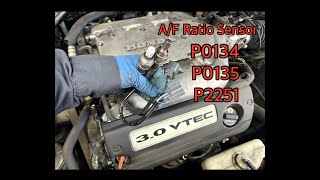
Typical fix: Replace the Rear (Bank 1) upstream Air/Fuel Ratio sensor. It is highly recommended to use the OEM part or a direct equivalent from Denso or NGK/NTK. 🎬 See this walkthrough for replacing sensors on Acura V6 models.
Est. part cost: $180-$260 - Damaged Wiring or Connector 🟡 Medium Probability The sensor is located in a high-heat area near the exhaust, making its wiring susceptible to damage over time from heat, abrasion, or environmental exposure.
How to confirm: Visually inspect the wiring harness and connector leading to the sensor for any signs of melting, corrosion, chafing, or rodent damage. Check for 12V power and ground at the harness-side connector with the key on, engine off. 🎬 Watch: How to test and replace a faulty air fuel sensor. A lack of voltage points to a wiring or fuse issue, not the sensor itself.
Typical fix: Repair the damaged section of the wiring harness or replace the connector pigtail.
Est. part cost: $15-$50 - Blown Fuse for Heater Circuit ⚪ Low Probability
How to confirm: Locate and inspect the fuse that supplies power to the A/F and O2 sensor heater circuits. Consult the owner's manual or the fuse box diagram for the correct fuse location (often labeled A/F HEATER or similar).
Typical fix: Replace the blown fuse. If the fuse blows again immediately, it indicates a short circuit in the wiring or within the sensor itself that must be diagnosed.
Est. part cost: $1-$5
Rare But Worth Checking
- Powertrain Control Module (PCM) Software Issue: Acura TSB 15-007 explicitly states that on 2014-2015 MDX models, the PCM may misinterpret the sensor's signal, triggering P0134. The fix is a PGM-FI software update performed by a dealership. It is essential to contact a dealer with your VIN to check if this TSB applies and has been performed before replacing the sensor.
- Exhaust Leak: A significant exhaust leak upstream of or near the A/F sensor can introduce extra oxygen into the exhaust stream, potentially confusing the sensor and causing erratic readings or codes. This is less likely to cause a specific heater circuit code but is worth considering if other symptoms like loud exhaust noise are present.
Diagnosis Steps
- Confirm the code P0134 is present using an OBD-II scanner.
- Contact an Acura dealer with your VIN to determine if TSB 15-007 is applicable and has been performed on your vehicle. If not, this software update is the first recommended step.
- Identify the correct sensor. Bank 1 is the cylinder bank near the firewall (rear of the engine bay). Sensor 1 is the upstream sensor in the exhaust manifold, before the catalytic converter.
- Check the fuse for the A/F sensor heater circuit in the vehicle's fuse box.
- Perform a thorough visual inspection of the sensor's wiring harness and connector. Look for any signs of melting, corrosion, or physical damage.
- If the wiring appears intact, disconnect the sensor. Use a multimeter set to Ohms to test the resistance of the heater circuit on the sensor side (between the two same-colored wires). An open loop (OL or infinite resistance) or a very high resistance (e.g., over 200 ohms) indicates a failed heater element, and the sensor must be replaced. A good sensor will have a low resistance, typically in the 2-15 ohm range when cold.
- With the sensor still disconnected and the ignition on (engine off), test the harness-side connector for 12-volt power and a good ground connection on the heater circuit pins.
- If power and ground are present and the sensor's heater circuit tested open, the sensor is confirmed faulty and needs to be replaced.
- If power or ground is missing from the harness connector, the wiring between the fuse box/PCM and the sensor needs to be traced and repaired.
Parts You'll Likely Need
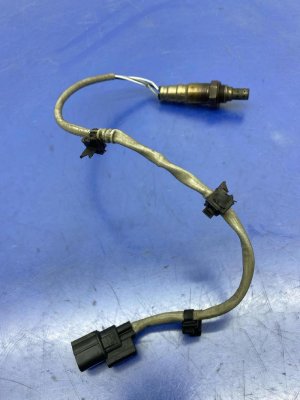
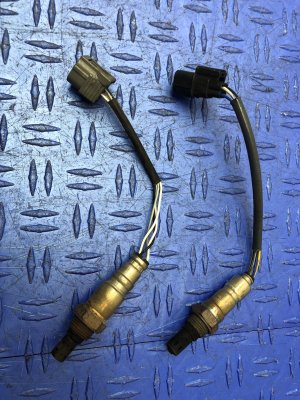
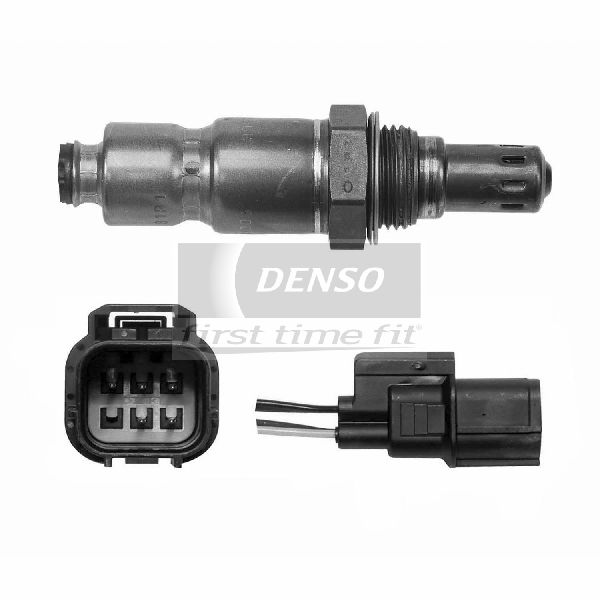
- Rear Air/Fuel Ratio Sensor (Bank 1, Sensor 1)
(OEM #36531-R70-A02)— This is the component that contains the heater element that fails, triggering code P0134. The TSBs issued by Acura for this exact problem confirm it's the primary point of failure. This part number supersedes 36531-R70-A01.
Trusted brands: Denso (OEM supplier, Part #234-5053), NGK/NTK
OEM price range: $220-$280
Aftermarket price range: $180-$260
Related Codes That Often Appear With This One
- P0154 — This is the identical code but for the opposite bank (Bank 2, Front). Acura's TSBs group these two codes together, as they are caused by the same software issue or part failure pattern.
Technical Service Bulletins (TSBs) & Recalls
- TSB 15-007 (NHTSA ID: 10108863): States the "PCM misinterprets the heater system input from the A/F sensor and sets DTC codes P0134 and/or P0154." The corrective action is to update the PGM-FI software. This applies to all 2014-15 MDX models.
- Bulletin #DLR MSG - RFP - (2015 EQUIPMENT, dated 2014-11-03): Acknowledges investigation into P0134 (Rear Air Fuel Ratio Sensor [Bank 1, Sensor 1] Heater System Malfunction).
- Bulletin #Service Bulletin (2014 EQUIPMENT, dated 2015-02-04): Notes the MIL comes on with DTC P0134 (rear A/F sensor [bank 1, sensor 1] heater system malfunction).
Platform-Specific Known Issues
- Acura issued multiple TSBs (e.g., #DLR MSG - RFP, #Service Bulletin 15-007) regarding P0134 and P0154 on 2014-2015 MDX models, indicating a known problem with the A/F sensor heater system or the PCM software interpreting its signal.
- Access to the Bank 1 (rear) sensor is tight due to its location between the engine and the firewall, making replacement more difficult than the Bank 2 sensor. Removing the plastic engine cover can provide better access from the side. 🎬 Watch: Step-by-step guide to replacing the Bank 1 sensor.
Mechanic-Grade Diagnostic Values
- A/F Sensor (Sensor 1) Heater Circuit Resistance — expected: 2 to 15 ohms at room temperature.. Failure: The PCM will set DTC P0134 if the internal resistance is 200 Ω or more for at least 40-90 seconds after startup. A reading of OL (Open Loop) on a multimeter also confirms failure.
- Mode 6 - A/F Sensor "non-activation" time — expected: The measured value is the time in seconds the PCM waited for the sensor to activate. This value is compared against an internal maximum limit.. Failure: If the measured time exceeds the PCM's maximum threshold, it contributes to setting the DTC.
- A/F Sensor Heater Power Supply (at harness connector) — expected: Battery Voltage (~12V) with key on, engine off.. Failure: 0V indicates a problem with the fuse or power supply wiring, not the sensor itself.
Hidden / Shadow Codes Worth Checking
- Mode 6, Monitor ID $01, Test ID $80: Check of A/F sensor "non-activation" time. This test measures how long it takes for the sensor to become active after a cold start. (see via Advanced OBD-II scanner capable of displaying Mode 6 data.)
- Mode 6, Monitor ID $01, Test ID $87: Check of A/F sensor heater resistance during A/F feedback control. (see via Advanced OBD-II scanner capable of displaying Mode 6 data.)
Scan Tool Commands That Help
- Honda Diagnostic System (HDS): A/F Sensor Heater Test — This is a bidirectional test that allows a technician to command the A/F sensor heater ON and OFF to verify the functionality of the circuit and the sensor's heater element directly, without waiting for a drive cycle. It can confirm if the heater is drawing current.
- Honda Diagnostic System (HDS): CKP Pattern Clear/Learn — While not directly for P0134, this procedure is often required after major engine work or PCM replacement. If other work was performed alongside the P0134 diagnosis, ensuring the CKP pattern is learned is a crucial step to prevent other driveability issues.
Wiring & Ground Locations
- G101 — Located on the right rear of the engine compartment.. This is a primary engine ground. A loose or corroded G101 can cause a variety of sensor and PCM-related issues, including erratic sensor readings or incorrect voltages that could potentially trigger fault codes.
- A/F Sensor Connector (Bank 1, Sensor 1) — Tucked between the engine and the firewall, below the heater control valve. Access is difficult and often done by feel.. This is the direct connection point for the sensor. The heater circuit power (approx. 12V) and ground can be tested at this connector's harness side to differentiate between a failed sensor and a wiring/PCM issue. The two same-colored wires are for the heater circuit.
Real Owner Repair Stories
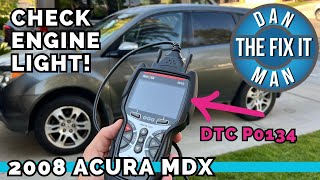
- Innova (YouTube) (2008 Acura MDX (similar 3.7L V6 engine and sensor location)) — Check Engine Light with DTC P0134 stored.
❌ Tried (didn't work) Visual inspection of wiring showed no obvious damage.
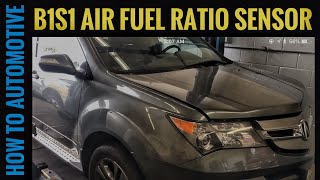
✅ What actually fixed it The problem was resolved by replacing the Bank 1, Sensor 1 Air/Fuel Ratio sensor. The scan tool specifically mentioned a 'heater system malfunction,' and the new sensor fixed the issue after a test drive. - How to Automotive (YouTube) (2008 Acura MDX (similar 3.7L V6 engine and sensor location)) — Not specified, but performing replacement for Bank 1 Sensor 1.
✅ What actually fixed it The video demonstrates the replacement of the Bank 1 Sensor 1 Air Fuel Ratio sensor, confirming the difficult access and the need to perform the replacement largely by feel from the top of the engine bay.
OEM Part Supersession History
36531-R70-A01→36531-R70-A02— Standard part revision by the manufacturer.
Heads up: The new part number (36531-R70-A02) is the correct replacement for the original. No known incompatibilities exist.
Model Year Variations Within This Range
- 2014-2015: There are no significant mechanical or engine differences between the 2014 and 2015 Acura MDX models that would affect the diagnosis or repair of code P0134. Both use the same J35Y5 engine and have the same base horsepower. Forum discussions from the time confirm the models were considered identical.
Helpful Videos

Used OEM Parts in Stock
New Aftermarket Parts Available


The information in this article is provided for general reference and educational purposes only. Vehicle specifications, procedures, and part compatibility can vary by production date, trim level, and region. Always consult your vehicle's factory service manual and verify part numbers before purchasing or performing repairs. Safety-critical components such as airbags, seat belts, and braking systems should be installed by a qualified professional.
- Acura MDX:
- 🎬 Helpful Videos
- 🛍️ Shop This Part
- What's Unique About the 2014-2015 Acura MDX
- Diagnostic Flowchart
- Symptoms You May Notice
- Most Likely Causes
- Rare But Worth Checking
- Diagnosis Steps
- Parts You'll Likely Need
- Related Codes That Often Appear With This One
- Technical Service Bulletins (TSBs) & Recalls
- Platform-Specific Known Issues
- Mechanic-Grade Diagnostic Values
- Hidden / Shadow Codes Worth Checking
- Scan Tool Commands That Help
- Wiring & Ground Locations
- Real Owner Repair Stories
- OEM Part Supersession History
- Model Year Variations Within This Range
- 🎟️ Get 5% Off