

P0132 on 2005-2009 Subaru Outback 2.5L: Front O2 Sensor High Voltage Causes and Fixes
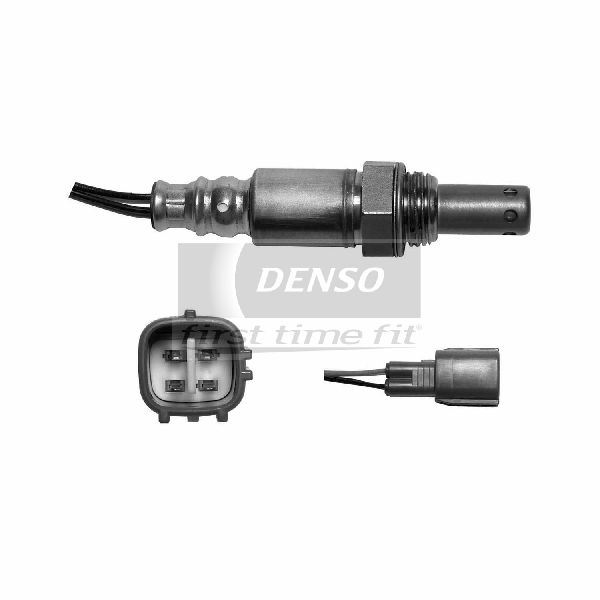
On a 2005-2009 Subaru Outback, code P0132 almost always points to a failed front oxygen sensor, which Subaru calls an Air/Fuel (A/F) Ratio Sensor. The ECM detects a voltage stuck above 0.9V. Replacing it with a quality part like a Denso (Part No. 234-9123) is the most reliable fix. Expect to pay around $120-$150 for the Denso sensor and $160-$220 for an OEM part from Subaru. DIY difficulty is 2/5, but the sensor can be difficult to remove without a special socket.
- P0132 on your Outback means the front oxygen sensor (A/F sensor) is sending a constant high voltage signal.
- The most probable cause by far is a failed sensor. Don't waste money on other parts until you've tested or replaced it.
- Always use a high-quality, direct-fit replacement sensor from a brand like Denso or NGK. Universal sensors are likely to cause problems.
- Before replacing the sensor, perform a quick visual check of the wiring harness for any obvious signs of melting or damage, as this is the second most common cause.
- Ignoring this code will hurt your fuel economy and can eventually damage your catalytic converter, a much more expensive repair.
What's Unique About the 2005-2009 Subaru Outback
Subaru refers to the front oxygen sensor on this platform as an Air/Fuel (A/F) Ratio Sensor. This is a type of wideband oxygen sensor that provides more precise feedback to the engine computer than a conventional O2 sensor. These sensors are known to be sensitive, and the engine management system is often finicky about non-OEM or 'universal' replacements, which can lead to the code returning even after a replacement. Owners on forums like LegacyGT.com and Reddit's r/Subaru frequently report that using the OEM supplier brand (Denso) is the most reliable fix to avoid repeat failures.
Symptoms You May Notice
- Check Engine Light is on
- Flashing cruise control light (a common Subaru trait when a CEL is present)
- Reduced fuel economy
- Rough or unstable idle
- Engine hesitation or stumbling during acceleration
- Black smoke from the exhaust in severe cases
- Smell of raw fuel from the exhaust
- Replacing the sensor with a cheap 'universal' model. These often have incorrect electrical characteristics or heater resistance and will not fix the code on a Subaru.
- Replacing the rear (downstream) oxygen sensor instead of the front (upstream) Air/Fuel Ratio sensor. 🎬 Watch: How to replace both the upstream and downstream sensors.
- Replacing the sensor without first inspecting the wiring harness for obvious damage like melting or fraying.
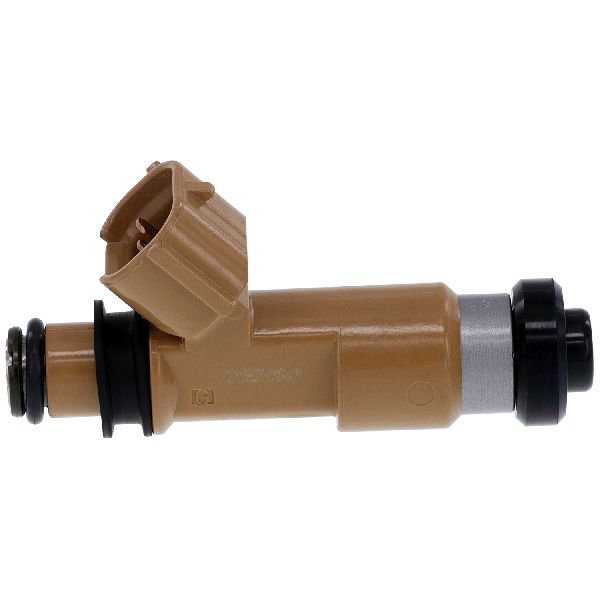
- Assuming the sensor is bad when there is an underlying rich condition from a separate component like a leaking fuel injector.
Most Likely Causes
- Failed Front Air/Fuel (O2) Sensor 🔴 High Probability The sensor element can degrade or crack over time from heat cycles and exposure to exhaust gases. There was a Subaru service program (WXW-80) for some models due to sensor elements cracking, indicating a known issue with the original parts.
How to confirm: Use a scan tool to monitor live data for the 'Bank 1, Sensor 1' voltage. If the voltage is stuck high (e.g., above 0.9V) and does not fluctuate rapidly during engine operation (especially when revving), the sensor has likely failed internally. A good sensor's voltage should oscillate quickly between approximately 0.1V and 0.9V.
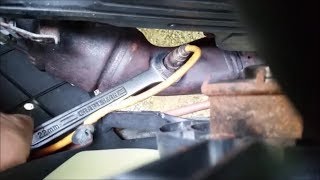
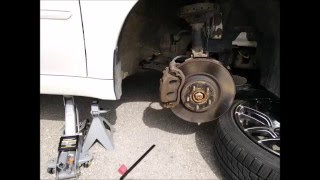
Typical fix: Replace the front Air/Fuel Ratio sensor. It is located in the exhaust manifold before the catalytic converter. Access is typically through the passenger-side fender well or from below. An oxygen sensor socket is highly recommended for removal. 🎬 See this walkthrough for changing the upstream sensor on a Legacy.
Est. part cost: $120-$220 - Wiring or Connector Issue 🟡 Medium Probability The sensor wiring is routed near hot exhaust components and can become melted, brittle, or frayed. The main connector, located on the passenger side strut tower, can also suffer from corrosion or loose pins.
How to confirm: Visually inspect the entire wiring harness from the sensor to the engine bay connector. Check for melted insulation, chafing, and corrosion in the connector pins. A multimeter can be used to check for a short to power in the signal wire by disconnecting both the sensor and ECM and checking for continuity to a 12V source.
Typical fix: Repair the damaged section of wiring using heat-shrink butt connectors or solder. Clean corroded connectors with electrical contact cleaner or replace the connector pigtail if necessary. Secure the harness away from heat sources with zip ties.
Est. part cost: $10-$50 - Engine Running Rich ⚪ Low Probability While less common, issues like leaking fuel injectors or a faulty fuel pressure regulator can create a genuine rich condition that the A/F sensor accurately reports as high voltage.
How to confirm: This is a genuine rich condition, not a sensor error. Look for other trouble codes, especially P0172 (System Too Rich Bank 1). Diagnosis involves checking fuel trims with a scan tool and may require testing fuel pressure or having injectors professionally cleaned and tested.
Typical fix: Diagnose and repair the root cause of the rich condition, such as replacing a leaking fuel injector or faulty fuel pressure regulator.
Est. part cost: $50-$400+
Rare But Worth Checking
- Exhaust Leak: An exhaust leak before the A/F sensor can, in some cases, draw in outside air and disrupt sensor readings, potentially causing a high voltage code. It's more likely to cause a lean code (P0131), but it's worth checking the manifold for cracks or gasket leaks, especially if you hear an exhaust leak.
- Faulty Engine Control Module (ECM): This is extremely rare. The ECM should only be considered after all other possibilities, including the sensor, wiring, and fuel system, have been definitively ruled out. A faulty voltage regulator within the PCM could theoretically cause the issue.
Diagnosis Steps
- Read the code with an OBD-II scanner to confirm P0132 is the primary code present.
- Use the scanner's live data function to monitor the voltage of 'Bank 1 Sensor 1'.
- Observe the voltage reading at idle and while holding RPMs around 2500. If it is stuck high (above 0.9V) and does not fluctuate, it points towards a sensor or circuit issue.
- Unplug Test: A definitive test is to unplug the front A/F sensor connector. With the sensor unplugged, the live data voltage should drop to a default low value. If it does, the sensor itself is faulty and sending the high voltage. If the voltage remains high even when unplugged, there is a short-to-power in the vehicle's wiring harness that needs to be traced.
- Turn the engine off and let the exhaust cool completely.
- Visually inspect the A/F sensor's wiring harness for any signs of melting, chafing, or corrosion, from the sensor itself to the connector on the passenger strut tower.
- If the wiring appears intact and the unplug test pointed to the sensor, the A/F sensor itself is the confirmed culprit.
- If you replace the sensor and the code returns, perform a detailed check of the wiring for a short-to-power. This involves using a multimeter to test the signal wire with the sensor and ECM disconnected.
- If no sensor or wiring faults are found, investigate potential causes of a true rich condition, such as fuel pressure tests or checking for leaking injectors.
Parts You'll Likely Need
- Front Air/Fuel Ratio Sensor
(OEM #22641AA280 (superseded by 22641AA381))— This is the component that fails in the vast majority of P0132 cases on this vehicle.
Trusted brands: Denso (OEM supplier) - Part #234-9123, NTK - Part #24825
OEM price range: $160-$220
Aftermarket price range: $120-$150
Related Codes That Often Appear With This One
- P0172 — If the engine is genuinely running rich, you may also get a P0172 (System Too Rich Bank 1) code along with P0132.
- P0152 — On 6-cylinder Subaru engines (H6), P0152 is the equivalent code for Bank 2. If both P0132 and P0152 are present, it points to a systemic issue like fuel pressure rather than a single failed sensor.
Technical Service Bulletins (TSBs) & Recalls
- WXW-80 (Subaru Service Program for cracking front O2 sensor element)
Platform-Specific Known Issues
- Subaru issued a service program (not a safety recall) with reference number WXW-80 for certain models because the front oxygen (air/fuel ratio) sensor element could develop a crack, leading to a Check Engine Light. This indicates a known weakness in the original sensors.
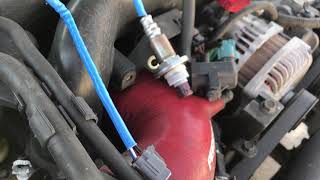
- On some models, the vehicle-side connector has a white plastic insert and rubber gasket that must be removed to fit the new Denso sensor. After removal, a small amount of dielectric grease should be applied to the connection to prevent moisture intrusion. 🎬 Watch a quick demonstration of the O2 sensor replacement process.
Mechanic-Grade Diagnostic Values
- A/F Sensor Signal Voltage (Live Data) — expected: Fluctuates rapidly between 0.1V and 0.9V.. Failure: Stuck consistently above 0.9V, with some sources noting thresholds as high as 1.2V.
- A/F Sensor Heater Resistance (aftermarket example) — expected: A quality aftermarket Delphi sensor measured 3.8 Ω ±0.2.. Failure: Significantly higher or lower resistance. A clone sensor measured 5.1 Ω ±1.5.
- Harness continuity check between ECM and Sensor Connector — expected: Less than 5 ohms.. Failure: Resistance higher than 5 ohms indicates a problem in the wiring.
- Harness short-to-power check at ECM connector — expected: Less than 8V.. Failure: Voltage reading of more than 8V at specific ECM pins (e.g., B136 No. 33 or 35) with key on, engine off.
Wiring & Ground Locations
- ECU Main Ground Path — The ECU grounds through the top of the intake manifold to the engine block.. A poor ground at the intake manifold (often caused by aftermarket TGV spacers/deletes) can cause a host of electrical issues, including incorrect sensor readings that could trigger a P0132.
- Primary Engine Bay Grounds — Key points include: where the negative battery cable meets the chassis, top of the intake manifold, the engine block itself, the alternator housing, and two wires on a bracket in front of the master brake cylinder.. A faulty ground at any of these locations can create a voltage differential, potentially leading to a high voltage reading in the sensitive A/F sensor circuit.
- Front A/F Sensor Connector — Located on the passenger side strut tower. The wiring diagram ID can be E23, E24, B18, B262, or B379 depending on the specific diagram.. This is the main connection point to test the sensor vs. the harness. Corrosion or damage here is a common cause of failure.
- Oxygen (A/F) Sensor Relay — Located at the right end of the dash.. This relay supplies power to the A/F sensor circuit; a fault here could interrupt power or cause voltage issues.
- Ground Point GB-2 — Located at the left front of the engine compartment.. This is a chassis ground point referenced in wiring diagrams that could be part of the sensor's circuit path.
Real Owner Repair Stories
- LegacyGT.com forum user (Subaru Legacy (4th Gen, similar platform)) — Initially had a P0131 (Lean) code, then after a repair, got a P0132 (Rich) code that would not clear.
❌ Tried (didn't work) Replacing the original front A/F sensor with a 'universal' 4-wire Bosch sensor.
✅ What actually fixed it The discussion concluded that the universal, non-OEM sensor was the cause of the P0132 code, as Subarus of this era are notoriously finicky about sensor compatibility. The implied fix is to use an OEM or OEM-supplier (Denso) sensor. - AliExpress user review/guide (2007 Subaru Outback Wagon) — P0132 code, rough idle, intermittent check engine light while driving, and a 20% drop in fuel economy.
❌ Tried (didn't work) Receiving a quote for a $420 genuine Subaru sensor from a mechanic.
✅ What actually fixed it The owner replaced the factory Denso sensor (234-9010) with a specific aftermarket DELPHI RE94 sensor, which resolved all symptoms and the code did not return.
OEM Part Supersession History
22641AA140→22641AA280— Part revision/update.22641AA230→22641AA280— Part revision/update.22641AA280→22641AA381— Part revision/update.
Model Year Variations Within This Range
- 2008-2009: For the 2008 model year, the 2.5i non-turbo engine was certified as a PZEV (Partial Zero Emissions Vehicle). PZEV cars can have different components, such as larger catalytic converters or different ECU programming, to meet stricter emissions standards. While the A/F sensor part number often remains the same, a technician should verify the part against the vehicle's VIN, especially if it is a PZEV model from a state that adopted California emissions standards.
Diagnostic Flowchart
Real Owner Stories
Aggregated from forums and TSBs cited above. Mileages and costs reflect what owners reported in those sources.
2009 Subaru Legacy GT
Symptoms: Check Engine Light with code P0132 appeared after previously having a P0131 code.
What fixed it: The issue was caused by installing a universal Bosch 4-wire sensor. The community identified that the vehicle is finicky about non-OEM sensors, requiring an OEM-style replacement.
Source hint: LegacyGT.com thread titled 'DTC P0132 - Diagnostic procedure'
2005 Subaru Outback 2.5i
Symptoms: Experienced a P0131 code, replaced the front A/F sensor with a Denso 234-9123, which immediately triggered a P0132 code.
What fixed it: Realized the brand new Denso sensor was faulty out of the box. Installing a second new Denso sensor resolved the issue.
Source hint: subaruoutback.org thread titled 'P0131 and now P0132'
Subaru Outback H6
Symptoms: Experienced P0132 and P0152 high voltage codes after installing incorrect, and then correct, O2 sensors.
What fixed it: Extensive troubleshooting of rich conditions, which included cleaning the MAF/MAP sensors and the throttle body to resolve the underlying rich running condition.
Source hint: Reddit r/subaru thread titled 'O2 Sensor High Voltage After Installing New Sensors'
Related OBD-II Codes
Frequently Asked Questions
Is there a recall or known issue for the front O2 sensor on the 2005-2009 Subaru Outback?
Why is my cruise control light flashing along with the Check Engine Light for P0132?
I replaced my front A/F sensor with a universal Bosch sensor, but the P0132 code came back. What should I do?
Where is the wiring connector for the front A/F sensor located on the EJ25 2.5L engine?
My new Denso sensor won't plug into the factory harness on my Outback. How do I fix this?
How can I tell if the P0132 code is caused by a bad sensor or a wiring short?
Helpful Videos
We Have This Part in Stock


The information in this article is provided for general reference and educational purposes only. Vehicle specifications, procedures, and part compatibility can vary by production date, trim level, and region. Always consult your vehicle's factory service manual and verify part numbers before purchasing or performing repairs. Safety-critical components such as airbags, seat belts, and braking systems should be installed by a qualified professional.
- Subaru Outback:
- 🎬 Helpful Videos
- 🛍️ Shop This Part
- What's Unique About the 2005-2009 Subaru Outback
- Symptoms You May Notice
- Most Likely Causes
- Rare But Worth Checking
- Diagnosis Steps
- Parts You'll Likely Need
- Related Codes That Often Appear With This One
- Technical Service Bulletins (TSBs) & Recalls
- Platform-Specific Known Issues
- Mechanic-Grade Diagnostic Values
- Wiring & Ground Locations
- Real Owner Repair Stories
- OEM Part Supersession History
- Model Year Variations Within This Range
- Diagnostic Flowchart
- Real Owner Stories
- 2009 Subaru Legacy GT
- 2005 Subaru Outback 2.5i
- Subaru Outback H6
- Related OBD-II Codes
- Frequently Asked Questions
- 🎟️ Get 5% Off