

P0132 on 2003-2008 Subaru Forester EJ25: O2 Sensor High Voltage Causes and Fixes
On a 2003-2008 Forester, P0132 almost always means the front oxygen (A/F) sensor has failed. The ECU sees a stuck high voltage signal, indicating a rich mixture. Replacing it with an OEM-quality Denso sensor (Part No. 234-9120) is the most reliable fix, costing around $150-$220 for the part. Ignoring the issue leads to poor fuel economy and can damage the catalytic converter.
- P0132 on a 2003-2008 Forester almost always means the front oxygen sensor has failed.
- You MUST use an OEM-quality Denso replacement sensor (part #234-9120). Cheaper or universal sensors will likely cause the code to return.
- While you can drive with the code, it will cause poor fuel economy and can lead to costly catalytic converter damage over time.
- Before replacing the sensor, do a quick visual check of the wiring for any obvious melting or damage near the exhaust.
- The front O2 sensor is located on the passenger side, in the exhaust manifold before the catalytic converter. Its electrical connector is typically accessible from the top of the engine bay, near the passenger-side strut tower.
What's Unique About the 2003-2008 Subaru Forester
Subarus, including the Forester with the EJ25 engine, are known to be particularly sensitive to the brand and quality of the front oxygen sensor. While many vehicles can use various aftermarket brands, Forester owners frequently report that using anything other than the OEM supplier (Denso) or a direct equivalent from NTK/NGK will cause the P0132 code to return quickly. The problem is so common that experienced owners and mechanics will replace the sensor with a Denso part as the first and often only step. Subaru also issued a service program (WXW-80) for some models due to the front A/F sensor element developing cracks, indicating a known weakness in the original part.
Symptoms You May Notice
- Check Engine Light is on
- Flashing cruise control light
- Decreased fuel economy by 10-20%
- Rough or unstable idle
- Engine hesitation during acceleration
- Black soot on the exhaust tip
- Slight odor of gasoline from the exhaust
- Replacing the rear (downstream) oxygen sensor. P0132 specifically refers to Sensor 1, which is the front/upstream sensor.
- Using a cheap, universal, or non-Denso brand oxygen sensor. Many aftermarket sensors, including some from reputable brands like Bosch, will not work correctly with the Subaru ECU and will cause the code to return.
- Assuming the O2 sensor is bad when the engine is actually running rich due to another problem, like a leaking fuel injector.
Most Likely Causes
- Failed Front Oxygen (A/F) Sensor 🔴 High Probability Subaru ECUs are very sensitive to the electrical characteristics of the front O2 sensor. Aftermarket sensors often don't match the OEM signal precisely, leading to persistent codes. Denso is the original equipment manufacturer, and their direct-fit replacement is the most reliable solution.
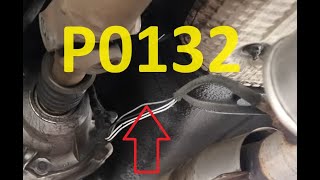
How to confirm: Use a scan tool to monitor the Bank 1, Sensor 1 voltage. 🎬 Watch: Understanding the causes and fixes for the P0132 code. If it is stuck above 0.9V and does not switch rapidly when the engine is warm and at a steady RPM, the sensor has likely failed. A healthy sensor's voltage should fluctuate rapidly.
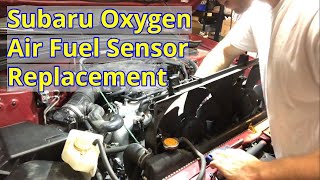
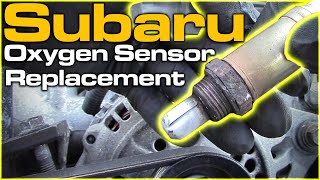
Typical fix: Replace the front (upstream) oxygen sensor. It is located in the exhaust manifold before the catalytic converter. Using a Denso-branded sensor (Part No. 234-9120) is highly recommended 🎬 Watch: A step-by-step guide to replacing the upstream sensor. to prevent the code from returning.
Est. part cost: $150-$220 - Damaged Wiring or Connector ⚪ Low Probability The sensor wiring is routed near hot exhaust components, making it susceptible to melting or physical damage over time. The main connector, located on the passenger side strut tower, can also corrode or have its pins loosen.
How to confirm: Visually inspect the wiring harness from the sensor to the main engine harness on the strut tower. Look for melted insulation, frayed wires, or corrosion in the connector pins. Check for a short to power in the signal wire using a multimeter.
Typical fix: Repair the damaged section of the wiring harness or clean/replace the connector.
Est. part cost: $10-$50
Rare But Worth Checking
- Engine Running Rich: This is a less common cause for P0132 alone, as it would typically be accompanied by other codes like P0172 (System Too Rich). A rich condition can be caused by a leaking fuel injector, faulty fuel pressure regulator, or a malfunctioning Mass Airflow (MAF) sensor. If a new O2 sensor doesn't fix the code, investigate these other possibilities.
- Exhaust Leak: An exhaust leak upstream of or near the O2 sensor can sometimes draw in outside air, confusing the sensor and causing erratic readings that may trigger a high voltage code. This is less likely than a sensor failure but worth checking, especially around the manifold gaskets.
- Faulty Engine Control Module (ECM): This is extremely rare. The ECM itself could have a faulty driver circuit for the O2 sensor. This should only be considered after all other possibilities, including wiring, have been exhaustively ruled out.
- Faulty New Sensor: In some documented cases, a brand new Denso sensor has been faulty out of the box, causing an immediate P0132 code after installation. While rare, it's a possibility if the code appears immediately after a replacement.
Diagnosis Steps
- Verify the code with an OBD-II scanner. Note any other codes present, especially P0172.
- Using the scanner's live data function, monitor the voltage of 'O2 Sensor Bank 1 Sensor 1' with the engine fully warmed up.
- A healthy sensor's voltage should fluctuate rapidly between approximately 0.1V and 0.9V. If the voltage is stuck high (e.g., >0.9V), the sensor is the primary suspect.
- If the sensor appears faulty, perform a visual inspection of the sensor's wiring harness and its connector on the passenger-side strut tower for any signs of melting, corrosion, or damage.
- If the wiring looks good, the most likely cause is the sensor itself. Prepare to replace the front O2 sensor. It is recommended to spray the sensor threads with penetrating oil and let it sit while the exhaust is warm (not hot) to aid removal.
- Use a specialized 22mm (7/8") O2 sensor socket with a slit for the wire to remove and install 🎬 See this walkthrough for removing and installing the sensor. the sensor.
- Replace the sensor with a Denso 234-9120 or equivalent OEM-spec part.
- If replacing the sensor does not resolve the issue, further diagnosis is needed to check for a rich running condition (fuel pressure, injectors) or a short in the wiring harness.
Parts You'll Likely Need
- Front Air/Fuel Ratio Sensor (Oxygen Sensor)
(OEM #22641AA211)— This is the component that fails in the vast majority of P0132 cases on this vehicle.
Trusted brands: Denso (Part #234-9120)
OEM price range: $200-$250
Aftermarket price range: $150-$220
Related Codes That Often Appear With This One
- P0172 — System Too Rich (Bank 1). If the engine is genuinely running rich from another issue (like a bad injector), the O2 sensor will correctly report high voltage (P0132), and the ECU may also set a code for the resulting rich fuel trim.
- P0131 — O2 Sensor Circuit Low Voltage. A failing sensor or intermittent wiring short can cause the voltage to fluctuate wildly, sometimes triggering both high (P0132) and low (P0131) codes.
Technical Service Bulletins (TSBs) & Recalls
- WXW-80: While not a recall, Subaru issued this service program for certain models because the front oxygen (A/F) sensor element could develop a crack, leading to a Check Engine Light. This acknowledges a known weakness in the sensor's design or manufacturing.
Platform-Specific Known Issues
- Real-world repair story: A user on subaruoutback.org reported replacing a sensor that was causing a P0131 code with a new Denso 234-9123, which immediately triggered a P0132 code. The issue was resolved by replacing the brand-new, but faulty, sensor with another new Denso part, confirming that even quality parts can occasionally be bad from the factory.
Mechanic-Grade Diagnostic Values
- Front A/F Sensor (B1S1) Voltage — expected: Rapidly fluctuating between ~0.1V and 0.9V when in closed loop.. Failure: Stuck high, consistently above 0.9V, for P0132.
- A/F Sensor Heater Circuit Resistance — expected: Approximately 2 Ω.. Failure: A significantly higher reading (open) or near zero (short) indicates a failed heater circuit.
- A/F Sensor Element Resistance — expected: 1-3 kΩ (when testing across sensor leads, disconnected).. Failure: Values outside this range suggest a shorted or open sensor element.
- Mass Air Flow (MAF) Sensor at Warm Idle — expected: ~1.5 g/s ±0.3 g/s.. Failure: A significantly different reading could indicate a MAF issue causing a true rich/lean condition that the O2 sensor is correctly reporting.
- Alternator AC Ripple Voltage — expected: Less than 0.5V (500mV), ideally less than 0.1V (100mV).. Failure: Excessive AC ripple voltage (e.g., over 1V) can introduce electrical noise into the system, potentially causing the ECU to misinterpret the O2 sensor signal as high voltage.
Hidden / Shadow Codes Worth Checking
- Mode 6, Test ID $84: This test monitor relates to O2 Sensor Circuit Slow Response. While not a DTC, failing values in Mode 6 can indicate a sensor is becoming lazy or failing before a code is set. It measures the time for the sensor to switch from lean-to-rich and rich-to-lean. (see via An advanced OBD-II scan tool capable of displaying Mode 6 test results.)
Scan Tool Commands That Help
- Subaru Select Monitor (SSM): Current Data Display & Save — Use this to view manufacturer-specific PIDs not available on all generic scan tools, such as 'A/F Sensor #1 Current (mA)' and 'A/F Sensor #1 Resistance (ohm)'. These provide more detailed insight into the sensor's performance beyond just voltage.
Wiring & Ground Locations
- Front O2 Sensor Connector (E23) — On the passenger side of the engine bay, mounted to the strut tower, near the power steering pump and upper radiator hose. It is a black plug connecting to the grey harness-side connector.. This is the primary connection point to inspect for corrosion, backed-out pins, or damage when diagnosing a P0132 that isn't solved by a sensor replacement.
- Harness Chafe Point — Inspect the wiring harness as it routes along the right-side (passenger) fender liner towards the front passenger wheel arch.. This area is susceptible to rubbing and road debris, which can wear through the insulation and cause a short to power on the signal wire, leading to a constant high voltage reading.
Real Owner Repair Stories
- LegacyGT.com forum user (Subaru Legacy GT (similar EJ25 engine and ECU logic)) — Initially had a P0131 (Low Voltage), then after a repair, got a persistent P0132 (High Voltage).
❌ Tried (didn't work) Replacing the original sensor with a universal 4-wire Bosch sensor.
✅ What actually fixed it The consensus from experienced users was that the P0132 was caused by the non-OEM, universal sensor. The fix is to replace the universal sensor with a proper OEM-style Denso or NTK sensor.
OEM Part Supersession History
22641AA211→22641AA32A, 22641AA490, 22641AA450— Standard part revisions and consolidation over time.
Heads up: While these part numbers are listed as interchangeable for the application, always confirm fitment with the vehicle's VIN. The critical factor remains using a Denso or genuine Subaru sensor, regardless of the specific part number revision.
Model Year Variations Within This Range
- 2008: Some 2008 models are PZEV (Partial Zero Emissions Vehicle) certified. While the P0132 diagnosis is fundamentally the same, these vehicles may have different ECU programming or catalytic converter designs to meet stricter standards. This is unlikely to change the fix (replace the sensor) but is a notable difference.
Diagnostic Flowchart
Other Known Issues on This Vehicle
Issues unrelated to this code that are worth knowing about as an owner of this generation:
- Head Gasket Failure 🔴 High — Very common, especially on the naturally aspirated EJ25 engine between 100,000 and 150,000 miles. Typically presents as external oil and/or coolant leaks. (Ref: Subaru addressed this in later engine designs but no recall was issued for this generation. A coolant conditioner was recommended by dealers to slow leaks.)
- Excessive Oil Consumption 🟠 Medium — Common at higher mileage. Some owners report needing to add a quart of oil every 1,000-2,000 miles. This is partly attributed to piston ring design.
- Clogged Banjo Bolt Filters (Turbo Models) 🔴 High — On turbo models (Forester XT), small mesh filters in the banjo bolts for the AVCS and turbo oil feed lines can clog, leading to oil starvation and catastrophic turbo failure. (Ref: Multiple TSBs for later models recommend removing the filters entirely as a preventative measure.)
- Catalytic Converter Failure 🟠 Medium — Failures leading to a P0420 code are frequently reported at higher mileage. (Ref: A service bulletin (09-110-23) exists for diagnosing P0420, though it doesn't indicate a specific component flaw.)
Used vs. New Parts: Buying Guide for This Vehicle
When a used part is the smart pick: Almost never for the oxygen sensor itself. It is a wear-and-tear component with a finite lifespan. The cost savings of a used sensor are not worth the high risk of it being faulty or failing shortly after installation. A used wiring harness pigtail could be a viable option if only the connector is damaged.
What to inspect on the donor part:
- If sourcing a connector pigtail, ensure the wiring is not brittle, the insulation is not cracked, and the connector housing is not broken or melted.
- Look for a donor vehicle that has not been in a front-end collision.
OEM-only on this vehicle (don't cheap out):
- Front Air/Fuel Ratio Sensor (Oxygen Sensor)
Aftermarket brands forum-validated for this vehicle:
- Denso (OEM manufacturer)
- NTK (NGK)
Brands owners have reported issues with on this vehicle:
- Bosch (specifically universal-fit types)
- Generic unbranded or 'white box' sensors
Real Owner Stories
Aggregated from forums and TSBs cited above. Mileages and costs reflect what owners reported in those sources.
2005 Subaru Outback 2.5i
Symptoms: Check Engine Light with code P0132 appeared immediately after replacing the front A/F sensor to fix a P0131 code.
What fixed it: Realized the brand new Denso sensor was faulty out of the box. Installing a second new Denso sensor resolved the issue.
Cost: $120-$150
Source hint: subaruoutback.org thread 'P0131 and now P0132' via Go-Parts article
2009 Subaru Legacy
Symptoms: Initially had a P0131 (Lean) code, then after a repair, got a P0132 (Rich) code that would not clear.
What fixed it: Replacing the universal, non-OEM Bosch sensor with an OEM-style Denso sensor.
Source hint: LegacyGT.com thread titled 'DTC P0132 - Diagnostic procedure'
Related OBD-II Codes
Frequently Asked Questions
Which brand of front oxygen sensor should I use for my 2003-2008 Forester to ensure the P0132 code doesn't return?
Is there a specific Subaru service program related to front oxygen sensor failures on these models?
Where is the front oxygen sensor located on the EJ25 engine, and do I need special tools?
Can a brand new sensor cause a P0132 code immediately after installation?
Why is my cruise control light flashing along with the Check Engine Light for P0132?
Where should I check for wiring damage if the sensor itself isn't the problem?
Helpful Videos
We Have This Part in Stock


The information in this article is provided for general reference and educational purposes only. Vehicle specifications, procedures, and part compatibility can vary by production date, trim level, and region. Always consult your vehicle's factory service manual and verify part numbers before purchasing or performing repairs. Safety-critical components such as airbags, seat belts, and braking systems should be installed by a qualified professional.
- Subaru Forester:
- 🎬 Helpful Videos
- 🛍️ Shop This Part
- What's Unique About the 2003-2008 Subaru Forester
- Symptoms You May Notice
- Most Likely Causes
- Rare But Worth Checking
- Diagnosis Steps
- Parts You'll Likely Need
- Related Codes That Often Appear With This One
- Technical Service Bulletins (TSBs) & Recalls
- Platform-Specific Known Issues
- Mechanic-Grade Diagnostic Values
- Hidden / Shadow Codes Worth Checking
- Scan Tool Commands That Help
- Wiring & Ground Locations
- Real Owner Repair Stories
- OEM Part Supersession History
- Model Year Variations Within This Range
- Diagnostic Flowchart
- Other Known Issues on This Vehicle
- Used vs. New Parts: Buying Guide for This Vehicle
- Real Owner Stories
- 2005 Subaru Outback 2.5i
- 2009 Subaru Legacy
- Related OBD-II Codes
- Frequently Asked Questions
- 🎟️ Get 5% Off