

OBD-II Code P0129: Barometric Pressure Too Low
What P0129 means, why it triggers, and how to fix it
- Code P0129 indicates the Powertrain Control Module (PCM) detects impossibly low atmospheric pressure, almost always caused by a failed MAP/BARO sensor or a broken vacuum hose.
- Expect a 10% to 25% drop in fuel economy, rough idling, and sluggish acceleration because the engine defaults to a rich fuel mixture.
- Verify the sensor's 5-volt reference and ground wires with a multimeter before spending $40 to $150 on a replacement MAP sensor.
- Repair this issue within 14 days to prevent the rich fuel mixture from melting the catalytic converter, which escalates a $100 repair into a $2,000 exhaust system replacement.
What Does P0129 Mean?

Code P0129 means the Powertrain Control Module (PCM) receives a signal indicating atmospheric air pressure is impossibly low. The engine requires accurate air pressure data to calculate the correct air-fuel mixture and adjust for altitude. When the PCM receives a low-voltage reading, it defaults to a rich fuel mixture (excess fuel) to prevent engine lean-out, causing sluggish performance and poor fuel economy.
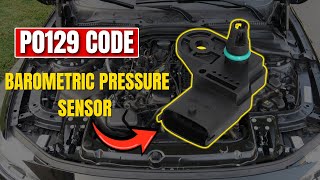
Technical definition: The SAE/OBD-II definition is "Barometric Pressure Too Low. 🎬 Watch: A complete breakdown of P0129 and how to fix it." The PCM detects the signal from the Barometric Pressure (BARO) or Manifold Absolute Pressure (MAP) sensor falls below the manufacturer's specified range (e.g., below 2.2 volts) during the key-on/engine-off (KOEO) self-test.
Can I Drive With P0129?

Yes, But With Caution. Yes, you can drive your car for short distances, but it is risky. The engine runs on an incorrect, rich fuel mixture, causing poor performance, a 10-25% drop in fuel economy, and stalling. The rich condition overheats and permanently damages the catalytic converter, a repair costing $900 to $2,500+. Diagnose and repair the issue within a week to avoid expensive secondary failures.
Common Causes

- Faulty Manifold Absolute Pressure (MAP) or Barometric Pressure (BARO) Sensor (Very Common) — The sensor measuring air pressure fails internally, gets contaminated with oil, or wears out, sending a constant low-voltage signal to the PCM.
- Wiring or Connector Issues (Common) — Damaged, frayed, or corroded wires cause a voltage drop. A bad connection at the sensor's plug mimics a low-pressure reading and is frequently misdiagnosed as a bad sensor.
- Vacuum or Boost Leaks (Common) — Cracked PCV hoses, leaking intake manifold gaskets, or loose turbocharger intercooler pipes cause a massive loss of vacuum or boost, triggering the code.
- Restricted Air Intake (Less Common) — A severely clogged engine air filter or carbon buildup in the throttle body restricts airflow, creating an artificial vacuum condition that skews the MAP sensor reading.
- Clogged Catalytic Converter (Less Common) — A restricted catalytic converter creates excessive exhaust backpressure. This disrupts the engine's ability to draw in air, reducing engine vacuum and dropping the MAP sensor reading below the expected range.
- Faulty PCM or Internal BARO Sensor (Rare) — On vehicles like Subarus, the BARO sensor is integrated inside the PCM. If this internal sensor fails, the entire PCM requires replacement.
Symptoms

- Check Engine Light is On — The primary indicator. The light flashes if the rich condition causes severe engine misfires.
- Poor Engine Performance and Hesitation — The vehicle feels sluggish, stumbles, or hesitates when accelerating from a stop.
- Reduced Fuel Economy — Fuel consumption increases by 10% to 25% because the engine defaults to a rich fuel strategy.
- Rough or Unstable Idle — The engine shakes, idles erratically, or stalls at stoplights.
- Black Smoke from Exhaust — Unburned fuel exits the tailpipe, indicating a severely rich air-fuel mixture.
- Hard Starting — The engine requires extended cranking times due to flooded cylinders.
Diagnostic Flowchart
Tap your situation to follow the diagnostic path that matches what you're seeing on this code.
Common Fixes & Costs
- Replace MAP/BARO Sensor
— Parts: $40-$150, Labor: $50-$100, ~0.5 hr book time
(DIY)
Dodge Ram 1500 (2004-2013): OEM [{'brand': 'Mopar', 'part_number': '56041018AD'}] (Alt: {"brand": "Bosch", "part_number": "0261230180"})
Subaru WRX (2002-2014): OEM [{'brand': 'Subaru/Denso', 'part_number': '22627AA210'}] (Alt: {"brand": "Bosch", "part_number": "0261230232"})
Ford F-150 (2004-2011): OEM [{'brand': 'Motorcraft', 'part_number': 'CX-2228'}] (Alt: {"brand": "Bosch", "part_number": "0261230295"}) - Repair Wiring or Connector — Parts: $5-$30, Labor: $120-$250, ~1.5 hr book time (Professional)
- Repair Vacuum or Boost Leak
— Parts: $10-$60, Labor: $100-$300, ~1.5 hr book time
(Intermediate)
Dodge Ram 1500 (2002-2008): OEM [{'brand': 'Mopar', 'part_number': '53032922AC'}] (Alt: {"brand": "Dorman", "part_number": "46021"}) - Clean Throttle Body & Replace Air Filter — Parts: $20-$40, Labor: $75-$150, ~0.8 hr book time (DIY)
- Replace Clogged Catalytic Converter — Parts: $300-$2,500, Labor: $150-$300, ~2 hr book time (Professional)
- Replace Powertrain Control Module (PCM) — Parts: $800-$1,500, Labor: $150-$300, ~1.5 hr book time (Professional)
DIY vs Professional
- Replace MAP/BARO Sensor — Beginner: yes
Tools: Basic socket set or screwdriver. - Repair Vacuum Leak — Beginner: yes
Tools: Pliers, screwdriver, flashlight. A smoke machine is highly recommended for finding non-obvious leaks. - Clean Throttle Body — Beginner: yes
Tools: Throttle body cleaner, rags, basic hand tools to remove the air intake tube. - Repair Wiring or Connector — Beginner: no
Tools: Multimeter, wire strippers, crimpers, soldering iron, heat shrink tubing. - Replace Catalytic Converter — Beginner: no
Tools: Vehicle lift, reciprocating saw, welder, specialty exhaust tools, safety gear. - Replace Powertrain Control Module (PCM) — Beginner: no
Tools: Advanced scan tools for programming, socket set.
Used vs. New Parts: Buying Guide
When a used part is worth it: For a MAP/BARO sensor, buying new is mandatory due to the low cost and high reliability of new parts. A used catalytic converter from a low-mileage vehicle (<80k miles) is a cost-effective option, but carries legal and longevity risks.
Donor-vehicle mileage cap: roughly under 80000 miles for the part to have meaningful remaining life.
Donor quality checklist:
- Verify the donor vehicle was not scrapped for emissions-related failures.
- Match the part number exactly; visual similarities do not guarantee compatibility.
- Avoid parts from regions with heavy road salt usage to prevent housing corrosion.
Decision logic:
- If The part is a MAP/BARO sensor → Buy new. The cost savings for a used sensor are minimal and not worth the risk of premature failure.
- If The part is a catalytic converter and the vehicle is over 150,000 miles → A used converter from a verified low-mileage donor saves money, but reduces remaining lifespan.
- If The vehicle must meet strict CARB (California) emissions standards → Purchase a new, CARB-compliant catalytic converter. Installing a used one is illegal and fails the smog test.
Warranty tradeoff: Used parts typically come with a 30-90 day warranty. New aftermarket parts offer a 1-year to limited lifetime warranty. New OEM parts carry a 1-2 year warranty.
Worst-case if a used part fails: $300-$600 if a used part fails shortly after installation, accounting for repeat labor costs and the price of another replacement part.
What Happens If You Wait — Timeline
- 0-2 weeks: Check Engine Light illuminates. You notice a slight drop in fuel economy or minor hesitation when accelerating. (MPG impact: 5-10%% · Added cost: $0-$40 in wasted fuel.)
- 2 weeks - 3 months: Engine performance worsens. Rough idle, stalling at stops, and a 10-25% drop in MPG occur. The rich fuel mixture stresses the catalytic converter. (MPG impact: 10-25%% · Added cost: $50-$200 in wasted fuel.)
- 3-6 months: The catalytic converter sustains permanent damage. Excess unburned fuel overheats the catalyst substrate, causing it to melt. You notice a rotten egg smell or reduced engine power. (MPG impact: 20-30%% · Added cost: $1,000-$2,500 for a catalytic converter replacement.)
- 6+ months: Catastrophic failure of the catalytic converter blocks the exhaust, preventing the engine from running. Spark plugs and O2 sensors foul with carbon. (MPG impact: 30-50%+% · Added cost: $1,500-$4,000+ to replace the catalytic converter, O2 sensors, and fouled spark plugs.)
Cost of Not Fixing It
- 0-1 month: Noticeable decrease in fuel economy (10-25% drop), poor acceleration, and rough idling. Potential for stalling. (Added cost: $50-$150 in wasted fuel.)
- 1-6 months: The continuous rich fuel mixture overheats and damages the catalytic converter, leading to irreversible failure. O2 sensors become fouled. (Added cost: $1,200-$3,500 for catalytic converter and O2 sensor replacement.)
- 6+ months: Severe damage to the catalytic converter blocks the exhaust. The engine suffers from fouled spark plugs and carbon buildup, leading to misfires. (Added cost: $2,000-$4,000+ to cover the catalytic converter, O2 sensors, spark plugs, and engine cleaning services.)
Diagnosis Steps

- Check for Other Trouble Codes
Use an OBD-II scanner to check for MAP sensor circuit codes (P0106, P0107, P0108) or misfires (P0300 series). Address circuit codes first, as they pinpoint electrical faults.
Tools: OBD-II Scanner (Beginner) - Check Live Sensor Data (KOEO)
With Key On, Engine Off (KOEO), view the MAP/BARO sensor PID on a scanner. The reading must match your local atmospheric pressure (e.g., ~14.7 psi or 101 kPa at sea level). A discrepancy greater than 5 kPa (0.7 psi) confirms a sensor, wiring, or PCM fault.
Tools: OBD-II Scanner with Live Data (Intermediate) - Perform a Visual Inspection
Inspect the wiring harness at the MAP/BARO sensor for frayed wires or corrosion. Check for disconnected or collapsed vacuum hoses around the intake manifold and PCV system.
Tools: Flashlight (Beginner) - Test the Sensor's Electrical Circuit
Unplug the sensor and probe the connector with a multimeter (Key On, Engine Off). Verify a 5-volt reference signal from the PCM, a solid ground (near 0V), and continuity on the signal wire. Missing voltage indicates a wiring harness or PCM failure.
Tools: Multimeter (Advanced) - Test for Vacuum Leaks with a Smoke Machine
Connect a smoke machine to a vacuum port on the intake manifold. Smoke escaping from hoses, gaskets, or the throttle body base pinpoints hidden leaks altering the pressure reading.
Tools: Smoke Machine (Intermediate) - Test Sensor Response
Back-probe the signal wire with the sensor plugged in (KOEO). Voltage should read 4.5-5.0V. Apply vacuum using a hand pump; voltage must drop smoothly (e.g., 1.0-1.5V at 20 inHg). Erratic drops mean the sensor is dead.
Tools: Multimeter, Hand-held Vacuum Pump, Back-probe kit (Advanced) - Check for Exhaust Restriction
Remove the upstream O2 sensor and install a backpressure gauge. Pressure exceeding 1.25 PSI at idle or 3 PSI at 2,500 RPM confirms a clogged catalytic converter.
Tools: Backpressure Gauge, O2 Sensor Socket (Advanced)
When This Code Triggers (Freeze-Frame Conditions)
- Engine Coolant Temp: 175-210°F (Engine at full operating temperature.)
- RPM: 0 (Code sets during the Key-On, Engine-Off (KOEO) self-test before startup.)
- Engine Load: N/A (Not applicable if set during KOEO. If set while running, it occurs during low-load or idle.)
- Vehicle Speed: 0 mph (Occurs when the vehicle is stationary as the PCM compares the BARO reading to an expected range at startup.)
Related Codes
- P0107 — Manifold Absolute Pressure/Barometric Pressure Circuit Low Input. P0107 sets when the PCM sees a voltage signal near zero (below ~0.5V), indicating an electrical short to ground or a dead sensor. P0129 indicates the pressure is low, but the voltage is still within a plausible (though incorrect) range.
- P0106 — Manifold Absolute Pressure/Barometric Pressure Circuit Range/Performance. P0129 indicates the pressure is stuck reading too low. P0106 indicates the pressure reading is erratic or doesn't correlate with throttle position and engine RPM.
- P0108 — Manifold Absolute Pressure/Barometric Pressure Circuit High Input. P0108 means the signal voltage is too high (stuck at 5 volts), indicating an open signal wire or a short to the 5V reference. Seeing both P0129 and P0108 intermittently suggests a loose, corroded connector.
- P0300-P0308 — Random or Specific Cylinder Misfire. Misfire codes are a symptom of P0129. The low-pressure reading causes a rich air-fuel mixture, fouling spark plugs and leading to incomplete combustion. Fix P0129 first to resolve the misfires.
Climate & Environmental Factors
- High Humidity: Prolonged exposure to high humidity accelerates corrosion on the MAP sensor's electrical connector pins. This corrosion increases electrical resistance, dropping the voltage signal and triggering P0129.
- Extreme Cold: Very cold temperatures cause plastic and rubber components, such as vacuum hoses and intake snorkels, to become brittle. This increases the likelihood of cracking, creating vacuum leaks.
How to Talk to a Mechanic About This Code
Say this: "I have a P0129 code and I'd like to schedule a diagnostic. Please check the live MAP/BARO sensor reading with the key on and engine off, and perform a smoke test to check for vacuum leaks before recommending part replacements."
This directs the mechanic to perform logical diagnostic steps first. It prevents them from blindly replacing the MAP sensor and pushes them to prove if the fault is the sensor, a vacuum leak, or wiring.
Avoid saying:
- 'Just fix whatever's wrong'
- 'My check engine light is on, can you look at it?'
- 'My car is running rough, I think it needs a new sensor'
Questions to ask before authorizing the repair:
- What was the MAP sensor's pressure reading in psi or kPa with the key on and engine off?
- Did the smoke test show any vacuum leaks? If so, can you show me the leaking component?
- If you recommend a sensor replacement, did you confirm it has a good 5-volt reference and ground at the connector?
- What is the warranty on this repair, for both parts and labor?
Where to Take It: Dealer vs Independent vs Chain
- Dealer:
Best for: Vehicles still under powertrain or emissions warranty, Complex manufacturer-specific quirks (e.g., PCM replacement and programming), Recalls and Technical Service Bulletin (TSB) related work
Downsides: Highest labor rate (1.5-2x vs. independent), Recommends replacing entire assemblies when a smaller component fails (Typical cost: +50% vs. baseline) - Independent Shop:
Best fit. A reputable independent shop is well-equipped to diagnose and repair the common causes of P0129 (bad sensor, vacuum leaks, wiring) at a reasonable cost.
Best for: Out-of-warranty vehicles where cost is a factor, Common diagnostic trouble codes like P0129, Building a long-term relationship with a mechanic
Downsides: Quality and expertise vary widely; vet shops by reviews and ASE certifications, Lacks access to the latest manufacturer-specific software (Typical cost: +0% vs. baseline) - Chain Shop:
Avoid for diagnosis. Acceptable only if you have already diagnosed a faulty MAP sensor yourself and just need a simple replacement.
Best for: Simple, routine services like oil changes, tires, and battery replacement
Downsides: High potential for upselling unnecessary services, Technician skill and experience are inconsistent, Lacks advanced diagnostic equipment for complex electrical issues (Typical cost: -10% vs. baseline)
When to Walk Away From the Repair
If the estimated repair cost exceeds 50% of the car's current private-party value, strongly consider selling or trading in the vehicle instead of repairing it.
- Car worth $4000, fix is $2200: Walk away. The repair cost is 55% of the car's value. It is not a sound financial decision.
- Car worth $12000, fix is $1800: Fix it. The repair cost is only 15% of the car's value, well below the threshold.
- Car worth $3000, fix is $200: Fix it. A simple sensor or vacuum hose replacement is a minor cost to keep an otherwise functional car on the road.
What Scan Tool You Need for This Code
Minimum: A scanner that reads and graphs live data PIDs, specifically for the MAP sensor. A basic reader that only provides the P0129 code is insufficient.
A $20 code reader only confirms the code is present. Diagnosing P0129 requires viewing live pressure and voltage readings to determine if the fault is mechanical (vacuum leak) or electrical (wiring).
Budget: BlueDriver Pro (~$99) — Connects to your smartphone via Bluetooth. It reads and clears codes, views freeze-frame data, and graphs live sensor data to watch the MAP sensor's behavior.
Mid-range: Innova 5610 or Foxwell NT510 Elite (~$150) — Handheld units offering live data, freeze frame, and manufacturer-specific codes. Includes limited bidirectional controls for advanced diagnostics.
Professional: Autel MaxiCOM MK808 (~$450) — A professional tablet scanner providing full bidirectional control, extensive live data graphing, and OEM-level diagnostic functions.
Rent vs buy: Auto parts stores offer free code scanning, but diagnosing P0129 requires live data. Buying a capable scanner like the BlueDriver costs less than a one-hour diagnostic fee at a shop, making it a smart investment.
How to Clear the Code After You Fix It
- Use an OBD-II scan tool to erase the P0129 trouble code.
- If the battery was disconnected, reconnect it.
- Perform a complete drive cycle to allow the readiness monitors to run.
Drive cycle (~20 minutes): Start the engine and let it idle for 2-3 minutes. Drive in mixed city/highway conditions, including steady cruising between 40-60 mph for at least 10 minutes. Perform several smooth accelerations and decelerations. Allow the vehicle to idle for another 2-3 minutes before shutting down.
Readiness monitors affected: Catalyst (CAT) Monitor, Evaporative System (EVAP) Monitor, Oxygen (O2) Sensor Monitor
Before emissions retest: drive at least 50 miles to fully set monitors.
Watch out for:
- Disconnecting the battery clears the Check Engine Light but resets readiness monitors, causing an automatic emissions test failure.
- If a vacuum leak is not fully repaired, the code returns within the first few drive cycles.
Will This Fail Emissions / State Inspection?
Yes — this code typically fails an OBD-II emissions inspection.
- California: A P0129 code results in an automatic smog check failure. All OBD-II readiness monitors must be set to 'Ready' before a re-test, requiring 50-100 miles of driving after repairs. Installing a used catalytic converter is illegal.
- New York: The presence of a P0129 code causes an immediate failure of the NYS emissions inspection. The Check Engine Light must be off and readiness monitors must be set.
- Texas: In the 17 counties requiring emissions testing, a vehicle with an active P0129 code fails the OBD-II portion of the inspection.
Manufacturer-Specific Notes
- Dodge/Chrysler/Jeep: Interrupting the ignition sequence (turning the key off mid-crank) temporarily confuses the sensor logic and sets a P0129 code. Clearing the code with a scanner or resetting the PCM resolves it if there is no underlying fault.
- Dodge (Hemi V8): A failing CRANKSHAFT position sensor causes a P0129 code to appear alongside P0340 (camshaft sensor). This is due to a shared 5v reference circuit in the PCM. Investigate the crankshaft sensor before replacing the MAP sensor.
- Vehicles with Superchargers/Turbochargers: Forced induction systems are highly sensitive to air pressure. A leak in the pressurized intake tract (hoses, intercooler, blow-off valve) causes this code. A smoke test on the intake system is critical.
- General Motors (GM): A faulty thermostat stuck open leads to a P0128 code, accompanied by P0129. The PCM uses coolant temperature for its rationality check of the BARO reading. An engine failing to reach operating temperature triggers P0129.
Real Owner Stories
2006 Dodge Ram 1500 5.7L Hemi stalls at intersection
Truck stalled at a stoplight. ETC (lightning bolt) and Check Engine lights illuminated. The truck restarted but ran erratically.
What they tried:
- Read code P0129.
- Cleaned the throttle body based on a YouTube video.
- The truck ran fine for a short drive, but the problem returned after a restart.
Outcome: The owner found forum discussions pointing to an interrupted key crank sequence confusing the sensor. After cleaning the throttle body failed, testing the sensor wiring revealed a corroded connector pin. Replacing the connector pigtail fixed the issue.
Lesson: If cleaning the throttle body and resetting the PCM fails, a faulty MAP sensor connector is the next likely culprit. Always check the pins for green corrosion.
2002 Dodge Intrepid 3.5L with stalling and RPM fluctuations
Car stalled at stops, RPMs surged, and performance was poor. The Check Engine Light illuminated with code P0129.
What they tried:
- A transmission shop incorrectly suggested replacing an O2 sensor.
- The owner researched P0129 and suspected the MAP sensor.
Outcome: The owner replaced the MAP sensor for $89 from a local auto parts store. This resolved all symptoms, including stalling and erratic RPMs.
Lesson: Do not assume secondary suggestions (like an O2 sensor) are correct when P0129 points strongly toward the MAP/BARO circuit. The MAP sensor is a common failure point and an inexpensive first repair after visual checks.
Dodge Ram 5.7L Hemi with crank-no-start and codes P0129 & P0340
The truck cranked but did not start. It threw codes P0129 (Barometric Pressure) and P0340 (Camshaft Position Sensor).
What they tried:
- Owner read forum posts where others replaced the MAP and Camshaft sensors without success.
- Tested the 5-volt reference wire at the CAM sensor and found a constant 5 volts even with the key off, indicating a short.
Outcome: The CRANKSHAFT position sensor was faulty and shorting out internally. Replacing the crankshaft position sensor fixed the truck. The P0129 and P0340 codes were false flags caused by the electrical short.
Lesson: On Hemi engines, P0129 and P0340 together indicate a faulty CRANKSHAFT position sensor. Its failure disrupts the 5-volt reference circuit shared by other sensors. Test the electrical circuit before replacing parts.
How to Prevent This Code From Triggering
- Clean the throttle body (Every 75,000-100,000 miles, or if idle becomes rough.) — Carbon buildup restricts airflow and affects pressure near the MAP sensor. Regular cleaning ensures proper airflow and prevents incorrect readings.
- Inspect and maintain vacuum hoses (Annually during other maintenance.) — Rubber hoses become brittle and crack with age. Checking for softness and cracks prevents the vacuum leaks that cause P0129.
- Keep the engine air filter clean (Check every oil change, replace every 15,000-30,000 miles.) — A clogged air filter restricts incoming air, creating a vacuum that causes the MAP sensor to read an artificially low pressure.
- Inspect MAP sensor connector (Opportunistically (e.g., when changing spark plugs).) — Vibration and heat loosen the electrical connector. Ensuring it is secure and free of corrosion prevents intermittent signal loss.
Frequently Asked Questions
Can I fix P0129 myself?
Yes, you can fix P0129 yourself. Inspecting for vacuum leaks, checking the air filter, cleaning the throttle body, and replacing the MAP/BARO sensor require only basic hand tools. Leave wiring repairs or PCM replacements to professionals.
What's the difference between a MAP and BARO sensor?
A BARO sensor measures atmospheric pressure, while a MAP sensor measures intake manifold vacuum. Modern cars combine these into a single MAP sensor. It reads atmospheric pressure before the engine starts, then switches to measuring manifold pressure while running.
What are the most common mistakes when diagnosing P0129?
The biggest mistake is replacing the MAP/BARO sensor without testing the electrical circuit. Always verify the 5-volt reference and ground wires with a multimeter first. Swapping parts without testing wastes money and ignores underlying wiring faults.
I replaced the MAP sensor, but the code came back. What now?
If a new sensor fails to clear the code, the fault lies in the wiring harness or a hidden vacuum leak. Perform a smoke test to locate intake leaks. If the intake is sealed, test the sensor's signal wire for a short to ground.
My car has a separate BARO sensor, but I can't find it. Where is it located?
The location varies, often mounted on the firewall or inner fender. However, on many modern vehicles (especially Subaru and Chrysler), the BARO sensor is integrated directly into the Powertrain Control Module (PCM). In that case, there is no separate sensor to replace.
Will P0129 clear itself?
No, the Check Engine Light remains illuminated until the underlying problem is repaired. After fixing the issue, clear the code using an OBD-II scanner. The code remains stored in the PCM's history until the vehicle completes several successful drive cycles.
Does driving at high altitude cause a P0129 code?
No, a properly functioning system adjusts for altitude changes without setting a code. P0129 indicates the sensor reports a pressure that is impossibly low for any driving condition, or it failed its key-on self-test.
Key Takeaways
- Code P0129 indicates the Powertrain Control Module (PCM) detects impossibly low atmospheric pressure, almost always caused by a failed MAP/BARO sensor or a broken vacuum hose.
- Expect a 10% to 25% drop in fuel economy, rough idling, and sluggish acceleration because the engine defaults to a rich fuel mixture.
- Verify the sensor's 5-volt reference and ground wires with a multimeter before spending $40 to $150 on a replacement MAP sensor.
- Repair this issue within 14 days to prevent the rich fuel mixture from melting the catalytic converter, which escalates a $100 repair into a $2,000 exhaust system replacement.
Helpful Videos

The information in this article is provided for general reference and educational purposes only. Vehicle specifications, procedures, and part compatibility can vary by production date, trim level, and region. Always consult your vehicle's factory service manual and verify part numbers before purchasing or performing repairs. Safety-critical components such as airbags, seat belts, and braking systems should be installed by a qualified professional.
- 🎬 Helpful Videos
- What Does P0129 Mean?
- Can I Drive With P0129?
- Common Causes
- Symptoms
- Diagnostic Flowchart
- Common Fixes & Costs
- DIY vs Professional
- Used vs. New Parts: Buying Guide
- What Happens If You Wait — Timeline
- Cost of Not Fixing It
- Diagnosis Steps
- When This Code Triggers (Freeze-Frame Conditions)
- Related Codes
- Climate & Environmental Factors
- How to Talk to a Mechanic About This Code
- Where to Take It: Dealer vs Independent vs Chain
- When to Walk Away From the Repair
- What Scan Tool You Need for This Code
- How to Clear the Code After You Fix It
- Will This Fail Emissions / State Inspection?
- Manufacturer-Specific Notes
- Real Owner Stories
- 2006 Dodge Ram 1500 5.7L Hemi stalls at intersection
- 2002 Dodge Intrepid 3.5L with stalling and RPM fluctuations
- Dodge Ram 5.7L Hemi with crank-no-start and codes P0129 & P0340
- How to Prevent This Code From Triggering
- Frequently Asked Questions
- Can I fix P0129 myself?
- What's the difference between a MAP and BARO sensor?
- What are the most common mistakes when diagnosing P0129?
- I replaced the MAP sensor, but the code came back. What now?
- My car has a separate BARO sensor, but I can't find it. Where is it located?
- Will P0129 clear itself?
- Does driving at high altitude cause a P0129 code?
- Key Takeaways
- 🎟️ Get 5% Off