

P0128 on 2001-2011 Mazda Tribute: Coolant Temperature Below Normal, Causes and Fixes
This code almost always means the engine thermostat is stuck open and needs to be replaced. On the 2.3L 4-cylinder, it's a manageable DIY job. On the 3.0L V6, the thermostat is very difficult to access, making professional service a common choice. Expect to pay $30-$80 for an aftermarket part or $90-$150 for an OEM part. Using a high-quality OEM Motorcraft part on the V6 is critical to avoid repeat repairs.
- P0128 on your Tribute means the engine is running too cold, most likely due to a thermostat that's stuck open.
- Symptoms include a low reading on the temperature gauge, poor cabin heat, and worse fuel mileage.
- The required repair is almost always a new thermostat. For the 3.0L V6, this is a difficult job; for the 2.3L 4-cylinder, it is much more DIY-friendly.
- Always use the correct type of engine coolant when refilling the system after the repair to prevent corrosion and other issues.
- Don't replace the coolant temperature sensor unless you have specifically diagnosed it as faulty; the thermostat is the far more likely cause.
What's Unique About the 2001-2011 Mazda Tribute
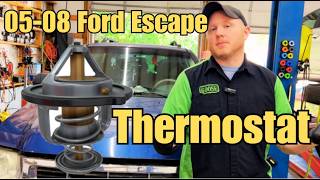
The Mazda Tribute is a rebadged Ford Escape, so parts and repair procedures are identical between the two vehicles. For code P0128, the story is all about which engine you have. On the 2.3L 4-cylinder engine, the thermostat is relatively easy to access and replace. 🎬 Watch: Step-by-step thermostat replacement for the 2.3L 4-cylinder engine. However, on the 3.0L V6 engine, the thermostat is notoriously difficult to reach, as it's buried in the engine 'valley' beneath the intake manifold. This turns a simple part replacement into a labor-intensive job that can take a professional several hours. Because of the high labor cost, it is critical to use a high-quality OEM (Motorcraft) part to avoid a costly repeat repair due to a premature failure of a cheaper aftermarket part.
Generation note: The 2001-2011 year range covers two generations of the Mazda Tribute. The first generation (2001-2007) used the 2.3L L3 engine from 2005-2007 and the 3.0L AJ V6 for the entire run. The second generation (2008-2011) introduced a 2.5L 4-cylinder but continued to use a version of the 3.0L V6. The primary cause and fix for P0128 are consistent across both generations, with the main difference being the extreme difficulty of the thermostat replacement on the 3.0L V6 engine 🎬 See this walkthrough for replacing the difficult 3.0L V6 thermostat. compared to the 4-cylinder models.
Symptoms You May Notice
- Check Engine Light is on
- Engine temperature gauge reads lower than normal or fluctuates
- Heater blows lukewarm or cool air, especially in cold weather
- Noticeable decrease in fuel economy
- Engine fan seems to run constantly or at inappropriate times
- Replacing the Engine Coolant Temperature (ECT) sensor when the thermostat is the actual problem. The thermostat is the most likely culprit, and replacing the sensor first often fails to fix the issue. It's best to diagnose based on live data rather than just replacing parts. 🎬 Watch: A professional mechanic's guide to diagnosing P0128 correctly.
Most Likely Causes
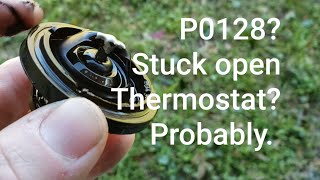
- Engine thermostat stuck open 🔴 High Probability This is the most common failure mode for thermostats on most vehicles, including the Tribute/Escape platform, accounting for over 95% of P0128 cases. The internal wax pellet or spring mechanism wears out over time, failing in the open position, which allows coolant to circulate constantly through the radiator.
How to confirm: Use an OBD-II scanner to monitor the live engine coolant temperature (ECT) data. Start the cold engine and watch the temperature. It should rise steadily to about 190-195°F and stabilize. If it warms up extremely slowly, never reaches full temperature, or drops significantly at highway speeds, the thermostat is stuck open. Another simple test is to feel the upper radiator hose shortly after a cold start; it should remain cool until the engine warms up. If it gets warm along with the engine, the thermostat is open.
Typical fix: Replace the engine thermostat and the housing/gasket as an assembly. The plastic housings are a common failure point and can become brittle and crack over time. Bleed the cooling system of air after the repair.
Est. part cost: $30-$150 - Low engine coolant level 🟡 Medium Probability Coolant leaks can develop over time from hoses, the radiator, water pump, or the plastic thermostat housing itself. If the coolant level is too low, the temperature sensor may be exposed to an air pocket and not get an accurate reading, triggering the code.
How to confirm: Visually inspect the coolant reservoir and radiator (when the engine is cold) to ensure the level is between the 'MIN' and 'MAX' marks. Check for visible signs of coolant leaks (puddles under the car, crusty green or orange residue on engine parts).
Typical fix: Find and repair the source of the leak, then top off or flush and refill the cooling system with the correct type of coolant (Ford Motorcraft Gold or equivalent meeting spec WSS-M97B51-A1).
Est. part cost: $20-$50 for coolant, plus parts for any leak found. - Faulty Engine Coolant Temperature (ECT) Sensor ⚪ Low Probability While less common than a thermostat failure, the ECT sensor can fail and send incorrect readings to the computer, making it think the engine is colder than it is. Manufacturer TSB Bulletin #01-005-20-3704 notes that some vehicles may exhibit a MIL with P0128 where the engine temperature may be cold and report as hot, or be hot and report as cold, which can also affect cooling fan operation.
How to confirm: Watch the live ECT data on a scan tool. If the reading is erratic, jumps around, or shows an illogical value (like -40°F on a warm day), the sensor is likely bad. You can also test the sensor's resistance with a multimeter; at 68°F (20°C), the resistance should be between 2,000 and 3,000 ohms. If the temperature gauge on the dash is completely bottomed out even after some driving, it can point to a failed sensor.
Typical fix: Replace the ECT sensor and ensure the electrical connector is clean and secure. On some Tribute/Escape models, the sensor is removed by pulling a locking tab and rotating it counter-clockwise, as it has a snug, bayonet-style fit.
Est. part cost: $20-$60
Rare But Worth Checking
- Cooling fan stuck on: If the electric cooling fan runs constantly, even when the engine is cold and the A/C is off, it can over-cool the engine and prevent it from reaching operating temperature, triggering a P0128 code. This is usually caused by a failed fan relay or fan control module, which was a known issue on some related Mazda/Ford platforms.
- Wiring issue to ECT sensor: Damaged or corroded wiring or connectors for the ECT sensor can cause incorrect signals to be sent to the PCM, leading to the code.
- PCM Control Logic: While documented on other models like the Mazda3, TSB Bulletin #01-021-13-2817B indicates that some P0128 codes (Thermostat Stuck Open) can be caused by improper control logic of the PCM, which is corrected by updating the software.
Diagnosis Steps
- Verify the code: Use an OBD-II scanner to confirm that P0128 is the active code.
- Check coolant level: With the engine cold, check the coolant level in the overflow reservoir and the radiator. Top off if low and inspect for any obvious leaks.
- Monitor live data: Connect a scan tool and monitor the Engine Coolant Temperature (ECT) PID. Start the engine from cold.
- Observe warm-up time: Watch the ECT reading. The engine should reach its operating temperature (around 190-195°F or 88-91°C) within 10-15 minutes of driving.
- Test drive: If the temperature rises very slowly, never reaches the target range, or drops significantly when driving at highway speeds (e.g., drops from 190°F to 160°F), the thermostat is almost certainly stuck open and needs replacement.
- Inspect ECT sensor reading: If the temperature reading on the scan tool is erratic, nonsensical (e.g., -40°F), or never changes from its cold reading, suspect a faulty ECT sensor or wiring.
- Check cooling fan: Ensure the cooling fan is not running constantly from the moment the cold engine is started. It should only turn on when the engine gets hot or the A/C is on.
Parts You'll Likely Need
- Engine Coolant Thermostat & Housing Assembly
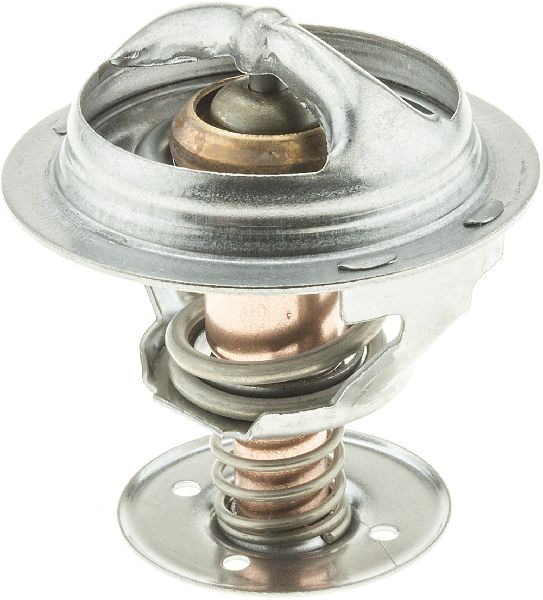
(OEM #L336-15-170 (for 2.3L/2.5L), YL8Z-8592-AB / Motorcraft RH-124 (for 3.0L, early models 2001-2004))— This is the root cause in over 95% of P0128 cases. The thermostat fails in the open position, preventing the engine from warming up correctly. Replacing the whole assembly is highly recommended because the original plastic housing becomes brittle and is a common source of leaks.
Trusted brands: Motorcraft (OEM), Gates, Dorman, Stant
OEM price range: $90-$150
Aftermarket price range: $30-$80 - Engine Coolant Temperature (ECT) Sensor — A less common but possible cause. If the sensor fails, it can send incorrect temperature data to the computer. It's often replaced as a precaution if the thermostat replacement doesn't solve the issue.
Trusted brands: Motorcraft, Bosch, NTK
OEM price range: $40-$70
Aftermarket price range: $20-$50 - Engine Coolant / Antifreeze
(OEM #Motorcraft Gold Concentrated Antifreeze/Coolant (VC-7-B))— The cooling system must be drained to replace the thermostat. It's critical to refill with the correct coolant type to prevent corrosion and system damage. The specified coolant is Motorcraft Gold or an equivalent meeting Ford specification WSS-M97B51-A1.
Trusted brands: Motorcraft, PEAK (Gold), Prestone
OEM price range: $25-$35 per gallon
Aftermarket price range: $20-$30 per gallon
Platform-Specific Known Issues
- The thermostat replacement on the 3.0L V6 engine is significantly more difficult and labor-intensive than on the 2.3L 4-cylinder engine due to its location under the intake manifold. This high labor cost makes it crucial to use a high-quality OEM part to avoid premature failure and having to do the job again. Many owners on forums who used cheaper parts reported failures soon after, forcing a repeat of the expensive repair.
Mechanic-Grade Diagnostic Values
- Engine Coolant Temperature (ECT) Sensor Resistance — expected: Approximately 2,000 to 3,000 ohms at 68°F (20°C).. Failure: A reading of infinite resistance (open circuit) or very low resistance (short circuit) indicates a failed sensor.
- Engine Coolant Temperature (ECT) Sensor Voltage (at sensor connector) — expected: Approximately 3.00 Volts at 71°F (22°C). The voltage should decrease as the engine warms up.. Failure: Voltage that is stuck high (e.g., 5.0V) or low (0V), or does not change as the engine temperature changes, points to a sensor or wiring issue.
- Cylinder Head Temperature (CHT) Sensor Resistance (V6 models) — expected: Approximately 302 ohms at 182°F (83°C) and 175 ohms at 212°F (100°C).. Failure: Readings significantly outside the expected range for a given temperature suggest a faulty CHT sensor.
- PCM Logic: Cold Soak Temperature Comparison — expected: After the vehicle has sat overnight (cold soak), the Intake Air Temperature (IAT) and Engine Coolant Temperature (ECT) sensor readings should be within a few degrees of each other before starting the engine.. Failure: A significant difference between the IAT and ECT readings on a cold engine points to a faulty sensor providing an incorrect baseline reading to the PCM.
Scan Tool Commands That Help
- Ford IDS / ForScan: Live Data PID Monitoring (ECT, CHT, IAT) — This is the primary diagnostic function. Use it to monitor the Engine Coolant Temperature (ECT) or Cylinder Head Temperature (CHT) from a cold start. Compare the ECT/CHT reading to the Intake Air Temperature (IAT) reading after an overnight cold soak; they should be within a few degrees of each other. A significant discrepancy points to a faulty sensor before the engine is even started.
Wiring & Ground Locations
- G102, G103, G104 — Located in the engine compartment at the front of the vehicle. G102 and G103 are on the right (passenger) side, while G104 is on the left (driver) side.. These are primary ground points for the engine harness, which includes the wiring for the ECT sensor and other engine management components. A corroded or loose ground at one of these locations can cause erratic sensor readings, potentially leading to a false P0128 code.
- ECT Sensor Connector — On the 2.3L, it's on the thermostat housing. On the 3.0L V6, it's typically on the rear of the right cylinder head or on the thermostat housing itself, depending on the year.. The connector itself can become loose or the locking tab can break, leading to a poor connection that mimics a sensor failure. Wiggling this connector while watching live data can help diagnose an intermittent connection.
Real Owner Repair Stories
- escape-city.com forum user (2008 Ford Escape 3.0L V6) — Check Engine Light with code P0128. Temperature gauge was reading low.
❌ Tried (didn't work) Initially none, the first repair attempted was the correct one.
✅ What actually fixed it Replacing the thermostat and housing assembly fixed the code. The user noted the extreme difficulty of the job on the V6, requiring removal of the upper and lower intake manifolds to access the thermostat located in the engine valley. - North American Motoring forum user (MINI Cooper (different vehicle, but identical code behavior)) — P0128 code returned immediately after replacing the thermostat.
❌ Tried (didn't work) Replacing the thermostat assembly.
✅ What actually fixed it The electrical connector to the temperature sensor on the new thermostat housing was not fully seated. The locking clip was loose, causing the connector to back out. Pushing the connector on firmly until it clicked resolved the code.
When the Usual Fixes Don't Work
- In some cases, even after a thermostat replacement, the P0128 code can persist. The most common reason for this is either a defective new part (especially with low-quality aftermarket brands) or an unseated electrical connector on the ECT sensor. Before suspecting a more complex issue, it is crucial to verify the connection is secure and that an OEM or reputable aftermarket thermostat was used. If the problem continues, the next step should be to test the ECT sensor and its wiring circuit for correct resistance and voltage, as a wiring fault could be the underlying cause.
OEM Part Supersession History
YL8Z-8592-AB (Motorcraft RH-124)→5L8Z-8592-AA (Motorcraft RH-148)— Updated design for improved reliability and performance.
Heads up: The early (2001-2004) and late (2005-2007) 3.0L V6 thermostats are not interchangeable. The housings have different bolt patterns and hose connections. Using the wrong part will result in leaks and improper fitment. It is critical to verify the correct part for the specific model year.
Model Year Variations Within This Range
- 2001-2004 (3.0L V6): These early models often used a Cylinder Head Temperature (CHT) sensor as the primary input for the PCM's engine management, while a separate ECT sensor was used just for the dashboard gauge. This can complicate diagnosis, as a P0128 might be triggered by a faulty CHT even if the gauge appears to read correctly (or vice-versa).
- 2005-2011 (3.0L V6 and 2.3L/2.5L I4): Later models transitioned to a more conventional setup where a single ECT sensor provides data to both the PCM and the instrument cluster. The thermostat part number for the 3.0L V6 also changed around 2005, and the parts are not backward compatible.
Diagnostic Flowchart
Other Known Issues on This Vehicle
Issues unrelated to this code that are worth knowing about as an owner of this generation:
- Automatic Transmission Failure (CD4E) 🔴 High — Common on first-generation (2001-2008) models, especially when paired with the V6 engine. Failures often reported between 80,000 and 120,000 miles. (Ref: A recall existed for remanufactured replacement transmissions, but not for the original factory units.)
- Rear Shock Tower Rust 🔴 High — Very common in regions that use road salt. The seam where the inner fender panels are welded is a trap for moisture, causing the upper shock mount area to rust through, which can detach the shock from the body. (Ref: Aftermarket repair panels (e.g., Dorman 924-358) are widely available due to the frequency of this issue.)
- Ignition Coil Failure (3.0L V6) 🟠 Medium — Coil-on-plug units are a frequent failure item, often caused by oil leaks from the valve cover gaskets contaminating the spark plug wells or air leaks from intake gaskets.
- Oil Pan Gasket Leak (3.0L V6) 🟠 Medium — The oil pan gasket is a common source of oil leaks on the AJ 3.0L V6 engine.
- Stuck Throttle Cable (3.0L V6) 🔴 High — Affects 2001-2006 and 2008 models. Inadequate clearance with the engine cover could cause the throttle to stick open. (Ref: NHTSA Recall 12V016000)
Used vs. New Parts: Buying Guide for This Vehicle
When a used part is the smart pick: For this specific repair, using used parts is generally not recommended for the core components. However, if the repair on a 3.0L V6 requires removing the intake manifold, a used manifold from a junkyard could be a cost-effective replacement if the original is damaged during removal.
Donor-vehicle mileage cap: roughly under 100000 miles for the part to have meaningful remaining life.
What to inspect on the donor part:
- For an intake manifold, check for cracks, especially around bolt holes and gasket surfaces.
- Ensure all threaded inserts are intact and not stripped.
- Verify no signs of extreme heat damage or warping.
OEM-only on this vehicle (don't cheap out):
- Engine Coolant Thermostat for 3.0L V6: Due to the extremely high labor cost to access this part, using a new OEM Motorcraft thermostat is critical to avoid a repeat failure and another expensive repair job.
Aftermarket brands forum-validated for this vehicle:
- Gates
- Stant
- Dorman (for housing assemblies)
Brands owners have reported issues with on this vehicle:
- Motorad: Some professional technicians have reported a higher-than-average failure rate for this brand in forum discussions, specifically for the thermostat assembly on this platform.
Real Owner Stories
Aggregated from forums and TSBs cited above. Mileages and costs reflect what owners reported in those sources.
2008 Mazda Tribute
Symptoms: Check engine light came on; scanned and found code P0128.
What fixed it: Changed the thermostat and the coolant. The repair required removing the tension pulley.
Source hint: Mazda Forum thread titled 'Code P0128 on 08 tribute'
Related OBD-II Codes
Frequently Asked Questions
Is there a recall for the 3.0L V6 Mazda Tribute regarding the throttle sticking open?
Why is the thermostat repair more expensive on my 3.0L V6 Tribute than the 2.3L model?
What specific coolant should I use for my Mazda Tribute after fixing a P0128 leak?
My Tribute's rear shock mount seems to be detaching; is this a known issue?
Can a faulty ECT sensor on the Tribute be identified without tools?
Are there any common transmission issues I should watch for on my 2001-2008 Tribute?
Helpful Videos
We Have This Part in Stock



The information in this article is provided for general reference and educational purposes only. Vehicle specifications, procedures, and part compatibility can vary by production date, trim level, and region. Always consult your vehicle's factory service manual and verify part numbers before purchasing or performing repairs. Safety-critical components such as airbags, seat belts, and braking systems should be installed by a qualified professional.
- Mazda Tribute:
- 🎬 Helpful Videos
- 🛍️ Shop This Part
- What's Unique About the 2001-2011 Mazda Tribute
- Symptoms You May Notice
- Most Likely Causes
- Rare But Worth Checking
- Diagnosis Steps
- Parts You'll Likely Need
- Platform-Specific Known Issues
- Mechanic-Grade Diagnostic Values
- Scan Tool Commands That Help
- Wiring & Ground Locations
- Real Owner Repair Stories
- When the Usual Fixes Don't Work
- OEM Part Supersession History
- Model Year Variations Within This Range
- Diagnostic Flowchart
- Other Known Issues on This Vehicle
- Used vs. New Parts: Buying Guide for This Vehicle
- Real Owner Stories
- 2008 Mazda Tribute
- Related OBD-II Codes
- Frequently Asked Questions
- 🎟️ Get 5% Off