

P0128 on 2020-2024 Jeep Gladiator: Causes and Fixes for Coolant Temperature Issues
On a 2020-2024 Jeep Gladiator, the P0128 code almost always means the thermostat is stuck open or opening too soon, and needs to be replaced. This is a well-known issue on the 3.6L Pentastar engine, acknowledged by Jeep in technical service bulletins. The fix is to replace the entire thermostat and housing assembly, which includes a new integrated coolant temperature sensor. Using the updated OEM Mopar part (p/n 04893926AH) or a durable aftermarket aluminum housing is recommended.
- P0128 on a Jeep Gladiator almost always points to a faulty thermostat that is stuck open or opening prematurely.
- The official Jeep diagnostic procedure is to check the coolant level, and if it is correct, replace the entire thermostat and housing assembly.
- The OEM part number for the updated assembly is 04893926AH, which includes an integrated coolant temperature sensor.
- Using a quality OEM part is recommended, as some aftermarket units may not meet the precise temperature specifications and can cause the code to return.
- Upgrading to a cast aluminum thermostat housing is a popular long-term solution to prevent future failures of the stock plastic part.
What's Unique About the 2020-2024 Jeep GLADIATOR

The 3.6L Pentastar V6 engine used in the Jeep Gladiator has a well-documented history with this specific code across numerous Chrysler, Dodge, and Jeep platforms. The issue is so common that Jeep has issued Technical Service Bulletins (TSBs) for it. TSB #9100287 specifically points to an updated thermostat assembly for 2022-2024 models, indicating the manufacturer has revised the part to address the failures. The original plastic thermostat housings are a known weak point, prone to degradation from heat cycles and coolant, making this a frequent repair for Gladiator owners. For the Gladiator (JT) and Wrangler (JL), the Engine Coolant Temperature (ECT) sensor is integrated into the thermostat housing, so it is replaced as part of the assembly.
Diagnostic Flowchart
Tap your situation to follow the diagnostic path that matches what you're seeing on this vehicle.
Symptoms You May Notice
- Check Engine Light is on
- Engine takes a very long time to warm up
- Temperature gauge on the dashboard reads lower than normal, often staying below the halfway mark
- Heater may not blow hot air, or is only lukewarm
- Slight decrease in fuel economy
- In some cases, the temperature gauge may appear normal, but the code still triggers intermittently
- Replacing only the ECT sensor without checking the thermostat. On the Gladiator, the sensor is part of the thermostat housing, making this mistake less common but highlighting that the thermostat itself is the usual culprit.
- Using a cheap, poor-quality aftermarket thermostat assembly. Some aftermarket parts may not regulate temperature to the precise OEM specifications, causing the code to return. Sticking with a genuine Mopar part is often recommended to avoid this.
Most Likely Causes

- Faulty Thermostat and Housing Assembly 🔴 High Probability As confirmed by manufacturer TSBs S2118000009 and 9100287, the thermostat assembly is the primary failure point for P0128 on the 3.6L Pentastar engine. The thermostat typically fails in the 'stuck open' position or begins to open too soon, allowing coolant to circulate constantly through the radiator and preventing the engine from warming up properly. The plastic housing can also become brittle and leak.
How to confirm: Use an OBD-II scanner to monitor live coolant temperature data. Start the cold engine and watch the temperature rise. 🎬 Watch how to diagnose a P0128 code and replace the thermostat. If the temperature is slow to rise, struggles to reach ~195-200°F, or drops significantly at highway speeds, the thermostat is the cause. A simple physical check is to feel the upper radiator hose immediately after starting a cold engine; if it gets warm right away, coolant is flowing, meaning the thermostat is stuck open. The official dealer diagnostic procedure is to verify the coolant level is correct, and if so, replace the thermostat assembly.
Typical fix: Replace the entire thermostat and housing assembly. On the 3.6L Pentastar in the Gladiator, this is sold as a single, integrated unit that includes the thermostat, housing, and ECT sensor. It is highly recommended to use the updated OEM Mopar part (04893926AH) or a quality aftermarket replacement. Some owners upgrade to more durable cast aluminum housings from brands like Mishimoto for long-term reliability.
Est. part cost: $85-$265 - Low Engine Coolant Level 🟡 Medium Probability Leaks can develop from various places, including the radiator seams or the thermostat housing itself. An air pocket in the system due to a low level can cause erratic readings from the ECT sensor.
How to confirm: Visually inspect the coolant reservoir when the engine is cool. The level should be between the 'MIN' and 'MAX' lines. If it's low, there is a leak in the system that needs to be found and repaired. Check for white or pink crusty residue around the radiator and hose connections.
Typical fix: Top off the coolant with the correct type (Mopar 10-year/150,000 mile OAT coolant is specified) and properly bleed the system to remove air. Inspect the system for leaks from hoses, the radiator, or the water pump and repair as needed.
Est. part cost: $20-$40 - Faulty Engine Coolant Temperature (ECT) Sensor ⚪ Low Probability This is a low-probability cause on its own because the ECT sensor is integrated into the thermostat housing on the Gladiator JT and Wrangler JL. It is almost always replaced along with the thermostat.
How to confirm: If a new, quality thermostat assembly has been installed and the code returns, the issue could be with the wiring or connector to the ECT sensor. Compare its reading on a cold engine to the intake air temperature sensor; they should be within a few degrees of each other. A properly functioning sensor will have a resistance of approximately 2000-3000Ω at 20°C (68°F).
Typical fix: Replace the entire thermostat and housing assembly, as the sensor is included. If this has already been done, inspect the sensor's wiring harness and connector for damage or corrosion.
Est. part cost: $25-$50
Rare But Worth Checking
- Cooling Fan Running Constantly: If the electric cooling fan is stuck on and runs continuously, even when the engine is cold, it can over-cool the engine and trigger a P0128 code. This is typically caused by a faulty fan relay or control module, and is not a common issue on this platform.
- PCM Software Issue: In some rare cases, the Powertrain Control Module (PCM) may have a software glitch that causes it to set this code erroneously. A dealership can check for and apply any available software updates, though this is less likely to be the root cause than the thermostat itself.
- Failing Radiator: A radiator that is seeping or has a small, intermittent leak can introduce air into the system over time, leading to a P0128 code even after a thermostat replacement. Some owners have reported needing a radiator replacement to finally resolve a persistent P0128 code.
Diagnosis Steps
- Check for other Diagnostic Trouble Codes (DTCs) with an OBD-II scanner.
- With the engine cool, check the engine coolant level in the reservoir. Ensure it is at the proper level between the MIN/MAX lines.
- Visually inspect for any obvious coolant leaks. Look for pink/white crusty residue around hoses, the radiator (especially the seams), and the thermostat housing.
- Use a scan tool to monitor the Engine Coolant Temperature (ECT) sensor data live. Start the cold engine and watch the temperature rise.
- The temperature should climb steadily to around 195-200°F and then stabilize as the thermostat opens and closes. If it warms up extremely slowly, never reaches this range, or if the temperature drops significantly at highway speeds, the thermostat is almost certainly stuck open.
- Per TSB #S2118000009, the official diagnostic process is simple: If the coolant level is correct, the next step is to replace the thermostat assembly.
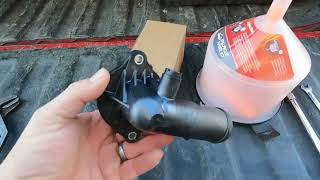
- After replacing the thermostat, properly bleed the cooling system to remove all air. The housing has a small bleeder screw for this purpose. 🎬 See a step-by-step walkthrough of the thermostat replacement and bleeding process. Failure to bleed the system can cause the code to return.
- If the thermostat is replaced with an OEM part and the issue persists, inspect the ECT sensor wiring and consider the possibility of a rare issue like a seeping radiator.
Parts You'll Likely Need

- Thermostat and Housing Assembly
(OEM #04893926AH)— This is the primary cause of code P0128 on the 3.6L Pentastar engine, as confirmed by owner reports and manufacturer TSBs. The thermostat fails in the open position or opens too early. The part is an integrated assembly including the housing and ECT sensor. This part number supersedes previous versions like 04893926AG, 4893926AD, and 4893926AF.
Trusted brands: Mopar (OEM), Mishimoto (Aluminum Upgrade), Motorad
OEM price range: $85-$265
Aftermarket price range: $55-$200
Technical Service Bulletins (TSBs) & Recalls
- 9100287: Mentions an upgraded thermostat assembly for 2022-2024MY 3.6L Pentastar engines with P0128.
Platform-Specific Known Issues
- TSB #9100287: Notes an updated Thermostat Assembly for 2022-2024 models with the 3.6L Pentastar engine experiencing P0128 failures. It advises technicians to follow specific inspection instructions before replacement.
- TSB #S2118000009: Explicitly states that for a customer complaint of a MIL-on with DTC P0128, the diagnostic procedure is to verify the coolant level and, if correct, replace the thermostat. This TSB applies to multiple Jeep models with the 3.6L engine, including the Gladiator, Wrangler, and Grand Cherokee.
- Plastic Housing Failures: The original equipment thermostat housing is made of plastic and is a known weak point that can crack or warp over time, leading to leaks or improper thermostat function. Many owners choose to upgrade to a more durable cast aluminum housing from brands like Mishimoto to prevent future failures.
- Integrated ECT Sensor: Unlike older models (like the Wrangler JK), the Gladiator (JT) and modern Wrangler (JL) have the engine coolant temperature sensor built directly into the thermostat housing assembly, simplifying the replacement as it's all one unit.
Mechanic-Grade Diagnostic Values

- ECT Sensor Resistance (unloaded) — expected: ~2830 Ω at 25°C (77°F); ~245 Ω at 90°C (194°F). Failure: Significant deviation from the expected resistance-to-temperature curve. An open circuit or short will show infinite or zero resistance.
- ECT Sensor Voltage (Key On, Engine Off, Cold) — expected: ~2.0V to 3.0V, depending on ambient temperature.. Failure: Voltage near 5.0V indicates an open circuit/bad ground. Voltage near 0V indicates a short to ground. Incorrect voltage for the given temperature (e.g., 1.5V on a cold engine) indicates a skewed sensor.
- ECT Sensor Voltage (Engine at Operating Temp) — expected: ~0.5V. Failure: Voltage remaining high (e.g., over 1.0V) when the engine should be warm indicates the sensor is not reading the temperature increase correctly or the engine is not actually getting hot.
Wiring & Ground Locations
- ECT Sensor Connector — On the top front of the engine, plugged directly into the plastic thermostat housing assembly where the upper radiator hose connects.. This is the primary connection for the sensor that provides the temperature reading to the PCM. A damaged connector or wiring here will cause incorrect readings, potentially triggering P0128 or other ECT-related codes like P0118. Since the sensor is integrated, the entire housing is typically replaced, but the connector and harness should still be inspected.
Real Owner Repair Stories
- Reddit user in r/Jeep (Jeep (model not specified, but 3.6L Pentastar context is relevant)) — Persistent P0128 code.
❌ Tried (didn't work) Replaced the thermostat assembly. The check engine light returned.
✅ What actually fixed it The dealership diagnosed a 'seeping' radiator that passed a pressure test. After the radiator was also replaced, the code was resolved. Another user confirmed a cracked radiator housing was a known issue that caused their coolant-related problems. - Jeep Wrangler JK Forum user (Jeep Wrangler JK (platform shares 3.6L engine and P0128 issue)) — P0128 code, temperature gauge reading low (185-190°F max).
❌ Tried (didn't work) Initially just diagnosing with a scan tool.
✅ What actually fixed it The user confirmed a stuck-open thermostat by feeling the upper radiator hose, which got warm immediately after a cold start. Replacing the thermostat assembly fixed the issue, with the new part allowing the engine to reach 217°F before the thermostat opened, then stabilizing around 199°F.
"I Checked Everything" — The Actual Cause
- A common report on forums involves replacing the thermostat for P0128, only for the code to return. In one documented case, the root cause was found to be a minutely seeping radiator. Even though it may pass a standard cooling system pressure test, a very small leak can introduce air into the system over time. This air pocket can cause erratic readings at the ECT sensor or a slight drop in overall coolant level, leading the PCM to incorrectly flag a P0128 fault again. The fix in this case was to replace the radiator in addition to the thermostat.
OEM Part Supersession History
4893926AD, 4893926AF, 04893926AG→04893926AH— The frequent supersession of this part number strongly suggests that the manufacturer has made multiple revisions to address the high failure rate of the thermostat assembly. The latest part, 04893926AH, is the currently recommended OEM replacement.
Model Year Variations Within This Range
- 2024: The 2024 Jeep Gladiator received a mid-cycle refresh. This included cosmetic changes like a revised seven-slot grille, which Jeep claims helps improve engine cooling. However, the 3.6L Pentastar V6 engine remains the sole powertrain option, and it continues to use the same thermostat assembly design. The P0128 issue and its fix are consistent with prior years, though the updated part number from TSB 9100287 should be used.
Helpful Videos
We Have This Part in Stock


The information in this article is provided for general reference and educational purposes only. Vehicle specifications, procedures, and part compatibility can vary by production date, trim level, and region. Always consult your vehicle's factory service manual and verify part numbers before purchasing or performing repairs. Safety-critical components such as airbags, seat belts, and braking systems should be installed by a qualified professional.
- Jeep GLADIATOR:
- 🎬 Helpful Videos
- 🛍️ Shop This Part
- What's Unique About the 2020-2024 Jeep GLADIATOR
- Diagnostic Flowchart
- Symptoms You May Notice
- Most Likely Causes
- Rare But Worth Checking
- Diagnosis Steps
- Parts You'll Likely Need
- Technical Service Bulletins (TSBs) & Recalls
- Platform-Specific Known Issues
- Mechanic-Grade Diagnostic Values
- Wiring & Ground Locations
- Real Owner Repair Stories
- "I Checked Everything" — The Actual Cause
- OEM Part Supersession History
- Model Year Variations Within This Range
- 🎟️ Get 5% Off