

P0128 on 2020-2024 Dodge Durango: Causes and Fixes for Coolant Temperature Issues
On a 2020-2024 Dodge Durango, especially with the 3.6L Pentastar V6 engine, the P0128 code is almost always caused by a faulty thermostat that is stuck open. Replacing the entire thermostat assembly with an OEM Mopar part (which includes a new sensor) is the recommended fix. The repair is straightforward, but properly bleeding air from the cooling system afterward is critical. Expect to pay around $60-$90 for the part and $100-$200 for labor.
- P0128 on a 2020-2024 Durango almost always means you need a new thermostat, especially on the 3.6L V6.
- The issue is extremely common across the entire 3.6L Pentastar engine family (Jeep, Ram, Chrysler), and Dodge has issued TSBs for it.
- The recommended repair is to replace the entire thermostat assembly with an OEM Mopar part, which includes the housing and a new temperature sensor.
- This is a DIY-friendly repair for those with basic tools, but the cooling system must be properly bled afterward using the bleeder screw to remove air pockets and prevent overheating.
- Continuing to drive with this code will result in poor fuel mileage, no cabin heat, a disabled remote start, and may cause long-term engine wear.
What's Unique About the 2020-2024 Dodge DURANGO

This issue is particularly common on Dodge vehicles with the 3.6L Pentastar V6 engine. The problem is so widespread that it affects nearly every Stellantis (formerly FCA) vehicle using this engine, including the Jeep Grand Cherokee and Ram 1500. Dodge has issued Technical Service Bulletins (TSBs) specifically addressing P0128 failures on these models, indicating a known issue with the thermostat assembly. [Bulletin #9100287, Bulletin #S2118000009] TSB #9100287 even points to an updated thermostat assembly for 2022-2024 models, suggesting an attempt by the manufacturer to correct a design or supplier flaw.
Diagnostic Flowchart
Tap your situation to follow the diagnostic path that matches what you're seeing on this vehicle.
Symptoms You May Notice
- Check Engine Light is on.
- Engine temperature gauge reads lower than normal (e.g., at the 1/4 mark) or takes a very long time to warm up.
- Heater may not blow hot air, or the heat may be inconsistent.
- Noticeable decrease in fuel economy.
- Engine temperature may drop at highway speeds.
- Remote start feature may be disabled by the system when the code is active.
- Replacing only the coolant temperature sensor when the actual fault is a mechanically stuck thermostat. Since the recommended part is a complete assembly including the sensor, this mistake is less common if the correct part is purchased.
- Using a cheap aftermarket thermostat assembly that is calibrated to the wrong temperature or fails quickly, leading to the code returning.
Most Likely Causes

- Faulty Thermostat Assembly 🔴 High Probability This is a well-documented issue, confirmed by multiple manufacturer TSBs (9100287, S2118000009) for this specific vehicle and engine (3.6L Pentastar). The thermostat fails by sticking in the open position. Owner and technician consensus strongly recommends using an OEM Mopar part, as some aftermarket units reportedly fail quickly or have incorrect temperature ratings, causing the code to return.
How to confirm: Use a scan tool to monitor live coolant temperature data. After 15-20 minutes of driving, the temperature should climb steadily and stabilize in the normal operating range (approx. 195-210°F). If it warms up extremely slowly, struggles to get above 170-180°F, or drops significantly at highway speeds, the thermostat is almost certainly stuck open.
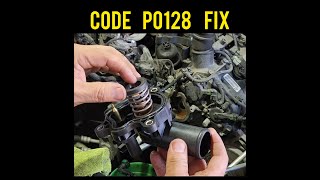
Typical fix: Replace the entire thermostat housing assembly. 🎬 See this step-by-step walkthrough for replacing the thermostat housing. The recommended OEM part is a single unit that includes the thermostat, the plastic housing, a new gasket, and a new coolant temperature (ECT) sensor, providing a comprehensive repair.
Est. part cost: $60-$90 for OEM Mopar part - Low Engine Coolant Level 🟡 Medium Probability While not specific to this vehicle, a coolant leak can cause air to enter the system, which may lead to erratic temperature readings and trigger a P0128 code before an overheating condition occurs.
How to confirm: Visually inspect the coolant reservoir and the radiator (when the engine is cold). If the level is below the 'MIN' line, it needs to be topped off. Also, check for any visible signs of coolant leaks, particularly around the radiator seams, water pump, and the oil filter housing assembly in the engine valley.
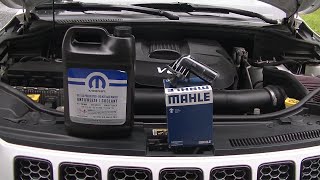
Typical fix: Top off the coolant with the correct type (Mopar OAT 10-year/150,000 mile coolant is specified) and bleed the system of any air. If a leak is present, the leaking component (hose, radiator, water pump) must be repaired or replaced.
Est. part cost: $20-$40 for coolant - Faulty Engine Coolant Temperature (ECT) Sensor ⚪ Low Probability
How to confirm: With a cold engine, use a scan tool to compare the ECT sensor reading with the Intake Air Temperature (IAT) sensor reading. They should be within a few degrees of each other. If the ECT reading is erratic or nonsensical (e.g., -40°F), the sensor is likely bad. However, this is an unlikely cause of P0128 on this vehicle.
Typical fix: The ECT sensor is integrated into the thermostat housing assembly. Since the standard repair for P0128 is to replace the entire assembly, the sensor is replaced by default, eliminating it as a separate point of failure.
Est. part cost: $25-$85 (included with thermostat assembly)
Rare But Worth Checking
- Cooling Fan Stuck On: If the electric cooling fan runs continuously, even when the engine is cold, it can prevent the engine from warming up properly, especially in colder climates. This is usually caused by a faulty fan relay or control module.
Diagnosis Steps
- Check for a Check Engine Light and scan for codes. Confirm P0128 is present.
- With the engine cold and off, check the coolant level in the reservoir. Top off if necessary with the correct Mopar OAT coolant.
- Start the engine and use a scan tool to monitor the Engine Coolant Temperature (ECT) sensor data in real-time.
- Observe the temperature rise. It should climb steadily to around 195-210°F and stabilize. If it warms up extremely slowly, struggles to get above 170°F, or drops significantly at highway speeds, the thermostat is stuck open.
- If the temperature reading is erratic, jumps around, or reads an illogical value from the start (like -40°F), the ECT sensor or its wiring is the primary suspect, but this is rare for this code.
- Based on overwhelming evidence from TSBs and owner forums, if the symptoms in step 4 are present, proceed with replacing the thermostat assembly.
- CRITICAL: Bleed the Cooling System After Repair. 🎬 Watch: How to properly bleed the Pentastar cooling system. After replacing the thermostat, air will be trapped in the system and must be removed to prevent overheating. Locate the small bleeder screw (often an 8mm hex or Torx head) on top of the new thermostat housing. Loosen it slightly while filling the radiator with coolant. When a steady stream of coolant (without air bubbles) comes out of the bleeder, tighten it. Alternatively, use a spill-free funnel kit on the radiator, start the engine, and turn the heater to high. Let the engine run until the thermostat opens and all air bubbles have escaped. Top off the coolant as needed.
Parts You'll Likely Need

- Engine Coolant Thermostat Assembly
(OEM #5184651AH (or superseded versions; always verify with VIN))— This is the most common failure part for a P0128 code on this vehicle, as confirmed by manufacturer TSBs and countless owner experiences. The assembly includes the thermostat, housing, gasket, and a new coolant temperature sensor, providing a complete fix. TSB #9100287 indicates an 'updated' part exists for 2022-2024 models.
Trusted brands: Mopar (Highly Recommended), Dorman, Motorad
OEM price range: $60-$90
Aftermarket price range: $40-$75
Technical Service Bulletins (TSBs) & Recalls
- 9100287: 'Thermostat Assy For 2022-2024MY 3.6L Pentastar Upgrade with P0128 failure code.'
- S2118000009: 'Customer complains of a MIL-on condition. Upon further inspection, there is a Diagnostic Trouble Code (DTC) P0128 Coolant Thermostat (Coolant Temperature Below Thermostat Regulating Temperature) set in the PCM.'
Platform-Specific Known Issues
- TSB #9100287 was issued for 2022-2024 models with the 3.6L engine, specifically mentioning an updated 'Thermostat Assy' for P0128 failures.
- TSB #S2118000009 confirms the P0128 code definition for customers complaining of a check engine light on 2020 models.
- The thermostat housing includes a small bleeder screw that is essential for properly bleeding air from the cooling system after the repair. Failure to bleed the system can lead to overheating.
- While replacing the thermostat, some owners opt to also replace the plastic coolant crossover pipe that the thermostat housing attaches to, as it can become brittle with age, though it is a separate part.
Mechanic-Grade Diagnostic Values

- Engine Coolant Temperature (ECT) Sensor Signal Voltage — expected: 2.0V - 3.0V with a cold engine (Key On, Engine Off). Around 0.5V with a warm engine (approx. 90°C / 194°F).. Failure: Voltage is stuck high (e.g., >1.5V) when the engine is warm, or reads 0V (short to ground) or 5V (open circuit).
- Engine Coolant Temperature (ECT) Sensor Resistance — expected: At 20°C (68°F), resistance should be between 2000-3000 Ω. At 90°C (194°F), resistance should drop to 200-300 Ω.. Failure: A reading significantly outside the expected range for a given temperature, or an open/short circuit reading on the multimeter.
- ECT Sensor Ground Circuit (K900) Resistance to Chassis Ground — expected: Below 5.0 Ω.. Failure: Resistance higher than 5.0 Ω indicates excessive resistance or an open in the ground circuit, which can cause incorrect sensor readings and trigger a false P0128.
Scan Tool Commands That Help
- wiTECH (Dealer Tool) or equivalent J2534 device: PCM Reflash / Software Update — If TSB #18-002-23 is found to be applicable and not yet performed on the vehicle. This TSB updates the PCM software with an enhanced 'Thermostat Rationality' diagnostic, which can prevent a false P0128 code from being set due to overly sensitive logic. This should be checked by a dealer, especially if a new thermostat does not resolve the code.
Wiring & Ground Locations
- ECT Sensor Connector — On the thermostat housing assembly, which is located at the front of the engine valley where the upper radiator hose connects.. This is a 2-pin connector that provides the signal and ground for the ECT sensor. Corrosion or damage to these pins or wires can cause erratic or incorrect temperature readings, potentially leading to a P0128 code.
- ECT Sensor Ground Circuit (K900) — This is the designated ground wire within the harness running from the ECT sensor back to the PCM.. High resistance on this specific ground circuit can skew the sensor's voltage reading, making the PCM think the engine is colder than it is. Resistance should be tested between the ground pin at the sensor connector and the chassis ground.
- G901A / G903A — These are main engine compartment ground points. G901A is typically on the left rear of the engine compartment, and G903A is on the right front.. The PCM and its sensors rely on clean chassis grounds. A loose or corroded main ground can cause a variety of electrical issues, including incorrect sensor readings that could contribute to a false P0128 code.
Real Owner Repair Stories
- BobIsTheOilGuy forum user 'wwillson' (2014 Dodge Durango 3.6L with 130,000 miles) — P0128 code triggered. Noted that with the old thermostat, oil temperature would only reach about 160°F on the highway, which was too cold.
✅ What actually fixed it Replacing the thermostat assembly with an OEM part. The user noted the job was very simple and took about 15 minutes. After replacement, the temperature gauge went quickly to the normal range and stayed there. The old thermostat was not visibly stuck open when cold but was clearly opening too early. - Reddit user in r/MechanicAdvice (2012 Honda Civic (Note: Different vehicle, but illustrates a common P0128 issue)) — P0128 code.
❌ Tried (didn't work) Replaced the thermostat with an 'OEM equivalent' part from an auto parts store (Advance Auto).
✅ What actually fixed it The code returned two months after replacing the thermostat with a non-dealer part. This story highlights the common pitfall where using aftermarket thermostats, which may have incorrect temperature ratings or lower quality control, can lead to a repeat failure for code P0128. The strong recommendation for the Durango is to use a genuine Mopar part to avoid this scenario.
OEM Part Supersession History
5184651AH (and earlier versions)→Multiple revisions exist. TSB 9100287 points to a specific 'upgraded' assembly for 2022-2024 models.— To correct a high rate of failure where the original thermostats would stick open or open at too low a temperature, triggering code P0128.
Heads up: While newer parts may physically fit older models, it is critical to use the specific part number recommended for the vehicle's VIN. TSB 9100287 implies a targeted fix for 2022-2024 models, and using this part on an older model is not explicitly recommended without dealer confirmation.
Model Year Variations Within This Range
- 2022-2024: For these model years, TSB #9100287 explicitly directs technicians to use an 'upgraded' Thermostat Assembly to resolve P0128 failures. This indicates a known issue with the originally supplied part and a specific, updated part was released as the official fix. Technicians are instructed to follow inspection instructions in STAR ONLINE PUBLICATION S2309000014 before replacement.
Helpful Videos
We Have This Part in Stock


The information in this article is provided for general reference and educational purposes only. Vehicle specifications, procedures, and part compatibility can vary by production date, trim level, and region. Always consult your vehicle's factory service manual and verify part numbers before purchasing or performing repairs. Safety-critical components such as airbags, seat belts, and braking systems should be installed by a qualified professional.
- Dodge DURANGO:
- 🎬 Helpful Videos
- 🛍️ Shop This Part
- What's Unique About the 2020-2024 Dodge DURANGO
- Diagnostic Flowchart
- Symptoms You May Notice
- Most Likely Causes
- Rare But Worth Checking
- Diagnosis Steps
- Parts You'll Likely Need
- Technical Service Bulletins (TSBs) & Recalls
- Platform-Specific Known Issues
- Mechanic-Grade Diagnostic Values
- Scan Tool Commands That Help
- Wiring & Ground Locations
- Real Owner Repair Stories
- OEM Part Supersession History
- Model Year Variations Within This Range
- 🎟️ Get 5% Off