

P0126 on 2022-2025 Mazda CX-5: Insufficient Coolant Temperature Causes and Fixes
On 2022-2025 Mazda CX-5s with non-turbo engines, code P0126 almost always indicates a faulty thermostat that is stuck open within the Coolant Control Valve (CCV). This is a very common, well-documented issue. Mazda has issued a warranty extension program (SSPD8) covering this specific failure for 15 years or 150,000 miles, so the repair is likely free at a dealership. The fix involves replacing the internal thermostat with an updated kit (Part No. PYY2-15-SA1). A newer TSB from late 2025 introdu
- P0126 on a 2022-2025 CX-5 is almost certainly a stuck-open thermostat.
- **Do not pay for this repair** until you have contacted a Mazda dealer with your VIN to check for coverage under the 15-year/150,000-mile warranty extension (SSPD8).
- Symptoms include a slow-to-warm engine, poor cabin heat, and the blue temperature light staying on.
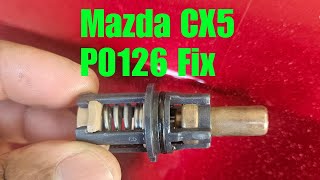
- The correct, modern fix is to replace an internal thermostat kit (PYY2-15-SA1), not the entire, more expensive Coolant Control Valve.
- You can continue to drive the vehicle, but you will experience poor fuel economy and heater performance until it is fixed.
What's Unique About the 2022-2025 Mazda CX-5

This issue is extremely common across many modern Mazda models with Skyactiv-G non-turbo engines, not just the CX-5. The problem became so widespread that Mazda issued multiple Technical Service Bulletins (TSBs) and a Special Service Program (SSP D8) that extends the warranty for this specific failure to 15 years or 150,000 miles. 🎬 Watch: Details on the Mazda warranty extension for thermostat issues. The failure is not in a traditional, standalone thermostat, but in a more complex, electronically-controlled "Coolant Control Valve" (CCV). Inside the CCV is a small, mechanical fail-safe thermostat which is designed to open only in an overheat situation. The widespread defect is that this fail-safe thermostat opens at normal operating temperatures and then sticks open, constantly allowing coolant to flow to the radiator and preventing the engine from warming up properly.
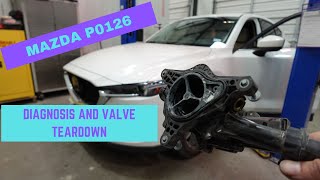
🎬 See a teardown of the failed coolant control valve.Diagnostic Flowchart

Tap your situation to follow the diagnostic path that matches what you're seeing on this vehicle.
Symptoms You May Notice

- Check Engine Light is on.
- Engine takes a long time to warm up.
- Blue low coolant temperature light stays on longer than usual or comes on while driving.
- Poor or lukewarm heater performance, especially when idling.
- Temperature gauge fluctuates or stays on the low end, often struggling to get past 1/3 of the way up.
- Decreased fuel economy.
- Replacing the entire Coolant Control Valve assembly when only the internal thermostat kit is needed. Mazda issued TSBs stating the full assembly replacement is no longer necessary for this specific code.
- Replacing the ECT sensor without first confirming the thermostat is functioning correctly. Given the overwhelming evidence from Mazda's own documents, the thermostat is the primary suspect.
- Charging the customer for the repair. Dealers may try to charge a diagnostic fee, but this should be waived if the issue is confirmed to be the thermostat covered by SSPD8. Some owners have been quoted over $1000 for an out-of-warranty repair.
Most Likely Causes

- Faulty Coolant Control Valve (Thermostat Stuck Open) 🔴 High Probability Mazda has acknowledged a design or production flaw in the fail-safe thermostat integrated into the Coolant Control Valve (CCV), causing it to stick open at lower-than-normal temperatures. This is the subject of multiple TSBs and a warranty extension (SSPD8). The dealership service department will be very familiar with this issue.
How to confirm: Use an OBD-II scanner to monitor live coolant temperature data. If the engine temperature rises very slowly, struggles to reach normal operating temperature (approx. 195-220°F), or drops significantly at highway speeds, the thermostat is almost certainly stuck open. A Mazda TSB confirms the diagnosis if the freeze frame data for the code shows a coolant temperature between 104-176°F (40-80°C). The presence of code P0126 is strong evidence on its own.
Typical fix: Contact a Mazda dealer to check for coverage under the SSPD8 warranty extension (15 years/150,000 miles). The dealer will replace the faulty thermostat component within the CCV with an updated part. As of late 2025, the official repair is to remove the thermostat and replace it with a 'dummy plug' (Part No. PYY3-15-SA1) and perform a mandatory PCM software update. It is no longer necessary to replace the entire CCV assembly for this code.
Est. part cost: $0 (if covered by warranty), $25-$100 for the thermostat kit otherwise. - Low Engine Coolant ⚪ Low Probability
How to confirm: With the engine cold, check the coolant level in the overflow reservoir. If it is below the 'MIN' or 'LOW' line, the level is low. Also, check for any visible signs of coolant leaks around hoses, the radiator, and the water pump. An air pocket from a recent coolant service can also cause issues.
Typical fix: Top off the coolant with the correct Mazda-specified fluid (FL22). If the level drops again, a pressure test of the cooling system is needed to find the leak. If an air pocket is suspected, a vacuum-fill procedure is recommended.
Est. part cost: $20-$30 for a gallon of coolant. - Faulty Engine Coolant Temperature (ECT) Sensor ⚪ Low Probability
How to confirm: Use an OBD-II scanner to watch the live ECT sensor data. If the reading is erratic, nonsensical (e.g., -40°F on a warm engine), or doesn't change as the engine warms up, the sensor or its wiring may be faulty. This is an unlikely cause given the known CCV issue.
Typical fix: Replace the ECT sensor and ensure the electrical connector is clean and secure. Note that on these vehicles, the ECT sensor is a separate part that is transferred from the old CCV to the new one during replacement.
Est. part cost: $25-$75
Diagnosis Steps
- Scan for DTCs. Confirm P0126 is the primary code. Note any other codes, but be aware that TSB 01-001-26b states that if P2B61:00 is also present, a different diagnostic path is required as it may indicate an electrical fault.
- Contact a Mazda dealership with your Vehicle Identification Number (VIN). Ask them to check for coverage under the Special Service Program SSPD8 for the P0126 code. This should be your first step, as the repair is likely free.
- If proceeding with your own diagnosis, check the engine coolant level when the engine is cold. Ensure it is at the proper level in the overflow tank.
- Use a scan tool to monitor the Engine Coolant Temperature (ECT) live data from a cold start. The temperature should rise steadily to around 195-220°F and stabilize.
- If the temperature rises very slowly, never reaches the target range, or drops while driving at speed (especially on the highway), the thermostat is confirmed to be stuck open. A Mazda TSB specifically notes to check the freeze frame data; if the coolant temperature is between 104-176°F (40-80°C), the faulty thermostat is confirmed.
- If the temperature reading is erratic or illogical, inspect the ECT sensor and its wiring harness for damage or corrosion.
- Based on overwhelming evidence from Mazda's own documents, the issue is the thermostat. Proceed with the repair outlined in the latest TSB, which involves replacing the thermostat with a 'dummy plug' and performing a PCM software update.
Parts You'll Likely Need
- Thermostat Set (Kit)
(OEM #PYY2-15-SA1)— This is the updated part from Mazda designed to fix the specific flaw causing the thermostat to stick open. It is installed into the existing CCV housing. This part is superseded by the dummy plug kit as of late 2025.
Trusted brands: Mazda (OEM)
OEM price range: $25-$50
Aftermarket price range: $20-$40 - Dummy Plug for CCV
(OEM #PYY3-15-SA1)— As of late 2025, this part, along with a PCM software update, is Mazda's official permanent fix. It replaces the failure-prone mechanical failsafe thermostat entirely.
Trusted brands: Mazda (OEM)
OEM price range: $30-$60 - Mazda Long Life Coolant (FL22)
(OEM #0000-77-508F-20)— The cooling system will need to be partially drained and refilled as part of the thermostat replacement. TSBs recommend replacing up to 7.4L.
Trusted brands: Mazda (OEM)
OEM price range: $25-$35
Technical Service Bulletins (TSBs) & Recalls

- SSPD8: Check Engine Light ON with DTC P0126:00 - WARRANTY EXTENSION. Extends warranty coverage for the thermostat failure to 15 years/150,000 miles for a wide range of Mazda vehicles, including the 2018-2025 CX-5.
- 01-001-26b: Describes symptoms of P0126:00 as engine taking longer to warm up, fluctuating temperature gauge, and low coolant light staying on. Also clarifies that the presence of code P2B61:00 requires a different diagnostic procedure.
- 01-001/26 (and later revisions): Details the updated repair procedure using a 'dummy plug' (PYY3-15-SA1) and a mandatory PCM software update instead of a replacement thermostat.
Platform-Specific Known Issues
- Warranty Extension (SSPD8): Mazda has extended the warranty for the specific repair of the fail-safe thermostat to 15 years or 150,000 miles, whichever comes first. This applies to 2018-2025 CX-5 models, among others. Owners should contact a dealer with their VIN to verify eligibility before paying for any repairs. Owners who previously paid for this repair may be eligible for reimbursement.
- Updated Repair Procedure: Mazda TSB 01-001/26 (and later revisions) specifies replacing the internal thermostat with a 'dummy plug' and performing a mandatory PCM software update. This became the required procedure as of December 8, 2025. The TSB provides specific torque specs for the cover (tighten to 26 in-lbs, then to 44 in-lbs in a criss-cross pattern) and warns against using power tools.
- Dealer Diagnosis: An updated TSB from early 2026 states that the DTC P0126:00 is no longer required to be present for the warranty repair to be performed if other symptoms (slow warm-up, poor heat, etc.) are verified.
Mechanic-Grade Diagnostic Values
- Freeze Frame Data - Engine Coolant Temperature — expected: Above 176°F (80°C) after sufficient warm-up time.. Failure: A stored temperature between 104°F and 176°F (40°C and 80°C) when the P0126 code was triggered strongly confirms the stuck thermostat.
- Thermostat Cover Bolt Torque — expected: Initial pass: 26 in-lbs (3 Nm). Final pass: 44 in-lbs (5 Nm).. Failure: N/A. This is a required tightening specification for the repair.
Scan Tool Commands That Help
- Mazda Modular Diagnostic System (M-MDS) - MDARS or IDS: PCM Reprogramming — This is a mandatory step after installing the 'dummy plug' (Part No. PYY3-15-SA1). Failure to perform the software update can lead to future issues or potential engine damage and will void warranty coverage for the repair.
Real Owner Repair Stories
- Mazda Forum (mazda-forum.com) (2021 Mazda CX-5, 12,000 miles) — Check Engine Light with code P0126 after a week-long cold snap. Coolant level was full.
❌ Tried (didn't work) Checking coolant level.
✅ What actually fixed it The dealership replaced the faulty component under warranty. The repair took two days because a related gasket the mechanic broke had to be ordered overnight. The owner was provided a loaner vehicle.
OEM Part Supersession History
PYY2-15-SA1 (Thermostat Kit)→PYY3-15-SA1 (Dummy Plug for CCV)— The original replacement thermostats were still prone to failure. Mazda's permanent solution is to eliminate the mechanical failsafe thermostat entirely and rely on the electronic valve and updated PCM logic.
Heads up: As of December 8, 2025, the Dummy Plug and a mandatory PCM software update became the required repair procedure. Installing the older thermostat kit after this date is not the correct permanent fix.
Model Year Variations Within This Range
- 2024+: A technician noted in a January 2024 video that the 2024 CX-5 features a revised engine design that has done away with the electronic Coolant Control Valve and returned to a traditional mechanical thermostat, at least in the US market. This suggests newer models (late 2024-2025) may not be affected by this specific failure mode, although they are still listed in the warranty extension.
Helpful Videos

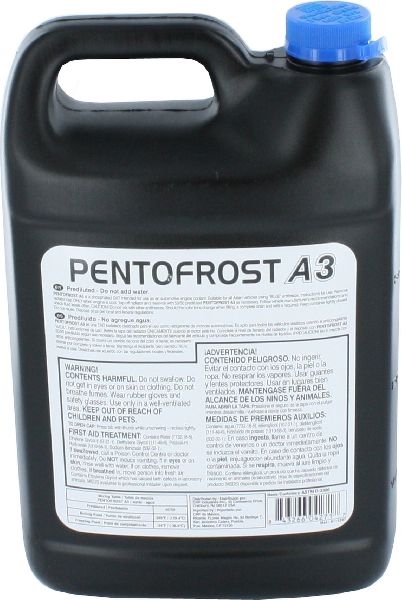
We Have This Part in Stock

The information in this article is provided for general reference and educational purposes only. Vehicle specifications, procedures, and part compatibility can vary by production date, trim level, and region. Always consult your vehicle's factory service manual and verify part numbers before purchasing or performing repairs. Safety-critical components such as airbags, seat belts, and braking systems should be installed by a qualified professional.
- Mazda CX-5:
- 🎬 Helpful Videos
- 🛍️ Shop This Part
- What's Unique About the 2022-2025 Mazda CX-5
- Diagnostic Flowchart
- Symptoms You May Notice
- Most Likely Causes
- Diagnosis Steps
- Parts You'll Likely Need
- Technical Service Bulletins (TSBs) & Recalls
- Platform-Specific Known Issues
- Mechanic-Grade Diagnostic Values
- Scan Tool Commands That Help
- Real Owner Repair Stories
- OEM Part Supersession History
- Model Year Variations Within This Range
- 🎟️ Get 5% Off