

P0126 on 2014-2021 Mazda CX-5: Insufficient Coolant Temperature Causes and Fixes
On 2017-2021 Mazda CX-5s with non-turbo engines, P0126 is almost always a faulty Coolant Control Valve (CCV), where an internal failsafe thermostat sticks open. This is a very common, well-documented issue covered by Mazda's Special Service Program (SSP D8), extending the warranty to 15 years/150,000 miles. Before paying for any repairs, contact a Mazda dealer with your VIN to check for free repair eligibility. The latest repair involves replacing the failsafe thermostat with a 'dummy plug' and
- P0126 on a 2017-2021 CX-5 (non-turbo) is almost certainly a failed Coolant Control Valve (CCV).
- This is a known issue with a 15-year/150,000-mile warranty extension (SSPD8) from Mazda.
- Contact a Mazda dealer with your VIN to check for free repair eligibility before paying for anything.
- The vehicle is safe to drive, but the issue should be addressed to prevent poor fuel economy and long-term engine wear.
- The latest official fix involves removing the internal thermostat and installing a 'dummy plug' with a software update.
What's Unique About the 2014-2021 Mazda CX-5

The 2014-2021 CX-5 spans two generations. The first generation (2014-2016) uses a traditional, simple thermostat. The second generation (2017-2021) with non-turbo engines uses a more complex, electronically controlled "Coolant Control Valve" (CCV) that integrates a failsafe mechanical thermostat. This CCV has a very high failure rate where the internal failsafe thermostat sticks open, causing the P0126 code. The problem is so widespread on second-generation models (and even newer ones up to 2025) that Mazda issued multiple Technical Service Bulletins (TSBs) and a warranty extension (SSP D8) to cover the repair.
Diagnostic Flowchart

Tap your situation to follow the diagnostic path that matches what you're seeing on this vehicle.
Generation note: This range covers two generations of the Mazda CX-5. The first generation (2014-2016) uses a conventional thermostat, which can fail 🎬 Watch: How to replace the thermostat on first-generation models. but is not part of a widespread documented issue for this code. The second generation (2017-2021) and beyond (up to 2025) with the non-turbo SKYACTIV-G engine uses a Coolant Control Valve (CCV) that is known to fail frequently, triggering code P0126. The TSBs and warranty extension from Mazda are specifically for these later models.
Symptoms You May Notice

- Check Engine Light is on
- Engine takes longer than usual to warm up.
- Blue low coolant temperature indicator light stays on for an extended period or comes back on while driving.
- Temperature gauge on the dashboard fluctuates or reads consistently low, never reaching the middle.
- Poor or inconsistent heater performance, especially when the car is at idle. 🎬 See why your heater is weak and the blue light stays on.
- Reduced fuel economy due to the engine running in a rich 'warm-up' mode.
- Replacing only the Engine Coolant Temperature (ECT) sensor. While the sensor reports the temperature, it's rarely the root cause of the P0126 code on these vehicles; the problem is the mechanical failure of the thermostat itself.
- Being told the repair is not covered by warranty. The powertrain warranty (5yr/60k miles) and the specific SSPD8 warranty extension (15yr/150k miles) both cover this exact failure.
Most Likely Causes

- Faulty Coolant Control Valve (CCV) / Thermostat 🔴 High Probability On 2017+ non-turbo models, the integrated failsafe thermostat within the CCV has a design flaw. TSB 01-005/23 states that coolant can seep into a 'dry hollow' area of the thermostat, causing it to open at a much lower temperature (104-176°F) than intended and then get stuck open. This is a well-documented issue acknowledged by Mazda through multiple TSBs and a warranty extension.
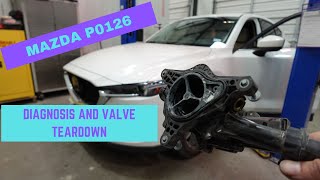
How to confirm: First, check if your vehicle's VIN is covered by Mazda's warranty extension SSPD8 by contacting a dealer. A mechanic can use a scan tool to monitor the engine coolant temperature (ECT) from a cold start. If the temperature rises very slowly, fails to exceed ~170-175°F, or drops significantly at highway speeds, the CCV/thermostat is stuck open. Freeze frame data for the P0126 code will almost always show a coolant temperature between 104-176°F (40-80°C), confirming the specific failure mode described in the TSB. 🎬 Watch: See a teardown of the failed valve and diagnosis.
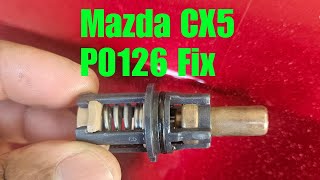
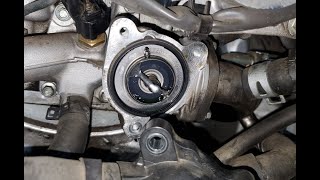
Typical fix: Replace the Coolant Control Valve assembly or its internal thermostat. Mazda has issued updated parts and repair procedures. The latest procedure as of late 2025 involves removing the failsafe thermostat entirely and installing a 'dummy plug' along with a PCM software update. This repair is often covered under warranty extension SSPD8.
Est. part cost: $150-$400 - Low Engine Coolant ⚪ Low Probability
How to confirm: Visually inspect the coolant level in the overflow reservoir and the radiator (when the engine is cold). If it is below the 'MIN' line, it is low. A low level can introduce air into the system, affecting the temperature sensor's reading.
Typical fix: Top off the coolant with the correct type (Mazda FL22) and inspect the system for leaks from hoses, the radiator, or the water pump.
Est. part cost: $20-$40
Rare But Worth Checking
- Faulty Engine Coolant Temperature (ECT) Sensor: While possible, this is much less common than the CCV failure for this specific code on this platform. A faulty ECT sensor would typically cause more erratic gauge readings (e.g., jumping from cold to hot instantly) or other performance issues not perfectly aligned with a slow warm-up. On this vehicle, the P0126 code is almost exclusively due to the mechanical thermostat failure.
Diagnosis Steps
- First, and most importantly, contact a Mazda dealer with your VIN. Ask them to check for coverage under the Special Service Program (SSP) D8 warranty extension for DTC P0126. This could result in a completely free repair.
- If not covered, or for initial diagnosis, check the engine coolant level in the overflow reservoir and radiator (only when the engine is completely cold). Top up with Mazda FL22 coolant if low.
- Using an OBD-II scanner, confirm P0126 is the active code and check the freeze-frame data. The data will show the engine coolant temperature when the fault was triggered. For this specific issue, the temperature will almost certainly be between 104-176°F (40-80°C), as specified in Mazda's TSBs.
- Monitor the live coolant temperature data with a scanner from a cold start. The temperature should rise steadily to around 195-210°F within about 15 minutes of driving. If it rises very slowly, gets stuck at a low temperature (e.g., 160-170°F), or drops while driving at a steady speed, the thermostat/CCV is stuck open.
- If the temperature reading is erratic or nonsensical (e.g., jumps from -40°F to 250°F), then suspect a faulty ECT sensor or wiring, but this is rare for this code.
- Based on the overwhelming evidence for this model, if symptoms and data point to a slow warm-up, the Coolant Control Valve is the culprit.
Parts You'll Likely Need
- Coolant Control Valve
(OEM #PYFD-15-16ZA)— This is the primary failure point for the P0126 code on 2nd generation (2017+) non-turbo Mazda CX-5s. It contains the thermostat that gets stuck open. The part number PYFD-15-16ZA supersedes the older PYFD-15-16Z and PYFB-15-16ZA.
Trusted brands: Mazda (OEM)
OEM price range: $300-$400
Aftermarket price range: $150-$250 - Engine Coolant (Mazda FL22) — The cooling system must be partially drained to replace the Coolant Control Valve, requiring a top-off or refill. Using the specified FL22 coolant is critical.
Trusted brands: Mazda, Ravenol, Pentofrost
OEM price range: $25-$35 per gallon
Aftermarket price range: $20-$30 per gallon - Thermostat Replacement Kit / Dummy Plug
(OEM #PYY2-15-SAY)— As of late 2025, Mazda's official repair procedure under TSBs and SSPD8 is to no longer replace the entire CCV, but to instead remove the faulty internal thermostat and replace it with a 'dummy plug', accompanied by a PCM update. This kit is used for the official dealer repair.
Trusted brands: Mazda (OEM)
OEM price range: N/A (Part of warranty repair)
Aftermarket price range: N/A
Technical Service Bulletins (TSBs) & Recalls
- SSPD8: Special Service Program (Warranty Extension) for Check Engine Light with DTC P0126:00. Extends warranty to 15 years/150,000 miles.
- 01-005/23 (and later revisions like 01-005/24): 'Check Engine Light ON with DTC P0126:00'. Details the cause as coolant entering a dry hollow in the failsafe thermostat, causing it to open at low temperatures.
- 01-001-26b: 'CHECK ENGINE LIGHT ON WITH DTC P0126:00'. Documents symptoms and confirms the cause as 'Thermostat stuck open'.
Platform-Specific Known Issues
- Mazda has issued a warranty extension under Special Service Program (SSP) D8 for the fail-safe thermostat within the coolant control valve. This extends coverage to 15 years or 150,000 miles for affected vehicles, which now includes CX-5 models up to the 2025 model year.
- Owner complaints filed with the NHTSA confirm this is a widespread real-world issue, with owners citing code P0126 and being directed to TSBs related to the coolant control valve.
- Some owners report that dealers may be hesitant to perform the warranty repair if the check engine light is not currently illuminated, even if the symptoms of a slow warm-up are present.
Mechanic-Grade Diagnostic Values
- Freeze Frame Data for Engine Coolant Temperature (ECT) — expected: Should be above 176°F (80°C) after sufficient warm-up time.. Failure: If the code P0126 is triggered and the freeze-frame ECT is between 104°F and 176°F (40°C and 80°C), it confirms the specific failure mode described in Mazda's TSB.
- ECT Sensor Resistance — expected: Resistance changes with temperature. For example: at 32°F (0°C) ~15-18 kOhms; at 68°F (20°C) ~5.5-6.5 kOhms; at 176°F (80°C) ~0.5-0.7 kOhms.. Failure: Resistance values that are wildly out of this range, or an open/short circuit, indicate a failed sensor. However, this is a rare cause for P0126 on this vehicle.
Hidden / Shadow Codes Worth Checking
- P0126:00: The ':00' is a Failure Type Code (FTC) used by Mazda and other manufacturers. For this DTC, it specifies 'Thermostat stuck open' as the direct cause, rather than a circuit fault. This helps technicians immediately focus on the mechanical thermostat failure instead of electrical issues. (see via Most modern OBD-II scanners will display this two-digit suffix after the main DTC. It is explicitly mentioned in Mazda's Technical Service Bulletins.)
- P2B61:00: This code for 'Coolant Control Valve Circuit Range/Performance' points to an electrical fault with the CCV, not the mechanical thermostat failure. If this code appears alongside P0126, Mazda's TSB for P0126 does not apply, and electrical circuit diagnosis is required first. (see via An OBD-II scanner. Its presence changes the diagnostic path away from the common P0126 fix.)
Scan Tool Commands That Help
- Mazda Modular Diagnostic System (M-MDS): PCM Reprogramming — This is a required step after installing the 'dummy plug' repair kit (PYY2-15-SAY) as per the latest TSBs (01-001/26). The software update informs the PCM that the failsafe thermostat is no longer present and adjusts cooling system logic, relying on the active grill shutters and fans.
- Mazda Modular Diagnostic System (M-MDS): PID/DATA Monitor for CCV_ACT and simulation item CCV_DSD — This allows a technician to monitor the actual position of the coolant control valve and command it to different positions to test its electronic function. This is useful for diagnosing the less common electrical fault code P2B61.
Wiring & Ground Locations
- ECT Sensor No. 1 — Located on the engine block, near the thermostat housing, which is next to the battery.. This is the primary sensor the PCM uses to determine if the engine is warming up correctly. While rarely the cause of P0126 on this platform, a bad connection or sensor could be a misdiagnosis.
- ECT Sensor No. 2 — Located on the passenger side of the engine bay, against the firewall, on a metal coolant pipe connection.. The PCM uses this sensor for cross-referencing temperature readings. A code P011A (Coolant Temperature Sensors 1/2 Correlation) is more likely if one sensor fails, but it's a relevant part of the system.
- Ground Strap above Thermostat — An 8mm bolt secures a ground strap directly above the thermostat housing.. During DIY replacement of the thermostat/CCV, this ground strap must be removed for clearance. Ensuring it is clean and securely re-fastened is critical to prevent unrelated electrical issues.
Real Owner Repair Stories
- Mazda Forum (mazdas247.com) user G@briel (2021 Mazda CX-5 with 12,000 miles) — Check Engine Light came on, code P0126 was retrieved. Coolant level was full.
❌ Tried (didn't work) No other steps mentioned; owner took it directly to the dealer.
✅ What actually fixed it The dealer replaced the faulty coolant control valve under warranty. The repair took two days because a related gasket the mechanic broke had to be ordered overnight. The owner noted the dealer was aware of the issue and handled it without issue. - Reddit r/CX5 user (2019 Mazda CX-5 with 36,000 miles) — Engine would not warm up properly for 1-2 years (coolant temps stayed around 120-130°F), but with no Check Engine Light. Heater performance was weak.
❌ Tried (didn't work) Living with the issue, as there was no CEL to force a repair.
✅ What actually fixed it The owner specifically requested the dealer perform the SSPD8 warranty fix. The dealer performed the latest TSB procedure (from Dec 2025), which involved removing the failsafe thermostat, installing a 'dummy plug', and reflashing the PCM. The owner reported the fix was successful and the car warmed up much faster.
OEM Part Supersession History
PYFB-15-16ZA, PYFD-15-16Z→PYFD-15-16ZA— Standard part evolution and updates to the Coolant Control Valve assembly.PYFD-15-16ZA→PW5S-15-16Z— Design change to support the 'dummy plug' repair strategy. This new part comes with the dummy plug pre-installed.
Heads up: CRITICAL: When installing part PW5S-15-16Z, a PCM software update is mandatory. Failure to update the PCM may result in drivability issues or new trouble codes.N/A (individual parts)→PYY2-15-SAY— Mazda consolidated the parts for the 'dummy plug' repair (Plug PYY3-15-SA1, Gasket PYFB-15-169, etc.) into a single kit for warranty work.
Heads up: As of March 5, 2026, only this complete kit can be ordered and claimed for warranty repairs under SSPD8.
Model Year Variations Within This Range
- 2014-2016: These first-generation models use a conventional, non-electronically controlled thermostat. While a thermostat can still fail and cause a P0126 code, it is not the widespread, systemic failure of the Coolant Control Valve seen in later models. The repair is simpler and not covered by the SSPD8 warranty extension.
- 2017-2025 (Non-Turbo): These second-generation models use the complex Coolant Control Valve (CCV) with the failure-prone internal failsafe thermostat. These are the primary vehicles affected by TSBs 01-005/24, 01-001/26, and warranty extension SSPD8.
Helpful Videos

Used OEM Parts in Stock


New Aftermarket Parts Available


The information in this article is provided for general reference and educational purposes only. Vehicle specifications, procedures, and part compatibility can vary by production date, trim level, and region. Always consult your vehicle's factory service manual and verify part numbers before purchasing or performing repairs. Safety-critical components such as airbags, seat belts, and braking systems should be installed by a qualified professional.
- Mazda CX-5:
- 🎬 Helpful Videos
- 🛍️ Shop This Part
- What's Unique About the 2014-2021 Mazda CX-5
- Diagnostic Flowchart
- Symptoms You May Notice
- Most Likely Causes
- Rare But Worth Checking
- Diagnosis Steps
- Parts You'll Likely Need
- Technical Service Bulletins (TSBs) & Recalls
- Platform-Specific Known Issues
- Mechanic-Grade Diagnostic Values
- Hidden / Shadow Codes Worth Checking
- Scan Tool Commands That Help
- Wiring & Ground Locations
- Real Owner Repair Stories
- OEM Part Supersession History
- Model Year Variations Within This Range
- 🎟️ Get 5% Off