

P0121 on 2007-2014 GMC Sierra 1500: Causes and Fixes for Reduced Power
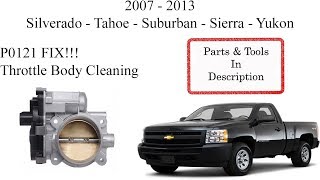
On a 2007-2014 GMC Sierra, code P0121 is most often caused by a dirty throttle body causing the throttle plate to stick. Cleaning the throttle body or replacing the entire assembly usually resolves the issue. This often triggers the 'Reduced Engine Power' warning.
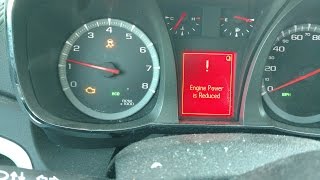
- P0121 on a 2007-2014 Sierra will almost always put the truck in 'Reduced Engine Power' mode.
- Before buying any parts, your first step should be to thoroughly clean the throttle body. This solves the problem in a majority of cases.
- The Throttle Position Sensor (TPS) is part of the throttle body and cannot be replaced on its own; the entire assembly must be purchased.
- After cleaning or replacing the throttle body, a 'relearn' procedure is necessary to reset the idle. This can often be done without special tools by following a sequence of key cycles and idling.
What's Unique About the 2007-2014 Gmc SIERRA 1500

On this generation of GMC Sierra and its platform mates, the P0121 code is notoriously linked to the "Reduced Engine Power" message appearing on the dashboard. The primary cause is often not an electrical failure of the sensor itself, but rather physical carbon buildup inside the throttle body bore. This buildup prevents the throttle plate from moving smoothly, causing a mismatch between the commanded and actual throttle position. The throttle position sensor is integrated into the throttle body and is not sold as a separate part, meaning the entire assembly must be replaced if the sensor fails. A key issue, particularly on 2007 models with the 8-wire throttle body, is a unique sensor configuration where TPS 2 operates on a 20-80% range instead of mirroring TPS 1, making the system sensitive to faults.
Diagnostic Flowchart

Tap your situation to follow the diagnostic path that matches what you're seeing on this vehicle.
Generation note: This range covers two Sierra 1500 generations: the GMT900 (2007-2013) and the K2XX (2014). For 2007 models, it's crucial to confirm you have the 'New Body Style' (smooth doors), not the 'Classic' (creased doors), as they use different parts. While the causes are similar, part numbers for the throttle body may differ between these generations and engine sizes (e.g., 4.8L, 5.3L, 6.2L). Notably, early GMT900 trucks (around 2007) use a unique 8-wire throttle body connector, which was later phased out for a more standard 6-wire setup.
Symptoms You May Notice

- "Reduced Engine Power" message on the instrument cluster
- Check Engine Light is on
- "Service Stabilitrak" or "Traction Control Off" message may appear at the same time
- Poor or sluggish acceleration
- Unstable, rough, or high idle, sometimes surging at stops
- Vehicle may stall, especially when coming to a stop
- Delayed throttle response
- In some cases, the transmission may not shift properly or seem stuck in a gear.
- Replacing the accelerator pedal position (APP) sensor. While the APP sensor is part of the throttle control system, P0121 specifically points to a performance issue at the throttle body itself, not the pedal. A bad APP sensor would typically set a different code, like P2138.
Most Likely Causes

- Dirty Throttle Body 🔴 High Probability Carbon and oil vapor from the PCV system build up around the throttle plate and bore over time, especially on high-mileage vehicles. As TSB #PIP4578B explains, the ECM learns to compensate for this buildup, but eventually, the sticking plate causes a performance error.
How to confirm: Remove the air intake hose from the throttle body and visually inspect the throttle plate and bore. A thick, black, sticky layer of carbon, especially around the edges of the plate, is a clear indicator.
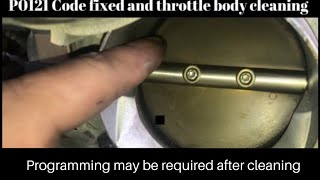
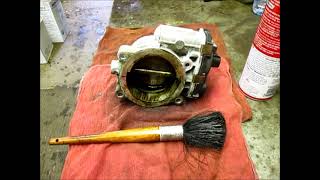
Typical fix: Clean the throttle body thoroughly with a dedicated throttle body cleaner and a soft brush or microfiber rag. It is best to remove the throttle body for cleaning to prevent debris from entering the intake manifold. A throttle relearn procedure is often required after cleaning to prevent a high idle.
Est. part cost: $10-$20 for cleaner - Failing Throttle Body Assembly 🟡 Medium Probability The internal electronic throttle position sensor (TPS) can fail from wear. Since the sensor is integrated into the assembly, the entire unit must be replaced. This is often the solution if a thorough cleaning does not resolve the code.
How to confirm: After cleaning the throttle body and checking wiring, if the code P0121 (or P2135) returns, the assembly is the likely culprit. A scan tool can monitor TPS 1 and TPS 2 voltages; they should move smoothly and in opposition as the throttle is pressed. Jumps or flat spots indicate a bad sensor.
Typical fix: Replace the entire throttle body assembly. A new gasket is recommended. 🎬 See this walkthrough for replacing the entire throttle body assembly. A throttle relearn procedure is required after installation.
Est. part cost: $90-$250 - Wiring or Connector Issue ⚪ Low Probability The engine harness connector at the throttle body is exposed to heat and vibration, which can lead to corrosion ('fretting') or damaged pins/wires over time. Poor engine block grounds (G103 and G104) are also a known cause of erratic sensor behavior.
How to confirm: Visually inspect the throttle body connector for green or white corrosion, pushed-out pins, or frayed wires. Wiggle the connector and harness with the engine running to see if it causes the idle to stumble or the code to appear. A forum user on GMTNation pointed to the dark green signal wire as a potential culprit. Inspect and clean engine ground points, especially G104 on the rear of the driver's side cylinder head.
Typical fix: Clean the connector terminals with electrical contact cleaner and apply dielectric grease to prevent future corrosion. If wires are damaged, the connector pigtail may need to be replaced. Clean engine block ground connections with a wire brush and ensure they are tight.
Est. part cost: $20-$50 for a new pigtail
Rare But Worth Checking
- Faulty Powertrain Control Module (PCM): This is very rare and should only be considered after all other possibilities, including wiring, have been exhaustively ruled out.
Diagnosis Steps
- Read all diagnostic trouble codes (DTCs) with an OBD-II scanner. Note any other codes that are present, especially P2135, P0068, or P1516.
- Visually inspect the wiring harness and connector going to the throttle body. Look for any signs of damage, corrosion, or loose connections.
- Remove the air intake duct from the throttle body. Inspect the throttle bore and plate for heavy carbon buildup.
- If significant carbon is present, remove the four 10mm bolts holding the throttle body, disconnect it, and clean it thoroughly off the vehicle using a dedicated cleaner and a soft cloth or brush. Do not spray cleaner directly into the electrical components.
- If the throttle body is clean, use a scan tool with live data to monitor the Throttle Position Sensor 1 and 2 voltages. With the key on and engine off, slowly press the accelerator pedal. TPS1 voltage should sweep smoothly from about 0.5V to 4.5V, and TPS2 should do the opposite. Any glitches, spikes, or dropouts indicate a failed sensor. 🎬 Watch: How to diagnose P0121 using a scan tool.
- Inspect and clean critical engine ground locations, particularly G103 (passenger side of engine) and G104 (rear of driver's side cylinder head), as poor grounds can cause erratic sensor readings.
- Perform a throttle body relearn procedure. This can be done with a capable scan tool (the most reliable method) or by a manual procedure.
- Manual Relearn Attempt: Turn ignition ON (engine off) for 3 minutes. Turn ignition OFF for 60 seconds. Restart the engine and let it idle. If the idle is still high, a drive cycle of 15-20 miles may help the computer adjust. Note: Manual methods have mixed success.
- If the code returns after cleaning, a successful relearn, and verifying good wiring and grounds, the throttle body assembly is the most likely cause and should be replaced.
Parts You'll Likely Need
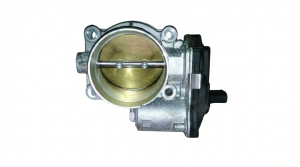
- Throttle Body Assembly
(OEM #12617792, 12678224, 12729500 (V8 engines, numbers vary by year/engine, verify with VIN))— This is the most common fix if cleaning fails, as the internal sensor fails or the unit becomes too worn to function correctly. The sensor is not available separately.
Trusted brands: ACDelco (GM Genuine), Hitachi, Standard Motor Products
OEM price range: $150-$250
Aftermarket price range: $90-$180 - Throttle Body Cleaner — Often, a thorough cleaning is all that is needed to fix the sticking throttle plate that causes this code.
Trusted brands: CRC, Berryman, Gumout
Aftermarket price range: $10-$20 - Throttle Body Gasket — It is best practice to replace the gasket anytime the throttle body is removed to ensure there are no vacuum leaks.
Trusted brands: ACDelco, Fel-Pro
OEM price range: $5-$15
Aftermarket price range: $3-$10
Related Codes That Often Appear With This One
- P2135 — This code indicates a correlation error between the two throttle position sensors (A and B) within the throttle body. It's very common to see with P0121 as they both point to a faulty throttle body assembly.
- P0068 — This code indicates a disagreement between the MAP sensor, MAF sensor, and throttle position. A sticking throttle plate can cause this, linking it to P0121 as mentioned in TSB #PIP4578B.
- P1516 — This is a GM-specific code that means the PCM has detected an issue with the Throttle Actuator Control (TAC) module performance. It often appears with P0121 when the throttle body fails to respond correctly to PCM commands.
Technical Service Bulletins (TSBs) & Recalls
- PIP4578B: Mentions DTC P0121 in relation to idle surge, reduced engine power, and other throttle-related codes on high mileage vehicles, reinforcing the commonality of this issue and explaining the need for an idle relearn after cleaning.
Platform-Specific Known Issues
- A GM Technical Service Bulletin (TSB #PIP4578B) addresses DTC P0121 along with others that may occur on high-mileage vehicles. It explains that as carbon builds, the PCM learns new throttle angles. Cleaning the throttle body without an idle learn reset can cause a high idle because the PCM is still using the old learned values.
- GM also had a Special Coverage Adjustment (11273) for throttle position sensor issues on many 2008-2011 models, which included the Sierra. This program extended the warranty on the throttle body to 10 years or 120,000 miles. This program has now expired for all eligible vehicles.
Mechanic-Grade Diagnostic Values
- TPS1 & TPS2 Voltage Sweep (Scan Tool) — expected: TPS1 should sweep smoothly from ~0.5V to ~4.5V. TPS2 should sweep smoothly in the opposite direction from ~4.5V to ~0.5V as the pedal is pressed. Note: Some early models in this range have a non-standard TPS2 that sweeps from ~20% to ~80%.. Failure: Any jumps, spikes, or flat spots in either voltage reading during the sweep indicates a failing sensor.
- TPS1 Raw Signal Voltage (at PCM) — expected: Between 0.376V and 4.506V.. Failure: A voltage reading below 0.376V or above 4.506V will trigger a fault.
- 5-Volt Reference at TB Connector — expected: 4.8V to 5.2V.. Failure: Voltage outside this range points to a wiring or PCM issue, not necessarily the throttle body itself.
- Throttle Body Mounting Bolt Torque — expected: 53 inch-pounds.. Failure: N/A - This is an installation specification.
Scan Tool Commands That Help
- GDS2 (GM Dealer Scan Tool): Idle Learn Reset — This function, found under 'Module Setup' or 'Configure/Reset Functions', is used after cleaning or replacing the throttle body to reset learned idle values and prevent a high or unstable idle.
- GDS2 / Professional Scan Tool: Throttle Actuator Control (TAC) Test — This bidirectional test allows the technician to command the throttle plate to specific angles (e.g., 10%, 20%, 30%) and verify that the reported TPS angles match the command. This helps isolate a faulty throttle motor or sensor from a wiring or PCM issue.
Wiring & Ground Locations
- Throttle Body Connector (8-Wire Type) — The main electrical connector on the electronic throttle body.. This connector contains all power, ground, and signal wires for both throttle position sensors and the throttle actuator motor. Corrosion or wire damage here is a common cause of P0121. The pinout is as follows: A: TPS 2 Signal, B: TPS 1 Signal (Dark Green), C: 5V Reference (Gray), D: Low Reference (Ground), E: Low Reference (Ground), F: TAC Motor Control 1, G: TAC Motor Control 2, H: 5V Reference.
- G103 — On the front of the passenger side (right) cylinder head.. This is a primary engine-to-chassis ground. High resistance or a loose connection here can cause multiple erratic sensor readings, including the TPS, leading to a false P0121 code.
- G104 — On the rear of the driver side (left) cylinder head, near the firewall. This ground can be difficult to see and access.. This ground is critical for the PCM and various sensors. A corroded or loose G104 is a known, but often overlooked, cause of throttle-related codes like P0121 and 'Reduced Engine Power' mode.
Real Owner Repair Stories
- User on GM-Trucks.com forum (2008 Silverado 5.3L) — Reduced Engine Power, Stabilitrak off, codes P0121, P0223, P2135.
❌ Tried (didn't work) Replacing the throttle body, Replacing the accelerator pedal position (APP) sensor
✅ What actually fixed it The user found a corroded ground wire at location G104 (back of driver's side head). After cleaning the ground connection point and the wire terminal, all codes were resolved and the issue was fixed. - User 'AtlWrk' on GMTNation forum (General GMT360/GMT900 platform) — Intermittent 'Reduced Engine Power' with code P0121.
❌ Tried (didn't work) Wiggling the harness did not immediately replicate the fault.
✅ What actually fixed it The user, a knowledgeable technician, stated that in 90% of cases, the issue is not the throttle body itself but a wiring problem. They specifically identified the dark green wire (TPS Sensor A signal) in the throttle body connector harness as a common point of internal breakage from heat and vibration.
OEM Part Supersession History
12678224→12740725— Standard part revision and improvement by the manufacturer (ACDelco/GM).
Model Year Variations Within This Range
- 2007 (and similar 2003-2006 models): These early 'New Body Style' trucks often use a unique 8-wire throttle body connector. The internal sensors have a non-standard operation where TPS2 sweeps a 20-80% range instead of the typical 100-0% opposing sweep. This makes the system particularly sensitive to wiring and ground issues and can cause compatibility problems with aftermarket throttle bodies or adapters.
- 2008-2014: Later models in this range transitioned to a more conventional 6-wire throttle body connector with standard opposing TPS sensor logic (0-100% and 100-0%). While still susceptible to carbon buildup, they are less prone to the specific electronic and wiring sensitivities of the earlier 8-wire system.
Helpful Videos
We Have This Part in Stock





The information in this article is provided for general reference and educational purposes only. Vehicle specifications, procedures, and part compatibility can vary by production date, trim level, and region. Always consult your vehicle's factory service manual and verify part numbers before purchasing or performing repairs. Safety-critical components such as airbags, seat belts, and braking systems should be installed by a qualified professional.
- Gmc SIERRA 1500:
- 🎬 Helpful Videos
- 🛍️ Shop This Part
- What's Unique About the 2007-2014 Gmc SIERRA 1500
- Diagnostic Flowchart
- Symptoms You May Notice
- Most Likely Causes
- Rare But Worth Checking
- Diagnosis Steps
- Parts You'll Likely Need
- Related Codes That Often Appear With This One
- Technical Service Bulletins (TSBs) & Recalls
- Platform-Specific Known Issues
- Mechanic-Grade Diagnostic Values
- Scan Tool Commands That Help
- Wiring & Ground Locations
- Real Owner Repair Stories
- OEM Part Supersession History
- Model Year Variations Within This Range
- 🎟️ Get 5% Off