

P0121 on 2006-2013 Chevrolet Silverado 1500: Throttle Body Causes and Fixes
On a 2006-2013 Silverado, P0121 is almost always caused by a dirty or failing throttle body. Cleaning the throttle body of carbon buildup is the first step and often fixes it. If not, replacing the entire throttle body assembly is the most common repair. An idle relearn procedure is critical after either cleaning or replacement.
- P0121 on a 2006-2013 Silverado almost always points to the throttle body.
- Before buying any parts, your first step should be to thoroughly clean the throttle body of carbon buildup.
- If cleaning doesn't work, the entire throttle body assembly usually needs to be replaced, as the sensor is built-in.
- After cleaning or replacing the throttle body, a throttle relearn procedure is necessary to restore proper idle and performance.
- Do not ignore this code, as it can cause the truck to enter 'Reduced Engine Power' mode at any time, creating a significant safety hazard.
What's Unique About the 2006-2013 Chevrolet Silverado 1500
On this generation of Silverado, which uses an Electronic Throttle Control (ETC) or "drive-by-wire" system, the P0121 code is notoriously common. It is frequently linked to carbon buildup inside the throttle body, which physically restricts the throttle plate's movement, causing the ECM to see a disagreement between the commanded and actual throttle position. This issue is so prevalent that General Motors issued a Technical Service Bulletin (TSB #PIP4578B) that covers this code in relation to idle surge and reduced power modes on high-mileage vehicles. Owners often experience the dreaded "Reduced Engine Power" message and a high idle as the first sign of this problem.
Diagnostic Flowchart
Tap your situation to follow the diagnostic path that matches what you're seeing on this vehicle.
Generation note: This range covers two Silverado generations: the end of the 1st Gen (GMT800, 2006 and 2007 'Classic') and the 2nd Gen (GMT900, 2007-2013). While both use electronic throttle control, the specific throttle body part numbers and some diagnostic procedures may differ. However, the root cause—carbon buildup or electronic failure of the throttle body—is common to both. The 'Classic' has a two-piece headlight design with a bar across the middle, while the 'New Body Style' (GMT900) has a one-piece square headlight.
Symptoms You May Notice
- "Reduced Engine Power" message on the dash
- Check Engine Light is on
- Poor, delayed, or hesitant throttle response.
- Unstable, surging, or high idle (e.g., 1500+ RPM in Park).
- Vehicle stalling at low speeds or when coming to a stop.
- Difficulty accelerating or maintaining speed.
- Engine hard to start.
- Replacing the accelerator pedal position (APP) sensor. While the APP sensor can cause similar symptoms, code P0121 specifically points to a performance issue at the throttle body itself. Other codes, like P2135 or P2138, are more common for a failing pedal sensor.
Most Likely Causes
- Dirty Throttle Body 🔴 High Probability The PCV (Positive Crankcase Ventilation) system routes oil vapors and combustion byproducts back into the intake, which can bake onto the throttle body and plate over time. This carbon buildup restricts the blade's movement, causing the actual position to deviate from what the ECM commands, triggering P0121.
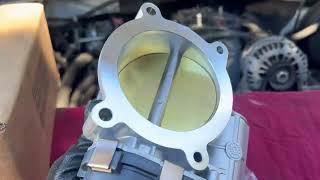
How to confirm: Remove the air intake tube from the throttle body and visually inspect for a thick, black ring of carbon buildup around the throttle plate and bore. A mechanic noted that on these trucks, a TPS angle reading above 20% at idle on a scan tool is a strong indicator of a dirty throttle body that the ECM is trying to compensate for.
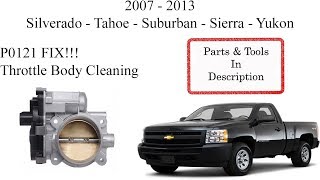
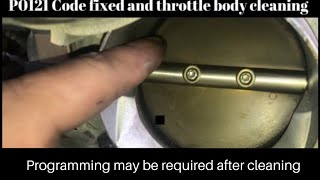
Typical fix: Thoroughly clean the throttle body bore and plate with a dedicated throttle body cleaner and a soft brush or rag. 🎬 Watch: Step-by-step guide to cleaning your Silverado throttle body. It is critical to perform a throttle relearn procedure afterward, otherwise a high idle and new codes may result.
Est. part cost: $5-$15 - Failing Throttle Body Assembly 🟡 Medium Probability The Throttle Position Sensor (TPS) is integrated into the throttle body and is not sold as a separate, reliable part for most of these models. Electronic failure of the internal sensor or the actuator motor requires replacing the entire unit. This is a common failure on high-mileage vehicles, as noted in TSB #PIP4578B.
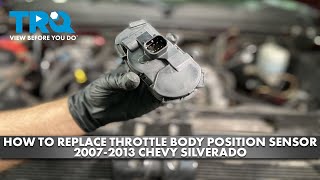
How to confirm: If cleaning the throttle body does not resolve the code (or it returns quickly), and the wiring is confirmed to be good, the throttle body assembly itself is the likely culprit. 🎬 See how to replace the assembly and perform a relearn. A scan tool can monitor the TPS voltage for erratic readings or dropouts as the pedal is pressed.
Typical fix: Replace the entire throttle body assembly and the gasket. An idle relearn procedure is necessary after replacement. Many owners and mechanics strongly recommend using an OEM ACDelco part, as some aftermarket units can have issues with the relearn procedure.
Est. part cost: $120-$300 - Wiring or Connector Issue ⚪ Low Probability The wiring harness to the throttle body is exposed to engine heat and vibration, which can cause wires to fray or the connector pins to lose tension or corrode over time. A user on GMTNation noted that wiring issues are a very common cause, sometimes more so than the part itself.
How to confirm: Visually inspect the wiring harness leading to the throttle body for any signs of damage, chafing, or melting. Unplug the connector and check for corrosion or backed-out pins. Wiggle the harness with the engine running to see if it triggers the fault or changes engine behavior. 🎬 Watch this mechanic diagnose and repair a P0121 code.
Typical fix: Repair the damaged section of wire or replace the connector pigtail.
Est. part cost: $15-$40
Diagnosis Steps
- Read all diagnostic trouble codes with an OBD-II scanner. Note any other codes present and review freeze frame data to see the engine conditions when the code was set.
- Visually inspect the air intake tube for cracks or loose connections, then remove it to access the throttle body.
- Inspect the throttle body bore and plate for heavy carbon buildup. The backside of the plate is often the dirtiest.
- If dirty, clean the throttle body thoroughly. With the key OFF, use a dedicated throttle body cleaner and a soft rag or brush. Do not use brake cleaner, as it can damage plastic components. Manually open the plate to clean all surfaces.
- After cleaning or replacement, perform a throttle relearn procedure. A common method without a scan tool is: let the truck idle for 3 minutes, turn it off for 60 seconds, and idle for another 3 minutes. However, TSB #PIP4578B states this may not work and a scan tool (like a Tech 2) provides the most reliable method to reset idle learn values. Driving for 50-300 miles may also allow the computer to relearn on its own, but can result in a temporary high idle.
- If the code returns, inspect the wiring harness and connector at the throttle body for damage, corrosion, or loose pins.
- Using a scan tool with live data, monitor the TPS voltage (or percentage). It should sweep smoothly from its idle value (e.g., ~0.5V) to wide-open throttle (~4.5V) without any glitches or dropouts as you slowly press the gas pedal (with the engine off, key on).
- If cleaning and wiring inspection do not solve the issue, and the live data is erratic, replace the throttle body assembly.
Parts You'll Likely Need
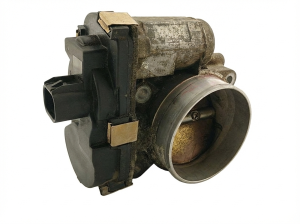
- Throttle Body Assembly
(OEM #ACDelco 12679524 (Supersedes 217-3151, verify by VIN))— This is the most common fix if cleaning fails. The TPS is integrated into the assembly. Using an OEM part is highly recommended to avoid relearn and performance issues.
Trusted brands: ACDelco (OEM), Standard Motor Products, Duralast
OEM price range: $200-$280
Aftermarket price range: $120-$180 - Throttle Body Gasket
(OEM #Mahle G31974 (Example, verify by VIN))— A new gasket should always be used when the throttle body is removed and reinstalled to prevent vacuum leaks.
Trusted brands: Fel-Pro, ACDelco, Mahle
OEM price range: $10-$20
Aftermarket price range: $5-$15 - Throttle Body Cleaner — Required for the first and most important diagnostic step: cleaning the throttle plate and bore. Use a product specifically designed for throttle bodies.
Trusted brands: CRC, Berryman
OEM price range: $5-$15
Aftermarket price range: $5-$15
Related Codes That Often Appear With This One
- P0171 — Indicates a lean condition on Bank 1. A faulty throttle position reading can cause the ECM to miscalculate airflow, leading to an incorrect fuel mixture. This was seen in NHTSA complaint #10542787.
- P0174 — Indicates a lean condition on Bank 2, for the same reason as P0171. This was also seen in NHTSA complaint #10542787.
- P1516, P2101, P2119 — These are all GM-specific codes related to the Throttle Actuator Control (TAC) module and throttle body performance. They often appear with P0121 and are mentioned together in TSB #PIP4578B, pointing to a comprehensive failure of the throttle control system.
- P0507 — Indicates Idle Air Control System RPM Higher Than Expected. This code can appear after cleaning a throttle body if the idle relearn procedure is not performed correctly, as the ECM is still compensating for the now-removed carbon buildup.
Technical Service Bulletins (TSBs) & Recalls
- Bulletin #PIP4578B: Mentions P0121 in the context of idle surge and reduced engine power mode on high mileage vehicles, suggesting a known pattern with the throttle body. It explicitly states that cleaning the throttle body requires an idle learn reset to prevent further issues.
Platform-Specific Known Issues
- Cleaning is a temporary fix for some: Multiple owners on forums report that cleaning the throttle body resolved the P0121 code, but only for a few weeks or months, after which the code returned and replacing the entire throttle body was necessary for a permanent fix.
- High Idle After Cleaning: A very common owner experience is a high, surging idle (1500-2500 RPM) immediately after cleaning the throttle body. This happens because the ECM had learned to open the throttle wider to compensate for carbon, and now that the restriction is gone, the learned position is too high. Performing an idle relearn procedure is necessary to correct this.
Mechanic-Grade Diagnostic Values
- TPS1 and TPS2 Voltage Sweep (Key On, Engine Off) — expected: These two sensors work opposite each other. As the throttle opens, one sensor's voltage will sweep up (e.g., ~1V to ~4V) while the other sweeps down (e.g., ~4V to ~1V). The sum of the two voltages should remain constant at approximately 5V.. Failure: Any glitches, spikes, dropouts, or a non-linear sweep on either sensor's voltage indicates a fault. If the sum of the two voltages deviates from 5V, there is a problem.
- 5-Volt Reference at Throttle Body Connector — expected: 4.8V - 5.2V between the 5V reference wire (typically gray) and the low reference/ground wire.. Failure: Voltage below 4.8V or above 5.2V points to a problem with the ECM or the wiring, not necessarily the throttle body itself.
- Throttle Actuator Motor Resistance — expected: Between 2 and 15 Ohms when measured across the two motor control terminals (often pins A and B) on the throttle body.. Failure: A reading significantly outside this range, especially an open circuit (infinite resistance) or a short (near zero), indicates the internal motor has failed and the assembly needs replacement.
Scan Tool Commands That Help
- Tech 2 / GDS2: Idle Learn Reset / Throttle/Idle Learn — This function should be used immediately after cleaning or replacing the throttle body. It forces the ECM to erase its previously learned idle airflow compensation values, which were based on the old, dirty throttle body. Using the scan tool function is the most reliable way to prevent a high or surging idle and is superior to manual relearn methods.
Wiring & Ground Locations
- G103 — On the front of the passenger side (right) cylinder head on GMT900 models.. This is a primary engine ground. A loose or corroded connection here can create a floating ground, causing erratic voltage readings for multiple sensors, including the throttle position sensor, leading to a P0121 code even if the sensor and wiring are good.
- G104 — On the rear of the driver's side (left) cylinder head on GMT900 models.. Similar to G103, this is another critical engine-to-chassis ground. It is known to become loose or corroded and can cause intermittent and hard-to-diagnose electronic issues, including throttle control faults.
- Throttle Body Connector (C109) — The 8-pin electrical connector plugged directly into the throttle body assembly.. This is the single point of failure for all signals to and from the throttle body. Check for backed-out pins, corrosion (especially in wet climates), and chafed wires in the harness leading to this connector. The dark green signal wire has been noted as a common point of failure.
Real Owner Repair Stories
- PerformanceTrucks.net Forums (2008 Silverado) — P0121 code with a high idle of 1500 RPM in Park.
❌ Tried (didn't work) Wiping down the throttle body initially made the high idle problem worse.
✅ What actually fixed it The user was advised that cleaning may not be enough and that the entire throttle body assembly often needs replacement as the sensor is integrated. Another user noted that if replacement is needed, the part is covered under the 5yr/100k mile powertrain warranty, which is a critical piece of information for owners. - Cobalt SS Network (similar GM 2.4L engine with same issue) (2006 Cobalt SS with 194k miles) — P0121 code, high idle of 2800 RPM after cleaning the throttle body, surging up to 4000 RPM when driving.
❌ Tried (didn't work) The manual '3 minute idle, 60 seconds off, 3 minute idle' relearn procedure did nothing.
✅ What actually fixed it The owner drove the vehicle for approximately 300 miles over a couple of days. The ECU eventually relearned the correct idle parameters on its own, and the high idle issue resolved itself without further intervention. This demonstrates that if a scan tool is not available, the 'drive cycle relearn' can work, but it takes time and patience.
OEM Part Supersession History
12572658, 12580760→12679524— Standard part evolution, likely for improved reliability or manufacturing efficiency.
Heads up: While physically similar, some aftermarket throttle bodies have been reported by owners to fail the idle relearn procedure or have a shorter lifespan. Using the OEM ACDelco part (12679524) is strongly recommended for compatibility.
Model Year Variations Within This Range
- 2006-2007: In 2007, Chevrolet sold both the old GMT800 body style (as the 'Classic') and the new GMT900. The Classic models are a carry-over from the 1999-2006 generation. While both use electronic throttle control, the specific part numbers for the throttle body and related components may differ. It is critical to identify the vehicle as a 'Classic' or 'New Body Style' when ordering parts.
Helpful Videos
We Have This Part in Stock




The information in this article is provided for general reference and educational purposes only. Vehicle specifications, procedures, and part compatibility can vary by production date, trim level, and region. Always consult your vehicle's factory service manual and verify part numbers before purchasing or performing repairs. Safety-critical components such as airbags, seat belts, and braking systems should be installed by a qualified professional.
- Chevrolet SILVERADO 1500:
- 🎬 Helpful Videos
- 🛍️ Shop This Part
- What's Unique About the 2006-2013 Chevrolet Silverado 1500
- Diagnostic Flowchart
- Symptoms You May Notice
- Most Likely Causes
- Diagnosis Steps
- Parts You'll Likely Need
- Related Codes That Often Appear With This One
- Technical Service Bulletins (TSBs) & Recalls
- Platform-Specific Known Issues
- Mechanic-Grade Diagnostic Values
- Scan Tool Commands That Help
- Wiring & Ground Locations
- Real Owner Repair Stories
- OEM Part Supersession History
- Model Year Variations Within This Range
- 🎟️ Get 5% Off