

P0121 on 2011-2018 Chevrolet Camaro: Causes and Fixes for Throttle Position Issues
On a 2011-2018 Camaro, code P0121 usually means the throttle body is dirty with carbon buildup. The most common fix is cleaning the throttle body and performing an idle relearn procedure. If that fails, the entire throttle body assembly, which includes the integrated sensor, likely needs replacement. This issue is common across many GM vehicles with similar engines.
- P0121 on a 2011-2018 Camaro is a serious code that will likely put the car in 'Reduced Engine Power' mode.
- The first and most likely fix is to clean the carbon buildup from the throttle body and perform an idle relearn with a scan tool.
- The throttle position sensor (TPS) is built into the throttle body; if the sensor has failed, the entire assembly must be replaced.
- Do not confuse this with an accelerator pedal problem; P0121 points directly to the throttle body assembly.
What's Unique About the 2011-2018 Chevrolet CAMARO
For this generation of Camaro, especially on higher-mileage vehicles, P0121 is strongly associated with carbon buildup inside the throttle body from the PCV system. A specific General Motors Technical Service Bulletin (TSB PIP4578B) addresses this exact issue, noting that accumulated carbon can restrict throttle plate movement, leading to this code and a 'Reduced Engine Power' state. Unlike older cars where the TPS was a separate, replaceable part, on the 2011-2018 Camaro it is integrated into the throttle body assembly, meaning the entire unit must be replaced if the sensor fails.
Diagnostic Flowchart
Tap your situation to follow the diagnostic path that matches what you're seeing on this vehicle.
Generation note: This range covers the end of the 5th Generation (2011-2015) and the start of the 6th Generation (2016-2018). While the engines and specific part numbers for the throttle body differ (e.g., LFX V6 vs LS3/LT1 V8), the root cause of P0121—carbon buildup or electronic failure of the throttle body—is common to both generations. The diagnostic and repair approach is fundamentally the same.
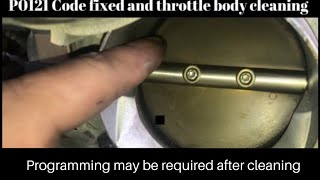
🎬 Watch: A professional diagnostic and repair walkthrough for code P0121.Symptoms You May Notice
- Check Engine Light is on
- "Reduced Engine Power" message displayed
- Hesitation or stumbling during acceleration
- Rough or unstable idle
- Engine may stall at low speeds
- Poor or erratic throttle response
- Engine revs up when coming to a stop
- Transmission shifts hard or improperly
- Replacing the Accelerator Pedal Position (APP) sensor. While the pedal sensor also relates to throttle control, P0121 specifically points to a performance issue at the throttle body itself. Other codes, like P2138, are more specific to the APP sensor.
Most Likely Causes
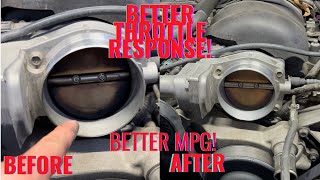
- Dirty Throttle Body 🔴 High Probability As identified in GM TSB PIP4578B, carbon from the PCV system builds up in the throttle body bore on high-mileage vehicles. This buildup restricts the throttle plate's movement, causing a mismatch between the commanded and actual throttle position that triggers P0121.
How to confirm: Remove the air intake tube from the throttle body and visually inspect the throttle plate and bore for a layer of black carbon soot.
Typical fix: Clean the throttle body thoroughly with a dedicated throttle body cleaner and a soft cloth. After cleaning, an 'Idle Learn Reset' procedure must be performed. This can be done with a capable scan tool or by a manual procedure.
Est. part cost: $5-$15 - Failing Throttle Body Assembly 🟡 Medium Probability The integrated Throttle Position Sensor (TPS) can fail electronically. Since it is not sold as a separate component for these models, the entire throttle body assembly must be replaced.
How to confirm: If cleaning the throttle body does not resolve the code, use a scan tool to monitor the TPS 1 and TPS 2 voltages while slowly pressing the accelerator pedal (with the engine off, key on). The voltages should sweep smoothly in opposite directions (one rising, one falling) and their sum should remain near 5.0V. Jumps or dropouts indicate a faulty sensor.
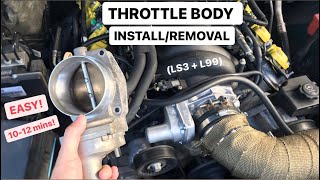
Typical fix: Replace the entire throttle body assembly and the corresponding gasket. 🎬 Watch this step-by-step guide to replacing the throttle body assembly. Perform an 'Idle Learn Reset' procedure after installation.
Est. part cost: $150-$500 - Wiring or Connector Issue ⚪ Low Probability Engine vibration and heat can, over time, cause issues with the wiring harness or the electrical connector at the throttle body. Fretting corrosion can build up on the connector pins, causing an intermittent signal.
How to confirm: Visually inspect the wiring harness leading to the throttle body for any signs of chafing, melting, or damage. Unplug the connector and check for corrosion, moisture, or bent/loose pins. Wiggling the harness with the engine running may trigger the fault.
Typical fix: Repair the damaged section of wire or clean the connector pins. Applying a small amount of dielectric grease can help prevent future corrosion. In some cases, the connector pigtail may need to be replaced.
Est. part cost: $10-$50
Rare But Worth Checking
- Faulty Engine Control Module (ECM): This is extremely rare. The ECM should only be considered after all other possibilities, including the throttle body and wiring, have been definitively ruled out.
- Aftermarket/Ported Throttle Body: Installing a larger or ported throttle body can sometimes allow more air than the stock tune expects, causing the ECM to set a P0121 code. This situation often requires a custom tune to adjust the ECM's parameters.
Diagnosis Steps
- Read the trouble codes with an OBD-II scanner and note any other codes present.
- Visually inspect the wiring and connector at the throttle body for any obvious damage, looseness, or corrosion. Check for fretting corrosion on the pins.
- Remove the air intake hose from the throttle body.
- Inspect the throttle body bore and plate for carbon buildup.
- If carbon is present, remove the throttle body (typically 4 bolts), clean it thoroughly off the vehicle using throttle body cleaner and a soft rag. Do not spray cleaner directly into the electronic components.
- Reinstall the throttle body with a new gasket.
- Perform an 'Idle Learn Reset'. The preferred method is with a scan tool. A manual procedure can also be attempted: Start the engine and let it idle in Park for 3 minutes. Turn the engine off for 60 seconds. Start the engine again and let it idle for another 3 minutes. A drive cycle may be required afterward.
- If the code returns, use a scan tool to monitor live data for 'TP Sensor 1 Voltage' and 'TP Sensor 2 Voltage'. The readings should be smooth as you slowly operate the pedal (engine off, key on). Jumps or dead spots indicate a failed sensor.
- If the sensor is confirmed to be faulty, replace the entire throttle body assembly and gasket.
- Perform the 'Idle Learn Reset' again after replacing the part.
Parts You'll Likely Need
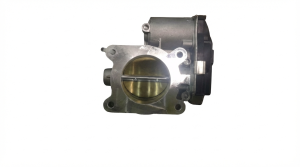
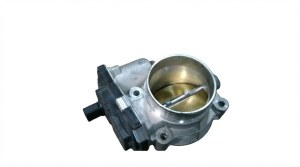
- Throttle Body Assembly
(OEM #V6 (LFX): 12670981; V8 (LS3/L99): 12601387 (superseded by 19420707); V8 (LT1): 12678224)— This is the most common repair if cleaning fails. The sensor is integrated. Part numbers vary by engine and year, so always verify with VIN.
Trusted brands: ACDelco, Bosch, Duralast
OEM price range: $250-$500
Aftermarket price range: $95-$250 - Throttle Body Cleaner — Required for the most common and first-step solution: cleaning carbon buildup.
Trusted brands: CRC, Berryman
OEM price range: $5-$15
Aftermarket price range: $5-$15 - Throttle Body Gasket — Should always be replaced when the throttle body is removed to prevent vacuum leaks.
Trusted brands: ACDelco, Fel-Pro
OEM price range: $10-$20
Aftermarket price range: $5-$15
Related Codes That Often Appear With This One
- P0068 — Relates to a mismatch between MAP/MAF sensor readings and throttle position. Listed as a related code in TSB PIP4578B.
- P1516 — A GM-specific code indicating an issue with the Throttle Actuator Control (TAC) module performance. Also listed in TSB PIP4578B.
- P2101 — Indicates a performance problem with the throttle actuator control motor circuit. Also listed in TSB PIP4578B.
- P2119 — Relates to the throttle actuator control throttle body range/performance. Also listed in TSB PIP4578B.
- P2176 — Indicates the ECM has not learned the throttle body idle position. This often appears after a throttle body is cleaned or replaced without performing the relearn procedure, as noted in TSB PIP4578B.
- P2135 — Indicates a correlation error between the two internal throttle position sensors (A/B). This often points directly to a failing throttle body.
Technical Service Bulletins (TSBs) & Recalls
- PIP4578B: Addresses idle surge, reduced engine power, and DTCs including P0121, P0068, P1516, P2101, P2119, and P2176 on high-mileage vehicles. It confirms the cause is often carbon buildup in the throttle body and explicitly states that cleaning must be followed by an idle learn reset.
Platform-Specific Known Issues
- As per TSB PIP4578B, high-mileage Camaros are prone to carbon buildup in the throttle body, which directly causes P0121 and associated symptoms like idle surge and reduced engine power.
- Failure to perform an 'Idle Learn Reset' with a proper scan tool after cleaning or replacing the throttle body can cause the code to return immediately, along with other codes like P2176.
- Some owners on forums report that cleaning the throttle body provides only a temporary fix or no fix at all, with the P0121 code returning shortly after. In these cases, replacing the entire throttle body assembly was the final solution.
Mechanic-Grade Diagnostic Values
- TPS 'A' (TPS1) Signal Voltage — expected: Approx. 0.5V - 0.7V at closed throttle (idle) and sweeps smoothly up to approx. 4.5V at Wide Open Throttle (WOT).. Failure: Voltage is outside the expected range, does not change smoothly, or has sudden drops/spikes when the throttle is opened.
- TPS1 vs. TPS2 Voltage Correlation — expected: TPS1 and TPS2 voltages should move in opposite directions (one increases, one decreases). Their sum should remain constant at approximately 5.0V throughout the throttle range.. Failure: The sum of the two voltages deviates significantly from 5.0V, or one sensor does not respond, indicating an internal fault in the throttle body assembly.
- 5-Volt Reference Circuit — expected: A steady 5.0V (+/- 0.5V) should be present at the 5V reference pin on the throttle body connector with the key on, engine off.. Failure: Voltage is significantly lower or higher than 5.0V, or is absent. This could indicate a wiring issue or a fault in the ECM.
Scan Tool Commands That Help
- GDS2, Autel, Launch, or other professional scan tool: Idle Learn Reset / Throttle Relearn — This function is mandatory after cleaning or replacing the throttle body. It resets the ECM's learned values for the closed throttle position, preventing high idle, stalling, and the return of codes like P2176.
- Any capable OBD-II scan tool with live data: Live Data Monitoring: TP Sensor 1 and TP Sensor 2 — Used to diagnose a faulty sensor. Graphing both PIDs while slowly operating the throttle (Key On, Engine Off) should show two smooth, opposing lines. Any glitches, flat spots, or jumps indicate a failing sensor within the throttle body.
Wiring & Ground Locations
- Throttle Body Connector (X1) — Directly on the electronic throttle body assembly at the front of the engine.. This is the primary connection point for the TPS and throttle actuator motor. It is susceptible to corrosion, pin fretting, and harness damage from heat and vibration, which can cause intermittent P0121 codes.
- G103 — On the cowl in the left rear of the engine compartment, often above the brake booster.. This is a major ground point for several critical modules, including the Body Control Module (BCM) and the Data Link Connector (DLC). A poor ground here can cause a wide range of difficult-to-diagnose electronic issues, including erratic sensor readings.
- G102 — Located at the left rear of the engine, typically on the cylinder head.. This ground point serves the ignition coils. While not directly for the TPS, electrical noise from a poor ignition ground can potentially interfere with sensitive sensor signals processed by the ECM.
- ECM (Engine Control Module) — Located in the right front of the engine compartment for the 2011 SS model.. All throttle body signals are sent to and processed by the ECM. Knowing its location is critical for end-to-end circuit testing (checking for continuity and shorts) if a wiring fault is suspected.
Real Owner Repair Stories
- Camaro5 forum user 'The_bald_eagle_machine' (2011 Chevrolet Camaro 2SS/RS) — Flashing Check Engine Light with code P0121.
❌ Tried (didn't work) Cleaning the throttle body.
✅ What actually fixed it The code returned immediately after cleaning. The user concluded the electronic sensor was faulty and ordered a new throttle body assembly and an accelerator pedal, though the final confirmed fix was not posted. This story illustrates that cleaning is not always a sufficient fix. - Camaro6 forum user 'Ajs16400' (2017 Camaro SS with LT4 supercharger and aftermarket 95mm throttle body.) — Check Engine Light with codes P0121 and P1101.
❌ Tried (didn't work) Blaming the throttle body (tuner's opinion) or blaming the tune (throttle body manufacturer's opinion).
✅ What actually fixed it The suggested fix was to use a tuning software (like HP Tuners) to disable the diagnostic tests for P0121 within the ECM's calibration. This is often required when aftermarket throttle bodies flow air differently than the stock unit, causing the ECM to perceive a performance error. - Camaro5 forum user 'FistfulofSam' (2010 Camaro 3.6L V6 with 86k miles.) — Reduced Engine Power mode with codes P0223, P2176, and P0121.
❌ Tried (didn't work) Dealer reprogrammed the ECM, which did not solve the issue.
✅ What actually fixed it The problem started immediately after the owner tried to pry open the plastic side cover of the throttle body during cleaning. The dealership misdiagnosed it as a faulty ECM. The actual cause was the physical damage to the throttle body's internal electronics during the cleaning attempt. The correct fix was to replace the damaged throttle body assembly.
When the Usual Fixes Don't Work
- While cleaning the throttle body is the most cited first step and is referenced in GM's own TSB, numerous owner experiences show this is often not a permanent solution. In many documented cases, the P0121 code returned shortly after cleaning. The underlying cause was not the carbon restricting the plate, but rather the failure of the integrated electronic throttle position sensor itself. This suggests that if the vehicle has higher mileage, the probability of the sensor failing electronically is significant, and cleaning may only be a temporary fix before an inevitable replacement of the entire throttle body assembly is required.
OEM Part Supersession History
12601387→19420707— Standard part revision and replacement by manufacturer.
Model Year Variations Within This Range
- 2011-2015 (5th Gen) vs 2016-2018 (6th Gen): The primary difference is the engine lineup. 5th Gen models use the LFX V6 and LS3/L99 V8s, while 6th Gen models use the LGX V6 and LT1 V8. These engines use different throttle body designs and part numbers. While the root cause (carbon, electronic failure) and diagnostic procedure are the same, the physical part being replaced is not interchangeable between generations or even engine types.
Helpful Videos
We Have This Part in Stock





The information in this article is provided for general reference and educational purposes only. Vehicle specifications, procedures, and part compatibility can vary by production date, trim level, and region. Always consult your vehicle's factory service manual and verify part numbers before purchasing or performing repairs. Safety-critical components such as airbags, seat belts, and braking systems should be installed by a qualified professional.
- Chevrolet CAMARO:
- 🎬 Helpful Videos
- 🛍️ Shop This Part
- What's Unique About the 2011-2018 Chevrolet CAMARO
- Diagnostic Flowchart
- Symptoms You May Notice
- Most Likely Causes
- Rare But Worth Checking
- Diagnosis Steps
- Parts You'll Likely Need
- Related Codes That Often Appear With This One
- Technical Service Bulletins (TSBs) & Recalls
- Platform-Specific Known Issues
- Mechanic-Grade Diagnostic Values
- Scan Tool Commands That Help
- Wiring & Ground Locations
- Real Owner Repair Stories
- When the Usual Fixes Don't Work
- OEM Part Supersession History
- Model Year Variations Within This Range
- 🎟️ Get 5% Off