

OBD-II Code P0120: Throttle Position Sensor 'A' Circuit Malfunction
The Ultimate 2026 Guide: What P0120 Means, Why It Triggers, and How to Fix It—For Good
- P0120 flags an electrical circuit failure in the primary Throttle Position Sensor ('A' Circuit), meaning the computer receives erratic or zero voltage.
- Clean the throttle body first; this $15 DIY fix resolves sticking throttle plates that frequently trigger P0120 before you spend $200+ on parts.
- Driving with P0120 is dangerous because the vehicle frequently forces a 20-mph 'limp mode' or stalls unexpectedly in traffic.
- Test the 5-volt reference wire with a multimeter before replacing the sensor; a missing 5V signal guarantees the problem is in the wiring or PCM.
- Ignoring P0120 drops fuel economy by up to 25% and dumps unburned fuel into the exhaust, destroying a $1,500 catalytic converter within months.
What Does P0120 Mean?

The Powertrain Control Module (PCM) detected a voltage malfunction in the 'A' circuit of the Throttle Position Sensor (TPS). The TPS tells the computer how far open the throttle blade is, matching your gas pedal input. When the PCM receives a voltage signal outside the expected 0.5V to 4.5V range, it triggers P0120 and activates fail-safe driving modes.
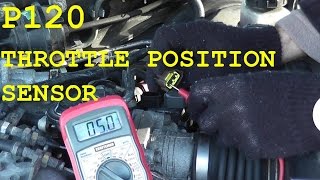
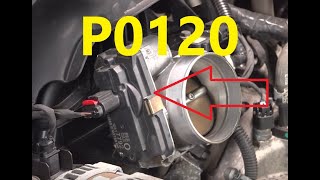
🎬 Watch: A breakdown of P0120 causes and common fixes.Technical definition: The official definition is "Throttle/Pedal Position Sensor/Switch 'A' Circuit Malfunction." This indicates the PCM registered a voltage signal from the primary ('A') throttle or pedal position sensor circuit that falls outside predefined operational parameters. In drive-by-wire systems, this points to either the sensor on the throttle body or the Accelerator Pedal Position (APP) sensor.
Can I Drive With P0120?
Yes, But With Caution. You can drive, but doing so risks your safety. Your vehicle frequently enters a reduced-power 'limp mode,' stalls unexpectedly, or hesitates severely in traffic. Continuing to drive forces a rich fuel mixture, dropping fuel economy by up to 25% and destroying your catalytic converter—a $1,500+ repair—within months.
Common Causes

- Faulty Throttle Position Sensor (TPS) (Very Common) — The internal potentiometer wears out, creating dead spots or erratic voltage signals. The signal drops to 0V, spikes above 5V, or fails to sweep smoothly, feeding the PCM garbage data. 🎬 See how to test and replace a faulty TPS sensor.
- Dirty or Sticking Throttle Body (Common) — Carbon and oil residue accumulate in the throttle body bore, causing the throttle plate to stick. This physical obstruction prevents the TPS from accurately reporting the plate's true position.
- Damaged Wiring or Corroded Connectors (Common) — Engine heat and vibration fray the TPS wiring harness or cause shorts to ground/power. Connector pins corrode or loosen, causing an intermittent or complete loss of the 5V reference signal.
- Blown Electronic Throttle Fuse (Uncommon) — A dedicated fuse (often labeled 'ETCS' or 'Sensor Power') protects the TPS circuit. A blown fuse cuts power to the sensor, immediately triggering the fault code.
- Faulty Accelerator Pedal Position (APP) Sensor (Less Common) — In electronic throttle systems, the APP sensor on the gas pedal fails. If its signal contradicts the TPS signal, the PCM triggers P0120.
- Jammed Floor Mats (Uncommon) — A thick or improperly placed floor mat physically obstructs the accelerator pedal, preventing it from returning to idle. This creates a signal discrepancy between the APP and TPS sensors.
- PCM Software or Hardware Failure (Rare) — The PCM requires a software update to fix overly sensitive fault triggers, or the PCM's internal analog-to-digital converter fails. Consider this only after exhausting all electrical tests.
Symptoms

- Limp Mode / Reduced Power — The PCM activates a failsafe mode, severely restricting engine power, throttle response, and capping vehicle speed to around 20-30 mph.
- Check Engine Light is On — The PCM illuminates the Malfunction Indicator Lamp (MIL) immediately upon detecting the voltage discrepancy.
- Poor or Hesitant Acceleration — The vehicle feels sluggish, jerky, or unresponsive when pressing the gas pedal due to conflicting throttle data.
- Rough Idle or Stalling — The engine idles erratically or stalls at stops because the PCM cannot accurately determine the closed-throttle position.
- Incorrect Transmission Shifting — The Transmission Control Module (TCM) uses TPS data for shift points. A bad signal causes hard, erratic, or delayed shifting.
- Poor Fuel Economy — An inaccurate TPS signal forces the PCM to command an overly rich fuel mixture, decreasing gas mileage by 15-25%.
Diagnostic Flowchart
Tap your situation to follow the diagnostic path that matches what you're seeing on this code.
Common Fixes & Costs
- Cleaning the Throttle Body — Parts: $10-$20, Labor: $75-$150, ~0.8 hr book time (DIY)
- Replacing the Throttle Position Sensor (TPS) — Parts: $40-$150, Labor: $130-$200, ~1.0 hr book time (DIY)
- Repairing Damaged Wiring or Connectors — Parts: $10-$50, Labor: $150-$350, ~1.5 hr book time (Intermediate)
- Replacing the Entire Throttle Body Assembly — Parts: $200-$700, Labor: $130-$260, ~1.2 hr book time (Intermediate)
- Replacing the Accelerator Pedal Position (APP) Sensor — Parts: $70-$250, Labor: $65-$150, ~0.7 hr book time (DIY)
Used vs. New Parts: Buying Guide
When a used part is worth it: Buy new for a standalone TPS. For an expensive, integrated throttle body assembly on a vehicle over 150,000 miles, a used part from a low-mileage donor saves hundreds of dollars.
Donor-vehicle mileage cap: roughly under 80000 miles for the part to have meaningful remaining life.
Donor quality checklist:
- Verify the donor vehicle's mileage; lower is mandatory.
- Ensure the part includes a 30-90 day warranty.
- Match the part number exactly to avoid ECU coding failures.
Decision logic:
- If Fix is a standalone sensor → Always buy new. The savings are minimal and the risk of premature failure is high.
- If Fix is an integrated throttle body and the vehicle is over 150K miles → A low-mileage used part is a cost-effective choice.
- If The vehicle is newer or has low mileage → Buy a new OEM part to maximize reliability.
Warranty tradeoff: Used parts offer a 30-day part-only warranty. New aftermarket parts offer 1-year warranties. New OEM parts carry a 2-year warranty.
Worst-case if a used part fails: $200-$500 if a used throttle body fails, covering repeat labor costs.
What Happens If You Wait — Timeline
- 0-1 month: Intermittent Check Engine Light and slight hesitation from a stop. Indicates an early-stage wiring short or dirty throttle body. (MPG impact: 0-5%% · Added cost: $0-$20 in wasted fuel)
- 1-3 months: Check Engine Light remains on. The car unexpectedly enters 'limp mode' with reduced power and erratic shifting. (MPG impact: 10-15%% · Added cost: $50-$100 in wasted fuel)
- 3-6 months: Frequent stalling at stops. The consistently incorrect air/fuel mixture overheats the catalytic converter, reducing its efficiency. (MPG impact: 15-25%% · Added cost: $200-$400 in wasted fuel and fouled spark plugs)
- 6+ months: Catastrophic failure of the catalytic converter. The internal substrate melts and clogs the exhaust, preventing the engine from running. (MPG impact: 25%+% · Added cost: $1200-$3000+ for catalytic converter and O2 sensor replacement)
Cost of Not Fixing It
- 0-1 month: Noticeable drop in fuel economy, poor acceleration, and stalling in traffic. (Added cost: $50-$150 in wasted fuel)
- 1-6 months: An incorrect air/fuel ratio overheats the catalytic converter, causing internal melting and complete blockage. (Added cost: $1200-$2800 for catalytic converter replacement)
- 6+ months: Sustained rich fuel conditions foul spark plugs and oxygen sensors, triggering misfire codes. (Added cost: $200-$500 for plugs and sensors)
Diagnosis Steps

- Scan Codes and Review Freeze Frame Data
Use an OBD-II scanner to confirm P0120. Note companion codes (P0121, P0122, P0220). Review freeze frame data to identify the exact engine speed, temperature, and load when the fault triggered.
Tools: OBD-II Scanner (Beginner) - Perform a Visual Inspection & Check Floor Mats
Inspect the TPS, its connector, and the wiring harness for frayed wires, rodent damage, or green corrosion on pins. Ensure the floor mat is not wedged under the accelerator pedal.
Tools: Flashlight (Beginner) - Check the Electronic Throttle Fuse
Locate the fuse boxes and check for a blown fuse labeled 'ETCS' or 'Sensor Power'. A blown fuse cuts the 5V reference to the sensor and instantly triggers P0120.
Tools: Fuse Puller or Pliers (Beginner) - Analyze Live TPS Data
With the key 'ON' and engine off, view live 'Throttle Position' data on a scanner. Slowly press the gas pedal. The reading must sweep smoothly from 0-10% (idle) to 90-100% (wide-open). Jumps, dead spots, or fixed values confirm a sensor or wiring fault.
Tools: Advanced OBD-II Scanner (Intermediate) - Perform a Wiring Harness 'Wiggle Test'
While watching the live TPS voltage on your scanner, vigorously wiggle the wiring harness at the sensor connector and along its path. If the voltage drops out or spikes, you have an intermittent open or short in the wiring.
Tools: Advanced OBD-II Scanner (Intermediate) - Test Circuit Voltages with a Multimeter
Disconnect the TPS. Key on, engine off. Probe the harness: you need a 5V reference (4.5-5.5V) and a ground (~0V). If missing, the wiring or PCM is bad. Reconnect and backprobe the signal wire. Voltage must sweep smoothly from ~0.5V to ~4.5V as you open the throttle.
Tools: Multimeter, Backprobe Kit (Advanced) - Test Sensor Resistance
Disconnect the sensor. Measure resistance (Ohms) between the 5V and ground pins (typically 2.0k-5.0k Ohms). Measure between signal and ground while rotating the sensor. Resistance must sweep smoothly without sudden jumps.
Tools: Multimeter, Vehicle-specific resistance specs (Advanced) - Check for Technical Service Bulletins (TSBs)
Search for manufacturer TSBs. Nissan and GM frequently release software updates to fix overly sensitive PCM calibrations that falsely trigger P0120.
Tools: Internet Access (Beginner) - Use a Lab Scope for Definitive Proof
Connect an oscilloscope to the signal and ground wires. Open and close the throttle. The waveform must be a clean line. Sharp vertical drops ('dropouts') definitively prove a failing internal resistive track.
Tools: Digital Oscilloscope (Advanced)
When This Code Triggers (Freeze-Frame Conditions)
- Engine Coolant Temp: 180-200°F (Fully warmed up during steady-state driving.)
- RPM: 1500-2500 (Cruise or steady throttle application.)
- Engine Load: 30-60% (Light to moderate load, consistent with highway cruising.)
- Vehicle Speed: 35-55 mph (Steady speed where throttle position remains constant.)
Related Codes
- P0121 — P0121 is a logic failure (signal exists but doesn't match MAP/MAF data). P0120 is a hard circuit failure (no signal or short). Seeing both points to an intermittently failing sensor.
- P0122 — Indicates a low voltage input (< 0.2V). Caused by a short to ground in the signal wire. P0120 is general; P0122 pinpoints the voltage as too low.
- P0123 — Indicates a high voltage input (> 4.8V). Caused by a short to the 5V reference wire. P0120 is general; P0123 pinpoints excessive voltage.
- P0220 — Relates to the secondary 'B' circuit. Seeing P0120 and P0220 together indicates a failure of the entire throttle body assembly or a shared ground issue.
Climate & Environmental Factors
- High Humidity / Water Intrusion: Moisture accelerates corrosion on TPS connector pins. Engine washing frequently forces water into the seal, causing temporary shorts.
- Extreme Cold: Moisture inside the throttle body freezes, causing the throttle plate to stick open. This creates a mismatch between expected and actual TPS readings on startup.
- Vibration and Heat Cycles: Constant engine vibration and extreme heat cause wiring insulation to crack, driving chafing and short circuits in the TPS harness.
How to Talk to a Mechanic About This Code
Say this: "I have a P0120 code. I authorize one hour of diagnostic time. Please check for a dirty throttle body, inspect the wiring harness, and verify the 5V reference signal before recommending a part replacement."
This directs the mechanic to perform a proper electrical diagnosis instead of immediately replacing the most profitable part, saving you money if the fix is just a cleaning.
Avoid saying:
- 'Just replace the throttle position sensor.'
- 'My check engine light is on, can you look at it?'
- 'Whatever you recommend.'
Questions to ask before authorizing the repair:
- Did you watch the TPS voltage sweep on a scanner?
- Did you find carbon buildup in the throttle body?
- If recommending a new throttle body, is the sensor integrated and failed, or is there another issue?
- Does this quote include the mandatory throttle relearn procedure?
Where to Take It: Dealer vs Independent vs Chain
- Dealer:
Use only if the vehicle is under warranty or requires a dealer-only software flash.
Best for: Vehicles under powertrain warranty., Known manufacturer TSBs requiring a software update.
Downsides: Labor rates are $180-$250/hr., Dealers default to replacing the entire throttle body assembly rather than cleaning it. (Typical cost: +50% vs. baseline) - Independent Shop:
Best fit. A reputable independent shop diagnoses and repairs P0120 effectively and affordably.
Best for: Out-of-warranty vehicles., Diagnosing electrical shorts and performing throttle body cleanings.
Downsides: Diagnostic capabilities vary; ensure they have ASE-certified technicians. (Typical cost: +0% vs. baseline) - Chain Shop:
Avoid for initial diagnosis of an intermittent P0120 fault.
Best for: Simple part replacements after a confident diagnosis is made elsewhere.
Downsides: Lacks advanced diagnostic tools for electrical issues, leading to incorrect part-swapping. (Typical cost: -10% vs. baseline)
When to Walk Away From the Repair
If the estimated repair cost exceeds 40% of the car's private-party value, consider selling it.
- Car worth $4000, fix is $1800: Walk away. A PCM failure at this price signals more electrical issues to come.
- Car worth $12000, fix is $750: Fix it. A throttle body replacement restores critical functionality.
- Car worth $2500, fix is $300: Fix it. A simple TPS replacement is a small investment to keep the car running.
What Scan Tool You Need for This Code

Minimum: A scanner that displays live data, specifically the Throttle Position Sensor voltage.
A $20 code reader only shows the P0120 code. It cannot show the live sensor signal required to spot voltage dropouts.
Budget: BlueDriver Pro or OBDLink MX+ (~$100) — Connects to your smartphone and provides live data graphing to visually track TPS voltage glitches.
Mid-range: Foxwell NT510 Elite or XTOOL D7 (~$180) — Offers bidirectional controls crucial for performing the mandatory 'throttle relearn' procedure after replacement.
Professional: Autel MaxiCOM MK808 (~$500-1200) — Provides OE-level diagnostics and accesses manufacturer-specific data for complex electrical troubleshooting.
Rent vs buy: For a one-time diagnosis, rent a live-data scanner from an auto parts store for free. Buy only if you diagnose vehicles regularly.
How to Clear the Code After You Fix It
- Use an OBD-II scan tool to clear the P0120 code.
- Perform a throttle body relearn procedure via scan tool if the throttle body was cleaned or replaced.
- Perform a complete drive cycle to reset readiness monitors.
Drive cycle (~30 minutes): Cold start the vehicle. Idle for 3 minutes. Drive city streets (25-40 mph) with stops for 15 minutes. Drive steady highway speeds (55-60 mph) for 5 miles. Coast down without braking. Idle for 2 minutes before shutting off.
Readiness monitors affected: Catalyst (CAT) monitor, Oxygen (O2) Sensor monitor, Evaporative (EVAP) System monitor
Before emissions retest: drive at least 100 miles to fully set monitors.
Watch out for:
- Clearing the code without fixing the wiring guarantees the code returns immediately.
- Disconnecting the battery resets all readiness monitors, causing an automatic emissions test failure.
- Skipping the throttle relearn procedure causes a permanent high idle.
Will This Fail Emissions / State Inspection?
Yes — this code typically fails an OBD-II emissions inspection.
- California: An active P0120 is an automatic failure. After repair, it takes 100+ miles of driving to set readiness monitors before a retest.
- New York: An illuminated Check Engine Light and stored P0120 code results in an immediate emissions failure.
- Texas: In emissions-testing counties, an active P0120 fails the OBD-II inspection.
Most Commonly Affected Vehicles
- Toyota Tacoma (2005-2015) — Highly prone to standalone TPS failure. Cleaning the MAF sensor alongside the throttle body resolves airflow discrepancies that trigger the code.
- Ford Focus (2012-2018) — Frequently experiences wiring harness chafing near the TPS connector, leading directly to limp mode. Inspect wiring before replacing the integrated throttle body.
- Honda CR-V (2015-2019) — A dirty throttle body is the primary cause. Cleaning the carbon and performing the idle relearn procedure resolves the code without new parts.
- Chevrolet Cruze (2016-2019) — P0120 is frequently caused by a faulty Accelerator Pedal Position (APP) sensor inside the cabin rather than the TPS on the engine.
- Nissan Rogue (2014-2020) — Often triggered by an ECM software glitch. Check with a dealer for TSB software updates before replacing hardware.
Manufacturer-Specific Notes
- Toyota: The Electronic Throttle Control System fuse is labeled 'ETCS'. A blown ETCS fuse causes P0120 and a no-start condition. Always check this fuse first.
- General Motors (GM): GM requires a specific 'throttle body relearn procedure' after replacement, mandating a bidirectional scan tool to reset the idle parameters.
- Ford: The wiring harness on the Focus and Escape is a known failure point. Wires chafe against the engine block, causing an intermittent short that triggers P0120.
- Honda: Honda advises against spraying cleaner directly into the throttle body to avoid washing out the internal bearing grease. Spray the rag, then wipe.
Real Owner Stories
2017 Honda CR-V with hesitation
Owner noticed hesitation when accelerating and the Check Engine Light illuminated.
What they tried:
- Scanned the vehicle and found code P0120.
Outcome: The issue was a dirty throttle body. Cleaning it with a $10 spray resolved the hesitation and permanently cleared the code.
Lesson: Start with the cheapest fix. A dirty throttle body is a primary cause for P0120 and takes 15 minutes to clean before attempting expensive part replacements.
2002 Toyota 4Runner with intermittent failure
The engine sputtered on the highway and lost throttle response until the pedal was pressed halfway down.
What they tried:
- Replaced the TPS with a used one (failed after 3 days).
- Replaced the coolant temperature sensor.
- Installed a complete used throttle body from a salvage yard.
- Replaced the ECU.
Outcome: The problem persisted and worsened. The actual cause was a damaged wiring harness with an intermittent connection, which the owner never tested.
Lesson: Never fire the parts cannon without a multimeter diagnosis. Intermittent electrical issues stem from wiring problems, not component failure. A simple 'wiggle test' pinpoints these faults.
FIAT 500 with persistent P0120 after collision repair
After bodywork repairs, a P0120 error constantly reset when shifting into second gear.
What they tried:
- Replaced the throttle pedal assembly.
- Replaced the throttle body.
Outcome: The final diagnosis was a faulty ECU. A pinched cable from the pedal sent abnormally high voltage to the ECU, damaging the internal circuit.
Lesson: When multiple related components test fine but the code persists, check pin voltages directly at the ECU connector to confirm the computer is receiving correct signals.
How to Prevent This Code From Triggering
- Clean the throttle body. (Every 40,000 miles.) — Removes carbon buildup that causes the throttle plate to stick, preventing the TPS from reporting the correct idle position.
- Inspect and protect the wiring harness. (During routine oil changes.) — Engine heat makes wires brittle. Adding high-temperature wire loom to vulnerable sections prevents the chafing and shorts that trigger P0120.
- Apply dielectric grease to the TPS connector. (Whenever disconnected.) — Seals the connector from moisture, preventing pin corrosion and intermittent signal loss.
Frequently Asked Questions
What is the most common misdiagnosis for a P0120 code?
Mechanics frequently replace the Throttle Position Sensor (TPS) without diagnosing the root cause. The actual problem is often a dirty throttle body causing a sticky throttle plate, or a corroded wiring connector. Always clean the throttle body and test the 5V reference wire before buying parts.
What does the 'A' circuit in P0120 mean?
Modern cars use multiple sensors (labeled A, B, C) for the throttle and pedal to ensure redundancy and safety. The 'A' refers to the primary sensor in that system. P0120 specifically points to a voltage failure in this primary circuit.
Can I just replace the sensor to fix P0120?
Replacing the sensor without testing is a gamble. The issue is frequently damaged wiring, a dirty throttle body, or a blown fuse. Five minutes with a multimeter saves you the cost of an unnecessary part.
Is it safe to drive with a P0120 code?
No. The vehicle forces a low-power 'limp mode' or stalls unexpectedly, creating a severe safety hazard in traffic.
How do I perform a throttle relearn procedure?
Procedures vary by manufacturer. A manual method involves turning the key 'ON' for 2 minutes, 'OFF' for 10 seconds, then idling the engine. However, most modern vehicles require a bidirectional scan tool to initiate the relearn.
Can a bad battery cause a P0120 code?
Yes. A weak battery creates low voltage conditions throughout the electrical system. This causes erratic behavior in sensitive 5V sensors, potentially triggering P0120.
Can a vacuum leak cause a P0120 code?
No. A vacuum leak causes lean codes (P0171) or idle issues, but P0120 strictly monitors the electrical circuit integrity of the TPS.
Key Takeaways
- P0120 flags an electrical circuit failure in the primary Throttle Position Sensor ('A' Circuit), meaning the computer receives erratic or zero voltage.
- Clean the throttle body first; this $15 DIY fix resolves sticking throttle plates that frequently trigger P0120 before you spend $200+ on parts.
- Driving with P0120 is dangerous because the vehicle frequently forces a 20-mph 'limp mode' or stalls unexpectedly in traffic.
- Test the 5-volt reference wire with a multimeter before replacing the sensor; a missing 5V signal guarantees the problem is in the wiring or PCM.
- Ignoring P0120 drops fuel economy by up to 25% and dumps unburned fuel into the exhaust, destroying a $1,500 catalytic converter within months.
Helpful Videos

The information in this article is provided for general reference and educational purposes only. Vehicle specifications, procedures, and part compatibility can vary by production date, trim level, and region. Always consult your vehicle's factory service manual and verify part numbers before purchasing or performing repairs. Safety-critical components such as airbags, seat belts, and braking systems should be installed by a qualified professional.
- 🎬 Helpful Videos
- What Does P0120 Mean?
- Can I Drive With P0120?
- Common Causes
- Symptoms
- Diagnostic Flowchart
- Common Fixes & Costs
- Used vs. New Parts: Buying Guide
- What Happens If You Wait — Timeline
- Cost of Not Fixing It
- Diagnosis Steps
- When This Code Triggers (Freeze-Frame Conditions)
- Related Codes
- Climate & Environmental Factors
- How to Talk to a Mechanic About This Code
- Where to Take It: Dealer vs Independent vs Chain
- When to Walk Away From the Repair
- What Scan Tool You Need for This Code
- How to Clear the Code After You Fix It
- Will This Fail Emissions / State Inspection?
- Most Commonly Affected Vehicles
- Manufacturer-Specific Notes
- Real Owner Stories
- 2017 Honda CR-V with hesitation
- 2002 Toyota 4Runner with intermittent failure
- FIAT 500 with persistent P0120 after collision repair
- How to Prevent This Code From Triggering
- Frequently Asked Questions
- What is the most common misdiagnosis for a P0120 code?
- What does the 'A' circuit in P0120 mean?
- Can I just replace the sensor to fix P0120?
- Is it safe to drive with a P0120 code?
- How do I perform a throttle relearn procedure?
- Can a bad battery cause a P0120 code?
- Can a vacuum leak cause a P0120 code?
- Key Takeaways
- 🎟️ Get 5% Off