

P0116 on 2014-2021 Jeep Cherokee: Engine Coolant Temp Sensor Causes and Fixes
P0116 on a Jeep Cherokee usually means the Engine Coolant Temperature (ECT) sensor is failing, the thermostat is stuck, or the PCM software is too sensitive. It's a common issue, often fixed by replacing the sensor or thermostat, or getting a dealer software update. DIY parts cost is typically under $100.
- P0116 means the engine coolant temperature reading is illogical, not just high or low.
- The most likely fixes are replacing the Engine Coolant Temperature (ECT) sensor or the thermostat.
- Always check the coolant level first; low coolant can cause erratic sensor readings.
- On the 2014-2021 Cherokee, this code is often part of a software issue. Check with a dealer for available PCM updates before replacing expensive parts.
- The difficulty of the repair varies significantly between the 2.4L (difficult) and 3.2L (easier) engines.
What's Unique About the 2014-2021 Jeep CHEROKEE

For the 2014-2021 Jeep Cherokee (KL generation), the P0116 code is frequently mentioned in manufacturer Technical Service Bulletins (TSBs) alongside a list of other seemingly unrelated codes. This indicates that the root cause is often not a simple hardware failure but a logic issue within the PCM. The original software calibration can be overly sensitive, triggering a P0116 fault due to minor sensor fluctuations, especially during cold starts or when a block heater has been used. In many cases, a software update performed by a Jeep dealer is the official fix, designed to make the system less sensitive. Therefore, before replacing parts, it's critical to check if your vehicle's VIN has any outstanding software updates, as this could be a no-parts-required fix.
Diagnostic Flowchart

Tap your situation to follow the diagnostic path that matches what you're seeing on this vehicle.
Symptoms You May Notice

- Check Engine Light is on.
- Temperature gauge on the dashboard behaves erratically (e.g., stays on cold, jumps to hot, or fluctuates randomly).
- Reduced fuel economy because the engine runs in a rich fuel mixture, thinking it's always cold.
- Engine may be hard to start, especially when warm.
- Cooling fans may not turn on when needed, risking overheating, or may run constantly even when the engine is cold.
- Black smoke from the exhaust due to an overly rich fuel mixture.
- Heater may not blow warm air if the engine isn't reaching proper temperature.
- Replacing the ECT sensor when the actual problem is a thermostat that is stuck open.
- Replacing the thermostat when the ECT sensor itself is faulty.
- Replacing parts without first checking for low coolant levels or air in the cooling system.
- Replacing hardware (sensor or thermostat) when the root cause is a sensitive PCM software calibration that needs a TSB-prescribed update.
Most Likely Causes

- Faulty Engine Coolant Temperature (ECT) Sensor 🔴 High Probability Sensors can fail over time due to thermal stress and corrosion from the coolant. It's a common failure point in many modern vehicles. For the 2.4L engine, the ECT sensor is located on the thermostat housing itself.
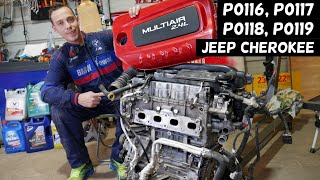
How to confirm: Use an OBD-II scanner to monitor the live ECT data. On a cold engine, the ECT reading should be very close to the Intake Air Temperature (IAT) reading. If it's drastically different, or if the temperature doesn't rise smoothly as the engine warms up, the sensor is likely bad. 🎬 Watch: Diagnosing P0116 and sensor faults on your Cherokee You can also test the sensor's resistance with a multimeter; at 68°F (20°C), it should be between 2,000 and 3,000 ohms.
Typical fix: Replace the ECT sensor. This requires partially draining the coolant. On the 2.4L engine, many owners and mechanics recommend replacing the entire thermostat housing assembly, which includes a new thermostat and sensor.
Est. part cost: $20-$50 - Faulty Thermostat 🔴 High Probability Thermostats can get stuck open or closed. A thermostat stuck open is a very common cause of P0116 because the engine never reaches its proper operating temperature within the time the PCM expects, which flags a performance issue. This is often seen with the companion code P0128.
How to confirm: After starting the engine from cold, feel the upper radiator hose. It should remain cool for several minutes and then get hot suddenly as the thermostat opens (around 195-200°F). If it warms up gradually right away, the thermostat is likely stuck open. If the engine overheats and the hose never gets hot, it's likely stuck closed.
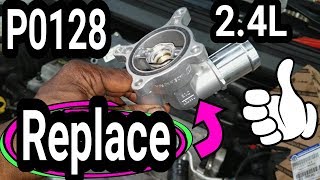
Typical fix: Replace the thermostat and gasket, which often comes as a complete housing assembly including the ECT sensor for the 2.4L engine. This requires draining the coolant. The job can be difficult for DIYers due to a hard-to-access bolt. 🎬 See this quick tip for reaching that difficult thermostat bolt
Est. part cost: $40-$80 - Outdated Powertrain Control Module (PCM) Software 🟡 Medium Probability Jeep has released multiple TSBs (e.g., 18-044-26, 18-085-17, 18-093-16 REV. A) that include P0116 as a code fixed by a software update. The original software may be too sensitive to temperature differences between sensors on a cold soak or when a block heater is used.
How to confirm: A Jeep dealership or a well-equipped independent shop can check your vehicle's VIN against their database for available PCM software updates. This is not a recall, so you won't be notified automatically.
Typical fix: Reprogram the PCM with the latest software version. This is often called a 'flash'. If the vehicle is under warranty, this is typically free; if out of warranty, it can cost $100-$200.
Est. part cost: $0-$200 - Low Engine Coolant Level 🟡 Medium Probability If the coolant level is low, the sensor may be exposed to air pockets instead of coolant, causing erratic temperature readings and triggering the code. This points to a leak in the cooling system that must be addressed.
How to confirm: Visually inspect the coolant reservoir when the engine is cold. The level should be between the 'MIN' and 'MAX' lines. If it's low, there is a leak in the system that must be found and repaired.
Typical fix: Top off the coolant with the correct type (OAT for this model) and find and repair the source of the leak.
Est. part cost: $15-$30 for coolant - Wiring or Connector Issue ⚪ Low Probability The wiring harness to the ECT sensor can become damaged from engine heat and vibration, or the connector pins can corrode. The red locking tab on the connector can also be left unseated after a repair, leading to a loose connection.
How to confirm: Visually inspect the ECT sensor's connector and wiring for any signs of damage, corrosion, or loose connections. Use a multimeter to check for a 5-volt reference signal and a good ground at the connector.
Typical fix: Repair the damaged wire or replace the connector pigtail.
Est. part cost: $10-$30
Rare But Worth Checking
- Faulty Powertrain Control Module (PCM): This is extremely rare. Before condemning the PCM, all other possibilities, including sensor, thermostat, wiring, and software updates, must be thoroughly ruled out.
Diagnosis Steps
- Check the engine coolant level in the reservoir and radiator (when cold). Top off if necessary and check for leaks.
- Connect an OBD-II scanner and check for any other stored codes, paying close attention to P0128, P0117, or P0118.
- View the live data stream for the Engine Coolant Temperature (ECT) sensor. When the engine is cold, the ECT reading should be nearly identical to the Intake Air Temperature (IAT) sensor reading.
- Start the engine and monitor the ECT reading. It should climb steadily and smoothly to around 195-220°F.
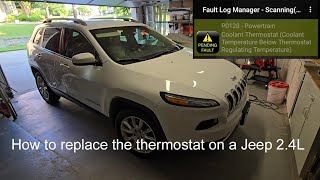
- If the temperature rises very slowly or never reaches operating temperature (e.g., stays below 180°F), suspect 🎬 Watch: Step-by-step thermostat replacement guide for the 2.4L engine a thermostat that is stuck open.
- If the temperature reading is erratic, jumps around, or is clearly incorrect (e.g., reads -40°F or 300°F on a cold engine), suspect a faulty ECT sensor or wiring issue.
- Inspect the ECT sensor's electrical connector and wiring for any visible damage, corrosion, or looseness. Ensure the red locking tab is secure.
- If no issues are found with the sensor, thermostat, or coolant level, contact a Jeep dealer to check if a PCM software update is available for your vehicle's VIN, as this is a known fix per multiple TSBs.
Parts You'll Likely Need
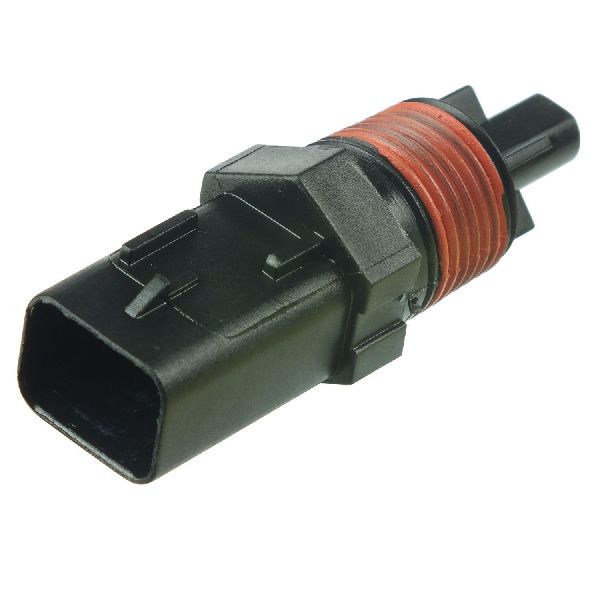
- Engine Coolant Temperature Sensor
(OEM #68068746AA)— This sensor is the primary source of the temperature reading. It's a common failure item and often the direct cause of the P0116 code. Note: This part number does not appear to fit the Cherokee KL according to some parts sites; a more common solution is replacing the entire thermostat housing which includes the sensor.
Trusted brands: Mopar, NTK, Standard Motor Products
OEM price range: $30-$50
Aftermarket price range: $15-$35 - Engine Coolant Thermostat Housing Assembly (2.4L Engine)
(OEM #5047861AC (superseded by 5047861AD))— For the 2.4L engine, the thermostat, housing, and ECT sensor are often replaced as a single unit. A thermostat stuck open is a frequent cause of this code. This part is confirmed to fit many 2014-2020 Jeep Cherokees with the 2.4L engine.
Trusted brands: Mopar, Dorman, Motorad
OEM price range: $75-$115
Aftermarket price range: $40-$80 - Engine Coolant Thermostat (3.2L V6 Engine) — On the 3.2L V6, the thermostat can be replaced separately from its housing. It is also a common failure item leading to P0116 and P0128 codes.
Trusted brands: Mopar, Dorman
OEM price range: $50-$90
Aftermarket price range: $30-$60
Related Codes That Often Appear With This One
- P0128 — P0128 (Thermostat Rationality) is very common with P0116. It specifically indicates the engine is not reaching operating temperature within a calculated time, often because the thermostat is stuck open.
- P0117 — P0117 (ECT Sensor Circuit Low) indicates the signal voltage is below the specified range, suggesting a short to ground.
- P0118 — P0118 (ECT Sensor Circuit High) indicates the signal voltage is above the specified range, suggesting an open circuit.
- P2610 — This code for 'PCM Internal Engine Off Timer Performance' was cited in TSB #18-093-16 REV. A along with P0116, indicating a potential software issue where the PCM's internal clock, used to judge sensor rationality, is malfunctioning.
Technical Service Bulletins (TSBs) & Recalls
- 18-044-26
- 18-085-17
- 18-093-16 REV. A
- 1800416REVA
- 18-035-16 REV.A
- 18-005-15 REV F
- 18-023-16 REV. C (for platform mate Chrysler 200)
Platform-Specific Known Issues
- ECT Sensor Location Varies by Engine: On the 2.4L MultiAir engine, the ECT sensor is located on the thermostat housing on the passenger side of the engine. For the 3.2L V6 engine, the sensor is on the back of the driver's side cylinder head. Always verify your engine before purchasing parts or starting a repair.
- Thermostat Replacement Difficulty on 2.4L: Replacing the thermostat on the 2.4L engine is known to be labor-intensive due to the location and bolts that are very difficult to access. It often requires removing the battery, battery tray, and vacuum pump to gain clearance.
- Software Sensitivity in Cold Weather: Some owners report triggering a P0116 code specifically on very cold days, especially after using a block heater. This can create a large, illogical temperature difference between the ECT sensor (warmed by the heater) and the IAT sensor (at ambient temp), which the sensitive PCM software flags as a fault.
Mechanic-Grade Diagnostic Values
- ECT vs. IAT/Ambient Temp Sensor Rationality Check (Cold Soak) — expected: After an engine off time greater than 480 minutes, the ECT sensor value should be within 10°C (50°F) of the IAT and Ambient Air Temperature sensors.. Failure: A variance greater than 10°C (50°F) will set the P0116 code.
- ECT Sensor Resistance at 68°F (20°C) — expected: 2,000 - 3,000 Ohms (Ω). Failure: A reading significantly outside this range, or an open/shorted reading, indicates a faulty sensor.
- ECT Sensor Signal Voltage (Key On, Engine Off, Cold) — expected: ~3.5 - 4.0 Volts. Failure: A reading of 5.0V suggests an open circuit; a reading near 0V suggests a short to ground.
- ECT Sensor Signal Voltage (Engine at Operating Temp) — expected: ~0.5 - 1.3 Volts. Failure: Voltage does not decrease smoothly as the engine warms up, or remains high.
- ECT Sensor Connector Voltage (Sensor Unplugged, KOEO) — expected: 5.0 Volts (Reference Voltage). Failure: No voltage indicates a problem with the PCM or the wiring from the PCM.
Scan Tool Commands That Help
- wiTECH (OEM Chrysler/Jeep Tool): Flash PCM / Reprogram Powertrain Control Module — This is the required function to install updated software from a Technical Service Bulletin (TSB) to correct overly sensitive P0116 logic.
- Generic OBD-II Scanner (Live Data): Graph ECT and IAT Sensor Data — On a cold start, graph both sensors. They should start at nearly the same temperature. As the engine runs, the ECT should climb smoothly. Jumps, dropouts, or a very slow climb (indicating a stuck thermostat) are easily visible on a graph.
Wiring & Ground Locations
- ECT Sensor (2.4L Engine) — On the thermostat housing, located on the passenger side of the engine.. This is the primary sensor for this code. The connector has a red locking tab that must be fully seated to ensure a good connection.
- ECT Sensor (3.2L V6 Engine) — On the back of the driver's side cylinder head.. The location is different and less accessible than on the 2.4L engine, affecting repair strategy.
- (K2) ECT Signal Circuit — The wire running from the PCM to the ECT sensor that carries the temperature signal.. An open or short in this wire will cause incorrect voltage readings, leading to P0116, P0117, or P0118.
- (K900) Sensor Ground Circuit — The wire providing the ground reference for the ECT sensor, originating from the PCM.. A poor ground connection (high resistance) will skew the sensor's voltage reading, causing a performance code.
- G903A / G906A — Common engine compartment ground points. G903A is on the lower left front of the engine compartment; G906A is on the left rear of the engine compartment.. While the ECT has a dedicated sensor ground from the PCM, overall PCM health relies on clean, tight main ground points. Loose or corroded grounds can cause a host of bizarre electronic issues, including sensor rationality codes.
Real Owner Repair Stories
- YouTube channel 'Robert Dotterer (Dotterer's Auto Service)' (2015 Jeep Cherokee 2.4L MultiAir) — Check Engine Light with code P0128 (Thermostat Rationality). The owner also noted the coolant level was very low.
❌ Tried (didn't work) Initially diagnosed as just low coolant.
✅ What actually fixed it After topping off the coolant, the technician monitored live data and confirmed the engine was warming up too slowly. The final fix was replacing the entire thermostat housing assembly, which resolved the code. This is a common scenario where P0116 and P0128 appear together and point to a stuck-open thermostat.
When the Usual Fixes Don't Work
- While replacing the ECT sensor or thermostat is a common fix, a significant number of P0116 codes on 2014-2016 Jeep Cherokees were not resolved by replacing parts. The root cause was frequently the PCM's software calibration being too sensitive, especially during cold starts. In these cases, the only successful repair was a dealership visit to have the PCM reprogrammed ('flashed') with updated software as prescribed by a Technical Service Bulletin (TSB). Owners who replaced hardware first often found the code returned until the software update was performed.
Model Year Variations Within This Range
- 2014-2021: The ECT sensor location varies by engine. On the 2.4L I4, it is on the thermostat housing on the passenger side of the engine. On the 3.2L V6, it is located on the back of the driver's side cylinder head.
- 2014-2015: Multiple TSBs (e.g., 18-005-15 REV. C, 18-014-17) were issued specifically for these early model years to correct overly sensitive software logic that could trigger P0116, especially on the 2.4L engine. Later models may have shipped with the updated software from the factory.
Helpful Videos
We Have This Part in Stock


The information in this article is provided for general reference and educational purposes only. Vehicle specifications, procedures, and part compatibility can vary by production date, trim level, and region. Always consult your vehicle's factory service manual and verify part numbers before purchasing or performing repairs. Safety-critical components such as airbags, seat belts, and braking systems should be installed by a qualified professional.
- Jeep CHEROKEE:
- 🎬 Helpful Videos
- 🛍️ Shop This Part
- What's Unique About the 2014-2021 Jeep CHEROKEE
- Diagnostic Flowchart
- Symptoms You May Notice
- Most Likely Causes
- Rare But Worth Checking
- Diagnosis Steps
- Parts You'll Likely Need
- Related Codes That Often Appear With This One
- Technical Service Bulletins (TSBs) & Recalls
- Platform-Specific Known Issues
- Mechanic-Grade Diagnostic Values
- Scan Tool Commands That Help
- Wiring & Ground Locations
- Real Owner Repair Stories
- When the Usual Fixes Don't Work
- Model Year Variations Within This Range
- 🎟️ Get 5% Off