

OBD-II Code P0115: Engine Coolant Temperature Circuit Malfunction
The Ultimate Guide to Diagnosing and Fixing P0115
- Check your coolant level and bleed the system before buying any parts; air pockets are a leading cause of false P0115 codes.
- Use a scan tool to view live ECT data; a reading stuck at -40°F indicates an open circuit, while 280°F+ indicates a short.
- Inspect the sensor connector for green corrosion or leaking coolant, which disrupts the 5V reference signal and requires a pigtail replacement.
- Fix a P0115 within one week to prevent the engine from running rich, which can destroy a $1,500 catalytic converter.
What Does P0115 Mean?

Code P0115 means the Powertrain Control Module (PCM) detects erratic, irrational, or out-of-range voltage signals from the engine coolant temperature (ECT) sensor or its circuit. The PCM relies on this data to precisely control the air-fuel ratio, ignition timing, and cooling fan operation.
Technical definition: The SAE/OBD-II definition for P0115 is "Engine Coolant Temperature Circuit Malfunction." The PCM sets this code when the ECT sensor's voltage signal falls outside the specified 0.5V (hot) to 4.5V (cold) range. For example, Honda triggers the fault if voltage drops below 0.14V or exceeds 4.91V. This indicates an open circuit, a short circuit, or a completely failed sensor.
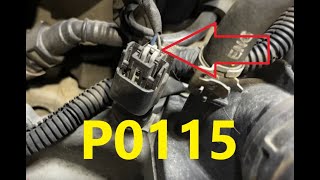
🎬 Watch: A quick overview of P0115 causes and common fixes.Can I Drive With P0115?
Yes, But With Caution. You can drive short distances with a P0115 code, but address it within a week. The faulty sensor forces the engine to run excessively rich, which washes oil from cylinder walls and overheats the catalytic converter. Ignoring a $150 sensor replacement easily escalates into a $1,500+ catalytic converter repair.
Common Causes

- Faulty Engine Coolant Temperature (ECT) Sensor (Very Common) — The thermistor inside the sensor fails, sending incorrect, stuck, or zero voltage readings to the PCM.
- Damaged Wiring or Connectors (Common) — Heat, vibration, or leaking coolant corrodes the wiring harness or connector, disrupting the 5V reference signal or ground connection.
- Low Coolant or Air Pockets (Common) — If coolant is low or air pockets exist (often after a recent flush), the sensor measures air temperature instead of liquid, causing irrational readings that trigger the code.
- Stuck Thermostat (Less Common) — A thermostat stuck open prevents the engine from reaching operating temperature, causing ECT readings to fall outside the expected time-based range.
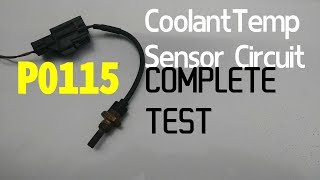
- Incorrect Aftermarket Sensor (Rare) — Cheap aftermarket sensors often have incorrect resistance values that do not match OEM specifications, instantly triggering a circuit fault. 🎬 Watch this step-by-step guide to testing and replacing the sensor.
Symptoms

- Check Engine Light is On — The Malfunction Indicator Lamp (MIL) illuminates immediately after the PCM detects the circuit fault.
- Hard Starting and Rough Idle — The engine struggles to start cold and idles roughly because the PCM commands an incorrect fuel mixture based on faulty temperature data.
- Cooling Fans Run Constantly — The PCM defaults to running the radiator fans at 100% as a fail-safe to prevent overheating when it loses the ECT signal.
- Erratic Temperature Gauge — The dashboard temperature gauge reads unusually high, stays pinned at cold, or fluctuates wildly.
- Poor Fuel Economy and Black Smoke (also visible on scanner) — A false 'cold' reading forces the engine to run rich, wasting fuel and emitting black smoke from the tailpipe.
Diagnostic Flowchart

Tap your situation to follow the diagnostic path that matches what you're seeing on this code.
Common Fixes & Costs
- Replace Engine Coolant Temperature (ECT) Sensor
— Parts: $20-$80, Labor: $80-$150, ~0.8 hr book time
(DIY)
: OEM 06A919501A (Alt: {"brand": "Bosch", "part_number": "0280130026", "price": "$15-$30"})
: OEM 13621433076 (Alt: {"brand": "Delphi", "part_number": "TS10277", "price": "$20-$35"}) - Top Off Coolant and Bleed System — Parts: $15-$30, Labor: $50-$100, ~0.5 hr book time (DIY)
- Repair Damaged Wiring or Connector — Parts: $15-$40, Labor: $100-$250, ~1.5 hr book time (Intermediate)
- Replace Faulty Thermostat — Parts: $30-$100, Labor: $150-$350, ~1.8 hr book time (Intermediate)
DIY vs Professional
- Replace ECT Sensor — Beginner:
- Top Off and Bleed Coolant — Beginner:
- Replace Thermostat — Beginner:
- Repair Damaged Wiring or Connector — Beginner:
Used vs. New Parts: Buying Guide
When a used part is worth it: Never buy a used ECT sensor. It is a low-cost wear item, and the savings are negligible compared to the risk of immediate failure.
Donor-vehicle mileage cap: roughly under 10000 miles for the part to have meaningful remaining life.
Donor quality checklist:
- Ensure the part number matches exactly.
- Inspect related parts like a thermostat housing for cracks or corrosion.
Decision logic:
- If The part is an ECT sensor or thermostat. → Always buy new. The cost savings are not worth the labor to replace it again.
- If The part is a high-cost consequential failure, like a catalytic converter. → A used part from a low-mileage wreck is a viable option, but carries risk.
Warranty tradeoff: Used sensors have no warranty. New aftermarket sensors offer 1-year to lifetime warranties. OEM parts carry a 1-2 year warranty.
Worst-case if a used part fails: $150-$300 if a used sensor fails, requiring repeat labor and a new part.
What Happens If You Wait — Timeline
- 0-1 month: Check Engine Light illuminates. Engine is hard to start cold. PCM defaults to a rich fuel mixture and runs cooling fans constantly. (MPG impact: 5-10%% · Added cost: $15-$50 in wasted fuel.)
- 1-3 months: Fuel economy worsens noticeably. Constant rich running causes black smoke and carbon buildup on spark plugs and oxygen sensors. (MPG impact: 10-20%% · Added cost: $50-$150 in wasted fuel and new spark plugs.)
- 3-6 months: The rich mixture overheats the catalytic converter. Unburned fuel melts the internal substrate, restricting the exhaust. (MPG impact: 15-25%% · Added cost: $800-$2,000 for catalytic converter replacement.)
- 6+ months: Complete catalytic converter failure. Severe carbon buildup affects engine compression. Risk of catastrophic engine damage if an actual overheating event goes undetected. (MPG impact: 20-30%+% · Added cost: $1,500-$4,000+ for catalytic converter, oxygen sensors, and engine repairs.)
Cost of Not Fixing It
- 0-1 Month: Noticeable drop in fuel economy (5-15%) and hard starting in cold weather. (Added cost: $20-$60 in wasted fuel.)
- 1-6 Months: Engine runs consistently rich, causing carbon buildup on spark plugs and subjecting the catalytic converter to excessive heat. (Added cost: $1,000-$2,500 for catalytic converter replacement.)
- 6+ Months: Severe damage to the catalytic converter is highly likely. Internal engine damage from prolonged rich operation or undetected overheating becomes a serious risk. (Added cost: $1,500-$4,000+ for catalytic converter and engine repairs.)
Diagnosis Steps

- Inspect Coolant Level and Condition
With the engine completely cool, check the coolant level in the radiator and overflow tank. Ensure it is full and the coolant is clean. A low coolant level or trapped air pocket is a common and overlooked cause.
Tools: Flashlight (Beginner) - Check for Other Codes and Review Freeze Frame Data
Use an OBD-II scanner to check for related codes (like P0117, P0118, or P0128). Look at the freeze frame data to see the exact engine temperature and conditions when the P0115 code triggered.
Tools: OBD-II Scanner (Beginner) - Visually Inspect the ECT Sensor and Wiring
Locate the ECT sensor. Inspect the connector and wiring harness for damage, green corrosion, bent pins, or loose connections. Look for coolant or oil contamination inside the connector.
Tools: Flashlight (Beginner) - Check Live Data with a Scan Tool
With the engine cold, the ECT reading should match the ambient air temperature (IAT) within 5°F. Start the engine; the temperature should climb smoothly to 190-212°F. A reading stuck at -40°F or 300°F points to a circuit failure.
Tools: OBD-II Scanner with Live Data (Intermediate) - Perform a "Wiggle Test"
While monitoring live ECT data on your scanner, carefully wiggle the wiring harness and connector. If the temperature reading jumps or cuts out, you have an intermittent connection or a broken wire.
Tools: OBD-II Scanner with Live Data (Intermediate) - Test the ECT Sensor with a Multimeter (Resistance)
Disconnect the sensor and measure its resistance in Ohms. Compare readings to a vehicle-specific chart (e.g., 68°F ≈ 2,500-3,500 Ω; 212°F ≈ 177 Ω). Infinite resistance means the sensor is dead.
Tools: Digital Multimeter, Thermometer (Intermediate) - Check the Circuit for Voltage and Ground
Disconnect the sensor. With the key on and engine off, probe the connector terminals. One wire must have a 5-volt reference signal from the PCM, and the other must show a solid ground (less than 100mV).
Tools: Digital Multimeter (Advanced) - Live Data PID Cross-Validation
Monitor Engine Coolant Temperature (ECT), Intake Air Temperature (IAT), and Engine Oil Temperature (EOT). If IAT or EOT rises smoothly but ECT does not, it confirms the ECT circuit is providing irrational data.
Tools: Advanced OBD-II Scanner with Live PID Data (Advanced)
When This Code Triggers (Freeze-Frame Conditions)
- Engine Coolant Temp: -40°F or >280°F (Implausible reading at startup or during operation.)
- RPM: 700-3000 (Code sets at idle, during acceleration, or at a steady cruise.)
- Engine Load: 15-70% (The fault is not load-dependent and occurs under various conditions.)
- Vehicle Speed: 0-65 mph (The circuit malfunction is detected whether the vehicle is stationary or moving.)
Related Codes
- P0116 — Indicates 'ECT Sensor Circuit Range/Performance.' P0115 flags a hard circuit failure (open/short), while P0116 sets when readings are irrational but not completely failed (e.g., rising too slowly).
- P0117 — Stands for 'ECT Circuit Low Input.' This specifically points to a short to ground in the signal wire or an internally shorted sensor, whereas P0115 is a general circuit fault.
- P0118 — Stands for 'ECT Circuit High Input.' This specifically indicates an open circuit (disconnected sensor or broken wire), whereas P0115 is a general circuit fault.
- P0128 — Indicates 'Coolant Temperature Below Thermostat Regulating Temperature.' This sets when the engine fails to warm up in time, almost always pointing to a thermostat stuck open rather than an electrical fault.
Climate & Environmental Factors
- Cold Weather: If the sensor incorrectly tells the PCM the engine is warm, the PCM won't command a rich fuel mixture, leading to severe starting difficulties and stalling in freezing temperatures.
- High Humidity / Coastal Areas: High moisture accelerates corrosion on the electrical connector pins, creating unwanted resistance or short circuits that trigger the code.
How to Talk to a Mechanic About This Code
Say this: "I have a P0115 code and I'd like to schedule a diagnostic. I've already verified the coolant level is full. Can you check the live data from the ECT sensor and inspect the wiring connector before recommending a sensor replacement?"
This signals you are an informed customer. It directs the mechanic to perform a logical diagnostic sequence (data, wiring, then parts) rather than blindly replacing the sensor.
Avoid saying:
- 'My check engine light is on, can you just fix it?'
- 'I think I need a new temperature sensor.'
- 'Just do whatever you think is necessary.'
Questions to ask before authorizing the repair:
- Did the live data show the ECT sensor reading was stuck, erratic, or not matching ambient temperature on a cold start?
- Did you find any corrosion or damage to the sensor's connector or wiring harness?
- If replacing the sensor, does the estimate include bleeding the cooling system to remove air pockets?
- What is the warranty on the new part and the labor?
Where to Take It: Dealer vs Independent vs Chain
- Dealer:
Recommended only if the vehicle is under warranty or has known manufacturer-specific issues. Overkill for a standard P0115.
Best for: Vehicles under powertrain or emissions warranty., Complex electrical issues or known TSBs for P0115., European brands (VW, BMW) with complex cooling systems.
Downsides: Highest labor rates., May recommend replacing related components preventatively. (Typical cost: +50% vs. baseline) - Independent Shop:
Best fit for most situations. An experienced independent mechanic efficiently diagnoses a P0115 at a reasonable cost.
Best for: Most out-of-warranty vehicles., Straightforward diagnostic and repair of common codes.
Downsides: Diagnostic capabilities vary. Look for ASE-certified technicians. (Typical cost: +0% vs. baseline) - Chain Shop:
Acceptable for a simple sensor swap if you are certain that's the issue. Use caution for complex diagnosis.
Best for: Simple, clear-cut repairs like replacing an easily accessible sensor.
Downsides: May lack advanced diagnostic tools for electrical circuit testing., Technicians may be pressured to replace parts rather than diagnose wiring faults. (Typical cost: -10% vs. baseline)
When to Walk Away From the Repair
If the estimated repair cost exceeds 40-50% of the car's private-party value, pause and carefully consider your options.
- Car worth $4000, fix is $350: Fix it. This is a relatively low-cost repair essential for engine health.
- Car worth $3000, fix is $1800: Walk away. If P0115 was ignored and destroyed the catalytic converter, the repair cost is too high.
- Car worth $12000, fix is $500: Fix it. Even a complex P0115 repair is well worth the cost on a vehicle of this value.
What Scan Tool You Need for This Code
Minimum: An OBD-II reader that displays live data, specifically the Engine Coolant Temperature (ECT) PID.
A basic $20 code reader only shows the P0115 code. It cannot show the live temperature data the computer sees, which is essential to determine if the sensor is stuck, erratic, or dead.
Budget: BlueDriver Pro (~$90) — Connects via Bluetooth to your smartphone and provides live data graphing for the ECT sensor. You can watch the temperature rise to see if it's smooth and logical.
Mid-range: Foxwell NT510 Elite (~$150) — Offers bi-directional controls. This allows you to view live ECT data and command the cooling fans to turn on, helping test the entire cooling system circuit.
Professional: Autel MaxiCOM MK808 (~$500) — Provides full-system diagnostics, advanced data graphing, and access to manufacturer-specific codes to diagnose complex wiring or PCM-related issues.
Rent vs buy: Auto parts stores scan codes for free, but their tools rarely show live data. Buying a budget scanner like the BlueDriver Pro is a crucial investment for properly diagnosing P0115.
How to Clear the Code After You Fix It
- Use an OBD-II scan tool to clear the fault code.
- Perform a complete drive cycle to allow the readiness monitors to run.
- Rescan the vehicle to confirm the code has not returned.
Drive cycle (~20 minutes): Start the engine cold (coolant below 122°F). Idle for 3 minutes with A/C on. Drive at a steady 55 mph for 5 minutes. Coast to 20 mph without braking. Accelerate to 55 mph and hold for 3 minutes. Cool down.
Readiness monitors affected: Catalyst Monitor, Evaporative System Monitor, Oxygen (O2) Sensor Monitor
Before emissions retest: drive at least 50 miles to fully set monitors.
Watch out for:
- Clearing the code resets all readiness monitors, causing an immediate emissions test failure.
- The code returns immediately if air pockets remain in the cooling system.
- Failing to start the drive cycle from a true 'cold start' prevents monitors from running.
Will This Fail Emissions / State Inspection?
Yes — this code typically fails an OBD-II emissions inspection.
- California: An active P0115 code is an automatic smog check failure. A full drive cycle must be completed after repair to set readiness monitors.
- New York: An illuminated Check Engine Light and active P0115 code results in an immediate NYS DMV inspection failure.
- Texas: In the 17 counties requiring emissions testing, a P0115 code causes the vehicle to fail the OBD portion of the safety inspection.
Most Commonly Affected Vehicles
- Volkswagen Golf, Jetta, Passat (2000-2015) — Known for plastic ECT sensor housing failures, causing coolant to leak directly onto the connector. OEM part: 06A919501A.
- Audi A3, A4, A6 (1998-2012) — Shares VW components; sensor and connector corrosion is common. OEM part: 06A919501A.
- BMW 3 Series, 5 Series, X3, X5 (2001-2010) — Prone to plastic cooling system component failures. ECT sensor is often replaced during cooling system overhauls. OEM part: 13621433076.
- Honda Civic, Accord (2000-2012) — Rodent damage to soy-based wiring insulation is a frequently reported cause for this code.
- Chevrolet Silverado, Cruze, Malibu (2005-2018) — On some models, a faulty instrument cluster causes erratic gauge readings and triggers this code (TSB 07-06-02-001A).
- Hyundai Elantra, Sonata, Santa Fe (2009-2020) — Properly bleeding the cooling system after replacing the sensor is critical to prevent air pockets from causing the code to return.
Manufacturer-Specific Notes
- Toyota: If P0115 appears simultaneously with P0110 (IAT) and P0120 (TPS), it indicates an open in the shared sensor ground circuit (E2), not a failure of all three sensors.
- Honda: TSB 03-078 for 2001-2004 Civics notes that a faulty radiator cap causes coolant loss and overheating, which damages the ECT sensor and triggers P0115.
- General Motors: TSB 07-06-02-001A addresses 2004-2007 models where a faulty instrument panel cluster causes erratic gauge readings and triggers P0115, even if the sensor is fine.
- Nissan: A P0115 code puts the engine into a fail-safe mode where cooling fans run constantly. TSB NTB08-045b addresses P0115 caused by a poor connection at the ECM harness.
Real Owner Stories
2001 Toyota 4Runner SR5
Truck was very difficult to start on cold mornings and idled roughly. Check Engine Light was on with code P0115.
What they tried:
- Replaced the battery.
- Replaced the ECT Sensor.
Outcome: After replacing the sensor, the owner discovered the actual problem: a rodent chewed through the wiring harness connector. Replacing the harness pigtail fixed the issue.
Lesson: Always inspect the wiring harness and connector thoroughly before replacing the sensor. Rodent damage perfectly mimics sensor failure.
2001 Toyota Corolla
After a mechanic replaced the thermostat, the engine began to overheat and threw a P0115 code.
What they tried:
- Mechanic replaced the thermostat.
- Mechanic replaced the ECT sensor.
Outcome: The problem continued. The cause was an air pocket introduced during the thermostat replacement. The system was not properly bled, causing the sensor to read air temperature instead of coolant.
Lesson: If P0115 appears immediately after a cooling system repair, the most likely cause is an air pocket. Bleed the system using a spill-free funnel.
3rd Gen Toyota 4Runner
After replacing fuel injector seals, the engine barely started, idled at 100 RPM, and threw a P0115 code.
What they tried:
- Suspected a major fuel system issue.
Outcome: The owner found the ECT sensor connector was bumped and dislodged during the injector repair. Reseating the connector fixed all symptoms instantly.
Lesson: If a new code appears immediately after a repair, check for disconnected or damaged connectors in the work area first.
How to Prevent This Code From Triggering
- Perform a cooling system flush at recommended intervals. (Every 30,000-100,000 miles or 3-5 years.) — Old coolant becomes acidic and damages the ECT sensor. A flush removes contaminants and restores anti-corrosive protection.
- Use only the manufacturer-specified type and color of coolant. (Whenever topping off or flushing the system.) — Mixing different coolant types causes gelling, leading to blockages, poor heat transfer, and sensor reading errors.
- Periodically inspect sensor wiring and connectors. (During routine oil changes.) — Catching brittle wires, corrosion, or rodent damage early prevents circuit failures from triggering codes.
Frequently Asked Questions
Can I replace the ECT sensor myself?
Yes, replacing the ECT sensor is a straightforward DIY job requiring basic hand tools. Ensure the engine is completely cold to avoid burns and pressurized coolant blowback. Have the new sensor ready to swap quickly to minimize coolant loss.
What are the most common mistakes when diagnosing P0115?
The biggest mistake is replacing the sensor without checking the coolant level first. Low coolant or trapped air pockets cause the sensor to read air temperature, triggering the code. Always verify the wiring connector isn't corroded before buying parts.
I replaced the sensor, but the P0115 code came back. What now?
If a new sensor doesn't fix it, you likely have a wiring issue, a stuck thermostat, or an air pocket in the cooling system. Use a multimeter to verify the connector is receiving a 5V reference signal and has a solid ground. If the voltage is missing, trace the wiring back to the PCM.
What is the difference between an ECT sensor and an ECT sender?
The ECT sensor sends temperature data to the PCM to control fuel injection and cooling fans. The ECT sender transmits data solely to the dashboard temperature gauge. While some modern cars combine these into one unit, P0115 specifically refers to the PCM's sensor circuit.
Can a blown fuse cause a P0115 code?
Yes. If a fuse powering the ECT sensor's 5V reference circuit blows, the PCM detects an open circuit and triggers P0115 or P0118. Always check your fuse box diagram and test related engine management fuses before replacing sensors.
Why does my scan tool read -40°F for the coolant temp?
A reading of -40°F (or -40°C) is the PCM's default fallback value when it detects a completely open circuit. This means the computer is receiving zero voltage signal. It almost always indicates an unplugged connector, a severed wire, or a completely dead sensor.
Can a bad radiator cap cause a P0115 code?
Indirectly, yes. A failing radiator cap cannot hold system pressure, lowering the coolant's boiling point and introducing air pockets. If an air pocket surrounds the ECT sensor, it sends erratic readings and triggers the code.
Key Takeaways
- Check your coolant level and bleed the system before buying any parts; air pockets are a leading cause of false P0115 codes.
- Use a scan tool to view live ECT data; a reading stuck at -40°F indicates an open circuit, while 280°F+ indicates a short.
- Inspect the sensor connector for green corrosion or leaking coolant, which disrupts the 5V reference signal and requires a pigtail replacement.
- Fix a P0115 within one week to prevent the engine from running rich, which can destroy a $1,500 catalytic converter.
Helpful Videos


The information in this article is provided for general reference and educational purposes only. Vehicle specifications, procedures, and part compatibility can vary by production date, trim level, and region. Always consult your vehicle's factory service manual and verify part numbers before purchasing or performing repairs. Safety-critical components such as airbags, seat belts, and braking systems should be installed by a qualified professional.
- 🎬 Helpful Videos
- What Does P0115 Mean?
- Can I Drive With P0115?
- Common Causes
- Symptoms
- Diagnostic Flowchart
- Common Fixes & Costs
- DIY vs Professional
- Used vs. New Parts: Buying Guide
- What Happens If You Wait — Timeline
- Cost of Not Fixing It
- Diagnosis Steps
- When This Code Triggers (Freeze-Frame Conditions)
- Related Codes
- Climate & Environmental Factors
- How to Talk to a Mechanic About This Code
- Where to Take It: Dealer vs Independent vs Chain
- When to Walk Away From the Repair
- What Scan Tool You Need for This Code
- How to Clear the Code After You Fix It
- Will This Fail Emissions / State Inspection?
- Most Commonly Affected Vehicles
- Manufacturer-Specific Notes
- Real Owner Stories
- 2001 Toyota 4Runner SR5
- 2001 Toyota Corolla
- 3rd Gen Toyota 4Runner
- How to Prevent This Code From Triggering
- Frequently Asked Questions
- Can I replace the ECT sensor myself?
- What are the most common mistakes when diagnosing P0115?
- I replaced the sensor, but the P0115 code came back. What now?
- What is the difference between an ECT sensor and an ECT sender?
- Can a blown fuse cause a P0115 code?
- Why does my scan tool read -40°F for the coolant temp?
- Can a bad radiator cap cause a P0115 code?
- Key Takeaways
- 🎟️ Get 5% Off