

P0113 on 2017-2018 Jaguar F-PACE: IAT Sensor Circuit High Causes and Fixes
This code almost always points to a failed Intake Air Temperature (IAT) sensor or its wiring. The sensor sends an impossibly high voltage signal, which the car interprets as extreme cold. It's a cheap part, often under $50, and is a straightforward DIY replacement. On 2.0L petrol engines, also check for air leaks at the intake elbow per a Jaguar TSB.
- P0113 on your F-PACE means the engine thinks the incoming air is freezing cold, causing it to inject too much fuel.
- The most likely culprit is a faulty IAT sensor, an inexpensive and relatively easy part to replace for a DIYer.
- Before buying parts, check the sensor's wiring and connector for obvious damage, as this can also cause the code.
- For the 2.0L petrol engine, a known issue is an air leak at the intake elbow, which should be checked with a smoke test if the sensor/wiring seem okay.
- Verify your engine (2.0L vs 3.0L) to locate the correct sensor and buy the right part number (e.g., C2Z17977 for 3.0L, LR090375 for 2.0L).
What's Unique About the 2017-2018 Jaguar F-PACE
On many Jaguar engines, including those in the F-PACE, the primary IAT sensor (Sensor 1) location varies by engine. For the 3.0L Supercharged V6 (AJ126), it is typically a standalone sensor mounted on the supercharger or intake manifold. For the 2.0L Ingenium engines (petrol and diesel), the IAT sensor may be integrated into the Mass Airflow (MAF) sensor housing or be a separate sensor in the intake tract. A Technical Service Bulletin (SSM73671) for the 2.0L petrol engine specifically links P0113 to an air leak at the intake elbow, adding a unique diagnostic path for that powertrain.
Diagnostic Flowchart
Tap your situation to follow the diagnostic path that matches what you're seeing on this vehicle.
Symptoms You May Notice
- Check Engine Light is on
- Reduced fuel economy
- Engine hesitation or stumbling on acceleration
- Rough idle
- Hard starting, especially when the engine is cold
- Black smoke from the exhaust due to a rich fuel mixture
- Engine may enter a failsafe or 'Restricted Performance' mode
- Replacing the oxygen sensors to fix a rich running condition without first checking the IAT sensor input.
- Replacing the spark plugs or ignition coils to address a rough idle or misfire caused by incorrect fueling from the bad IAT data.
- Replacing the MAF sensor on a 3.0L V6 when the IAT is a separate, standalone sensor.
Most Likely Causes
- Failed Intake Air Temperature (IAT) Sensor 🔴 High Probability Sensors are electronic components that can fail over time due to heat cycles and environmental exposure. The internal thermistor can degrade or crack, causing an open circuit.
How to confirm: Use a scan tool to view live data for IAT Sensor 1. A reading stuck at an extremely low temperature (e.g., -40°F/-40°C) regardless of actual engine temperature points to a failed sensor or circuit. A Jaguar owner with a similar engine reported a static reading of 168°F, also indicating a failed sensor providing a fixed, incorrect value.
Typical fix: Replace the IAT sensor. If it's integrated into the Mass Airflow (MAF) sensor, the entire MAF assembly is typically replaced.
Est. part cost: $20-$90 for a standalone sensor, $150-$300 for a complete MAF assembly. - Damaged Wiring or Connector 🟡 Medium Probability Wiring in the engine bay can become brittle from heat, and connectors can be damaged or not fully reconnected during other maintenance, such as an air filter change.
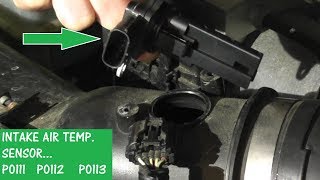
How to confirm: Visually inspect the wiring harness and connector for the IAT sensor for any signs of fraying, breaks, corrosion, or melted insulation. With the key on and sensor unplugged, use a multimeter to check for a 5-volt reference signal at the connector. A 'circuit high' code often means the signal wire is open or the connector is unplugged. 🎬 Watch this guide to fixing P0113 circuit high input codes
Typical fix: Repair the damaged section of wire or replace the pigtail connector. Ensure the connector is clean and fully seated.
Est. part cost: $10-$30 for a connector pigtail. - Improperly Fitted Air Intake Elbow (2.0L Petrol Only) 🟡 Medium Probability TSB SSM73671 specifically notes that for the 2.0L Ingenium petrol engine, the air intake elbow below the throttle body can be incorrectly fitted, causing an unmetered air leak.
How to confirm: A visual inspection may reveal a poor fit. A smoke test of the intake system is the definitive way to confirm a leak in this area, as recommended by Jaguar.
Typical fix: Correctly refit the air intake elbow to the throttle body and clear the codes.
Est. part cost: $0 if no parts are broken. - Dirty or Contaminated Sensor ⚪ Low Probability If an aftermarket oiled air filter is used, oil can contaminate the sensor element. While this more commonly causes a range/performance code (P0111), severe contamination can lead to an open circuit.
How to confirm: Remove the sensor and visually inspect it for a coating of oil or debris.
Typical fix: Clean the sensor carefully with dedicated MAF/electronics cleaner. Do not touch the sensing element with tools or fingers.
Est. part cost: $10-$15 for a can of electronics cleaner.
Rare But Worth Checking
- Faulty Powertrain Control Module (PCM): This is extremely rare and should only be considered after all other possibilities, including the sensor and its entire circuit, have been exhaustively tested and ruled out. A faulty PCM will usually trigger multiple, unrelated codes.
Diagnosis Steps
- Connect an OBD-II scanner and confirm P0113 is the active code. Check for any other related codes.
- View the live data stream for 'Intake Air Temp Sensor 1'. If it shows a static, extremely low value (like -40°F or -40°C), the fault is active.
- Locate the IAT sensor based on your engine. For the 3.0L V6, check the intake manifold/supercharger area. For 2.0L engines, check the intake duct after the air filter, possibly integrated into the MAF sensor.
- Visually inspect the sensor's connector and wiring for any obvious damage, corrosion, or loose connections. Pay close attention to areas that may be disturbed during routine service.
- Disconnect the sensor connector. Inspect the pins for damage or corrosion.
- With the key in the 'On' position (engine off), use a multimeter to test the terminals in the harness connector. You should find one with a 5-volt reference signal from the PCM and another with a ground connection.
- If the 5-volt reference is present, the wiring is likely good, and the sensor itself is the most probable cause. If the reference voltage is missing, there is an open circuit in the wiring between the PCM and the sensor.
- For 2.0L Petrol engines, if the sensor and wiring appear correct, perform a smoke test on the intake system to check for leaks, focusing on the elbow below the throttle body as per TSB SSM73671.
- If all wiring and connections check out, replace the IAT sensor (or the MAF assembly if integrated).
Parts You'll Likely Need
- Intake Air Temperature Sensor (3.0L V6)
(OEM #C2Z17977)— This is the most common failure point for a P0113 code on the supercharged V6 engine. It is a standalone sensor.
Trusted brands: Genuine Jaguar, Bosch, Walker, Denso
OEM price range: $50-$90
Aftermarket price range: $20-$50 - Intake Air Temperature Sensor (2.0L Ingenium)
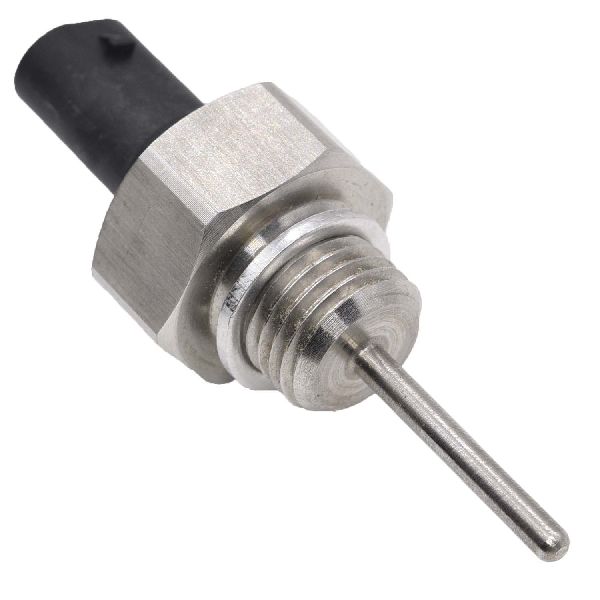
(OEM #LR090375, JDE1634)— This is the likely sensor for the 2.0L engines. Verify if your vehicle uses a standalone sensor or one integrated with the MAF before purchasing.
Trusted brands: Genuine Jaguar Land Rover, VEMO, Quinton Hazell
OEM price range: $40-$70
Aftermarket price range: $15-$40
Related Codes That Often Appear With This One
- P0111 — P0111 (IAT Sensor Circuit Range/Performance) can appear with P0113, as noted in TSB SSM73671. This indicates the sensor's readings are not just high, but also erratic or illogical compared to other engine sensors.
- P2178 — P2178 (System Too Rich Off Idle) is also mentioned in TSB SSM73671. The PCM interprets the false -40° temperature reading as very dense air and commands excessive fuel injection, leading to a rich condition.
- P0101 — P0101 (Mass Air Flow Sensor Circuit Range/Performance) may be present if the IAT sensor is integrated with the MAF sensor and the entire unit is failing.
Technical Service Bulletins (TSBs) & Recalls
- SSM73671: Links P0113, P0111, and P2178 on 2017 2.0L petrol models to a potential air leak from an incorrectly fitted air intake elbow.
Platform-Specific Known Issues
- Jaguar Technical Service Bulletin SSM73671 notes that on the 2017 F-PACE with the 2.0L Ingenium petrol engine, P0113 can be caused by an incorrectly fitted air intake elbow below the throttle body, leading to an air leak.
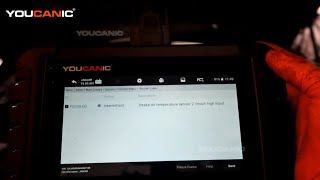
- On the 3.0L Supercharged V6, the IAT sensor is a distinct part from the two MAF sensors, which can cause confusion. A P0113 on this engine points to the sensor on the manifold/supercharger, not the MAFs in the intake tubes. 🎬 See a diagnostic walkthrough for Jaguar intake air temperature circuits
Mechanic-Grade Diagnostic Values
- IAT Sensor Resistance vs. Temperature — expected: Resistance should decrease as temperature increases. Example values from a generic chart are: 37 kOhms @ 20°C (68°F), 24 kOhms @ 30°C (86°F), 2.8 kOhms @ 90°C (194°F). Note: These are generic; comparing to a new Jaguar part is the best practice.. Failure: Infinite resistance (open circuit), zero resistance (short circuit), or a value that does not change when the sensor is heated or cooled.
- IAT Sensor Connector Voltage (Key On, Engine Off) — expected: One pin should show a 4.5V to 5V reference signal from the PCM. The other pin should show a good ground (near 0V).. Failure: Absence of the 5V reference points to a wiring or PCM issue. A ground reading significantly above 0V indicates a poor ground connection.
- Live Data Scan Tool Reading (KOEO) — expected: With the engine off and cold (sitting overnight), the IAT reading should be within 5-10°F of the Engine Coolant Temperature (ECT) and ambient air temperature.. Failure: A reading of -40°F/-40°C, or a value dramatically different from the ECT and ambient temp, confirms a sensor or circuit fault.
Hidden / Shadow Codes Worth Checking
- P0113-00: The '-00' suffix in the TSB (SSM73671) means 'no sub type information'. This is a standard format in JLR diagnostics. It indicates that the main fault (Circuit High) is the only information the PCM has logged for this event, without additional details like 'intermittent' or 'signal invalid' that might be present in other sub-codes. (see via JLR-specific diagnostic tools like SDD or Pathfinder would display this suffix, whereas generic OBD-II scanners may only show 'P0113'.)
Scan Tool Commands That Help
- JLR SDD / Pathfinder: Service Functions > Powertrain > Air Path Setup Routine / Air Path Calibration — While primarily for throttle body adaptation, this function resets all air shutoff valves. Running this after intake system repairs (like fixing the elbow leak from TSB SSM73671) or replacing related sensors can help ensure all components are correctly calibrated and may clear related adaptive-based faults.
Wiring & Ground Locations
- Engine Ground Strap — On many JLR vehicles, a primary engine ground strap is located on the lower right side of the car, connecting the engine block or transmission to the chassis frame, often near the starter motor.. A poor engine ground can cause a voltage offset on sensor ground reference circuits. The PCM relies on a stable ground to accurately measure the voltage drop across the IAT sensor. A faulty ground can cause erratic readings or trigger circuit high/low codes for multiple sensors, not just the IAT. Performing a voltage drop test on the ground side is a key diagnostic step.
- EMS LH Ground Stud — Jaguar electrical guides often refer to specific ground studs. For example, on similar platforms, an 'EMS LH Ground Stud' is located on the left front inner fender, which serves as a ground point for the Engine Management System (ECM/PCM).. The IAT sensor circuit begins and ends at the PCM. The PCM itself must have a clean, secure ground to function. Corrosion or looseness at this main grounding point can cause a P0113 and many other seemingly unrelated electrical issues.
Real Owner Repair Stories
- JaguarForums user (2017 F-Type (similar 3.0L V6 engine architecture)) — No crank, no start condition after performing coolant pipe repairs. All electronics worked, but the engine would not attempt to turn over.
❌ Tried (didn't work) Charging the battery, Jump starting the vehicle
✅ What actually fixed it The user had forgotten to reconnect one of the MAF sensors after the repair. Reconnecting the MAF sensor resolved the no-start issue. While not a P0113 code directly, this demonstrates how issues in the intake tract wiring (where the IAT may be located) can cause significant, non-obvious symptoms like a no-crank.
OEM Part Supersession History
C2Z17977→No official supersession found, this part number remains current for the specified applications.— N/A
Heads up: This part is listed for the 3.0L and 5.0L supercharged engines. It is often described generically as a 'Temp Sensor' and can be confused with a coolant sensor, but its application as a 'Supercharger temp sensor' or 'Manifold sensor' confirms its role as an IAT sensor for these engines.JDE1634→N/A— N/A
Heads up: This part is widely listed by vendors as a 'Coolant Temperature Sensor' for the F-PACE and other Jaguar models, including 2.0L and 3.0L engines. It should NOT be purchased to fix an IAT sensor code (P0113), as it measures coolant temperature, not air temperature. This is a common point of confusion.
Helpful Videos

We Have This Part in Stock


The information in this article is provided for general reference and educational purposes only. Vehicle specifications, procedures, and part compatibility can vary by production date, trim level, and region. Always consult your vehicle's factory service manual and verify part numbers before purchasing or performing repairs. Safety-critical components such as airbags, seat belts, and braking systems should be installed by a qualified professional.
- Jaguar F-PACE:
- 🎬 Helpful Videos
- 🛍️ Shop This Part
- What's Unique About the 2017-2018 Jaguar F-PACE
- Diagnostic Flowchart
- Symptoms You May Notice
- Most Likely Causes
- Rare But Worth Checking
- Diagnosis Steps
- Parts You'll Likely Need
- Related Codes That Often Appear With This One
- Technical Service Bulletins (TSBs) & Recalls
- Platform-Specific Known Issues
- Mechanic-Grade Diagnostic Values
- Hidden / Shadow Codes Worth Checking
- Scan Tool Commands That Help
- Wiring & Ground Locations
- Real Owner Repair Stories
- OEM Part Supersession History
- 🎟️ Get 5% Off