

P0108 on 2018-2019 Lincoln MKT: MAP Sensor Circuit High Causes and Fixes
On a 2018-2019 Lincoln MKT, code P0108 is most often caused by a faulty Manifold Absolute Pressure and Temperature (MAPT) sensor, a known issue documented in Technical Service Bulletin 19-2212. Replacing the sensor is a straightforward DIY fix requiring a T20 Torx driver, with the updated OEM part costing between $90 and $190.
- Code P0108 on a 2018-2019 MKT is almost certainly due to a bad MAPT sensor, as confirmed by manufacturer TSB 19-2212.
- Symptoms are more than just a check engine light; they include a noticeable lack of power and specific warnings for AdvanceTrac and Hill Start Assist.
- The repair is very simple and accessible for a DIY mechanic. It involves removing the engine cover and a single T20 Torx screw to swap the sensor.
- Ensure you purchase the correct, updated MAPT sensor. The original part AA5Z-9F479-B is obsolete; look for AA5Z-9F479-D or the TSB-recommended AA5Z-9F479-E.
What's Unique About the 2018-2019 Lincoln MKT
For this specific vehicle and year range, there is a high probability that the P0108 code is caused by a faulty Manifold Absolute Pressure and Temperature (MAPT) sensor. Lincoln issued a Technical Service Bulletin (TSB 19-2212) for this exact problem, which also applies to the Ford Flex, Explorer, and Taurus with the same 3.5L EcoBoost engine. This known issue makes diagnosis more direct. The failure also triggers secondary warnings like 'Service AdvanceTrac' because the PCM can no longer trust the engine's torque output calculations, which are a necessary input for the stability control system. As a precaution, the PCM disables these dependent systems.
Diagnostic Flowchart
Tap your situation to follow the diagnostic path that matches what you're seeing on this vehicle.
Symptoms You May Notice
- Check Engine Light is on
- Powertrain malfunction (wrench) lamp is on
- "Service AdvanceTrac" message
- "Hill Start Assist Not Available" message
- Lack of power or sluggish acceleration, especially from a stop.
- Rough or unstable idle
- Poor fuel economy
- Hesitation during acceleration
- Replacing the Mass Airflow (MAF) sensor. The MKT uses both a MAF and a MAP sensor; P0108 specifically points to the MAP sensor circuit. Forum discussions show this is a common point of confusion.
Most Likely Causes
- Faulty Manifold Absolute Pressure and Temperature (MAPT) Sensor 🔴 High Probability A known issue documented in Lincoln Technical Service Bulletin TSB 19-2212 for 2018-2019 models with the 3.5L EcoBoost engine.
How to confirm: With the key on and engine off, use a scan tool to read the MAP sensor voltage. A reading at or above 4.4V strongly points to a failed sensor. The sensor is easy to access on top of the intake manifold for replacement.
Typical fix: Replace the MAPT sensor. This is a simple repair involving the removal of the plastic engine cover and one T20 Torx screw.
Est. part cost: $90-$190 - Wiring or Connector Issue 🟡 Medium Probability
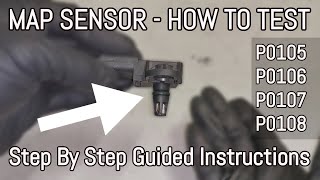
How to confirm: Visually inspect the MAPT sensor's electrical connector and wiring harness for signs of damage, corrosion, melting, or loose pins. Check for 5-volt reference, ground, and a proper signal voltage at the connector 🎬 Watch: A simple guide to testing your MAP sensor at home. with a multimeter.
Typical fix: Repair the damaged section of wire or replace the connector pigtail.
Est. part cost: $15-$40 - Clogged Catalytic Converter ⚪ Low Probability
How to confirm: A severe exhaust restriction can cause pressure to build in the intake manifold. An exhaust backpressure test can confirm if the catalytic converter is clogged. This is an unlikely cause compared to the known sensor failure.
Typical fix: Replace the clogged catalytic converter.
Est. part cost: $800-$2000
Rare But Worth Checking
- Faulty Powertrain Control Module (PCM): This is extremely rare. The PCM should only be considered after all other possibilities, including the sensor and wiring, have been exhaustively tested and ruled out.
Diagnosis Steps
- Connect an OBD-II scanner and confirm P0108 is present. Note any other codes like P0107 or P0109, which are also covered by TSB 19-2212.
- View live data on the scanner with the Key On, Engine Off (KOEO). Check the MAP sensor voltage reading. A reading at or above 4.4V indicates a faulty sensor. The pressure reading should reflect the atmospheric pressure of your location; if it's stuck high, the sensor has failed.
- Remove the plastic engine cover to access the MAPT sensor on top of the intake manifold.
- Inspect the sensor's connector and wiring for any visible damage, corrosion, or loose connections.
- If the wiring appears intact and the KOEO voltage reading was incorrect, the MAPT sensor is faulty and should be replaced. This is the most common failure according to the TSB.
- To replace, disconnect the electrical connector, remove the single T20 Torx screw, and carefully pull the sensor out. Lubricate the new sensor's O-ring with a small amount of clean engine oil before installation.
- If you replace the sensor and the code persists, perform a detailed wiring check using a multimeter to test for 5V reference, ground, and signal integrity between the sensor and the PCM.
- As a final, less likely step, check for a severe exhaust restriction by performing an exhaust backpressure test.
Parts You'll Likely Need
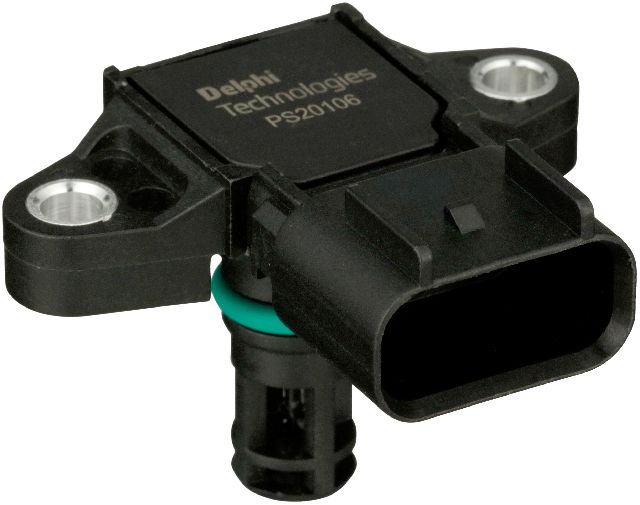
- Manifold Absolute Pressure and Temperature (MAPT) Sensor
(OEM #AA5Z-9F479-E (latest per TSB), AA5Z-9F479-D (supersedes -B))— This is the component identified in Ford's TSB 19-2212 as the primary cause of code P0108. The original part AA5Z-9F479-B was superseded by AA5Z-9F479-D, and the TSB calls for part AA5Z-9F479-E.
Trusted brands: Motorcraft (OEM), Bosch, Delphi
OEM price range: $115-$190
Aftermarket price range: $90-$150
Related Codes That Often Appear With This One
- P0107 — This code for 'MAP Sensor Circuit Low Input' can appear with P0108 due to an erratic sensor failure, as noted in TSB 19-2212.
- P0109 — This code for 'MAP Sensor Circuit Intermittent' can also be triggered by the same faulty sensor mentioned in TSB 19-2212.
Technical Service Bulletins (TSBs) & Recalls
- TSB 19-2212: Addresses diagnostic trouble codes (DTCs) P0107, P0108, and/or P0109 that may cause a wrench lamp, Service AdvanceTrac message, Hill Start Assist Not Available message, and/or lack of power. The bulletin identifies a faulty manifold absolute pressure and temperature (MAPT) sensor as the likely cause and instructs technicians to replace it. This TSB supersedes TSB 19-2183.
Platform-Specific Known Issues
- A Technical Service Bulletin (TSB 19-2212) was issued by the manufacturer for 2018-2019 Lincoln MKT models (among other Fords with the 3.5L EcoBoost) specifically for DTCs P0107, P0108, and/or P0109. The bulletin states the cause is a faulty MAPT sensor and results in a wrench lamp, Service AdvanceTrac message, Hill Start Assist Not Available message, and/or lack of power. The prescribed fix is to replace the sensor.
Mechanic-Grade Diagnostic Values
- MAP Sensor Signal Wire Voltage (Key On, Engine Off) — expected: 2.0V - 3.0V for turbo applications.. Failure: A reading at or above 4.4V - 4.5V indicates a fault and will trigger P0108.
- MAP Sensor Signal Wire Voltage (Engine at Idle) — expected: 1.4V - 1.8V.. Failure: Voltage stuck high and not responding to engine load changes.
- MAP Sensor 5-Volt Reference Wire — expected: 4.5V - 5.0V with key on.. Failure: No voltage or significantly lower voltage indicates a wiring or PCM issue.
- MAP Sensor Ground Wire Voltage — expected: Less than 0.10V (100 millivolts).. Failure: Higher voltage indicates a poor ground connection, which can skew sensor readings.
- Scan Tool PID Comparison (Key On, Engine Off) — expected: MAP sensor pressure reading should be within 10.35 kPa (1.5 psi) of the BARO reading.. Failure: A difference greater than 10.35 kPa (1.5 psi) points to a faulty MAPT sensor per TSB 19-2183.
Scan Tool Commands That Help
- OBD-II Scan Tool with Live Data: Graph MAP Sensor Voltage vs. Throttle Position — During a throttle snap test (KOER), the MAP voltage should rise from its idle value (~1.5V) to over 4.0V, and the TPS and MAP graphs should mirror each other. This verifies the sensor is responding to pressure changes and is not stuck high.
- OBD-II Scan Tool with Live Data: Monitor MAP (PRESS) PID — As per TSB 19-2183, this is used with Key On, Engine Off to compare the MAP sensor's pressure reading against the vehicle's other pressure sensors (like BARO) to quickly identify a skewed sensor.
Wiring & Ground Locations
- MAPT Sensor Connector — On top of the intake manifold, easily visible after removing the plastic engine cover.. This is the primary point of failure for wiring issues. The connector should be inspected for corrosion, damage, or pushed-out pins. It is a 3-wire connector for 5V reference, ground, and signal.
- Power Distribution Box — Located in the engine compartment on the left side of the vehicle.. Contains fuses and relays related to the engine control system. While not a primary suspect, a blown fuse affecting the PCM's 5V reference circuits could be a root cause if no power is found at the sensor.
- Passenger Compartment Fuse Panel — Located under the instrument panel to the left of the steering column.. Contains fuses related to the Powertrain Control Module (PCM) and other interior modules. A fault here is unlikely to be the direct cause but is part of a comprehensive electrical diagnosis.
Real Owner Repair Stories
- Ford Truck Enthusiasts Forums (1994.5-1997 Ford Truck with 7.3L Power Stroke Diesel (Note: Different vehicle, but illustrates a key diagnostic concept)) — P0108 code and related transmission line pressure issues.
❌ Tried (didn't work) Replacing the MAP sensor (three different times)., Replacing the PCM.
✅ What actually fixed it The owner discovered the truck had a separate Barometric Pressure (BARO) sensor located inside the cab under the steering column. Replacing this separate BARO sensor finally resolved the P0108 code and the associated symptoms.
OEM Part Supersession History
2R3Z-9F479-AA, AA5Z-9F479-A→AA5Z-9F479-E— Manufacturer update for improved reliability and to address the failures noted in TSB 19-2212.
Heads up: The newer part AA5Z-9F479-E is the correct and recommended replacement for all prior versions and is fully compatible.
Model Year Variations Within This Range
- 2019: For the 2019 model year, Lincoln discontinued the naturally aspirated 3.7L V6 engine for the MKT. The 3.5L Twin-Turbo EcoBoost V6 became the sole engine option. This does not change the diagnosis for P0108 on EcoBoost models but simplifies engine identification for the final model year.
- 2018: No significant mechanical or electrical changes were made for the 2018 model year that would affect the diagnosis of P0108 compared to the 2019 model.
Helpful Videos

We Have This Part in Stock




The information in this article is provided for general reference and educational purposes only. Vehicle specifications, procedures, and part compatibility can vary by production date, trim level, and region. Always consult your vehicle's factory service manual and verify part numbers before purchasing or performing repairs. Safety-critical components such as airbags, seat belts, and braking systems should be installed by a qualified professional.
- Lincoln MKT:
- 🎬 Helpful Videos
- 🛍️ Shop This Part
- What's Unique About the 2018-2019 Lincoln MKT
- Diagnostic Flowchart
- Symptoms You May Notice
- Most Likely Causes
- Rare But Worth Checking
- Diagnosis Steps
- Parts You'll Likely Need
- Related Codes That Often Appear With This One
- Technical Service Bulletins (TSBs) & Recalls
- Platform-Specific Known Issues
- Mechanic-Grade Diagnostic Values
- Scan Tool Commands That Help
- Wiring & Ground Locations
- Real Owner Repair Stories
- OEM Part Supersession History
- Model Year Variations Within This Range
- 🎟️ Get 5% Off